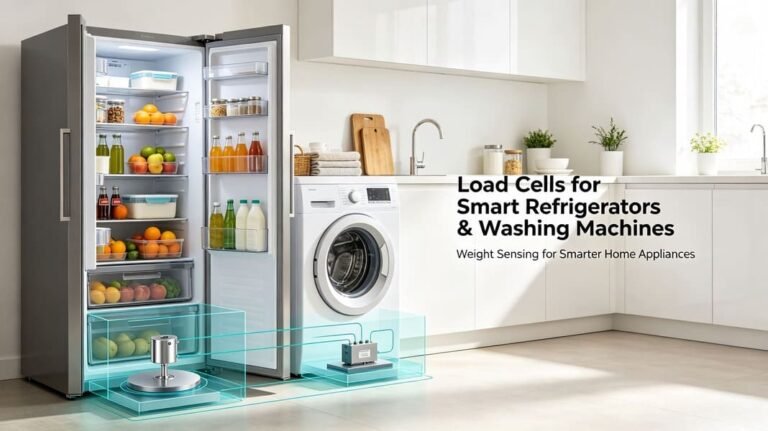

Load Cells for Smart Warehouse Management Systems: An OEM Integration Guide
Learn how load cells enable real-time inventory monitoring in smart warehouses and intelligent storage cabinets — from sensor selection and HX711 wiring to cloud-based stock management and OEM best practices.

Table of Contents
1. What Is a Smart Warehouse Management System?
A Smart Warehouse Management System (WMS) uses IoT sensors, RFID tags, cloud computing, and automated data collection to monitor inventory in real time — without manual stock counts. The core promise: know exactly how many units are on every shelf, in every bin, at every moment.
Traditional warehouses rely on periodic manual counts or barcode scans. Smart warehouses replace this with continuous, sensor-driven monitoring. Two complementary technologies make this possible:
- RFID tags — identify which product is in each storage bin
- Load cells (weight sensors) — measure how much product remains by weighing the bin
Together, they translate raw weight data into precise unit counts. For example, if a bin tagged as “M8 bolts” weighs 2.4 kg and each bolt weighs 12 g, the system knows there are 200 bolts in stock — and triggers a reorder when the count drops below a threshold.
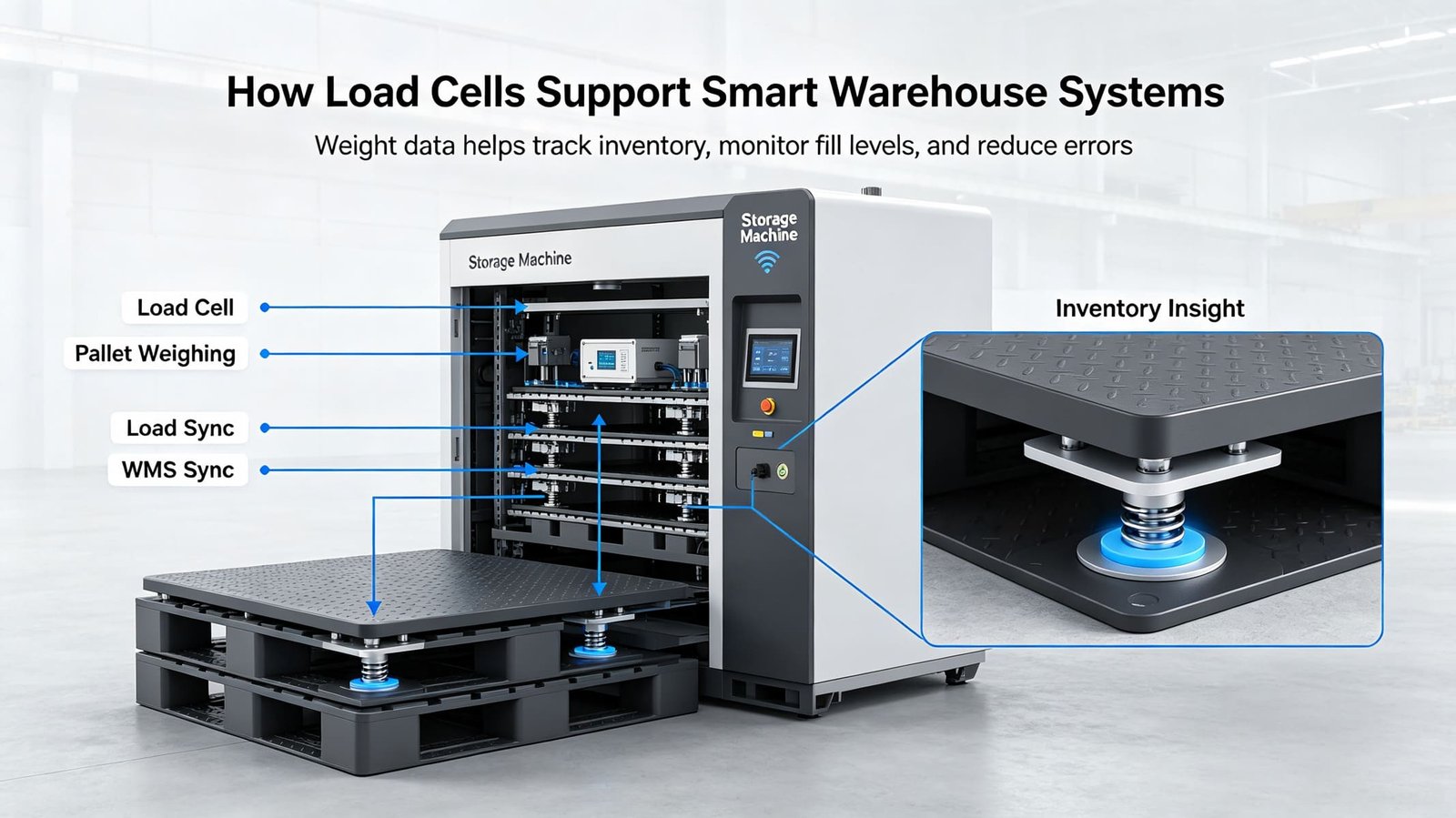
The concept extends beyond large distribution centers. Smart Electronic Bins (SEBs) — industrial storage cabinets with built-in weighing and RFID — bring the same technology to smaller-scale applications like manufacturing parts rooms, hospital supply cabinets, and retail backrooms.
2. Why Load Cells Are Essential in Smart Warehousing
Why not rely on RFID alone? Because RFID tells you what is in a bin but not how much. You still need someone to count items or estimate fill level. Load cells solve this by continuously measuring the total weight of the bin contents.
In warehouse applications, a critical function is stock-out prevention. A well-designed smart WMS can prevent empty shelves in most scenarios. When operators control inventory accurately, they save costs directly and increase profit margins.
Another major advantage: smart warehouses require fewer or zero on-site employees. Unmanned warehouse operations rely on many sensors. Among them, the force/weight sensor is one of the most critical — it drives inventory management, inbound/outbound control, storage buffering, and order processing.
3. How the System Works: RFID + Load Cell
The Smart Electronic Bin (SEB) concept illustrates how the two technologies work together:
1. RFID Identification
Each storage bin carries an RFID tag. The cabinet reads the tag to identify the product, regardless of bin position.
2. Weight Measurement
A load cell at the bin base measures total weight — including the bin itself (tared out) and contents.
3. Unit Count Conversion
The back-office system divides net weight by the known unit weight to calculate item count.
4. Cloud Reporting
Weight data is sent periodically to the cloud. Data can be exported to any desired format (ERP, API, dashboard).
5. Auto Reorder
When stock drops below a threshold, the system automatically initiates a purchase order.
A critical OEM requirement: the load cell must maintain 20–80% of full-scale load continuously for 5–10 years. Long-term stability and minimal creep are non-negotiable for this application.

4. System Architecture (5 Layers)
A complete smart warehouse weighing system spans five technology layers, from physical sensor to cloud dashboard:
5. 6 Key Benefits for Operators & OEMs
Real-Time Stock Visibility
Know exact inventory levels at all times. No more surprise stock-outs or over-ordering.
Automated Reordering
When weight drops below a threshold, the system generates a purchase order automatically.
Reduced Labor Costs
Eliminate manual cycle counts. Smart warehouses can operate with minimal or zero on-site staff.
Long-Term Stability
Quality load cells maintain accuracy under permanent load (20–80% FS) for 5–10 years.
ERP Integration
Weight data exports to SAP, Oracle, or any WMS via API. Full supply-chain visibility in one platform.
Scalable from Bin to Warehouse
Same sensor technology scales from a single smart cabinet to thousands of shelves across multiple sites.
6. Load Cell Types & Selection Guide
Different warehouse applications call for different sensor types. Here is how the most common options compare:
5-Point OEM Selection Checklist
- Bin/platform size: Determines the sensor footprint and whether you need one or multiple cells per platform.
- Accuracy & minimum weighable quantity: How light is the lightest item? The sensor resolution must detect single-unit weight changes.
- Operating temperature range: Cold storage (-20 °C), ambient (+5 to +40 °C), or outdoor extremes.
- Signal type: Analog (2 mV/V + HX711) for cost-sensitive designs; digital (RS-485/CAN) for smart, multi-drop networks.
- Single vs. multi-sensor platform: Small bins use one sensor; large shelves may need four corner cells summed through a junction box.
7. Recommended Load Cells
Below are load cell families commonly deployed in smart warehouse and intelligent storage cabinet projects:
Note: Model names are representative. Contact our engineering team for datasheets and custom mechanical integration.

8. Wiring: HX711 & Signal Conditioning
The HX711 is a dedicated 24-bit ADC and signal amplifier for load cells. It reads the resistance changes from the Wheatstone bridge and outputs a digital value to a microcontroller or PLC. After calibration with a known weight, you get highly accurate measurements.
4-Wire Load Cell to HX711 Wiring
Connecting to MCU or PLC
After wiring the load cell to the HX711, connect the HX711 to your microcontroller (e.g., Arduino) or PLC:
- HX711 VCC → Arduino 5V
- HX711 GND → Arduino GND
- HX711 DT (Data) → Arduino Digital Pin (e.g., D2)
- HX711 SCK (Clock) → Arduino Digital Pin (e.g., D3)
Through the Arduino program, set the zero point (tare), then calibrate with a standard weight. Once calibrated, the system runs normally and sends weight data to the cloud platform for unit-count conversion and remote monitoring.
9. OEM Integration Best Practices
Based on real smart warehouse deployments, here are the integration points that matter most:
- Mechanical design: Mount the load cell on a rigid, flat bracket. The weighing frame must transfer force vertically — avoid side loads from bin sliding. Use overload stops for protection.
- Long-term creep mitigation: Choose sensors with low creep specs. The system must hold 20–80% FS permanently for 5–10 years without significant drift.
- Tare management: Store the empty-bin weight in non-volatile memory. Recalibrate tare after any bin swap or mechanical change.
- Software logic: Apply moving-average filtering to smooth noise. Define stock-level states (Full → Normal → Low → Reorder → Empty) with hysteresis.
- Cloud data format: Export weight, timestamp, bin ID, and computed unit count to the cloud via MQTT or HTTPS. Support ERP/WMS API formats (JSON, XML, CSV).
- Multi-sensor platforms: For large shelves using four corner load cells, sum signals through a junction box with trimming potentiometers for corner adjustment.
10. Market Trends & Case Studies
The smart warehouse and intelligent inventory management market is growing rapidly as IoT adoption accelerates across logistics, manufacturing, and retail:
Key application sectors driving adoption:
- Manufacturing parts rooms: Smart Electronic Bins (SEBs) track fasteners, electronic components, and consumables. Auto-reorder prevents production line stoppages.
- E-commerce fulfillment: Real-time stock visibility across distributed micro-warehouses enables faster order promise dates.
- Healthcare & pharmacy: Smart cabinets monitor medication stock, track expiration dates, and prevent critical shortages.
- Retail backrooms: Weight-based shelf monitoring reduces out-of-stock events that cost retailers billions annually.
- Cold chain & food storage: IP67/IP68 load cells monitor inventory in refrigerated environments where manual counts are costly.
11. FAQ
How does a load cell convert weight into item count?
The system first identifies the product via RFID, then weighs the bin. By dividing the net weight (total minus empty-bin tare) by the known unit weight, it calculates the number of items. For mixed bins, weight thresholds confirm partial quantities.
How long can a load cell stay under permanent load?
Quality alloy-steel or aluminum load cells are designed for 5–10 years of continuous loading at 20–80% of full scale. Choose sensors with low creep specs and OIML C3 accuracy class or higher.
Do I need one load cell per bin?
Small bins typically use one parallel beam or single-point load cell. Larger platforms or multi-bin cabinets may use four corner cells summed through a junction box. Micro sensors suit very small parts bins.
Can load cells work in cold storage warehouses?
Yes. Select sensors rated for −20 °C or lower, with IP67/IP68 sealing for humidity protection. Perform calibration at operating temperature, as strain gauge output shifts with temperature.
Should I use analog or digital load cells for a smart warehouse?
Analog (2 mV/V + HX711) is cost-effective for small-scale deployments. Digital load cells (RS-485/CAN) are better for large, multi-drop networks where calibration data and diagnostics need to travel with the sensor.
How do I integrate weight data with my existing ERP or WMS?
The cloud platform receives weight data via MQTT or HTTPS, converts it to unit counts, and exposes it through REST APIs or webhooks. Most modern ERP systems (SAP, Oracle, Microsoft Dynamics) support API-based integration.
Can you customize load cells for our warehouse cabinet design?
Yes. Capacity, dimensions, cable length, connector type, mounting holes, and output signal can all be customized for OEM volume orders. We also provide weighing frame and bracket design support.
Ready to Source Load Cells for Your Smart Warehouse Project?
Whether you are building a Smart Electronic Bin cabinet or a full-scale intelligent warehouse, the right load cell is critical for long-term accuracy and reliability. Our parallel beam, single-point, and micro load cells are already deployed in smart storage projects worldwide.
Get a tailored quotation for your smart warehouse sensor requirements:
By Vektorforce | Published: