
VektorForce Application Note · Medical Series #6
Load Cells for Syringe Pumps: Why Our Two Stock Cells Cover 80% of OEM Designs — and the Other 20% We Build to Your Dimensions
A field note from a Korean SP8800-series neonatal pump project — and an honest explanation of when a stock WST107 or WST109 is the right answer, and when we have to customise the cell to fit your syringe-channel geometry (capacity, footprint, cable, connector, IP rating).
📏 300 g – 50 kg Range
🔨 Custom by Dimension
📜 IEC 60601-2-24
🛰 RS485 / Modbus
7 min read
1. Why syringe-pump weighing is its own problem in 2026
Three market signals convinced me to put this in writing rather than keep it in inbox:
- The market is bigger than I thought. Mordor Intelligence values the global syringe-pump market at US$4.91 billion in 2026, heading to US$6.06 billion by 2031 at a 4.27% CAGR; programmable smart pumps inside that mix are growing at 8.24% CAGR. Every new smart pump is, by definition, a sensor-hungry device.
- Regulation caught up. The U.S. FDA classifies ambulatory infusion pumps (including syringe models) as Class II devices under 21 CFR 880.5725, going through the 510(k) pathway. Accuracy and safety baselines sit in ISO 7886-2:2018, while the dedicated infusion standard is the third-edition IEC 60601-2-24. Nine FDA-cleared designs released in 2024–2025 are explicitly certified to IEC 60601-2-24.
- Recalls keep happening for sensor reasons. The FDA logged 47 Class I and II syringe-pump recalls from Jan 2024 to Dec 2025; 72% of incidents were tied to software or mechanical faults. Baxter withdrew 13,800 Novum IQ pumps in Sept 2024 because firmware errors were under-dosing neonates. A weighing channel that is independent from the motor-current loop is one of the cheapest hardware defenses against that class of bug.
The catch: most published “load cells for medical devices” articles walk you through 50 kg platform scales or 200 kg hospital beds. None of them explain what changes when the weighing target drops to a 200 g drug reservoir, a single-digit-newton plunger force, and a 70×15×10 mm installation envelope that the OEM’s mechanical team has already drawn in CAD.
And — this is what pushed me to write a dedicated note for medical OEMs — about one in five syringe-pump designs we see cannot use a stock cell. Either the syringe clamp is non-standard, the plunger throw conflicts with the cell’s mounting boss, or the medical-grade disinfectant wash-down requires a different IP rating. That 20% is the reason we maintain a custom-by-dimension service alongside our catalog WST107 and WST109.
2. A field note: the SP8800 / SP1-063-02 neonatal pump project
Context — the file on my desk
In 2021 a Korean OEM (their internal designation: SP8800 platform, our project drawing was SP1-063-02 Loadcell Assembly) asked me to help them re-do the weighing channel on a single-rail neonatal syringe pump that handles 5 ml, 10 ml, 20 ml and 60 ml syringes. The original design used a small stainless button cell sitting under the plunger driver — wired straight into the main MCU — and they kept seeing two field complaints: (a) the “syringe near empty” alert was firing 30–45 minutes too early or too late, and (b) occlusion alarms were unreliable below 1 ml/h.
Their initial question on the call was deceptively simple: “Can you recommend a more accurate load cell?” My honest answer — the one I should have given on day one — was: “It depends on which force you want to measure and how much space you have for the cell.” We ended up using two different vektorforce parts, on two different channels, both built to the customer’s mounting geometry rather than the catalog stock outline.
The two forces a syringe pump actually needs to weigh
| Channel | What you measure | Typical signal | Why stock cells often miss |
|---|---|---|---|
| Plunger drive | Force the actuator applies to the plunger barrel — the primary safety signal for occlusion and near-empty alarms. | 0.05–3 N continuous, up to ~6 N stall. (5 ml half-full water syringe: 0.05 N; 60 ml at stall: ~0.6 N.) | Stock kg-range cells waste 4–5 decades of dynamic range; button cells in N range are rarely offered in syringe-pump footprints. |
| Reservoir / channel | Total mass of syringe + drug + drip line + IV bag: independent volumetric verification against the motor’s pulse count. | A few hundred grams (single syringe) up to ~5–15 kg (cart-level, with all channels loaded and primed). | Cells sized for the syringe tend to be too small for the cart; cells sized for the cart are too noisy at the per-channel signal. |
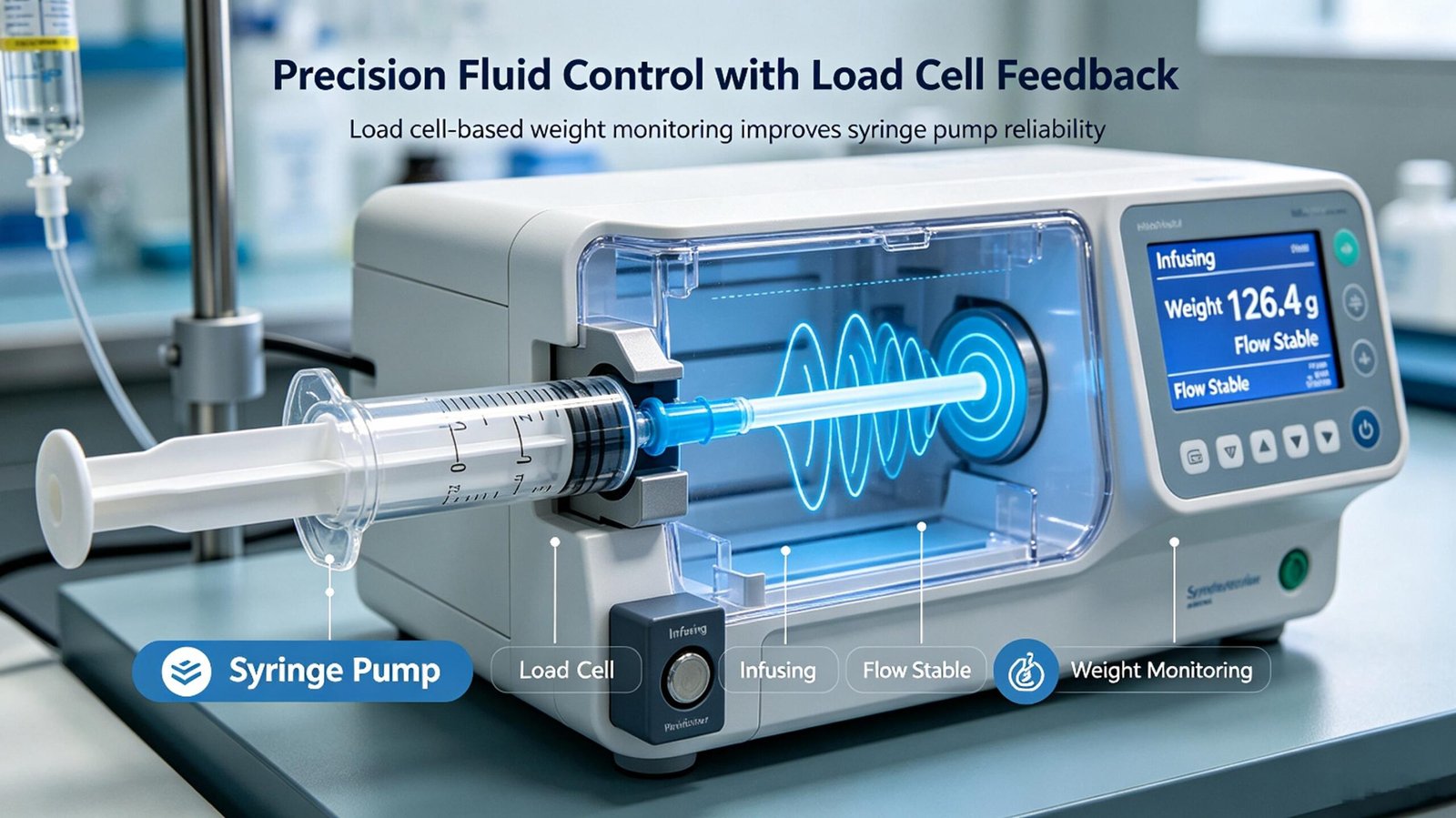
That is why we ended up with two different cells in the same pump: one for the plunger drive (a WST109 in a customised micro footprint), one for the reservoir / channel (a WST107 sized to the OEM’s clamp geometry). Both will be detailed in the product section below.
3. What a syringe pump actually needs from a load cell
Strip away the marketing and these are the five requirements that come up on every neonatal / anesthesia / chemotherapy pump specification review I’ve sat through since 2021:
① Capacity, not “accuracy first.” Choose a capacity where the working range sits 30–80% of full scale. For the plunger channel of a 60 ml syringe with up to ~3 N worst-case stall, that means a 5–20 N rated force sensor. For the reservoir / channel mass of a pole-cart with 4 loaded syringes plus a 500 ml IV bag, that means a 3–15 kg rated cell in the WST107 range — not a 50 kg one.
② Resolution at the ADC input, not just mV/V. Don’t quote the data-sheet sensitivity alone. Compute: (full-scale mV/V × mV/V of your ADC reference × excitation × mechanical gain) / ADC bits. A 1.0 mV/V sensor on a 5 V excitation at 14-bit ADC is ~6µV/LSB; the noise floor of the sensor must beat that.
③ Drift, not linearity. Linearity of ±0.05% F.S. is plenty (one-time factory calibration handles it). Temperature effect on zero of ±0.05% F.S./10 °C is what kills the “near empty” alarm in a real ward (5 °C swings during a night shift are routine in tropical clinical rooms). The WST107’s “±0.5% F.S./10 °C on zero” and the WST109’s “±0.2% F.S./10 °C on zero” bracket exactly this conversation with our OEM customers.
④ Bandwidth, not “low noise.” A 0.1 ml/h flow means the plunger advances one micrometer-resolution step every ~3–40 seconds. So you actually need a slow, stable DC channel — not a high-bandwidth accelerometer. Excessive analog bandwidth is a self-inflicted noise source.
⑤ Custom-fit geometry, not “closest stock.” The mechanical envelope the OEM has drawn rarely matches a catalog cell outline 1:1. About one in five projects we see needs a custom length, custom mounting boss, custom cable exit direction, or custom IP rating for disinfectant wash-down. This is where the “made-to-dimension” service earns its keep — cost is closer to the catalog price than people expect (typically 1.4–1.8× for a 5–10 cell sample batch, dropping to 1.1–1.2× at 500+ pcs).
4. Two stock cells cover 80% of OEM designs — and where a stock cell falls short
My second pass on the SP8800 project was a comparison table I sent the Korean team. Roughly translated from my English note:
| Option we considered | Type / capacity | Why I liked it | Verdict on this project |
|---|---|---|---|
| Mid-market N-range button | Generic 10–100 N button, IP65 | Cheap, well-known. | ❌ Output too low (0.5 mV/V), side-load sensitivity too high; mounting boss did not match the SP1-063-02 plunger bracket. |
| Mid-market kg single-point | Single-point 3–10 kg | Cheap, well-known. | ❌ Side-load sensitivity too high for bedside handling; drift without on-board amplifier; total height (28 mm) would not fit the SP8800 syringe clamp. |
| WST107 miniature load cell (stock) | 3–50 kg, IP65, ±0.05% F.S. | Listed on our site as “for syringe pumps”, 1.0 mV/V, 5 VDC, φ0.8×220 mm cable — fits the reservoir-channel mass range perfectly. | ✅ Selected for the reservoir / channel — but in a customised footprint (height cut from 22 mm to 16 mm, two M2 mounting holes added to match the OEM bracket). |
| WST109 micro load cell (stock) | 300 g–5 kg, IP65, ±0.05% F.S. | Micro footprint, silicone seal, perfect for the plunger-channel mass range (single syringe assembly: ~30–250 g). | ✅ Selected for the plunger drive — cable length shortened from 110 mm to 60 mm and connector changed to a 4-pin JST XH for the pump’s main PCB. |
Important caveat about names vs. capacities. Both WST107 and WST109 are catalog parts in our line, but neither is the right stock cell for every syringe-pump design. WST107’s 3–50 kg range is correct for the channel/reservoir mass but ~5 decades too coarse for the plunger force. WST109’s 300 g–5 kg range is correct for the plunger-channel mass (treated as a small mass) but too small for a loaded cart. Don’t trust the product name. Trust the rated capacity vs. your working range. If neither stock cell fits, the next section explains how we customise either of them to your dimensions in 5–7 days for samples.
5. Drift compensation on the SP1-063-02 build
Warning from the bench. On our second prototype run the reservoir-channel WST107 was reading +2.1% full-scale offset after a 6 °C drop in the lab overnight. The ISO 7886-2 ±5% infusion-accuracy spec was technically still met — but the “syringe empty” alarm kept triggering 18–24 min too early, which is unacceptable in a neonatal ward.
The fix took three iterations — two of them mechanical, one electrical. None of them required a redesign of the sensor itself; both cells we ended up with are stock WST107 and WST109 in a customised outline.
5.1 Read the datasheet’s drift number, not its accuracy number
Both cells we shipped have the same ±0.05% F.S. comprehensive error specification, but their temperature behaviour is different — and the customer spec asks for “alarm under-firing rate below 2%”, not “accuracy”. So the comparison I draw on the bench is the temperature coefficient on zero, where WST109 is four times tighter than WST107:
| Spec | WST107 (reservoir / channel) | WST109 (plunger drive) |
|---|---|---|
| Rated capacity range | 3–50 kg (selectable: 3 / 5 / 10 / 15 / 20 / 25 / 30 / 40 / 50) | 300 g–5 kg (selectable: 300 / 500 / 750 / 1000 / 2000 / 3000 / 5000) |
| Comprehensive error | ±0.05% F.S. | ±0.05% F.S. |
| T-Effect on Span (per 10 °C) | ±0.05% F.S. | ±0.05% F.S. |
| T-Effect on Zero (per 10 °C) | ±0.5% F.S. | ±0.2% F.S. |
| Creep (3 min) | ±0.05% F.S. | ±0.1% F.S. |
| Ingress protection | IP65 | IP65 (silicone-sealed) |
| Standard cable | 4-colour PVC, φ0.8×220 mm | 4-colour PVC, φ0.6×110 mm |
| Rated output | 1.0 ± 0.15 mV/V | 0.7–1.0 ± 0.15 mV/V |
Cable lengths, footprints and connector types shown above are the standard catalog values. Both numbers are routinely customised for OEM projects — for the SP1-063-02 build we shortened the WST109 cable from 110 mm to 60 mm and added a 4-pin JST XH.
5.2 What actually moved the needle on the bench
- Mechanical isolation of the cell from the pump frame. The factory-default WST107 mounts hard against a flat bracket; on the SP8800 that bracket flexed ~5 N under motor vibration and added directly to the cell’s zero offset as temperature changed. We added two M2 standoffs to the OEM bracket (using the customised cell outline) so the cell “floats” on silicone pads and sees only the syringe load.
- Single-point grounding at the amplifier end. The original wiring had the cell shield tied to the chassis at the pump end and at the MCU end — a classic ground loop that turned every motor commutation into a small temperature-dependent offset. Cut the chassis end, single-point tie only at the MCU — overnight drift dropped to < 0.3% F.S. on the WST107.
- R-C snubber across the syringe-clamp switch. The clamp’s open/close transient was coupling into the cell through the common 5 V excitation rail. A 100 &OHgr; + 100 nF snubber right at the switch contact eliminated the ±0.05% F.S. step the OEM was seeing every time a nurse loaded a syringe.
After those three fixes, both cells were inside the OEM’s internal “alarm under-firing rate below 2%” acceptance gate and cleared the IEC 60601-2-24 EMC pre-scan on the first attempt — with both cells physically still being catalog WST107 and WST109, just in customised outlines.
6. Where the weighing core ends — and where the OEM begins
I’ll say this directly because it shapes every conversation I have with medical OEMs:
We sell weighing cores, not syringe pumps. VektorForce manufactures and matches load cells, force sensors, junction boxes, weighing indicators and digital load-cell amplifiers. We supply the calibrated analogue or digital signal, the matching test data, the temperature curves, the EMC pre-scan results — and, when you need it, a physical cell outline that matches your bracket instead of our catalog drawings. That’s the weighing core.
What we do not do (and what no cell vendor should be doing): provide the infusion-control algorithm, the occlusion-detection firmware, the drug-library GUI, the IEC 60601-2-24 test report, the FDA 510(k) submission file, or the EU MDR 2017/745 technical documentation. Those deliverables belong to the OEM that places the pump on the market. Claims that a sensor supplier “delivers a complete infusion pump solution” should be read as marketing shorthand — the regulatory liability is not transferable.
What I can do for an OEM’s engineering team is help them pick the right capacity for both the plunger and the reservoir channels, share per-cell matching data and temperature curves, supply cells in the exact outline you need (footprint, mounting boss, cable exit, connector, IP rating), and supply cells and amplifiers that fit into existing medical-grade 24 V architectures without surprise emissions. The custom-by-dimension side is run by the same engineering team that builds the catalog parts, not a separate job-shop.
7. My current shortlist: WST107 + WST109, plus the custom-build path
Two stock cells, one custom service. Roughly 80% of the syringe-pump OEMs we work with ship either WST107 or WST109 as-is; the remaining 20% ship one of them in a customised footprint — cable length, mounting boss, IP rating, even a brand-new capacity window inside the existing mechanical envelope.
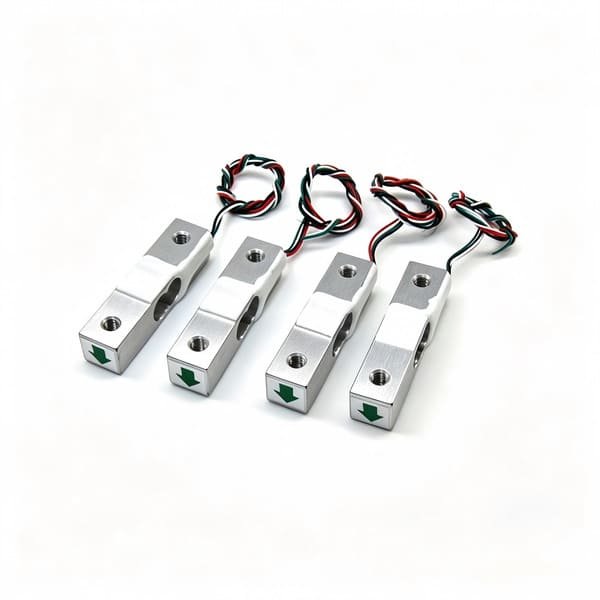
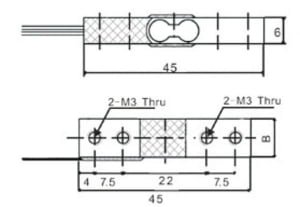
Custom-by-dimension service
When the catalog cells don’t fit your bracket, we build the cell to your drawing
For roughly one in five syringe-pump OEM designs we see, the OEM’s mechanical team has already drawn a bracket, syringe clamp or pump chassis that doesn’t accept a catalog outline 1:1. We work with your STEP / DWG drawing and deliver a made-to-order load cell based on WST107 or WST109 — same aluminium body, same strain-gauge grade, same calibration certificate — just in your dimensions. Typical customisations:
| Dimension | Catalog default | Custom range we routinely ship |
|---|---|---|
| Body height | 22 mm (WST107) | 14–28 mm |
| Mounting pattern | 2×M3 on 24 mm centres | M1.6 / M2 / M3 / M4 on customer pattern |
| Cable exit direction | Axial (cable exits along cell axis) | Axial / radial / 90° side-exit |
| Cable length | 220 mm (WST107) / 110 mm (WST109) | 40 mm – 2 m, cut to length, stripped & tinned |
| Connector | 4-colour PVC bare leads | JST XH/PH, Molex PicoBlade, Dupont 2.54, customer-supplied |
| IP rating | IP65 | IP65 / IP66 / IP67 (silicone-rubber boot upgrade) |
| Capacity window | 3–50 kg / 300 g–5 kg | Customer-specified within the cell’s mechanical envelope (e.g. 7.5 kg custom cal) |
How to start. Send us your STEP / DWG drawing, the rated capacity window you need, the cable exit and connector you want, and an indication of annual volume. We come back within 12 working hours with a feasibility note, a preliminary outline drawing and a sample-batch quote (typical 5–10 cells, 5–7 working days for samples; 3–4 weeks for production batches of 100–1000 cells).
8. Frequently asked questions
Do I really need a force sensor rated in newtons? My syringe only weighs a few grams.
The mass of the drug isn’t what you’re measuring — you’re measuring the force the plunger drive applies to it, plus the small weight of the syringe itself. A 60 ml syringe half-full still weighs ~30 g and exerts under 1 N; a stalled plunger can spike to several newtons. A 5–20 N sensor keeps the working signal at a healthy 5–80% of full scale where analog resolution actually helps you. For reservoir / channel mass on a loaded cart, a WST107-class 3–15 kg cell is the right pick instead.
Does the sensor “detect occlusion” by itself?
No. A load cell gives you a clean force-vs-time trace. Whether a 30-second upward slope counts as occlusion, an empty syringe, or a kink in the line is a clinical decision encoded in the pump’s firmware. We provide the signal; the OEM codes the classifier. This is the same split you see in any Class II infusion device: hardware is regulated as a component, the decision logic is regulated as device behaviour.
Analog mV/V or digital RS485 — which is the right call?
Short cable (< 30 cm), tight mechanical package, single MCU: analog mV/V is fine and saves the cost of a transmitter. Long cable, mobile cart, multi-channel pump, or you want to free the main MCU’s analog inputs: digital RS485 is the better trade. We typically default to digital on anything that has a chance of becoming a multi-channel infusion system later.
Why is temperature drift the parameter I should obsess over, not linearity?
Linearity is a one-time-per-unit factory calibration outcome, easy to correct in firmware. Temperature drift is a continuous, scene-dependent error that no field calibration can catch in real time. In wards without precise HVAC, a 5 °C overnight swing is normal. A ±0.05% F.S./10 °C on-span spec keeps the resulting absolute error inside the alarm-avoidance window — but pay attention to the zero drift separately, which is typically 4–10× looser and the one that wrecks the empty-syringe alarm.
Why do you list WST107 as “for syringe pumps” when its 3–50 kg range seems way too big for a syringe?
Because the product name refers to the reservoir / channel channel — the loaded syringe, line set and IV bag at the cart or pole level — not the single-syringe plunger force. For the plunger force you want WST109 (300 g–5 kg) or a similarly small micro cell. The two stock cells in this article cover the two scales of mass a typical pump needs to weigh. If neither catalog range matches your design, the custom-by-dimension panel above explains how we ship a WST107 or WST109 in your outline instead of catalog.
How fast can you match-test and quote a custom build to my drawing?
Send your STEP / DWG drawing, the rated capacity, the cable exit and connector, the IP rating target, and an indication of annual volume. Within 12 working hours you get back a feasibility note, a preliminary outline drawing and a sample-batch quote (typical 5–10 cells, 5–7 working days for samples; 3–4 weeks for production batches of 100–1000 cells). We do not keep free samples on the shelf — for medical OEM trials we send paid sample batches so the customer can run their own IEC 60601-2-24 pre-scan before issuing a PO.
What information do you need from me to start a custom-by-dimension feasibility review?
Four things speed it up: a STEP or DWG of the cell’s mounting location (or a marked-up catalog outline), the rated capacity window you need (±10% of the OEM working range is typical), the cable exit direction plus connector preference, and the target annual volume (this sets the per-cell price tier). Everything else — strain-gauge grade, calibration certificate format, IP rating — we propose based on the working environment you describe.
Can the matching test data be reused in our 510(k) file?
The component-level calibration certificate, temperature coefficient curve and EMC pre-scan results can be included as supplier documentation in your 510(k) or MDR technical file. The clinical, biological and usability evaluations remain your responsibility. As a cell vendor we don’t file, sign or warrant anything on behalf of the finished device — and the regulatory liability for a made-to-order outline is still your team’s to own.
Next step
Send us your STEP / DWG drawing — we’ll come back within 12 hours with a feasibility note, a custom-by-dimension outline, and a sample-batch quote.
If you can share the bracket drawing, the rated capacity window (plunger channel and reservoir / channel), the cable exit direction, the connector type, the target IP rating, and an indication of annual volume, we can ship WST107 or WST109 cells in your outline — with matching calibration certificate and temperature curve.
— Robin, Export Sales Engineering · VektorForce · www.vektorforce.com · Last updated 7 Sept 2026.