
How to Choose the Right Load Cell for Refrigerant Scales & Refrigerant Recovery Machines
A practical OEM guide to selecting load cells for refrigerant filling scales, refrigerant recovery machines, and air-conditioning charging systems — from sensor specifications and wiring to OEM integration best practices.
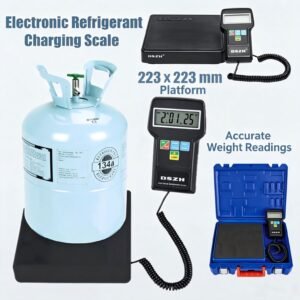
Table of Contents
1. What Is a Refrigerant Scale?
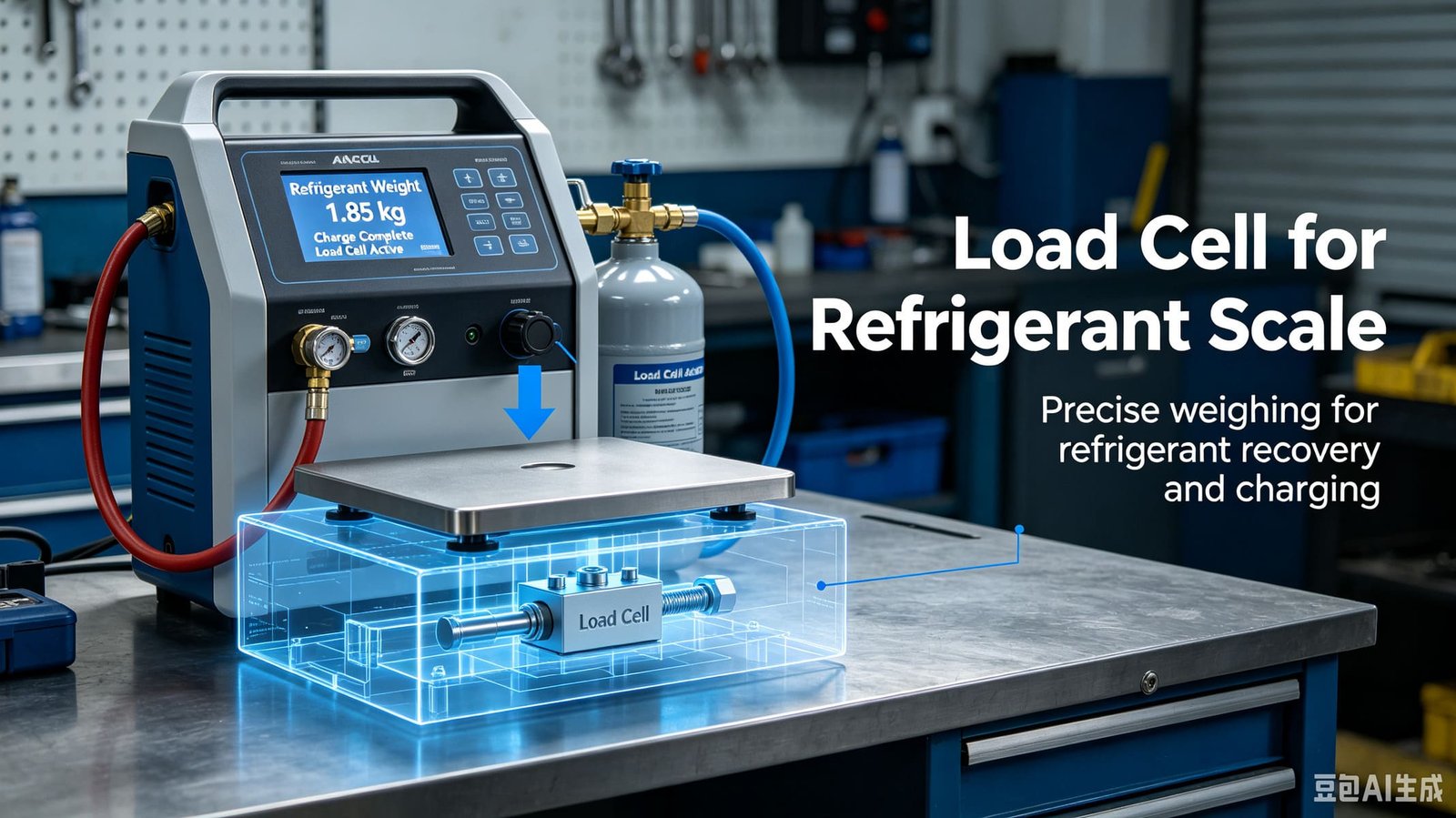
A refrigerant scale (also called a refrigerant filling scale, refrigerant charging scale, or air-conditioning fluorination electronic scale) is a precision weighing device used to measure the exact amount of refrigerant being charged into or recovered from a refrigeration system.
Refrigerant — sometimes called “coolant” or, in the trade, “snow” — is the working fluid that absorbs and releases heat inside refrigerators, freezers, air conditioners, heat pumps, and commercial cold storage equipment. It changes between liquid and gas states as the system runs.
Because refrigerant is essential to system performance, and because over-charging or under-charging can damage compressors, reduce efficiency, or violate environmental regulations, accurate weight measurement is a critical step in any HVAC/R service or production line.
A typical refrigerant scale consists of two parts:
- Weighing platform — A compact platform (typically 230 – 300 mm) that holds the refrigerant cylinder or tank.
- Handheld instrument — A display and control unit, connected to the platform by a spring cable (usually around 300 mm stretchable length). The instrument shows real-time weight, allows tare, and triggers auto shutoff at the target weight.
2. Why Refrigerant Must Be Weighed, Not Just Measured by Pressure
A common mistake in HVAC service is to judge the refrigerant charge by pressure gauge readings alone. This approach is unreliable for several reasons:
- Pressure depends on temperature as well as charge level, so two identical systems can read the same pressure but contain different refrigerant amounts.
- Non-condensable gases (air, nitrogen) in the system can mask low charge and give false pressure readings.
- Pressure readings cannot distinguish between overcharge and undercharge reliably across different ambient conditions.
The HVAC/R industry considers weigh-and-charge the only truly correct method. As long as the manufacturer specifies the correct charge weight on the nameplate, the technician can evacuate the system, connect the cylinder to the scale, and fill until the target weight is reached. The result is repeatable, verifiable, and independent of ambient conditions.
3. How Refrigerant Recovery Machines Work with Scales
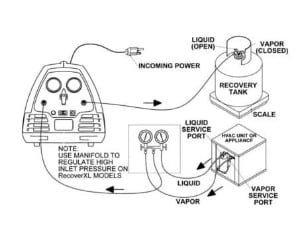
A refrigerant recovery machine extracts refrigerant from an HVAC/R system for recycling, reuse, or proper disposal. Modern recovery machines almost always work together with a refrigerant scale to monitor the recovered weight.
The typical recovery process works like this:
- Refrigerant leaves the air-conditioning system and enters the recovery machine through a liquid-line sight glass.
- A compressor and condenser inside the recovery machine convert the refrigerant to liquid form.
- The liquid is pushed into a recovery cylinder that sits on the refrigerant scale.
- A load cell inside the scale measures the cylinder’s weight in real time and sends the data to the mainboard.
- The MCU calculates the recovered refrigerant mass and shows it on the LCD panel.
- When the cylinder reaches about 80% full (the safety limit for liquid expansion), a level switch opens and the valve closes — recovery stops automatically.
- If non-condensable gases are detected, a purge valve releases them so recovery can continue safely.
- If the cylinder overheats, the technician can cool it in cold water to speed up recovery.
- When the system is fully recovered, the machine shuts down automatically.
Throughout the process, high-pressure and low-pressure alarms protect the machine and the technician. Indicator lights and buzzers provide instant feedback.

The world’s top three refrigerant charging machine manufacturers — WAECO, Bosch, and RTI — rely on the load cell used in their machines. All of them source their weighing sensors from experienced suppliers who can deliver consistent accuracy, long-term stability, and OEM-grade documentation.
4. Common Refrigerant Scale Specifications
Most refrigerant scales on the market share a similar hardware profile, with a few key parameters that OEMs and buyers should understand:
Some modern scales add Bluetooth or Wi-Fi connectivity so the weight reading can be displayed on a phone or tablet app. Others integrate directly with the recovery machine’s mainboard via analog mV/V or RS485 output.
5. Load Cell Selection Guide
Choosing the right load cell is the single most important decision in a refrigerant scale design. The sensor determines accuracy, stability, lifetime, and ultimately the user’s trust in the product. Use this checklist to narrow down your options:
Refrigerant Scale Load Cell Selection Checklist
- Capacity — Select 50 kg or 100 kg rated sensor based on the largest cylinder weight.
- Accuracy class — C3 (0.03% / 0.02%) is standard for 2 g / 5 g divisions.
- Type — Parallel beam single-point load cell is preferred for compact platforms.
- Material — Aluminum alloy with silicone sealing for indoor use; stainless steel for harsh environments.
- Protection — IP65 or higher to resist moisture and refrigerants.
- Output — 2.0 mV/V analog or digital output (RS485/Modbus) depending on the mainboard.
- Cable — Shielded cable with spring strain relief, 4-wire or 6-wire configuration.
- Calibration — Factory corner-adjusted for direct drop-in installation.
- Certifications — CE, RoHS, and OIML R60 for trade-approved scales.
For most refrigerant scale OEMs, a single-point parallel beam load cell is the right starting point. It offers:
- Easy mechanical mounting with built-in overload protection
- Tolerance to off-center loads (the cylinder does not need to be perfectly centered)
- Compact height for slim platform designs
- Low cost compared to multi-cell platform solutions
6. Recommended Load Cell: WST201 Parallel Beam
For most refrigerant scale designs, the WST201 parallel beam load cell is a proven, OEM-ready choice. Its key specifications:
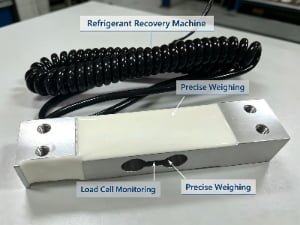
The WST201 is widely used by top-tier refrigerant charging machine manufacturers. Its compact size, drop-in calibration, and shielded spring cable make integration fast and cost-effective.
7. Wiring & Signal Connection
Correct wiring is critical for stable, drift-free weighing. The standard 4-wire color code for parallel beam load cells is:
Wiring tips:
- Keep the excitation voltage stable and low-noise. A dedicated LDO regulator is recommended.
- Use shielded cable and ground the shield at the mainboard end only.
- Avoid running the load cell cable parallel to power lines or motor cables.
- A 6-wire version (with sense lines) compensates for voltage drop on long cables — useful for remote cylinder scales.
- Always refer to the load cell manufacturer’s datasheet for the exact color code.
8. OEM Integration Best Practices
Whether you are designing a new refrigerant scale or upgrading an existing model, the following practices will help you avoid the most common field failures:
Refrigerant Scale OEM Integration Checklist
- Choose load cell capacity at 120% – 150% of the maximum cylinder weight.
- Mount the load cell on a rigid, flat platform with no flex under load.
- Use mechanical overload stops to protect the cell from dropped cylinders.
- Apply digital filtering on the MCU to suppress vibration from cylinder placement.
- Design the spring cable gland so it does not transmit force to the connector.
- Implement auto-tare and auto-zero tracking for reliable long-term use.
- Run EMC compliance tests (CE / FCC) early in development.
- Calibrate with known reference weights at the factory.
- Source load cells from a supplier with batch-to-batch consistency and full traceability.
Most field failures in refrigerant scales come from mechanical overload, moisture ingress, or unstable excitation. Designing these out at the start saves warranty costs and protects brand reputation.
9. Market & Industry Trends
The global refrigerant charging equipment market is growing steadily, driven by several long-term trends:
F-Gas Regulation
The EU F-Gas Regulation and similar rules worldwide require certified recovery and accurate charging of HFC, HFO, and natural refrigerants.
HVAC Service Growth
Rising demand for air conditioning, heat pumps, and cold-chain logistics drives technician tool upgrades.
Smart Charging Tools
Bluetooth-enabled scales, mobile apps, and cloud-based service records are becoming standard.
Refrigerant Reclamation
Stricter environmental rules push more recovery and recycling, creating demand for high-accuracy recovery scales.
For load cell suppliers, this means more demand for OEM-grade sensors with consistent accuracy, documentation, and the ability to scale production to thousands of units per month.
10. FAQ
Q1: Why is weighing the only correct way to charge refrigerant?
Pressure readings depend on temperature and may be skewed by non-condensable gases. Weighing provides a direct, repeatable measurement of the actual charge amount, independent of ambient conditions.
Q2: What capacity load cell do I need for a refrigerant scale?
For standard refrigerant cylinders up to 50 lb (~22 kg), a 50 kg load cell is sufficient. For larger recovery tanks or commercial cylinders, choose 100 kg. Always size at 120% – 150% of the maximum expected load.
Q3: Why is a parallel beam load cell the preferred choice?
Parallel beam single-point load cells tolerate off-center loads, have built-in overload protection, fit into compact platforms, and are easy to calibrate. They are the industry standard for refrigerant scales.
Q4: Can I use a 4-wire load cell with a 6-wire instrument?
Most modern instruments auto-detect 4-wire and 6-wire load cells. If not, jumper the sense lines to the excitation lines at the connector, or use a 6-wire extension cable with proper bridging.
Q5: How do I protect the load cell from refrigerant leaks?
Use IP65 or higher load cells, seal the cable entry with a waterproof gland, and avoid mounting the cell directly below valves or connectors where leaks may drip. Aluminum alloy with silicone sealing handles most refrigerants; choose stainless steel for harsh chemicals.
Q6: What accuracy class do I need for 2 g or 5 g divisions?
C3 (0.02% – 0.03%) is the standard accuracy class for 2 g / 5 g division refrigerant scales. For trade-certified legal-for-trade applications, OIML R60 certified cells are required.
Q7: Should I choose analog mV/V or digital RS485 output?
Analog mV/V is simpler and lower cost for a single-cell scale. Digital RS485 is preferred when multiple sensors are used, when long cables are required, or when the mainboard already speaks Modbus.
Need Load Cells for Your Refrigerant Scale Project?
We supply parallel beam load cells (including the WST201) and custom weighing modules for refrigerant filling scales, refrigerant recovery machines, and HVAC/R service equipment. Trusted by top-tier brands like WAECO, Bosch, and RTI.
Whether you need a sample for evaluation, OEM customization, or full-scale production, we can help with sensor selection, calibration, and supply chain stability.