

Load Cell Weighing Solutions for Silos and Feed Towers: An OEM Integration Guide
Modern livestock farms, grain elevators, and feed mills depend on accurate inventory control. By installing load cells under silo and feed tower legs, operators transform passive storage bins into intelligent weighing systems that track feed consumption, automate reordering, and reduce human contact with animals. This guide explains how silo weighing works, which load cell configurations fit 4-ton to 20-ton feed towers, and what OEMs need to know when designing integrated solutions.
In this guide: feed tower basics, load cell selection by capacity, 4/6/8-leg mounting layouts, junction box and indicator pairing, installation checklist, and answers to the most common buyer questions.
Table of Contents
- What Is a Silo or Feed Tower Weighing System?
- Why Weigh Feed Towers Instead of Estimating?
- Main Components of a Feed Tower Weighing System
- How Silo Load Cell Weighing Works
- Capacity, Leg Count, and Load Cell Selection
- Compression vs Shear Beam Load Cells for Silos
- Mounting and Installation Best Practices
- Junction Box, Wiring, and Indicator Setup
- OEM Integration Checklist
- Applications and Industry Trends
- Frequently Asked Questions
- Get a Silo Weighing Quote
What Is a Silo or Feed Tower Weighing System?
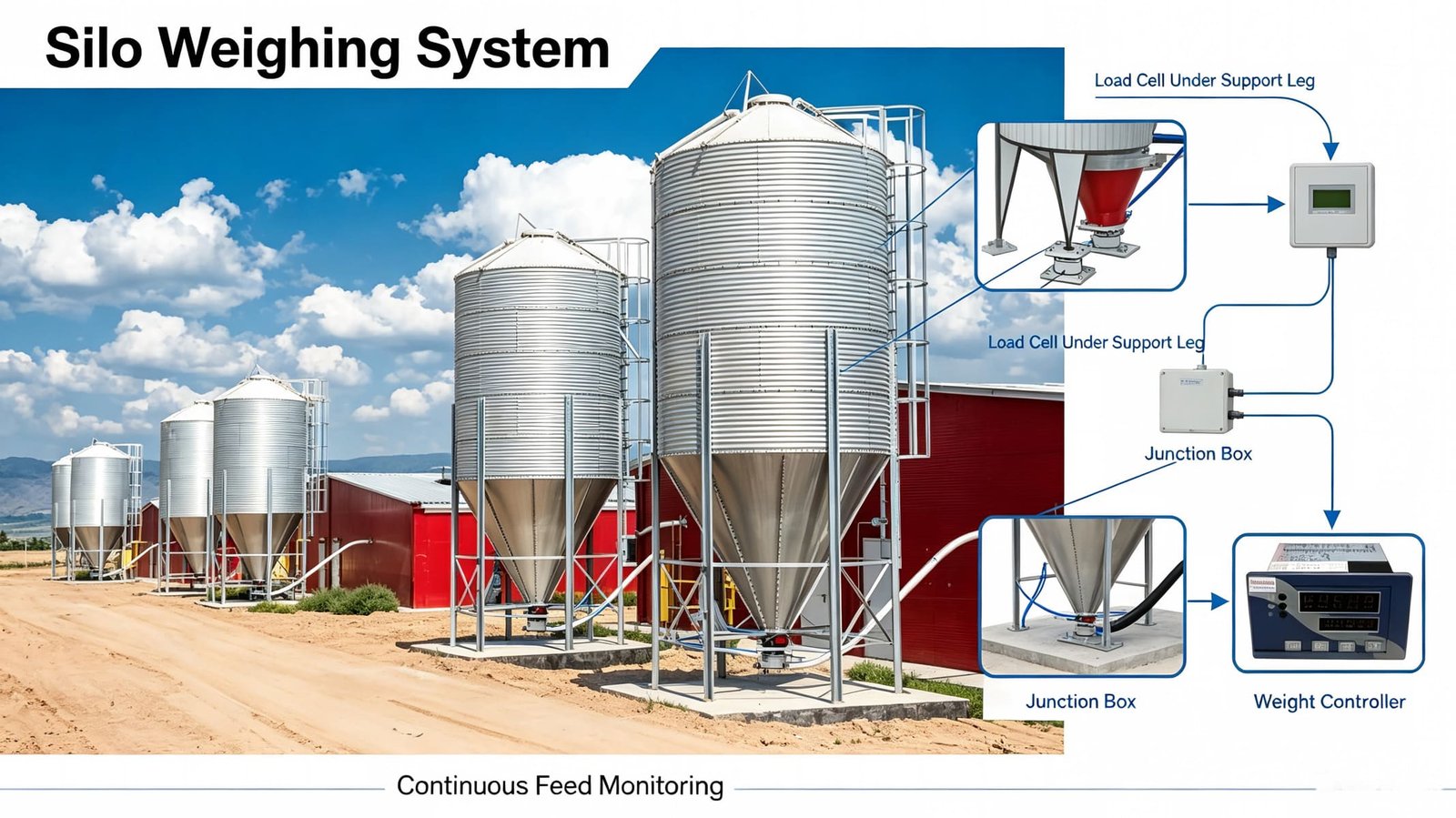
A silo or feed tower weighing system adds strain-gauge load cells, a junction box, and a digital indicator beneath the legs of a storage bin. Instead of relying on manual level gauges or visual inspection, the system continuously measures the total weight of the contents and reports it to a central controller, PLC, or farm management software.
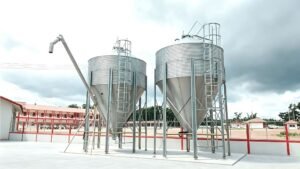
Feed towers are cylindrical storage silos with a conical bottom hopper. They are widely used in poultry, swine, cattle, and aquaculture farms to store dry powder or pelleted compound feed. Common materials include galvanized steel, carbon steel, and fiberglass reinforced plastic (FRP). Standard capacities range from 4 tons to 20 tons, with leg configurations of 4, 6, or 8 supports.
Why Weigh Feed Towers Instead of Estimating?
Accurate feed inventory is critical for three reasons: animal health, operational cost, and biosecurity. After the 2018 African swine fever outbreaks, many farms adopted intelligent weighing silos to reduce the number of delivery trucks entering the breeding area. Less vehicle traffic means lower disease risk and fewer epidemic-related losses.
Real-Time Inventory
Monitor feed consumption and remaining stock remotely so you can reorder before a bin runs empty.
Labor and Time Savings
Eliminate manual climbing and visual checks. One dashboard replaces repeated on-site inspections.
Biosecurity
Automated replenishment reduces human and vehicle contact inside the breeding zone.
Data-Driven Feeding
Analyze consumption patterns to optimize feed conversion ratio and farm profitability.
Main Components of a Feed Tower Weighing System
A complete feed tower weighing solution combines mechanical, electrical, and software elements. Each component must be matched to the silo capacity, number of legs, and environmental conditions.
| Component | Function | Typical Specification |
|---|---|---|
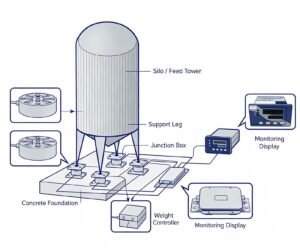
| Load cell weighing module | Measures compression force under each leg | 3 t or 5 t, IP67/IP68, alloy steel or stainless steel |
| Mounting kit | Distributes load and allows thermal expansion | Base plate, spherical cap, anti-lift bolt |
| Junction box | Summing and trimming of multiple cell signals | 4-in-1, 6-in-1, 8-in-1, 10-in-1, 12-in-1 |
| Weighing indicator | Displays weight and communicates with PLC/PC | RS485, 4-20 mA, 0-10 V, relay outputs |
| Cable assembly | Transmits mV/V signal from cell to junction box | Shielded 4-wire or 6-wire, UV resistant |
How Silo Load Cell Weighing Works
The entire weight of the silo and its contents is supported by its legs. When a load cell module is installed between each leg and the concrete foundation, it measures the vertical compression force at that support point. The combined output from all legs equals the gross weight of the structure and feed.
- Force distribution: The silo load is shared across 4, 6, or 8 support legs.
- Cell deformation: Each load cell deflects slightly under compression, changing the electrical resistance of its strain gauges.
- mV/V signal: The strain gauges output a small millivolt signal proportional to the applied load.
- Junction box summing: Signals from all cells are summed and corner-trimmed to compensate for uneven loading.
- Indicator conversion: The indicator amplifies and converts the signal into a calibrated weight reading.
- Data integration: Weight data is sent via RS485, analog output, or Ethernet to a PC, PLC, or cloud platform.
Capacity, Leg Count, and Load Cell Selection
Choosing the right load cell capacity depends on the total silo weight and the number of support legs. A safety factor of at least 1.5 is recommended to handle dynamic loads during filling and wind-induced forces.
| Feed Tower Capacity | Typical Leg Count | Recommended Load Cell Capacity | Total System Capacity |
|---|---|---|---|
| 4 t | 4 legs | 3 t per cell | 12 t |
| 6 t | 4 legs | 3 t per cell | 12 t |
| 8 t | 6 legs | 3 t per cell | 18 t |
| 10 t | 6 legs | 3 t per cell | 18 t |
| 15 t | 8 legs | 5 t per cell | 40 t |
| 20 t | 8 legs | 5 t per cell | 40 t |
Design tip: Do not size cells based only on feed weight. Include the empty silo self-weight, roof snow load, wind moment, and filling impact. A qualified weighing supplier will calculate the exact force per leg before recommending cell capacity.
Compression vs Shear Beam Load Cells for Silos
Two load cell technologies dominate the silo market. Compression cells are ideal for very heavy bins, while shear beam modules are more common for standard 4 t to 20 t feed towers because they are compact, cost-effective, and easy to mount.
| Feature | Compression Load Cell | Shear Beam Module |
|---|---|---|
| Typical capacity | 5 t to 50 t+ | 1 t to 10 t |
| Mounting height | Higher profile | Low profile |
| Accuracy class | C3, C4, C5 | C3, C4 |
| Environmental sealing | IP67 / IP68 | IP67 / IP68 |
| Best suited for | Large grain silos, cement tanks | Poultry and swine feed towers |
| Cost | Higher per cell | Lower per module |
Mounting and Installation Best Practices
Proper mechanical installation determines long-term accuracy and reliability. The goal is to ensure that 100% of the vertical load passes through the load cell while avoiding side forces, torque, and binding caused by thermal expansion.
- Level concrete pad: All footings must be flat and level to within 3 mm; uneven supports create corner errors that cannot be trimmed electronically.
- Install before the silo is erected: Retrofit mounting is possible but requires jacking up each leg, which increases labor and safety risk.
- Use spherical top fittings: A ball cup or spherical cap compensates for small angular misalignment and prevents side loading.
- Add anti-lift bolts: In high-wind regions, anti-lift hardware secures the silo to the foundation without adding vertical preload.
- Isolate from external structures: Ladders, piping, and conveyor supports must not bear on the silo once cells are active.
- Temperature protection: Cells exposed to direct summer sun should be shielded or selected with a wide compensated temperature range.
Junction Box, Wiring, and Indicator Setup
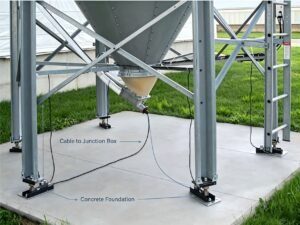
After the mechanical installation, the electrical wiring must be protected from moisture, rodents, and mechanical damage. Most farm environments require IP67-rated junction boxes and UV-resistant cables.
| Item | Options | Recommendation |
|---|---|---|
| Junction box material | Stainless steel or ABS plastic | Stainless steel for corrosive environments; ABS with sealed cable glands for cost-sensitive projects |
| Number of inputs | 4-in-1, 6-in-1, 8-in-1, 10-in-1, 12-in-1 | Match the number of silo legs |
| Protection rating | IP65 / IP67 / IP68 | IP67 minimum for outdoor feed towers |
| Indicator interface | RS232, RS485, 4-20 mA, 0-10 V, Ethernet | RS485 for multi-silo networks; 4-20 mA for simple PLC integration |
| Cable routing | Conduit or armored cable | Keep signal cables away from motor power lines |
When selecting a weighing indicator, confirm that it supports the total number of load cells and the impedance of your junction box configuration. Mixing 350 Ω and 700 Ω cells on the same indicator without verification can cause excitation voltage problems and unstable readings.
OEM Integration Checklist
If you are a feed tower manufacturer or system integrator preparing a bill of materials, use this checklist to avoid common specification errors.
- Confirm the total live load, dead load, and number of support legs.
- Select load cell capacity with a safety factor of at least 1.5x the maximum leg force.
- Specify the load cell accuracy class (C3 for standard, C4/C5 for precision inventory).
- Choose IP67 or IP68 sealing for outdoor farm environments.
- Match junction box input count to the number of cells (4, 6, 8, 10, or 12 inputs).
- Verify indicator compatibility with total load cell impedance and output signal.
- Include mounting kits with spherical caps and anti-lift bolts.
- Plan cable routes away from motors, heaters, and sharp edges.
- Allocate time for mechanical installation, corner trimming, and calibration with known test weights.
- Provide documentation: wiring diagram, calibration procedure, and maintenance schedule.
Applications and Industry Trends
Silo weighing technology is expanding beyond traditional livestock farms. The same load cell architecture is used in grain elevators, flour mills, plastic pellet storage, chemical tanks, and biomass fuel silos. Four trends are driving adoption:
- Biosecurity automation: Farms are reducing human and vehicle access to animal housing. Remote weighing enables just-in-time delivery without entering restricted zones.
- Precision livestock farming: Feed consumption data is correlated with growth rates, health records, and environmental sensors to optimize feed conversion ratio.
- Cloud connectivity: Modern indicators offer Modbus, MQTT, or LoRaWAN, allowing centralized dashboards across multiple farm sites.
- Sustainability reporting: Accurate inventory reduces feed waste and supports carbon footprint tracking in integrated supply chains.
Frequently Asked Questions
How accurate is a feed tower weighing system?
A well-installed system with C3 load cells typically achieves ±0.1% to ±0.3% of full scale. Accuracy depends on mechanical installation, corner trimming, and calibration with certified test weights.
Can I add load cells to an existing feed tower?
Yes, but each leg must be jacked up and supported while the load cell module is inserted. This is more labor-intensive than new installation, and structural checks are required before lifting.
What is the difference between galvanized and FRP feed towers?
Galvanized steel towers are strong and economical but can overheat in direct sun and may leak at bolted joints. FRP towers resist UV, corrosion, and temperature swings, with smoother interior walls that reduce feed residue and mold.
Why does the junction box need the same number of inputs as legs?
Each leg has its own load cell. The junction box sums the individual mV/V signals into one combined output and provides corner adjustment so each leg contributes equally to the total weight.
Can one indicator manage multiple silos?
A single indicator is usually dedicated to one silo. For multi-silo monitoring, use one indicator per silo connected via RS485 or Ethernet to a central PC, PLC, or cloud gateway.
What maintenance does a silo weighing system need?
Inspect cable glands and conduit annually, check for debris under the mounting plates, and recalibrate every 12 months or after any structural modification. Keep records of zero and span checks.
Which communication interface is best for farm networks?
RS485 is the most common choice for multi-drop wiring over long distances. For new cloud-connected farms, Ethernet or wireless LoRaWAN indicators reduce cabling and simplify remote access.
Get a Silo Weighing Quote
Whether you need 3-ton shear beam modules for 4-leg poultry towers or 5-ton compression cells for 8-leg pig farm silos, we supply matched load cell kits, junction boxes, and indicators for export-ready OEM projects. Contact us with your silo capacity, leg count, and target accuracy, and we will recommend a complete weighing solution.
Request a quote: Share your feed tower capacity, leg configuration, and required communication interface, and we will reply with a BOM and lead time.