
Load Cells for Smart Refrigerators & Washing Machines: How Weight Sensing Powers the Connected Home
By Robin | Updated July 2026 | 12 min read
Smart home appliances are no longer a futuristic concept—they are on retail shelves today. From Samsung’s Family Hub refrigerator that tracks what you eat, to LG’s washing machines that auto-detect laundry weight, load cell technology is the unsung hero making it all possible. In this guide, we explain how load cells work inside smart refrigerators and washing machines, which sensor types OEMs should choose, and what specifications matter most for appliance integration.
1. What Is a Smart Refrigerator with Weight Sensing?
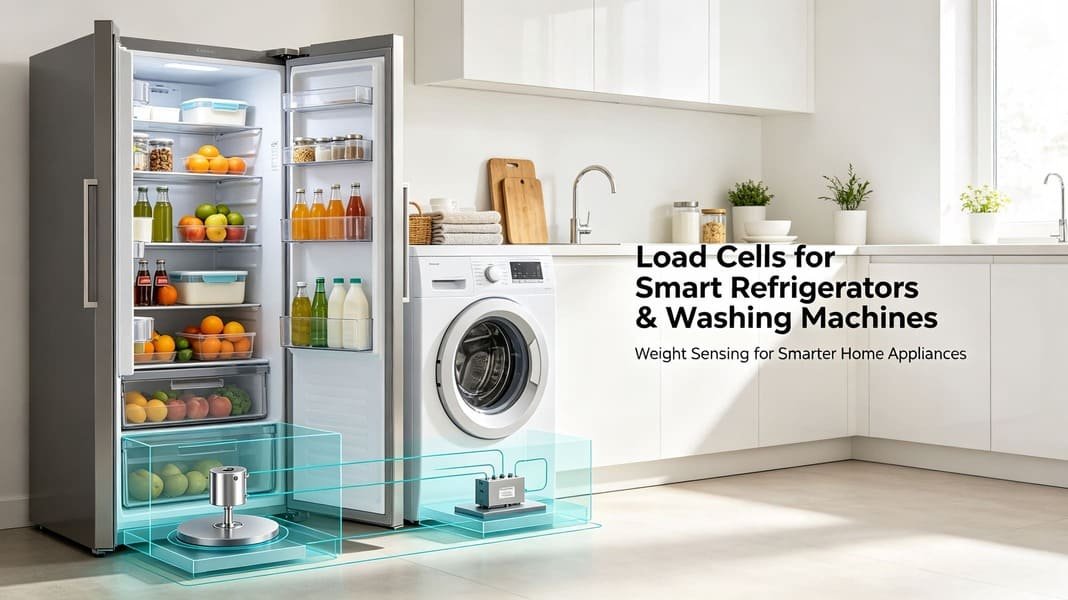
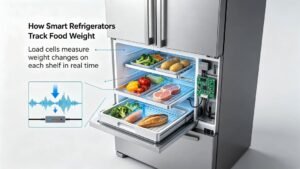
A smart refrigerator connects to your home Wi-Fi network and uses built-in sensors to monitor its contents in real time. While cameras and RFID tags help identify what is inside, load cells tell you how much is left—by weight.
Here is how the weight-sensing function works in practice:
- Real-time inventory tracking: Each shelf or drawer sits on one or more load cells. As you add or remove items, the sensor detects the weight change instantly.
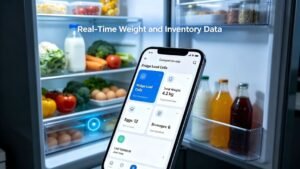
- Low-stock alerts: When the weight of milk, eggs, or any tracked item drops below a threshold, the companion app sends a notification to your phone.
- Automatic shopping lists: Some models integrate with grocery delivery services and can auto-order items that are running low.
- Nutrition tracking: By knowing how much food is consumed over time, the system can estimate calorie intake and dietary habits.
- Waste reduction: Expiry reminders paired with weight data help users consume food before it spoils, reducing household food waste.
Did you know? The average household wastes 30–40% of purchased food. Smart refrigerators with weight sensing can reduce this by up to 25% by providing timely consumption and expiry alerts, according to industry research.
2. How a Load Cell Works Inside a Refrigerator
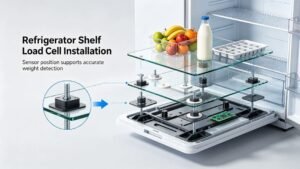
A load cell is a transducer that converts mechanical force (weight) into an electrical signal. Inside a smart refrigerator, small strain-gauge load cells are mounted beneath shelves, crisper drawers, or door compartments.
The Measurement Chain
1
Weight Applied
Food placed on shelf
2
Strain Gauge Deforms
Micro-strain on sensor body
3
Signal Output (mV)
Bridge circuit outputs mV/V
4
ADC Conversion
HX711 or MCU reads digital value
5
App Display
Weight shown on phone / screen
The most common sensor type used is the strain gauge load cell, specifically a single-point bending beam or parallel beam design. These are compact, accurate, and can measure off-center loads—essential for refrigerator shelves where items are placed unevenly.
The signal from the load cell (typically 1–3 mV/V) is amplified and digitized by an ADC chip such as the HX711, which communicates with the refrigerator’s main controller via I2C or SPI. The controller then calculates the actual weight using a calibration factor and sends the data to the cloud via Wi-Fi.
3. Benefits: Why Manufacturers Use Load Cells
For Consumers
- Never run out of essentials — auto low-stock alerts
- Reduce food waste with expiry + weight tracking
- Hands-free inventory management via app
- Energy savings — optimize cooling based on load
- Dietary insights from consumption data
For OEM Manufacturers
- Competitive differentiation in premium segment
- Recurring revenue via grocery partner integrations
- Data-driven product improvement from usage analytics
- Higher unit price vs. conventional models (30–50% premium)
- Future-proofing for IoT and smart home ecosystems
4. Load Cells in Smart Washing Machines
The same load cell technology is transforming smart washing machines. When you load laundry into the drum, a load cell measures the total weight and the machine adjusts automatically:
| Function | How Load Cell Helps | Benefit |
|---|---|---|
| Auto-load detection | Weighs clothes before cycle starts | Prevents overloading, extends drum life |
| Water optimization | Adjusts water volume to match load weight | Saves 20–30% water per cycle |
| Detergent auto-dosing | Calculates exact detergent needed | Reduces waste, prevents residue |
| Imbalance detection | Monitors weight distribution during spin | Reduces vibration, prevents damage |
| Energy saving | Optimizes cycle time and temperature | Lower electricity bills, eco-friendly |
Brands like Samsung, LG, and Haier have already integrated weight-sensing technology into their flagship washing machine lines, and the trend is spreading to mid-range models as component costs decrease.
5. Suitable Load Cell Types for Smart Appliances
Not all load cells are suitable for household appliances. The key requirements are compact size, low power consumption, high accuracy at small loads, and food-grade or moisture-resistant construction. Below are the most commonly used types:
| Type | Capacity Range | Best For | Key Advantage |
|---|---|---|---|
| Single-Point Parallel Beam | 1–50 kg | Refrigerator shelves, drawers | Off-center load tolerance, compact |
| S-Type (S-Beam) | 5–100 kg | Washing machine drum suspension | Tension/compression, high accuracy |
| Micro / Miniature Load Cell | 0.5–10 kg | Door bins, small compartments | Ultra-compact, fits tight spaces |
| Button-Type (Compression) | 2–20 kg | Shelf corner mounting (4-corner) | Low profile, easy installation |
| Strain Gauge on Flexure | 0.1–5 kg | Precision dosing, liquid containers | Highest resolution at tiny loads |
6. OEM Selection Guide: 7 Key Specs to Check
If you are an appliance manufacturer or sourcing engineer, these are the critical specifications to evaluate when selecting a load cell for smart refrigerator or washing machine applications:
| # | Specification | What to Check | Typical Requirement |
|---|---|---|---|
| 1 | Capacity | Max weight per shelf / compartment | Fridge: 3–15 kg; Washer: 10–100 kg |
| 2 | Accuracy | Combined error as % of rated load | ≤ 0.05% FS (appliance-grade) |
| 3 | Size / Footprint | Available mounting space | ≤ 50×50 mm for shelves |
| 4 | Temperature Range | Operating environment | Fridge: -10 to +10°C; Washer: 0 to +60°C |
| 5 | Protection Rating | Moisture / condensation exposure | IP54+ for fridge; IP65+ for washer |
| 6 | Signal Output | mV/V or digital (I2C/RS485) | 2.0 mV/V analog or HX711-compatible |
| 7 | Certifications | Food contact / electrical safety | RoHS, REACH, FDA (if applicable) |
7. Recommended Load Cell Models
Based on our experience supplying load cells to smart appliance OEMs, the following models are well-suited for refrigerator and washing machine applications:
| Model | Type | Capacity | Best Application | Notes |
|---|---|---|---|---|
| WST201 | Single-point beam | 5 -50Kg | Fridge shelf / crisper drawer | Compact, aluminum alloy, 2.0 mV/V |
| WST1101 | Single-point beam | 15kg | Fridge main shelf | Off-center load, IP65rated |
| WST404 | S-Type (S-Beam) | 50 kg | Washing machine drum | Tension/compression, |
| WST608 | Button-type | 50 kg | 4-corner shelf mounting | Low profile, |
| WST101 | Micro miniature | 1 kg | Door bins, small compartments | Ultra-compact 34×34 mm |
| WST401 | S-Type (S-Beam) | 100 kg | Large washing machines | IP65, high vibration resistance |
Selection tip: For refrigerator applications, always choose a load cell rated for low-temperature operation (down to -10°C or lower). Standard industrial load cells may drift or lose accuracy in cold environments. Ask your supplier for temperature-compensated versions.
8. Installation & Integration Considerations
Mechanical Mounting
- Rigid frame required: The load cell must be mounted between a rigid base and the shelf/platform. Any flex in the frame causes measurement error.
- Four-corner vs. single-sensor: For shelves > 30×30 cm, use 4 load cells (one per corner) summed through a junction box. For smaller compartments, a single-point sensor is sufficient.
- Vibration isolation: In washing machines, use rubber dampers between the load cell and the frame to absorb motor vibration.
- Level surface: Ensure the mounting surface is flat and level. Even a 1° tilt can introduce 0.1% error.
Electrical Integration
The typical wiring for an analog load cell in a smart appliance:
| Wire Color | Function | HX711 Pin |
|---|---|---|
| Red | Excitation + (E+) | E+ |
| Black | Excitation − (E−) | E− |
| Green | Signal + (S+) | A+ |
| White | Signal − (S−) | A− |
| Yellow (if present) | Shield / Sense | GND (shield) |
Important: Wire colors vary by manufacturer. Always verify with a multimeter: measure resistance between E+ and E− (~350–400 Ω), and between S+ and S− (~350–400 Ω). If readings are significantly different, the sensor may be damaged.
Calibration
- Zero calibration: With no load on the shelf, record the ADC output as the zero point.
- Span calibration: Place a known weight (e.g., 2 kg standard mass) on the shelf and record the ADC value.
- Calculate scale factor:
scale = (known_weight) / (loaded_ADC − zero_ADC) - Verify linearity: Test with 25%, 50%, 75%, and 100% of rated capacity. Error should be < 0.1%.
- Temperature compensation: If the appliance operates across a wide temperature range (e.g., refrigerator), perform calibration at both room temperature and operating temperature.
9. Industry Trends: Samsung, LG & Haier
The smart appliance market is growing rapidly. Here is how major brands are leveraging load cell technology:
Samsung
Family Hub refrigerators feature internal cameras and weight-sensing shelves. Their AI-powered “Vision AI” combines image recognition with weight data to identify 33+ food items and suggest recipes based on what is available.
LG
LG’s InstaView and ThinQ washing machines use load cells for auto-load detection and AI Direct Drive, which adjusts wash patterns based on fabric weight and type. Their refrigerators integrate weight sensing with the ThinQ app for remote monitoring.
Haier
Haier’s smart refrigerators and washing machines sold in the Chinese and European markets feature weight-based inventory management and auto-dosing. Their IoT platform integrates with smart home ecosystems for voice control via Alexa and Google Assistant.
The global smart refrigerator market is projected to reach USD 7.5 billion by 2030, growing at a CAGR of ~15%. As component costs for load cells and ADC chips continue to decrease, weight-sensing features are expected to move from premium to mid-range appliance tiers, creating significant OEM sourcing opportunities.
10. Frequently Asked Questions
Q: How many load cells does a smart refrigerator need?
It depends on the design. A basic model with one monitored shelf may use a single load cell. A full-featured model with 3–4 monitored compartments (crisper, main shelf, door bin, freezer) typically uses 4–8 sensors. Each compartment can use either one single-point load cell or four button-type sensors (one per corner).
Q: Can load cells work in freezer temperatures (below 0°C)?
Yes, but you must specify low-temperature-rated load cells. Standard sensors may experience output drift below 0°C. Look for sensors with temperature compensation down to -20°C and ask the supplier for a temperature curve chart.
Q: How accurate are load cells in a refrigerator?
A well-installed appliance-grade load cell achieves accuracy of ≤ 0.05% of full scale. For a 10 kg shelf, that means ±5 grams—more than enough to detect when a milk carton is nearly empty. The limiting factor is often the ADC resolution (24-bit HX711 provides ~0.1 g resolution at 5 kg).
Q: Do smart washing machines really save water with load cells?
Yes. By accurately measuring laundry weight, the machine calculates the optimal water volume, detergent dose, and cycle duration. Independent tests show 20–30% water savings compared to fixed-cycle machines. Over a year, this can save thousands of liters per household.
Q: Are load cells affected by refrigerator vibration (compressor)?
Compressor vibration can introduce noise into the load cell signal. This is mitigated by: (1) mechanical isolation using rubber dampers, (2) software filtering (moving average or Kalman filter in the controller), and (3) sampling during compressor-off periods. A well-designed system achieves stable readings within 1–2 seconds.
Q: Can I use the same load cell for both refrigerator and washing machine?
Generally no. Refrigerators need low-capacity (1–15 kg), low-temperature-rated sensors, while washing machines need higher-capacity (20–100 kg), high-vibration-resistant, IP65-rated sensors. The mechanical mounting and signal conditioning are also different. However, the underlying strain gauge technology is the same.
Q: Can you provide custom load cells for our specific appliance design?
Yes. As a load cell exporter serving appliance OEMs, we offer custom capacity, size, mounting holes, cable length, connector type, and calibration certificates. We also provide pre-calibrated sensor + HX711 module kits for rapid prototyping. Contact us to discuss your project requirements.
Need Load Cells for Your Smart Appliance Project?
We supply appliance-grade load cells to OEMs worldwide—from prototyping to mass production. Custom capacities, sizes, and calibration available.
About the author: Vektorforce is a leading exporter of load cells and weighing components, serving smart appliance OEMs, industrial automation companies, and retail technology providers worldwide.
Disclaimer: The model numbers and specifications listed in this article are for reference only. Please contact us for the latest product catalog and datasheets. All trademarks belong to their respective owners.