

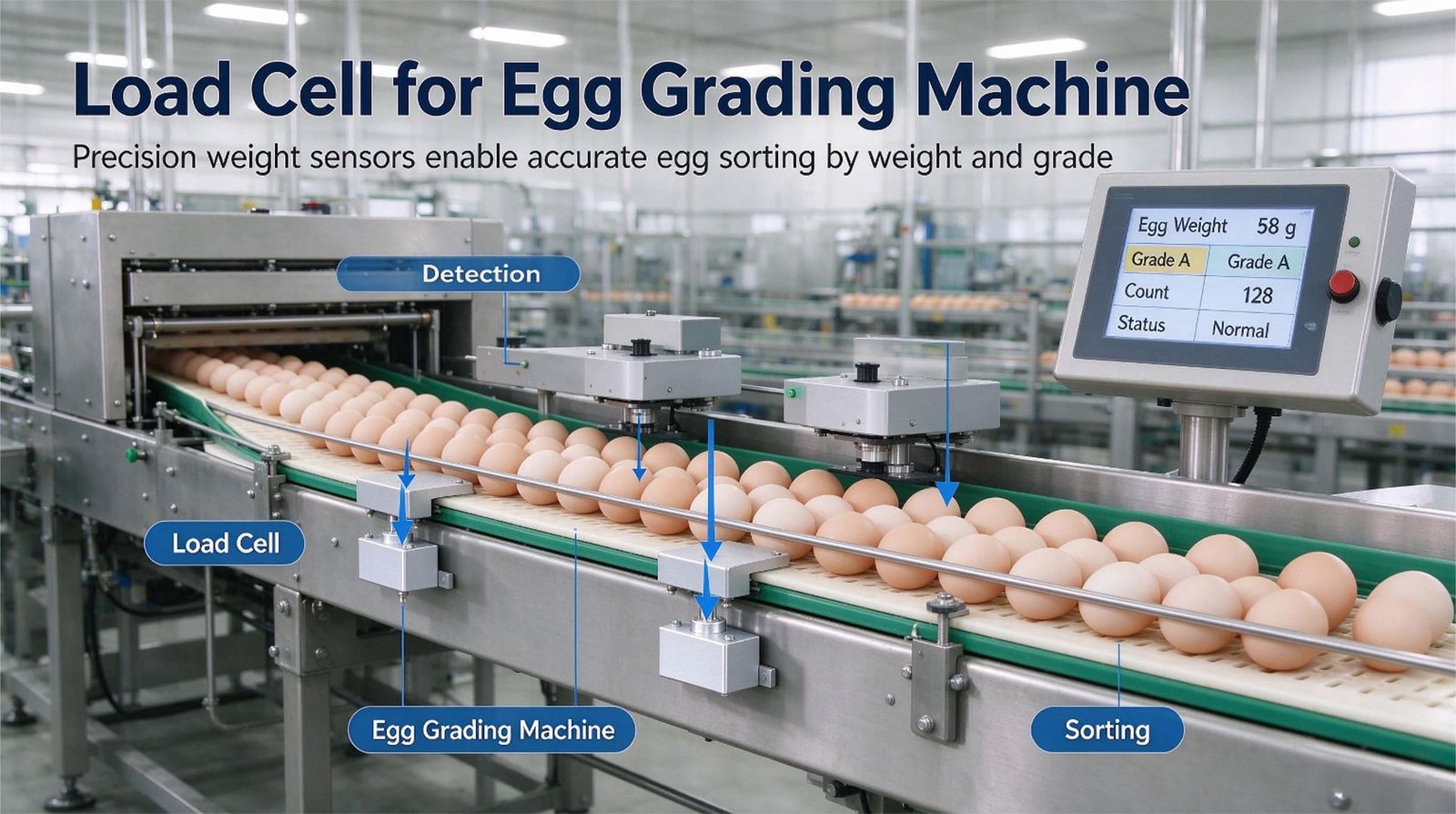
Load Cells for Egg Grading Machines: Field Notes From Weighing 30,000 Eggs an Hour
📅 October 7, 2026
⏱️ 18 min read
🥚 Egg Grading & Sorting Lines
Every specification argument I have ever had about an egg grader came down to one number, and it was never the number the customer wanted to talk about. They want to talk about resolution — “we need 0.1 g” — because resolution is the number in the brochure. The number that actually decides whether their machine holds a grade boundary at 53.0 g is the one printed three lines further down the same specification sheet: the temperature effect on zero.
An egg is a difficult object to weigh, not because it is light, but because it is light and valuable and moving. Thirty thousand of them an hour pass a weighing head that has to decide, in about a fifth of a second, whether this one is a small or a medium — and it has to make the same decision the same way at 07:00 and at 15:00, in a room with a washer and a dryer running at the other end, on a chain that never stops. I have quoted load cells into egg graders in Brazil, in Egypt, in Poland and in Malaysia, and the failures cluster in the same three places every time: range, temperature, and overload protection. Only one of those three is a load cell problem.
What follows is how I actually size a weighing head now — the single arithmetic that settles the range, the thermal budget that nobody writes down and everybody pays for, three real projects including the one where we broke a cell during the fix, and an honest account of the four things an egg grader’s scale can never tell you no matter how good the load cell is. There is also a section at the end that regular readers of this blog will recognise: the eleven lines I need before I can quote, and the parts of the machine that stay firmly with you.
I’m Robin from VektorForce. We supply load cells, force sensors, junction boxes and weighing indicators — the sensing layer. We do not build graders, we do not write the sorting algorithm, we do not supply the candling camera, and we do not certify a packing line as legally approved. That division matters more in this category than in most, because egg grading is one of the few industrial weighing jobs where the reading is regulated by law.
1. An egg grader is a weighing machine with a conveyor bolted on
Strip an egg grading machine down and you find three things: a mechanism that moves a fragile object without breaking it, an optical system that looks inside the shell, and a weighing station that sorts by mass. The mechanism and the optics are what people photograph. The weighing station is what the retailer’s contract actually depends on, because the number printed on the pack — M, 53 g to 63 g — is a legal declaration about mass.
It is worth being precise about that, because it is not a marketing convention. In the European Union, Commission Regulation (EC) No 589/2008 Article 4 fixes four weight grades for Class A eggs: XL at 73 g and above, L from 63 g to just under 73 g, M from 53 g to just under 63 g, and S under 53 g. Article 5 goes further and requires a packing centre to have both “equipment for grading eggs by weight” and “one or more approved balances for weighing eggs”. The grade letter on the carton is a metrological statement, and there is a competent authority behind it.
Where the packer subdivides those ten-gram bands further — and most do, because a supermarket buying M-grade eggs for a premium line does not want a 52 g egg and a 62 g egg in the same twelve-pack — the real working boundaries fall every five grams, or even every three. A five-gram band makes a ±0.5 g grading tolerance ten percent of the band. That is the whole engineering problem in one sentence, and it explains why the load cell in an egg grader is asked to do something a kitchen scale is not.
Four facts that set the whole specification
- The object is 45–75 g in commercial practice, and a duck egg or a turkey egg can push past 90 g. Anything on the platform that is much heavier than that is either a tray, a box, or a mistake.
- The grade bands are 10 g wide by regulation, 5 g in practice — so the load cell is being asked to resolve about one part in one hundred and twenty of the object it is weighing.
- The answer has to arrive in roughly 200 milliseconds, because that is how long the machine can hold a cup still over a moving chain at 30,000 eggs an hour.
- The cycle repeats tens of millions of times a year on a machine that runs three shifts, which makes this a fatigue application dressed up as a precision application.
That last point deserves a number, because it changes the way you read a datasheet. A packer running six hours a day at 30,000 eggs an hour puts 65.7 million eggs a year past the weighing head. If the machine has two heads, each cell takes about 32.9 million load cycles a year, and it is a load cycle every time an egg arrives and leaves — not one sustained load. A conventional single-point cell tested to a million cycles at rated load looks generous until you divide it into the calendar. Add the fact that a grader never really stops — it runs during wash-down, during changeovers, during the shift handover — and you begin to understand why the failure I see most often on these machines is not a dead cell but a drifting one.
The commercial backdrop is worth two paragraphs, because it explains why this category is busier than it was five years ago. Brazil is the clearest example and the one I have the most quotes in. Brazilian egg production reached 62 billion units in 2025, up 7.5 % on the 57.683 billion recorded in 2024, and ABPA projects up to 65 billion in 2026. Per-capita consumption went from 269 eggs in 2024 to 288 in 2025, and is forecast at 306 in 2026 — which puts Brazil, for the first time, inside the world’s ten largest per-capita egg consumers. Exports are the sharp part of the curve: shipments were projected at up to 40,000 tonnes in 2025, 116.6 % higher than the 18,469 tonnes shipped in 2024. Any company that has to move that volume of eggs across a border needs weight grading that a foreign buyer will accept, and that is a hardware problem before it is a paperwork problem.
The Brazilian machine-building side of that market is worth knowing by name, because it sets the size of the machines I am quoting into. Inovus, in Garça in the interior of São Paulo state, launched its first 90-carton-per-hour egg classifier in 2018 and now builds classifiers at 60 and 90 cartons an hour alongside washers, dryers and packers. At 360 eggs to a carton, 90 cartons an hour is roughly 32,400 eggs an hour. Yamasa, in Rinópolis, has been building poultry automation for sixty years and lists a model, the LCHSL-180.000, in a class that speaks for itself — a machine that size is not one weighing station, it is a bank of them. Between those two points — thirty thousand eggs an hour and one hundred and eighty thousand — sits almost every project I get asked to quote, and the weighing problem is identical in both. Only the number of copies changes.
2. Three different weighing jobs hiding in one machine
The single most expensive mistake I see on egg grading projects is not a wrong load cell. It is one load cell doing three jobs. Here is what I mean.
A modern grading line has at least three distinct points where mass matters, and they have almost nothing in common except that they all get called “the scale”.
| Job | What is on the platform | Accuracy you need | How often | Sensible range |
|---|---|---|---|---|
| Grade one egg | One egg in a cup, 45–75 g | ±0.5 g claimed; you want 0.2 g of reading | 5 times a second, forever | 0.6 kg |
| Weigh a tray | 30 eggs plus the tray, 1.8–2.4 kg | 1–3 g, to see a humidity trend | Twice per 18 days | 8 kg |
| Check a box | A 30-dozen box, about 21.6 kg | 10 g, to catch a missing tray | Once per box, at the end of the line | 30 kg |
Those three jobs want three different cells, and the ratio between the smallest and the largest is fifty to one. If you try to serve all three with one part number you will land somewhere in the middle and be mediocre at all three — which is exactly what happened in the hatchery case later in this article, and it cost the customer a batch of cells and a fortnight of production.
The one-bit version of the same argument is worth stating plainly, because it is the first question I ask now:
Ask which of these three sentences you are trying to make true: “This egg weighs this much” — a metrology problem. “This tray is a bit lighter than the last one” — a drift problem. Or “this box has roughly the right number of eggs in it” — a gross-error problem. The first needs resolution. The second needs stability and repeatability. The third needs almost nothing except capacity, and buying resolution for it is a waste of money and, as we will see, an active hazard.
There is one more distinction that matters on a grading line and it is a technology choice, not a specification choice. The industry’s own selection literature puts it in a single table: automatic checkweighers and grading systems use two families of sensor. One is electromagnetic force compensation — a coil in a magnetic field, the technology inside a laboratory balance. The other is the resistance strain gauge, which is what we make. Force compensation wins on resolution, and it wins by a wide margin. What it loses on is everything else an egg grader cares about: it is roughly an order of magnitude more expensive, it needs a very stable frame and a level floor, it recovers badly from overload, and it is unhappy in a room where a washer is running.
I want to be honest about the boundary here rather than sell past it. Force compensation is not in our product line, and I do not try to talk a customer out of it when they genuinely need it. If your requirement is 0.01 g on a single egg with a settling time measured in seconds, you should be talking to a balance manufacturer and I will tell you so. But if your requirement is “sort 30,000 eggs an hour into five bands and survive three shifts and a hose”, the strain gauge is not the cheap compromise. It is the correct engineering answer, and the arithmetic in the next two sections is how I show that.
3. The one calculation that decides your range
This is the calculation that ends most of my range arguments, and it takes about thirty seconds. It runs in three steps.
Step one: what division do you need? A grading decision at a boundary of 53.0 g should not be made on a scale whose smallest readable step is one gram. The working rule in weighing is that the reading division d should be at least five times finer than the tolerance you intend to certify, and preferably ten. For a ±0.5 g grading tolerance that puts you at d = 0.05 to 0.1 g if you are being strict. In practice, packers accept 0.2 g, because the alternative costs real money and 0.2 g is already only four percent of a five-gram band.
Step two: what does your cell give you at that range? A Class C3 cell is 3,000 divisions by definition. So the reading division is simply the range divided by 3,000, and the answer falls out immediately:
| Range at C3 | Reading division d | A 60 g egg as % of range | Can it hold a ±0.5 g grade boundary? |
|---|---|---|---|
| 0.3 kg | 0.1 g | 20 % | Yes, beautifully — but there is no overload room at all |
| 0.6 kg | 0.2 g | 10 % | Yes — this is the practical answer |
| 1.5 kg | 0.5 g | 4 % | No. Your reading step is your claimed tolerance |
| 3 kg | 1 g | 2 % | No. Twice your claimed tolerance |
| 6 kg | 2 g | 1 % | No — tray and box work only |
Read that table once more, because the fourth row is where most projects start and it is a dead end that looks like a safe choice. A 3 kg cell does not look extravagant when you are weighing something that never exceeds 75 g. It looks prudent. But the reading division is one gram, and no firmware, no filter and no averaging routine can recover a half-gram decision from a one-gram reading step. The information is not there.
Step three: check that the analogue front end is not the limit. This is where people expect the problem to be, so let me show the arithmetic and then show why it is not the problem at all. Take a 0.6 kg cell with a rated output of 1.0 mV/V — which is normal for a small-capacity single-point cell — and excite it at 5 V. Full-scale output is 5 mV. One division is one three-thousandth of that:
Vdivision = (S × Uexc) ÷ n
= (1.0 mV/V × 5 V) ÷ 3,000 = 1.67 µV per division
Now compare that with the converter. A 24-bit sigma-delta front end like the one in our own WST1502 weighing indicator has a ±10 mV input window and 5,000,000 displayed counts, which puts one count at 20 mV ÷ 5,000,000 = 4 nanovolts. One division of 1.67 µV is therefore about 420 counts. Even a pessimistic 16-bit converter would put a division at a comfortable multiple of its own noise floor.
So the answer to “is 0.1 g achievable?” is yes, and it has nothing to do with electronics. Which brings me to the honest half of the sentence: a division of 0.2 g sitting on top of 420 counts of headroom sounds enormous until you remember that a gram of chain vibration is five divisions, and a refrigerator compressor humming through the frame is twenty. Resolution on an egg grader never fails. Noise fails. Mechanics fail. Temperature fails. That is the whole story of the next section, and of the case that follows it.
One more number belongs in this section, because it sets the machine’s physical scale and therefore the cell’s dwell time. At 30,000 eggs an hour the chain is delivering 8.3 eggs a second. With cups at a 60 mm pitch that is a chain speed of about 0.5 m/s, and with a realistic 200 milliseconds of dwell time at the weighing head, one head can serve about five eggs a second — call it 18,000 eggs an hour. So a 30,000 EPH machine wants two weighing heads, a 90,000 EPH machine about five, and the 180,000 EPH class of machine roughly ten. That estimate is the first thing I do on any new enquiry, because it tells me immediately whether the customer is asking for a load cell or for a load cell programme.
And it tells me something else that surprises most electrical engineers on these projects: you cannot buy your way out of the dwell time with a faster converter. The 200 milliseconds is not conversion time, it is the time the mechanical assembly needs to stop ringing after the egg lands. A faster ADC on a frame that is still oscillating just gives you eight thousand beautifully resolved samples of a number that has not settled yet.
4. The thermal budget nobody writes down
Here is the part of an egg grader specification that gets skipped, and it is the part that generates the complaint emails. Every load cell datasheet lists its errors as a percentage of full scale. On a 0.6 kg cell that is a perfectly reasonable way to write it. The trouble is that you are not weighing 0.6 kg — you are weighing 60 grams, which is ten percent of full scale. Every error term on the sheet has to be multiplied back up into grams at your actual load before it means anything, and that conversion is where ±0.5 g grading claims quietly die.
Let me do it properly for a 0.6 kg C3 cell, using the specification of the WST205 because it is the one I quote most for this job.
| Error term as published | Value on a 0.6 kg cell | What it costs you in grams | Share of a ±0.5 g budget |
|---|---|---|---|
| Comprehensive error ±0.02 % FS | 1.2 g | 0.12 g | 24 % |
| Repeatability ±0.015 % FS | 0.9 g | 0.09 g | 18 % |
| Linearity ±0.015 % FS | 0.9 g | 0.09 g | 18 % |
| Hysteresis ±0.015 % FS | 0.9 g | 0.09 g | 18 % |
| Creep ±0.03 % FS / 30 min | 1.8 g | 0.18 g per half hour | 36 % |
| Temp. effect on zero ±0.05 % FS / 10 °C | 3.0 g | 0.30 g per 10 °C | 60 % |
| Temp. effect on output ±0.03 % FS / 10 °C | 1.8 g | 0.18 g per 10 °C | 36 % |
Two things fall out of that table and they are both uncomfortable.
The first is that a worst-case sum already exceeds the tolerance. Add the five non-thermal terms linearly and you get 0.57 g — more than the ±0.5 g you were planning to print. Add them the way a metrologist would, root-sum-square, and you get about 0.27 g, which passes. The truth is somewhere between the two, and this is exactly why the “±0.5 g” figure on a grading machine brochure is a typical value and not a guaranteed one. Anybody who tells you otherwise has not added up the sheet. What you do about it is a firmware decision, not a hardware one: put a dead band around every grade boundary so that an egg reading within, say, ±0.3 g of a boundary is deliberately placed in one nominated grade rather than left to the noise. That single change removes the “the same egg grades differently on two passes” complaint, which is the complaint that actually reaches the retailer.
The second is that the temperature terms are not small, and one of them is systematic. Look at the two amber rows together: on a 0.6 kg cell, a ten-degree ambient change can move the reading by up to 0.48 g. Over a twenty-degree swing between a cold morning start and an afternoon with the dryer running, that is approaching a gram — twice your grading tolerance, and worse than that, it moves every egg the same direction. This is not noise that averages out over a shift. This is a shift.
Now do the same arithmetic on the 3 kg cell that most projects start with, and watch what happens: 0.05 % of 3,000 g is 1.5 grams per ten degrees. Against a reading division of 1 gram, that means temperature alone moves your zero by one and a half divisions per ten degrees — and when the customer remembers that a 3 kg cell usually has a ±0.03 % FS/10 °C output term too, another 0.9 g, the picture is complete. On a big-range cell, the thermal terms are of the same order as the resolution. On a small-range cell, they are the dominant error source. Either way, they are the thing to design against.
Three cheap fixes that beat buying a better cell
- Re-zero on an empty cup every revolution. This is the most valuable line of code in the whole machine. The zero term — the 0.30 g row, the biggest single number in the table — disappears entirely, because you measure it and subtract it before every egg. What survives is the span term, which is smaller. A machine that re-zeros once per shift cannot do this, and it will drift.
- Move the weighing head away from the washer and dryer. In the case below, relocating one head by 1.2 metres and adding a polycarbonate shield cut the head-local air swing across a shift from around 14 °C to around 4 °C. That is a mechanical change costing almost nothing, and it beats any electronic compensation you could buy.
- Measure the temperature at the cell, not in the room. If you want to compensate, you need the sensor where the steel is. A 20 cent thermistor bonded to the cell body, logged alongside the weight, tells you within a day whether you have a thermal problem or a mechanical one. Without it you are guessing, and I have watched two suppliers each blame the other for a month because nobody had put a thermistor on the frame.
The honest summary of this section: on an egg grader, and on almost every small-capacity precision weighing job, the specification that decides whether you hold grade is not the resolution, and not the accuracy class. It is the temperature effect on zero, converted into grams at your load, and whether your controller is re-zeroing often enough to cancel it. I have written that sentence in a quotation cover note more times than I can count, and it has saved more projects than any part number I have ever recommended.
5. Case 1: a 3 kg cell on a 30,000 egg/hour grader in São Paulo
This is the project that taught me to ask about the thermal budget before I ask about anything else, and it is the one I use when a customer tells me their prototype “weighs fine on the bench”.
The customer. A grader builder in the interior of São Paulo state — the poultry belt that runs through Garça and Rinópolis — building a 30,000 eggs per hour classifier for a domestic packer. Five weight grades plus a reject lane, cups on a chain at a 60 mm pitch, two weighing heads, a washer and a hot-air dryer upstream of the grading section. Their first machine went into a customer’s plant in 2024.
Where it started. Their prototype used the load cell already in their BOM: a 3 kg Class C3 single-point cell they bought in volume for the box scale on their packing line. Nobody had specified it for the grading head. It was simply the cell they had, at a price they liked, and 3 kg felt safe for a machine where the heaviest object on the platform was three quarters of an egg. I have seen this exact decision made on four continents.
The symptom. During acceptance runs the packer checked repeatability by running the same reference egg through the machine eight times. They got a peak-to-peak spread of ±1.2 g on a nominally 60 g egg. Then they started watching the boundaries, and the real complaint surfaced: eggs reading 52.8 g and 53.1 g on consecutive passes were being sorted into different grades, and the same thing was happening at 62.9 and 63.2 g. The packer’s words, relayed to me, were the useful kind: “The grades do not repeat.”
The diagnosis, in three numbers. I asked for the cell’s range and did the arithmetic on the phone.
- A 3 kg C3 cell gives a 1 g reading division. Their ±0.5 g claim was half a division. You cannot certify a tolerance smaller than the smallest step you can read, and no amount of filtering changes that.
- The temperature effect on zero was 1.5 g per 10 °C. In a room with a washer and a dryer, air temperature at the grading head moved more than that between the start of the shift and the middle of it.
- Their safe overload was 120 % of 3 kg and ultimate overload 150 %. That is 3.6 kg safe and 4.5 kg ultimate, which is precisely why they had skipped a mechanical stop. The big range was not there for the egg. It was there as insurance for everything that could land on the platform by accident.
Notice that the mechanism, the gates, the reject lane and the PLC were all fine. The machine was well built. It was let down by one line in a purchase order.
Fix one: the range. We replaced the 3 kg cell with the WST205 at 0.6 kg — a Class C3 single-point cell with a 1.0 mV/V output on the sub-1 kg versions, 395 Ω input, IP65, and a sealed 200 mm cable. Reading division went to 0.2 g. Temperature effect on zero went from 1.5 g to 0.30 g per 10 °C. Same reference egg, same eight passes: the spread fell from ±1.2 g to ±0.25 g peak-to-peak.
That part of the fix was easy, and it took one quotation. The rest of it was not.
Fix two: the overload protection they had been buying with range. Dropping from 3 kg to 0.6 kg cut their safe overload from 3.6 kg to 0.9 kg, and ultimate overload from 4.5 kg to 1.2 kg. Everything that had previously been absorbed by a generous cell now had to be absorbed by the machine. That meant two mechanical changes: a hard stop under the cup carrier, set to engage at about 120 % of rated load, and a re-cut lift cam profile so that the cam can never push the cup past its lift point and load the cell in the wrong direction.
I want to include the part of this story that cost them money, because it is the reason I now insist on seeing a drawing before I quote. During the cam rework, one head was destroyed. A trial setting put something close to 4 kg through a 0.6 kg cell, which is over three times its ultimate overload, and a single-point cell that has been through that does not come back. It was a scrap part and two days of production. The lesson is not that 0.6 kg was the wrong choice. The lesson is that range and overload protection are a single decision, not two, and if you change one you must re-do the other. On this machine you genuinely cannot buy both resolution and overload headroom, so you buy resolution and engineer the protection.
Fix three: the afternoon drift. With the right cell in, a new symptom appeared that the 3 kg cell had been masking. Eggs that sorted as M at 07:00 were sorting as L by mid-afternoon, on a shift where the reference egg on the calibration stand had not moved. The offset was around 0.4 g and it was entirely one-directional.
Root cause, and it is the arithmetic from the previous section: the controller was re-zeroing once per shift, at start-up. So it was carrying the full zero term. The head sat about 1.2 metres from the dryer discharge, where the air swung roughly 14 °C across a shift; the zero term converted that into a few tenths of a gram, and the packer saw it as a grade shift. Three changes fixed it, and none of them was a load cell:
- Re-zero on an empty cup every revolution. This was a two-line change in their PLC and it removed the dominant error term outright. The residual afternoon drift fell to under 0.05 g.
- Move the weighing heads 1.2 metres upstream of the dryer discharge, and fit a polycarbonate shield between the head and the warm air path. Head-local air swing across a shift dropped from roughly 14 °C to roughly 4 °C.
- Add a dead band of ±0.3 g at every grade boundary in the sorting logic, with a nominated grade for eggs inside the band. This is the change that finally stopped the boundary complaints, because it makes the machine’s decision deterministic even when two readings of the same egg differ slightly.
Fix four, which was not really a fix. A later batch of cells arrived as six-wire while their panel was wired for four. I walked their technician through bridging IN+ to SENSE+ and IN− to SENSE− at the terminal, which takes five minutes. But I also told them honestly that on a 1.5 metre cable run they would not have measured the difference either way, and that the reason to standardise on six-wire was not accuracy — it was so that whatever indicator they fit in five years can sense the excitation at the bridge instead of assuming it. More on that in the wiring section.
Where it ended. Thirty thousand eggs an hour, five grades plus reject, repeatability of ±0.25 g peak-to-peak on the reference egg, and zero grade flips on boundary samples across three consecutive 2,000-egg acceptance runs. The load cell price went up by roughly forty percent per head. The mechanical rework cost more than the cells, twice over, once because of the destroyed head. And the customer now sends me the cup drawing with the first enquiry, which is the actual return on the project.
What I would have asked on day one, if I had known then what I know now
What is the smallest grade band you actually sell? Does the controller re-zero on an empty cup every revolution, or once a shift? What is the air temperature at the weighing head at 07:00 and at 15:00? How far is the head from the dryer discharge? And — the one that would have saved a cell — can you send me the cup drawing and the cam profile before I quote, so we size the stop and the cell together?
6. Case 2: the hatchery that asked one scale to do two jobs
The second project is a hatchery in the same state, and it is a clean illustration of the three-jobs problem from section 2. Nothing here was exotic. It was one purchase order trying to cover two completely different weighing tasks.
What a hatchery weighs, and why. Hatcheries care about egg mass because the chick’s weight at hatch is a fixed proportion of the egg it came from. That ratio has a name — chick yield — and it is one of the three numbers a hatchery manager steers the whole incubation process with, alongside eggshell temperature and egg water loss. The published targets cluster tightly: Lohmann puts ideal chick weight at 66–67 % of egg weight, Aviagen and the extension literature put optimum yield at 67–68 %. And the sensitivity is brutal: the standard hatchery reference material states that every one percent loss in chick yield is equivalent to about three extra hours in the hatcher.
Put those two facts together and you get a number I have used in more than one hatchery conversation. One percent of a 70 g hatching egg is 0.7 grams. So a weighing error of 0.7 g on the egg side looks, to the chick-yield calculation, exactly like three hours of extra incubation time. The hatchery is using egg weight to make a decision about a process, and their egg-weight instrument’s error converts directly into a process error. That is what makes egg weight worth measuring precisely in a hatchery even though nobody is printing a grade letter on the box.
They had two jobs, and both are legitimate:
- Grade hatching eggs before setting, so that each setter tray holds eggs of similar mass and the incubation profile can be tuned to the tray instead of to the average.
- Weigh whole setter trays at setting and again at transfer, to track water loss. This is standard hatchery practice and the reference literature recommends it explicitly, on the grounds that weighing whole trays of eggs is a cheap and reliable way to confirm that every setter is delivering the humidity its programme calls for. The target is around 11.5 to 12 % weight loss to pipping, and the loss is essentially all water.
What went wrong. They used the 0.6 kg grading cell for the tray job as well. A setter tray holds 30 eggs; at 72 g each that is 2.16 kg of eggs plus roughly 150 g of plastic tray. Call it 2.31 kg on a 0.6 kg cell — about 385 % of rated capacity, and nearly twice its ultimate overload. The cell survived, which is the cruellest part of this failure mode: a single-point cell that has been overloaded past ultimate does not always die, it just stops being the cell you bought. Its zero moved, and its creep got worse.
The customer’s complaint was that tray weights were running about 1.2 % low and drifting from tray to tray, which in water-loss terms is an error of the same size as five days of incubation humidity. They had spent a fortnight chasing the incubator before anyone questioned the scale.
Why the trap is so convincing. This is the part worth remembering. On the tray, the 0.6 kg cell’s reading division was 0.2 g — superb. They needed to resolve about 23 g, which is one percent of 2.31 kg and roughly the weight loss you would expect to see across half a day of incubation. A 0.2 g division on 23 g of required resolution looks like a hundred-fold margin. It is not a margin at all, because a good reading division says nothing whatsoever about capacity. The cell was being asked to weigh something four times heavier than it was built to weigh, and the datasheet term that should have stopped the project was not the accuracy line at all — it was the safe overload line, three rows further down.
The sentence I now put in writing on every tray-weighing quotation: a reading division of 0.2 g on a 0.6 kg cell means the instrument can resolve 0.2 g up to a maximum of 600 g. It is not a licence to put a 2.3 kg tray on it. Resolution and capacity are two different numbers on two different lines of the same sheet, and they are not interchangeable.
The fix. Separate the two jobs, which is what section 2 says to do and what the original BOM had quietly merged.
- Grading head: stays on the 0.6 kg cell, because 0.2 g on a 75 g egg is the right answer and nothing about the tray job changes that.
- Tray scale: a proper platform on a bigger single-point cell — WST216 at 8 kg, which is a Class C3 cell in aluminium with an anodised finish, a 200 × 200 mm platform, 150 % safe and 200 % ultimate overload, and a creep figure of 0.02 % FS/30 min that is tighter than most cells in this class. A 2.31 kg tray sits at 29 % of its range, and the reading division is 2.7 g. Against a 23 g resolution requirement, that is still a factor of eight, and now the cell is never asked to carry more than a third of what it was built for.
- And a note on the alternative: if a hatchery wants finer divisions on the tray, the 4 kg version of the same cell gives 1.3 g and puts the tray at 58 % of range. That is a legitimate choice, but it is a choice with a smaller margin, and it should be made deliberately rather than inherited from a price list.
One further change I pushed on them, and they resisted at first. The tray scale must not be an afterthought bolted to the same frame as the grader. A grading head is a dynamic instrument — five readings a second, on a machine that shakes, running continuously. A tray scale is a static instrument — one reading, twice per eighteen days, by a person who has just carried the tray across the room. If you mount one on the other you inherit all of the dynamic instrument’s problems and none of its requirements. Put the tray scale on its own bench, on its own feet, away from the line. It costs almost nothing and it removes an entire class of argument.
Two months later they sent me a chart of tray weight loss across a whole setter, plotted against the incubator’s humidity log, and the two curves agreed. That was the point at which the tray scale became an instrument they trusted rather than a number they argued about, and it happened because the two weighing jobs finally got two load cells.
7. Case 3: the packing centre that wanted a scale to count eggs
The third project is short, and it is the one I get asked about most often after somebody has read a specification and decided that a scale can replace a count.
The request. A packing centre, again in São Paulo state, wanted a weighing step at the end of the line to confirm that each outgoing box held the right number of eggs. Their reasoning was straightforward and, on the face of it, sound: the box has a known number of eggs, each egg has a known nominal weight, so weigh the box and you know whether one is missing. They had bought a 30 kg bench scale for the job.
Why it cannot work, in three numbers. This is the cleanest piece of arithmetic in the whole article, and it is worth doing properly because it settles an argument that comes up across the whole food-packaging industry.
Can a box scale detect one missing egg?
A 30-dozen box = 360 eggs × 60 g = 21.6 kg
Egg weight within one grade band: standard deviation ≈ 1.8 g
Box total: SD = 1.8 × √360 ≈ 34 g
One missing egg = 60 g ≈ 1.75 standard deviations
That is the answer, and it has nothing to do with the quality of the scale. A legitimately full box of eggs varies in total mass by about ±34 g purely because individual eggs vary. One missing egg is a 60 g deficit, which is smaller than the normal spread of a box that is completely correct. Roughly one full box in twenty-five will read more than 60 g light without a single egg missing, and you have no way to tell those apart from the box that is genuinely one short. A box scale cannot count eggs. No scale can count eggs.
What the scale can do is catch the errors that matter. A missing tray of ten eggs is 600 g, which is seventeen standard deviations — unmissable. A box that went through the packer with a missing divider, or with the wrong grade loaded into it, shows up immediately. So the right specification for the end-of-line scale is not a counting instrument at all; it is a gross-error instrument, and it should be set with a wide window and used to catch the failures that humans make rather than the failures that arithmetic makes.
What we actually specified. Two instruments doing two jobs, which is the recurring theme of this article:
- The box check platform: WST207, a Class C2 single-point cell in the 3–100 kg range on a 250 × 350 mm platform, with a stainless indicator running HI / OK / LO set points and a window of ±300 g around the nominal box mass. This catches a missing tray, a double-counted carton and a gross scale error. It does not, and will never, catch a single missing egg.
- A tray check scale on the grading line head: WST216 at 8 kg on a 12-egg “bandeja” platform, logged through the indicator’s isolated RS-485 Modbus interface into their pack-house system. This is the instrument that actually protects the label, and here is why.
A single tray of twelve eggs has a total SD of about 1.8 × √12 = 6.2 g. A one-gram shift in the flock’s average egg weight moves that tray’s reading by 12 g — about two standard deviations, which on one tray is a coin flip and on two hundred trays a day is a measurement. Averaging the day’s trays cuts the standard error to well under a gram, at which point a one-gram shift in the flock’s egg weight is visible while it is still a trend rather than a batch of mislabelled cartons. That is the value of weighing on a grading line: not counting individual eggs, but watching the flock.
The customer’s original idea — one scale, one job, catch a missing egg — was not a bad idea. It was the wrong instrument for the wrong question. What they actually needed was two instruments answering two questions they had not separated yet.
8. Overload, shock, and the mechanical stop you must not skip
Every reliable source on single-point cells, including the parallel-beam training material our own product team works from, says the same thing in the same order: small range, high accuracy, good rigidity, strong resistance to eccentric load — and weak overload capacity. That last item is the one that decides whether an egg grader runs for five years or eats a cell every season, and it is the one the range table in section 3 forces you to confront.
An egg grader is a shock-loading machine. Every egg arrives with a small vertical velocity and stops abruptly, five times a second, for tens of millions of cycles a year. So let us put a number on the shock, because “small” is doing a lot of unexamined work in that sentence.
The impulse factor for a dropped egg
n = 1 + √(1 + 2h / δ)
where h is the drop height and δ is the deflection of the support under the load.
h = 10 mm, soft mount δ = 0.5 mm → n = 7.4 → 60 g × 7.4 = 444 g
h = 10 mm, rigid mount δ = 0.1 mm → n = 15.2 → 60 g × 15.2 = 911 g
Read those two lines carefully, because they are the same egg, the same drop height and the same cell — the only thing that changed is how much the mount complies. On a soft mount the egg’s landing impulse peaks at 74 % of the cell’s rated capacity. On a rigid mount it peaks at 152 % of rated, which is at or beyond the safe overload limit of a 0.6 kg cell. In other words: the compliance of your cup mounting is a design parameter with the same weight as the load cell selection, and it is usually chosen by accident. Half a millimetre of deliberate compliance buys you a factor of two on every single egg, tens of millions of times a year.
That said, the single-egg impulse is survivable, and it is not the failure mode that empties a maintenance budget. These are, in the order I see them:
- The jam. A gate sticks, eggs accumulate on one cup, and the cup now carries eight eggs — 480 g, or 80 % of rated load, held continuously. Nothing breaks. What happens instead is that the cell now reads every subsequent egg with a 480 g offset, and the PLC cheerfully grades the next two thousand eggs into the reject lane. This is by far the most expensive failure mode on the list because it is silent, and it is why I always ask for a “no egg on the cup” plausibility check in the PLC. A lying cell is worse than a dead one.
- A fifteen-egg pile-up. 900 g, or 150 % of rated — exactly the safe overload limit. The cell may survive, but it will not be the same cell afterwards.
- An operator drops a setter tray onto the head. Thirty eggs is 1.8 kg, which is 300 % of rated and 150 % of ultimate overload. That cell is scrap, and no amount of mechanical protection will help unless the stop is set below it.
So the conclusion, and it is the conclusion I want any grader builder to take away from this article: on a machine that weighs 60 g objects, you cannot buy resolution and overload headroom in the same load cell. Section 3 shows you why resolution forces you to 0.6 kg. This section shows you what that costs you in headroom. The answer is not to go back to 3 kg and live with the grade flips. The answer is to buy for resolution, then engineer the protection: a hard stop that engages at around 120 % of rated load and takes the load path away from the cell before it can be exceeded, a compliant mount that halves your impulse factor, a cup-presence check in the PLC, and a documented re-zero routine.
One last thing about overload, and it is the practical test that a maintenance technician can actually run at 02:00. A cell that has been overloaded does not usually read zero when it should. It reads a stable, repeatable, wrong number — or it reads nothing. There is a short guide to that diagnosis on our own site that I hand to customers: how to determine whether a load cell is damaged. Read it before you order a replacement, because on an egg grader the fault is more often in the cup, the cam or the gland than in the cell.
9. Wiring, shielding, wash-down and the 4-wire question
Three practical wiring items come up on almost every egg grader I quote, and on two of them the honest answer is smaller than the customer expects.
Four-wire or six-wire? This is the question people ask with the most confidence and the least arithmetic. On a six-wire cell there are two extra conductors — SENSE+ and SENSE− — which let the indicator measure the excitation voltage at the bridge rather than assuming it at the terminals. That matters when the cable’s own resistance is a significant fraction of the bridge resistance, because the excitation you lose in the cable scales your span.
Now put numbers on an egg grader. The weighing heads sit a couple of metres from the panel at most. Say a 1.5 metre run of 24 AWG copper at roughly 85 mΩ/m, which is a loop resistance of about 0.26 Ω. Against a 395 Ω bridge that is a 0.065 % change in excitation, and when the whole cable warms by 20 °C the change in that 0.065 % works out at about three hundredths of a gram on a 0.6 kg cell. You will not measure it. I do not sell six-wire to egg graders on accuracy grounds, and I will tell a customer so.
Buy six-wire for the reasons that are real: your panel expects sensing, your run is long or your cable is thin, or — the most common honest reason — you want the cell to keep working correctly when somebody fits a different indicator in five years’ time. And if you have a six-wire cell and a four-wire panel, bridge IN+ to SENSE+ and IN− to SENSE− at the terminal and you are done. There is a step-by-step wiring and adjustment walkthrough on our site that covers exactly this, including the bridging and the corner adjustment: load cell junction box wiring diagram and adjustment guide.
Shielding is the item that actually bites. Your signal is 5 mV at full scale, and there is a variable-frequency drive running a chain motor a metre away. Three rules, all of them free:
- Ground the cable shield at the panel end only. Grounding both ends creates a loop and turns the shield into an antenna for exactly the noise you are trying to keep out.
- Never run the cell cable in the same trunking or the same cable tray as the motor leads. If they must cross, cross at right angles.
- Do not exceed about a metre of parallel run alongside motor cable, ever. On a machine with a moving carriage this is easier said than done, which is why the cable route deserves a line on the drawing rather than a decision made during assembly.
Wash-down is where cells die. An IP65 cell is protected against water jets — on its own. The seal between the cell body and the cable is the part that fails, and the most common cause of a dead weighing head on a wash-down line is water inside the cable entry, not a failed strain gauge. Three things fix it and none of them is a specification change: mount the cell so the cable gland points downwards, leave a drip loop in the cable below the head, and terminate in a sealed enclosure rather than an open one. On a machine that gets hosed at the end of every shift, this matters more than the load cell’s accuracy class.
And one item that is not a wiring matter at all but gets filed under “wiring” on most projects: if the grader has more than one weighing head, each head needs its own channel. Do not sum two lanes into one junction box. A junction box exists to sum several cells that are all supporting one common platform — a silo, a tank, a large platform scale. Two grading lanes are two independent instruments, and summing them gives you one meaningless number. The only place a summing junction box belongs on a grading line is if you add a genuinely common platform somewhere in the plant, such as a bulk check-weigh station. If you do have such a platform, the WST1513 is the box we normally quote: four, six or eight channels, stainless housing, sealed glands, and a board with surge and inductive protection on it.
10. What weight cannot tell you about an egg
I spend a lot of this blog arguing that weight is an under-rated credential in machine design. On an egg grader I have to argue the other way, because this is a category where well-meaning people ask a load cell to do an optical job, and the failure is expensive because it is discovered at the retailer.
Regulation (EC) No 589/2008 is useful here precisely because it separates the two. Article 4, which I quoted earlier, is entirely about weight. Article 2, which defines what makes an egg Class A, is entirely about things you have to look at: the shell must be normal, clean and undamaged; the air space must be no more than 4 mm for eggs marketed as “extra”; the yolk must be visible on candling only as a shadow, without a clearly discernible outline; the white must be clear and translucent; the germ must show imperceptible development; and foreign matter and foreign smell are not permissible. Not one of those criteria is a mass measurement. Every one of them is candling, vision, or smell.
| Property | Can a load cell detect it? | What actually detects it |
|---|---|---|
| Mass, and therefore grade | Yes — that is the whole job | Single-point load cell under a cup |
| Hairline cracks — “checks” | No. A check weighs what the egg weighs | Candling, camera or crack-detection acoustic tap |
| Dirt and staining on the shell | No | Vision |
| Blood or meat spots | No | Candling / vision |
| Air-cell height | No — though it correlates with mass loss over time | Candling with a measuring device |
| Yolk colour and position | No | Vision, or a yolk colour fan by eye |
| A shell fragment stuck on the cup | Yes, painfully — as a constant positive offset | The empty-cup re-zero, if you have one |
| Two eggs in one cup | Yes — as a 45 g excess, which the PLC should catch | A plausibility window in the sorting logic |
There is one more thing weight cannot do, and it catches people who are otherwise careful. An egg loses mass the whole time it exists. The shell is porous — the hatchery literature describes about ten thousand pores in a chicken eggshell — and water vapour leaves continuously. Published figures vary with conditions but the order of magnitude is consistent: Aviagen’s hatchery guidance notes that eggs held in reasonable storage conditions commonly lose about 0.5 % of their initial weight in a week, and the FAO’s marketing material states that a weight loss of 2 to 3 % is common in the marketing chain and seldom noticed by the consumer. Storage-condition data puts the extremes in perspective: around 0.01 to 0.02 % per day at 1 °C and 85 % relative humidity, rising to 0.05 to 0.08 % per day at 10 °C and 70 % relative humidity.
Convert that to the units this article has been using. Half a percent of a 60 g egg is 0.3 grams in a week. Two and a half percent, the FAO’s mid-chain figure, is 1.5 grams. Your grading tolerance is ±0.5 g. So an egg can lose three times your grading tolerance simply by existing between the hen and the carton — and the loss depends on temperature and humidity, which means it is different in the cold room and on the loading dock.
The one calibration rule I insist on with every grader customer: never calibrate or verify the weighing head with eggs. Use certified dead weights. An egg is a moving target that loses mass every day it sits, and a machine calibrated against last week’s eggs is calibrated against a weight that no longer exists. If you need to verify at typical egg mass rather than at a round number, buy two or three certified weights in the 50 g to 80 g range and keep them sealed. It costs very little and it removes the single most common source of phantom calibration error on a grading line.
11. What we supply, and what stays with the machine builder
I said at the top that this boundary matters more in egg grading than in most categories, and now I can show why. A carton of eggs carries a legally defined weight grade. That means the weighing that goes into it is not a convenience feature — it is a regulated declaration. Getting the boundary right is not modesty; it is how the project stays out of trouble.
| We supply (the sensing layer) | The machine builder owns |
|---|---|
| Single-point load cells matched to the job — 0.6 kg for grading heads, 8 kg for tray platforms, 30 kg for box checks | The grader itself: frame, chain, cups, lift cam, grading gates, reject lane |
| Dimensional drawings, rated output in mV/V, and calibrated test data per unit | The lifting and sorting mechanism timing, including the cam profile that determines how the cell is loaded |
| Junction boxes, sealed glands, and a recommended cable route | The PLC, HMI and the sorting algorithm, including the dead band at each grade boundary |
| Weighing indicators and transmitters where the job is slow enough for them — static tray and box scales, check-weigh stations | The high-speed A/D on the grading heads, where a reading is needed every 200 ms |
| A calibration protocol, a recommended re-zero policy, and help sizing the mechanical stop | The cup mounting, the stop itself, and the mounting compliance that sets the impulse factor |
| Component-level specification sheets and, where it applies to the model, component-level OIML R60 documentation — ask us for the certificate for the exact part number | The legal metrology approval of the complete instrument, which rests on the builder and on the national rules of the country where the machine is used |
| Cells, cable and gland rated for the wash-down regime you describe | Food-safety compliance for the whole machine — HACCP design, cleanability, food-contact approval of the rollers, cups and belts |
| Nothing else, and I will say so on the quotation | Candling and defect detection — cracks, dirt, blood spots, yolk assessment. All optical, none of it ours |
Two points on that table deserve to be made out loud, because they are where well-meaning suppliers get a customer into difficulty.
The first is about certificates. If your grading line is used for trade in your market, the complete instrument may fall under your national metrology regime — in the European Union that means OIML R76, EN 45501 and, for regulated trade use, the Measuring Instruments Directive 2014/32/EU. Our load cell is a component. Where a model carries component-level OIML R60 documentation we will send you the certificate, and you should keep it in your technical file. But a component certificate does not approve the machine, and no honest supplier should let you believe otherwise. Confirm with your notified body what the finished grader needs, and if you tell me which market you are shipping to I will tell you what documentation I can put in the box. That is a very different sentence from “our cells are OIML approved, so your machine is fine”.
The second is about speed, and it is a limit of ours that I would rather state than have discovered. Our weighing indicators and transmitters convert at 10 or 80 readings per second. At 80 readings per second you get about sixteen samples inside a 200 millisecond dwell window, which is genuinely enough to average when the mechanics behave. But sixteen samples is not a lot of margin, and 200 ms itself is a mechanical number you cannot shorten with a faster converter. So: for the grading heads, put the A/D on your own board and use our cell plus our mV/V calibration data. Use our indicators for the static jobs — the tray scale, the box check platform, the manual check-weigh station — where a reading every 100 ms is more than enough. If you need a reading every 50 ms on the grading head, that is a job for your electronics, and telling you so is worth more to me than an order.
12. The eleven lines I need before I can quote
Most of the bad quotations I have sent in this category were bad because I filled in a gap with an assumption. So this is the list I now send with the first reply. If you can answer eleven lines, you will get a part number, a range, a stop setting and a re-zero policy instead of a price and a hope.
- Eggs per hour on each weighing line, and the number of weighing heads. This sets the dwell time and therefore the whole mechanical design.
- The cup pitch in millimetres and the chain speed at the weighing head. From these two I can compute how much time a cup actually spends on the cell, which is the number that decides whether the scheme works.
- Which of the three jobs each scale is doing — grade one egg, weigh a tray, or check a box — and the heaviest object that could ever land on the platform by accident, including a dropped tray.
- The smallest grade band you actually sell, in grams. Five grams and ten grams are different machines, and a three-gram band changes the answer again.
- The accuracy you intend to print, so I can tell you honestly whether the range you have chosen can support it before you buy anything.
- A drawing of the cup and how it sits on the cell, with the load direction marked and the cable exit shown. This is the item customers most often think is optional, and it is the one that decides whether the cell is loaded correctly at all. Please include the cam profile if the cup is lifted — that is what destroyed a head in the case above.
- The direction of the applied load, and whether anything in the mechanism can ever push on the cell in the opposite direction. A single-point cell is not symmetric in this respect.
- Whether the controller re-zeroes on an empty cup every revolution, or once per shift. One of those two answers removes the largest error term in the thermal budget and the other one does not.
- Air temperature at the weighing head at the start of the shift and at the end, and the distance to the washer and dryer discharge. Two thermometers and a note, and it changes the specification more than any other single item on this list.
- Whether the head gets hosed down, how often, and with what. Plus the panel interface: mV/V into your own converter, 0–10 V, 4–20 mA, or RS-485 Modbus — and the cable length and route.
- The destination country and whether the grader is used for trade there. This decides what documentation you need in your technical file and what I should put in the box.
Send those eleven lines and I will send back a sizing note — including, fairly often, the answer that the cell you were about to buy is twice the range it should be.
13. Recommended load cells for grading and check weighing
These are the four cells I quote most for this category, in the role they are best suited to. All four are aluminium single-point cells with an anodised finish, which is the standard construction for small and mid-range precision weighing, and all four are IP65 as standard.

WST205 — the grading head cell
The cell I would put under an egg cup. Its own product page names egg sorting machines as a target application, and the specification is exactly what this job needs: a 0.6 kg range that gives a 0.2 g reading, a Class C3 error budget, and a low 1.0 mV/V rated output on the sub-kilogram versions.
- Range 0.3 / 0.6 / 1.5 / 3 / 6 kg, Class C3
- Rated output 1.0 mV/V up to 1 kg, 2.0 mV/V above
- Comprehensive error ±0.02 % FS; repeatability ±0.015 % FS
- Temp. effect on zero ±0.05 % FS/10 °C — the number that decides your grade stability
- Safe overload 150 %, ultimate 200 % — pair it with a mechanical stop
- Input 395 Ω, IP65, 4-wire, sealed 200 mm cable
Choose 0.6 kg for single-egg grading. Do not choose it for a tray.

WST214 — precision bench and check weighing
A high-accuracy C3 cell for a 120 × 120 mm platform, and the one I suggest when a customer wants to verify the grading head against a reference rather than against the machine’s own reading. Also the right cell for a small inspection scale at the line head.
- Range 0.5 – 25 kg, Class C3
- Comprehensive, linearity, repeatability and hysteresis all ±0.03 % FS
- Rated output 2.0 ±0.2 mV/V
- Creep 0.03 % FS/30 min; input 405 ±6 Ω
- Safe overload 120 %, ultimate 150 %
- Platform size 120 × 120 mm, IP65
Best for: a reference scale beside the grader, and small static weighing stations.

WST216 — the tray platform cell
The cell that should have been in the hatchery’s BOM from the start. A 200 × 200 mm platform carries a 30-egg setter tray comfortably at a third of its range, and its thermal and creep figures are the tightest of the four.
- Range 4 / 8 / 10 / 15 / 20 / 30 kg, Class C3
- Creep 0.02 % FS/30 min; comprehensive error ±0.02 % FS
- Temp. effect on zero and on output both ±0.02 % FS/10 °C
- Safe overload 150 %, ultimate 200 %; input 406 ±6 Ω
- Operating temperature −35 to +70 °C
- Platform size 200 × 200 mm, IP65
Choose 8 kg for a 30-egg tray with margin; 4 kg if you want 1.3 g divisions and can accept a smaller overload margin.

WST207 — the end-of-line box check
A 250 × 350 mm platform for a 30-dozen box. Its job is to catch gross handling errors — a missing tray, a mislabelled carton, a double-loaded pallet — not to count individual eggs, which no scale can do.
- Range 3 / 5 / 6 / 10 / 15 / 20 / 30 / 40 / 50 / 60 / 100 kg
- Class C2; comprehensive error ±0.03 % FS
- Rated output 2.0 ±0.2 mV/V; input 405 ±6 Ω
- Safe overload 120 %, ultimate 150 %; creep 0.03 % FS/30 min
- Platform size 250 × 350 mm, IP65
- Also used for counting and platform scales in the same plant
Set the HI / OK / LO window wide — around ±300 g on a 21.6 kg box — and treat it as a handling check.
For the rest of the signal chain, three parts come up again and again on these projects. The WST1502 weighing indicator runs a 5,000,000-count converter with programmable filters, HI / OK / LO set points and an isolated RS-485 Modbus RTU interface — which is what makes the logged tray-trend idea in case 3 practical. Its animal-weighing averaging mode is the closest thing a general-purpose indicator has to the hold-and-average behaviour a moving load needs, and it is genuinely useful on a static tray scale. The WST1508 weighing transmitter converts mV/V to 4–20 mA or 0–10 V and can drive up to twelve 350 Ω cells, which suits a plant-level bulk check-weigh platform. And the WST1513 junction box is the four, six or eight channel summing box for a genuinely common platform — with surge and inductive protection on the board, which matters on a machine that shares a supply with a chain drive.
14. FAQ
What load cell do I need for an egg grading machine?
For the grading head, a 0.6 kg Class C3 single-point cell weighing one egg at a time. That gives a 0.2 g reading division, which is enough to hold a ±0.5 g grade boundary. Tray weighing and end-of-line box checking are different jobs and want different cells — typically 8 kg and 30 kg — mounted on their own platforms rather than sharing the grading head.
What accuracy can I realistically hold on an egg grader?
With a 0.6 kg C3 cell, a 0.2 g reading division and re-zeroing on an empty cup every revolution, ±0.5 g is achievable on the grade boundary, and I would expect around ±0.25 g peak-to-peak repeatability on a reference egg. Add a dead band of roughly ±0.3 g at each boundary in the PLC so the decision is deterministic when two readings of the same egg differ slightly. The ±0.5 g figure on a brochure is a typical value, not a worst-case guarantee.
Why does my grader weigh differently in the afternoon?
Temperature effect on zero converted into grams at your working load. On a 0.6 kg cell the published figure is typically ±0.05 % FS per 10 °C, which is 0.30 g — and on a 3 kg cell the same figure is 1.5 g. Two fixes, in order of value: re-zero on an empty cup every revolution so the zero term cancels, and move the weighing head away from the washer and dryer discharge. Relocating one head by 1.2 m and adding a shield cut the local air swing from about 14 °C to about 4 °C in the case above.
How many load cells does a 30,000 egg per hour grader need?
Roughly two weighing heads. At 30,000 eggs an hour the chain delivers 8.3 eggs a second, and with about 200 ms of dwell time at the weighing head one cell serves about five eggs a second, which is 18,000 an hour. Scale from there: 90,000 eggs an hour is about five heads and the 180,000 class of machine about ten. The dwell time is a mechanical settling limit, not a converter limit, so a faster A/D does not reduce the head count.
Can I use one load cell for both single eggs and a tray of eggs?
No, and this is the mistake that costs the most money. A 30-egg setter tray at 2.31 kg on a 0.6 kg cell is 385 % of rated capacity and nearly twice its ultimate overload. The cell may not fail outright — it will just drift, which is worse. A good reading division says nothing about capacity; resolution and safe overload are two different lines on the same datasheet. Use 0.6 kg for eggs and 8 kg for a tray.
Can a scale count eggs?
No. A 30-dozen box holds 360 eggs, so one egg is 60 g out of 21.6 kg — but the total mass of a legitimately full box varies with a standard deviation of about 34 g, because individual eggs vary. One missing egg is 1.75 standard deviations, which is indistinguishable from a box whose eggs simply ran light. A missing tray of ten eggs is 600 g, or 17 standard deviations, and that the scale will catch. Use an end-of-line scale as a gross-error check and weigh trays if you want to track the flock.
Should I specify 4-wire or 6-wire load cells for an egg grader?
On a 1.5 m run into a 395 Ω bridge, four-wire loses about 0.065 % of the excitation voltage, and the temperature-driven change in that loss is worth around three hundredths of a gram on a 0.6 kg cell. You will not measure it, so I do not recommend six-wire on accuracy grounds. Specify six-wire if your panel expects sensing, your run is long, or you want the cell to keep working correctly when somebody fits a different indicator later. Six-wire into a four-wire panel is fine — bridge IN+ to SENSE+ and IN− to SENSE− at the terminal.
Do I need a junction box on an egg grading machine?
Not on the grading heads. Two grading lanes are two independent instruments, and summing them into one junction box gives you one meaningless number. A junction box exists to sum several cells supporting one common platform — a silo, a tank, a bulk check-weigh station. If your plant has such a platform, a four, six or eight channel stainless box with surge protection is the right part; if it does not, you do not need one.
Do egg graders need OIML, MID or NTEP approval?
If the machine’s readings are used for trade, the complete instrument may fall under your national metrology regime — OIML R76, EN 45501, or the Measuring Instruments Directive 2014/32/EU in the EU. That approval belongs to the machine and to the builder who declares it. Our load cells are components; where a model carries component-level OIML R60 documentation we will send the certificate, but a component certificate does not approve the machine. Also note that in the EU, Regulation (EC) No 589/2008 Article 5 requires a packing centre to have approved balances and weight-grading equipment, which is a separate requirement from the grader’s own approval.
Should I pick a 0.6 kg or a 3 kg load cell?
0.6 kg, if you are grading individual eggs. A 3 kg C3 cell gives a 1 g reading division, so a ±0.5 g claim is half a division — the information is not in the reading and no filter can recover it. The reason people pick 3 kg is overload headroom, and that is a real concern: dropping to 0.6 kg cuts safe overload from 3.6 kg to 0.9 kg. Buy for resolution and then engineer the protection — a mechanical stop at around 120 % of rated load, a compliant cup mount, and a cup-presence check in the PLC.
Tell me the eggs per hour and send me the cup drawing
That is enough for me to size the range, the stop and the re-zero policy — and to tell you honestly when the cell you were about to buy is twice the range it should be.
Send the machine throughput, the cup pitch or chain speed, the smallest grade band you sell, and the air temperature at the weighing head. You get a sizing note and a quotation, not a brochure.
Request a sizing note →
Email Robin directly
VektorForce — load cells, force sensors, junction boxes and weighing indicators since 2004. We supply the sensing layer; the grader is yours.