
Field Notes · Unmanned Retail
Load Cells for Smart Vending Machines: How Weight Sensing Ended a Shrinkage Problem Cameras Couldn’t Solve
A first-person account of spec’ing weighing cores for unmanned vending cabinets and smart coolers — what broke, what we changed, and the selection rules I now send every operator before quoting.
⏱ 12 min read
✍️ Robin — Export Sales Engineer
Table of Contents
- Why Vending Machines Suddenly Need to Weigh Things
- The Market Behind the Trend
- Where We Fit (and Where We Don’t)
- The Case: A Cooler Fleet Losing 1.8% of Revenue
- Three Vending Architectures, Three Weighing Jobs
- Analog or Digital? The Decision That Saves a BOM Line
- Field Enemies: Vibration, Condensation, Door Slams, Tilt
- The Single-SKU Rule and the Limits of Weight Alone
- Selection Framework: What I Ask Before Quoting
- Seven Mistakes I Keep Seeing
- FAQ
- Recommended Load Cells for Vending Projects
Key Takeaways
- Camera-only unmanned cabinets fail when shoppers block the lens — weight sensing is the second, physics-based confirmation that makes billing stick.
- In channel-weighed coolers, one channel = one SKU. Weight tells you how much left the shelf, never which brand did.
- RS485 digital cells with a 3 ms output rate let a controller scan 40+ channels per cabinet several times per second — no junction box, no corner trimming.
- In refrigerated machines, your real enemies are compressor vibration, condensation and door-slam shock — cell selection and firmware gating matter more than accuracy class.
- Choose cells by division value and repeatability, not by C3/C6 class labels: 1 g resolution on a 50 kg channel beats 0.02% FS if your firmware only thresholds on deltas.
1. Why Vending Machines Suddenly Need to Weigh Things
I sell load cells, transmitters and weighing indicators to OEMs in about 30 countries, and if you’d told me five years ago that one of my fastest-growing segments would be vending machines, I’d have laughed. Vending was coils, motors and coin mechanisms — mechanical stuff. Weighing had nothing to do with it.
Then two things happened at once. First, vending hardware went open-front: glass-door coolers where you scan a QR code, the lock pops, you grab what you want, and the door closes and your account gets charged. Second, fresh categories entered the box — cut fruit, salads, unbottled goods, pay-by-weight items — that a vending coil simply cannot handle.
Both shifts pushed operators to the same conclusion: the machine has to know what the shelf weighs. Not occasionally. Continuously, per shelf or per channel, in a cold and vibrating cabinet, for years without a technician visiting.
That’s the corner of the vending world I work in — and this article is the notes I wish someone had handed me before my first unmanned-retail project went sideways.
2. The Market Behind the Trend
Some context so you know this isn’t a niche hobby. According to Stratistics Market Research Consulting, the global smart vending machines market was worth about USD 5.34 billion in 2025 and is projected to reach USD 10.62 billion by 2032, growing at roughly 10.3% CAGR. Market Research Future pegs the 2025 figure at USD 5.25 billion with 8.34% CAGR through 2035 — the numbers differ by source, but the direction doesn’t. Asia-Pacific holds the largest regional share, and beverage machines alone account for roughly 40–55% of installations depending on the study.
What matters to a component supplier is what’s inside that growth: telemetry adoption is the fastest-moving segment, meaning more machines are expected to report their own inventory in real time. Once a machine reports inventory to a cloud, operators start asking why they should pay someone to walk around with a clipboard — and weight-based stock sensing is the cheapest, most physics-honest answer to that question.
There’s a second, quieter market worth knowing: reverse vending machines (RVMs) that accept bottles and cans for deposit refunds, and recycling cabinets. The weighing job there is the mirror image of vending — confirm what came in — but the sensing hardware is nearly identical.
3. Where We Fit (and Where We Don’t)
✅ What we supply (the weighing core)
- Analog & digital (RS485 / RS232 / CANbus) load cells
- Matched cell sets with factory test data
- Junction boxes and multi-channel weighing transmitters
- Weighing indicators for price-by-weight kiosks
- Channel/shelf layout advice, capacity sizing, firmware signal guidance
❌ What we don’t do
- We don’t build or sell vending machines, coolers or cabinets
- We don’t make payment systems, locks or cameras
- We don’t write your vending management software or app
- Machine-level certifications (safety, EMC of the finished machine, payment security) belong to the machine maker — we support the weighing sub-assembly and its documentation
This split matters in vending more than in most industries. A vending OEM’s compliance burden — payment certification, food-contact rules, EMC of the assembled machine — is theirs, and a sensor vendor who claims otherwise is selling you trouble. My job is that the weight signal your entire billing model rests on is solid from the mounting hole up.
4. The Case: A Cooler Fleet Losing 1.8% of Revenue
In mid-2024, an unmanned-retail operator I’ll call client N — they run glass-door smart coolers in offices and apartment blocks, and had just under 400 cabinets deployed with a contract to scale past 2,000 — contacted us through a friend at a cabinet manufacturer. Their problem was blunt: revenue was leaking.
Their cabinets were camera-only. The billing logic was pure computer vision: camera spots what you took, charges your account. It worked fine until it didn’t. Their telemetry showed a pattern: transactions where the camera saw nothing, but stock counts later proved items had left. People aren’t stupid — hold the bottle behind your backpack, lean your shoulder into the shelf, and the model returns “no event.” The system can’t charge what it can’t see. Their finance team put shrinkage at about 1.8% of revenue, and their COO told me the number was trending up as word spread in certain locations.
They came to us asking for “weight sensors” as a backup. Here’s how the project actually went — including the parts we got wrong first.
First mistake: we quoted the whole shelf as one weighing point
Their original idea was elegant in a misleading way: put the entire shelf on load cells, and when someone removes two 500 ml bottles, the shelf gets exactly 1,000 g lighter. Simple.
Two problems. First, a full shelf carried around 60 kg of product — with division values and drift appropriate to a 100 kg channel, resolving one 330 g can against 60 kg of tare was theoretically possible but fragile against vibration and temperature swings. Second, and worse: a whole-shelf reading can’t attribute the loss to a SKU. If the shelf holds colas and lemonades, both 500 g net, weight tells you something left, not what. Their billing still needed the camera anyway — we’d have added cost without adding the decisive second witness.
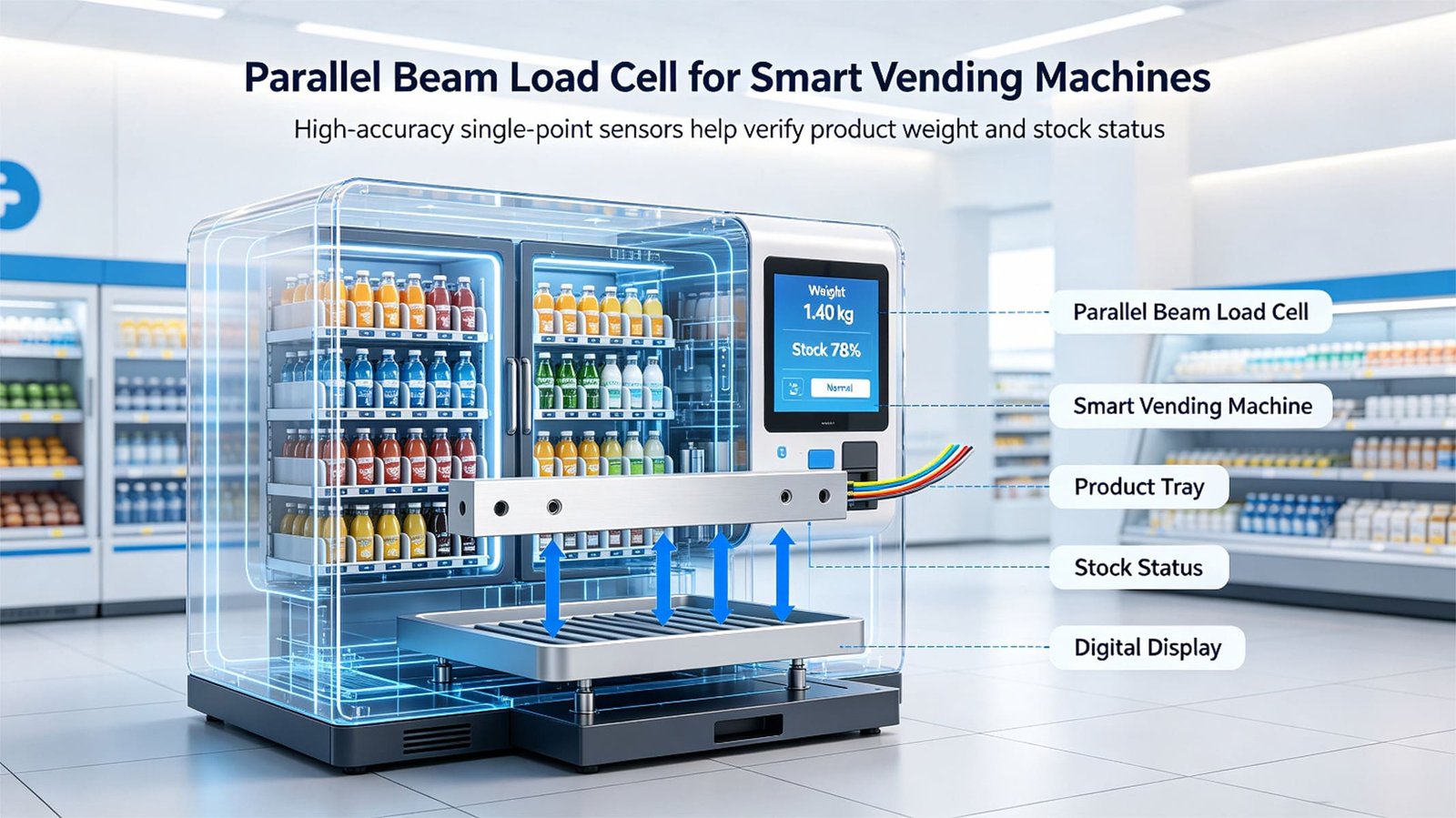
The redesign: divide each shelf into channels — one SKU per channel, one digital load cell per channel. A channel carrying 3–10 kg of a single product with a 1 g division value now sees a 330 g removal as an unmistakable step function. Attribution comes free: whatever left that channel is that SKU. The camera’s job changes from “sole witness” to “corroborating witness” — fusion instead of dependence.
Second mistake: underestimating the refrigerator itself
First pilot batch went into a test cabinet in their warehouse. Bench-top numbers looked beautiful. Then they moved the pilot into a live site — a gym lobby — and we got a support call: random 30–80 g weight “events” at 4 a.m. with nobody near the cabinet.
Diagnosis took us two days and a site visit. It wasn’t one cause, it was a stack of them:
- Compressor start/stop torque shook the cabinet frame and coupled into the shelf mounts as micro-transients;
- The defrost cycle kicked in around 4 a.m. — the temperature step moved zero points by tens of grams across 10+ channels at once (a tell-tale signature: every channel shifts together, which no human shopper can do);
- Condensation was forming on a cable entry and creeping into a connector.
The fixes were unglamorous engineering, which is to say they worked:
- Correlation-based event gating: a removal is only accepted when weight is stable before, changes, and is stable after — with a settling window. Vibration transients fail the stability test and are discarded.
- Synchronized-drift rejection: if all channels move together in one direction within a short window, it’s thermal, not a customer. Tag it, compensate zero, move on. (This single rule killed most of their false events.)
- Mounting hygiene: channels isolated from the frame with the cell as the only load path, connectors oriented downward, sealed entries.
- RS485 with a 3 ms output rate on the digital cells, so the controller could afford to oversample and filter without slowing the door-close billing decision.
The result after the firmware partner implemented the gating logic: on the 200-cabinet pilot, billing-confirmation accuracy on contested events went above 99%, and reported shrinkage fell below 0.3%. The fleet rolled out with weighing as standard. The last I heard, the same client was quoting the weighing option to franchisees as a feature, not an insurance policy — because “the machine catches what the camera misses” is a genuinely marketable sentence.
5. Three Vending Architectures, Three Weighing Jobs
“Vending” is really three different machines wearing the same word. Before any product conversation, I make clients say which one they’re building, because the weighing job differs completely.
| Machine type | What the load cell does | Typical sensing layout | Watch out for |
|---|---|---|---|
| Classic spiral machine | Vend verification — confirm the product actually dropped | One cell under the delivery tray or bucket | Impact from falling cans; small deltas vs. tray tare |
| Open-front unmanned cooler | Billing confirmation & stock counting per channel | One digital cell per SKU channel, RS485 bus | Vibration, defrost drift, condensation, door slams |
| Gravity / gravity-fed cabinet | Level detection & restock forecasting on tilted shelves | Digital planar cells, often 60–500 kg per shelf | Off-axis loads from tilt; heavier tares; shock at restock |
| Fresh / pay-by-weight kiosk | Actual trade weighing — price computed from weight | Single-point cell + trade-approved indicator | Legal metrology (OIML/NTEP) applies — see FAQ |
A note on the first row, because it’s underrated: in spiral machines the classic failure isn’t theft, it’s the failed vend — coil turns, product hangs up, customer stares at nothing. Support tickets and refunds follow. A small cell under the delivery bin turns “coil cycle completed” into “product confirmed delivered,” which is the difference between arguing with a refund claim and not having one. Cheapest goodwill a vending OEM can buy.
6. Analog or Digital? The Decision That Saves a BOM Line
Every vending client asks this, and my answer is more boring than they expect: count your weighing points first.
- One weighing point (vend-verification tray, single-shelf prototype): an analog cell plus a 24-bit ADC channel on the main board is the cheapest route. mV/V signal, short cable run, done.
- Many weighing points (the channel-weighed cooler): digital cells with RS485 output win so decisively it’s not really a contest. Each cell arrives factory-calibrated with its own address; you daisy-chain them; the controller polls weight values directly. No junction box, no corner-trimming pots, no analog runs across a cabinet full of compressor EMI.
The number that convinced client N’s hardware lead: with a 3 ms output rate on the RS485 bus, polling 40 channels still leaves you a full scan in ~120 ms plus protocol overhead — several complete snapshots per second across the whole cabinet. Your bottleneck will be your cloud dashboard, not the weighing.
One more digital-cell feature that vending people quietly love: factory eccentric-load compensation (done to OIML R60 practice) means a single cell can support a small platform without the classic four-cell corner dance. One channel, one cell, four screws. For a cabinet with 40+ channels, that’s the difference between an assembly line and an artisan workshop.
Where does that leave a 1–8 channel transmitter like our WST1511? In the middle machines: analog cells already designed in, or one weighing point per zone instead of per channel. It aggregates several analog cells into one RS485 node — useful when your mechanical design already has shelf-level cells and you don’t want to re-tool the whole cabinet.
7. Field Enemies: Vibration, Condensation, Door Slams, Tilt
A vending cabinet is a genuinely hostile sensor environment, and pretending otherwise is how projects fail after the pilot. The four enemies, ranked by how much of my support queue they cause:
| Enemy | What it does to the signal | Countermeasure |
|---|---|---|
| Compressor vibration | Micro-transients, noisy zero | Mechanical isolation; stability-window gating; digital filtering |
| Defrost / thermal steps | Synchronized zero drift across all channels | Correlated-drift rejection; temp-compensated cells (±0.02% R.O./10℃ class) |
| Condensation & washdown | Creep into connectors, corrosion, leakage paths | IP68/IP69K stainless cells in wet zones; downward connectors; sealed entries |
| Door slam & restock shock | Overload spikes; occasional zero offset after impacts | Overload headroom (see Section 9); auto-rezero when channel empty; event lockout during restock |
The door slam deserves a special mention because it’s the event your system will see a hundred times a day. A slammed glass door delivers a mechanical impulse through the whole frame. If your firmware treats any weight change as a “pick,” every slam becomes a phantom transaction. Gate picks on before-stable → change → after-stable sequences with realistic settling times (we use 1–2 s), and slam events wash out. And an installer who doesn’t level the cabinet adds a permanent off-axis load to every channel — the factory eccentric compensation of a good digital cell absorbs some of it, but the torque wrench is still cheaper than the algorithm.
8. The Single-SKU Rule and the Limits of Weight Alone
Here’s the honest limitation section, because a blog that only lists strengths reads like a brochure: weight cannot identify a brand. A 500 g cola and a 500 g lemonade are, to a load cell, the same physics. Two snack bars whose net weights overlap within a few grams will fool a delta-only algorithm.
The industry’s answer is procedural, not technical: one channel, one SKU. Attribution then comes from geography — whatever left the cola channel is a cola. Mixed channels are possible only when net weights are well separated (think 500 g bottles vs. 40 g candy), and even then I recommend the client compute the ambiguity rate from their actual product file before committing.
This is also why I push back when someone asks whether weighing can replace cameras in an open-front cooler. My honest view, having now watched this stack run at fleet scale: no — and you wouldn’t want it to. Fusion beats either sensor alone. The camera struggles with occlusion; weight is blind to brands but immune to deception. Together, each covers the other’s blind spot, and the billing confidence is higher than any single-sensor design can reach. Weight is also your independent stock-count: when camera and weight disagree at 3 a.m., you get a maintenance ticket instead of a mystery.
9. Selection Framework: What I Ask Before Quoting
After the project above (and a couple since), this is the question sheet I run with any vending or unmanned-retail OEM. It takes 20 minutes and saves weeks:
- Which architecture? Vend verification, channel billing, gravity level-sensing, or pay-by-weight kiosk (Section 5 decides the product family).
- Full load or delta load? Channel tare (empty shelf hardware) + full product weight = rated capacity. Then add restock-drop and door-slam headroom: I look for ≥50% margin over worst case, and more on gravity shelves where restocking is done by throwing crates.
- Smallest sellable unit. Lightest item’s net weight vs. the cell’s division value. A 40 g candy needs a channel whose division resolves single-digit grams at that tare — this is a division-value question, not a C-class question.
- Refrigerated? Washdown? Outdoor? Aluminum anodized housings handle dry office coolers; for wet or corrosive zones I move clients to stainless IP68/IP69K digital cells without discussion.
- How many channels per cabinet, and what update rate does billing need? This fixes RS485 vs CANbus vs transmitter aggregation, and the bus scan budget (Section 6).
- Who writes the event logic? If the client’s firmware team has never gated on weight stability before, I send them our gating notes with the first samples — half the “sensor problems” in vending are firmware problems wearing a sensor’s clothes.
- Any trade-weighing? If the machine computes price from weight (fresh-food kiosks), legal metrology applies — see the FAQ, and involve your metrology authority early.
10. Seven Mistakes I Keep Seeing
- Buying accuracy class when you need division value. A C3 badge on a 300 kg cell won’t resolve a 40 g candy; a 200 kg digital cell with 1 g division will. Match the metric to the job.
- Sizing capacity to the average shelf, not the restock event. The crate-drop at 6 a.m. is the real load case. Overload margin is cheaper than field failures.
- Mixed-SKU channels “to save sensors.” You don’t save a sensor; you lose billable events. Ambiguity is a recurring cost.
- Treating every weight change as a pick. Door slams and defrost cycles will happily eat your margin. Stability gating is not optional firmware.
- Analog runs across the cabinet to a central ADC in a compressor-rich environment. The mV signal loses that fight. Digital cells at the point of measurement, always, above a handful of channels.
- Ignoring correlated drift. All channels moving together is weather, not a customer. Build the rejection rule in from day one.
- Designing the sensor in last. By the time the cabinet structure is frozen, the clean mounting spots are gone. Weighing needs to be in the mechanical CAD review from the first draft — this is literally a message I now send with every first quotation.
11. FAQ
Q1: Can load cells completely replace cameras in an unmanned vending cabinet?
No — and you shouldn’t want them to. Weight is immune to occlusion but blind to brand; cameras are the reverse. The strongest designs run both and fuse the outputs. Weight also gives you an independent stock count the camera can’t provide.
Q2: What division value do I need for vending channels?
Rule of thumb: the lightest sellable item’s net weight should be at least 20–30× the division value at your channel tare. Typical digital single-point/planar cells offer 1 g up to ~50 kg capacity, 2 g at 60–100 kg, 5 g at 150–200 kg, 10 g at 300–500 kg.
Q3: How many channels can one RS485 bus handle?
With unique per-cell addressing, a single RS485 segment comfortably serves a full cabinet (40+ channels). At a 3 ms output rate per cell, scanning and protocol overhead still leave you several complete fleet snapshots per second. Larger sites split into segments per cabinet.
Q4: Do smart vending machines need legally certified weighing?
Only where the machine computes price from weight (pay-by-weight fresh-food kiosks) — that’s trade weighing, and OIML R76/NTEP-type approvals of the complete weighing instrument generally apply, which is the machine maker’s responsibility. Internal stock counting and billing confirmation normally don’t. Verify with your local metrology authority for the target market.
Q5: Do digital load cells need field calibration after installation?
Quality digital cells in this class ship factory-calibrated with eccentric-load compensation done to OIML R60 practice — mount, address, and read. Good ones also support g-value correction for different installation locations without recalibration. You still auto-rezero empty channels in firmware, but there’s no corner-trimming exercise.
Q6: We already have analog cells designed in — do we have to switch to digital?
No. A multi-channel weighing transmitter (e.g., 1–8 channels with RS485 output) aggregates existing analog cells into the same digital bus. It’s the pragmatic retrofit path when re-tooling the cabinet isn’t on the table.
12. Recommended Load Cells for Vending Projects
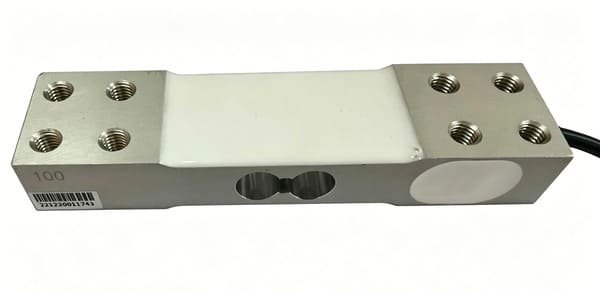
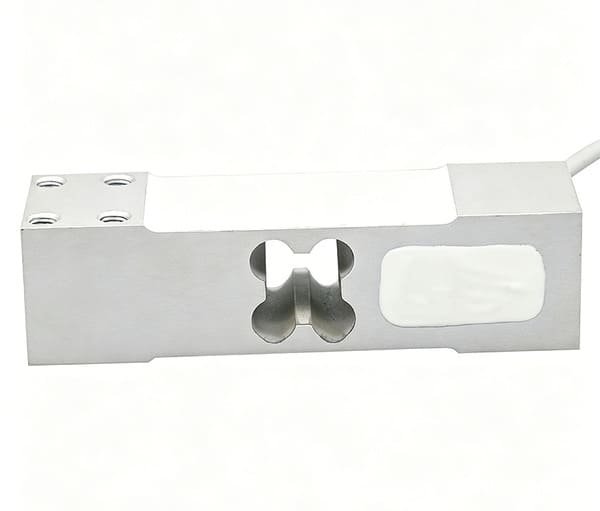
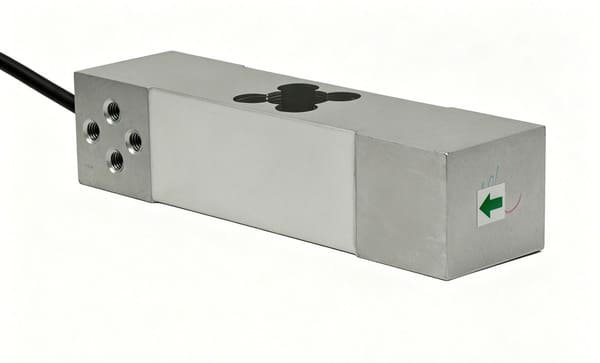
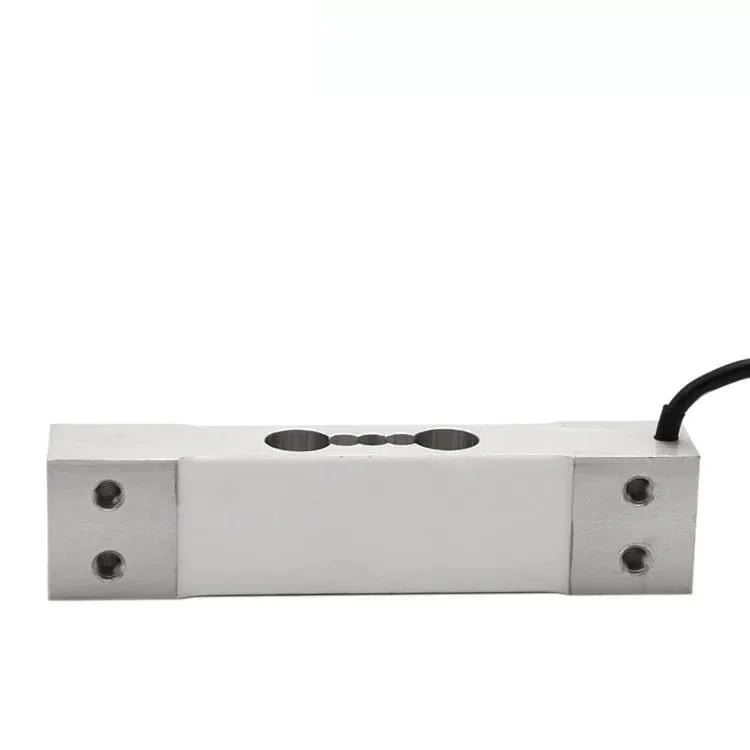
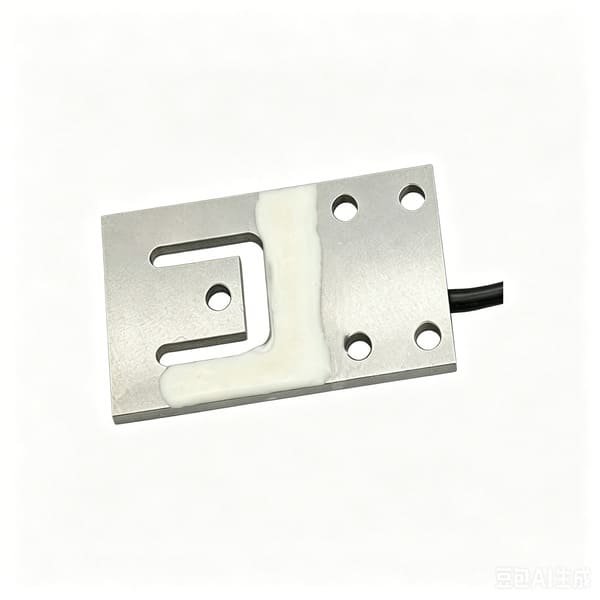
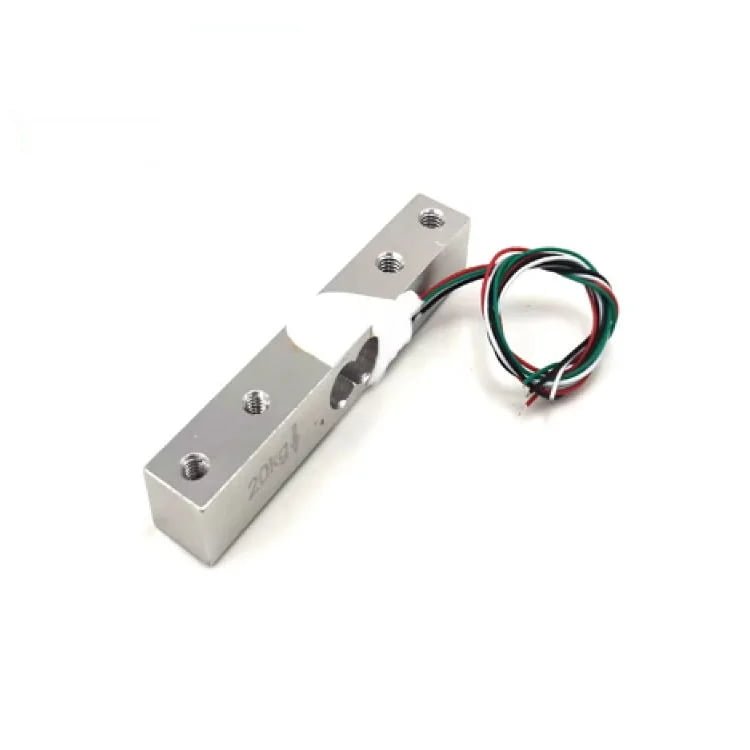
These are the five cells I most often end up quoting for vending and unmanned-retail builds — all from our digital and single-point lines, verified against the current catalog. Specs below are catalog values; confirm against the latest datasheet for your build.
Spec’ing the Weighing Core of a Vending Machine?
Send us your channel layout, product weights and cabinet environment — I’ll reply with a cell-by-cell selection, capacity margins and the bus topology that fits your controller. Cells, matched sets, junction boxes, transmitters, indicators: that’s the weighing core, from one accountable supplier.
Contact Our Engineering Team →
VektorForce · Load cells, force sensors, junction boxes & weighing indicators · OIML R60 / ISO 9001 factory