

Load Cells for Banknote Counters: What Weighing Cash Can and Cannot Do
📅 October 6, 2026
⏱️ 15 min read
💵 Cash Handling Equipment
A banknote counter is a weighing instrument that happens to have rollers on it. That sounds like a provocation, but look at what the good ones actually do: they count notes optically at over a thousand a minute, and then they put the stack on a scale and ask a completely different question — is this bundle the size the paperwork says it is? The optical head counts what passes in front of it. The load cell counts what is actually sitting on the tray. When those two numbers disagree, you have found the missing note, the folded note, the two notes stuck together, or the bundle that was never a hundred in the first place.
I’m Robin from VektorForce. We supply load cells, force sensors, junction boxes, transmitters and indicators — the weighing core. We do not build money counters, and we do not certify them. Everything below is about the weighing layer inside the machine, and about the two problems nobody warns you about: humidity, and paper dust.
1. Why a banknote counter is really a weighing instrument
Optical and magnetic counting is fast and it is good. A modern friction-fed counter runs at over 1,500 notes per minute and can tell you a note is a note, which denomination it is, and whether it is a forgery, all in the time it takes to pass a contact image sensor. What it cannot tell you is whether the pile it just processed is the pile it started with. Notes stick. Notes fold. Notes tear. A note that passes the head twice is counted twice, and a note that never leaves the hopper is never counted at all. Every operator in every cash room has a story about the strap that was one short.
Weight is the only second opinion that is completely independent of the transport. It does not care whether the note passed the sensor, whether two notes moved together, or whether the stack was fanned. It cares about total mass on the tray — and that makes it the natural cross-check for the optical count in exactly the situations where the optical count is fragile.
The category is not small, and it is not shrinking. One market study sizes the global banknote counter market at USD 2.64 billion in 2025, rising to USD 2.78 billion in 2026 and USD 4.16 billion by 2034, a 5.17% CAGR, with Asia-Pacific holding the largest regional share at roughly 41.5% and the fastest growth rate at 8.83%. A second study, looking specifically at currency counting machines, puts growth at 8.7% in 2026, driven by central bank fitness-sorting mandates that force banks to replace mechanical counters with electronic ones on a four-year rather than seven-year cycle. The reasons are mundane and durable: cash usage in the UK actually rose for a second consecutive year to 19.9% of transactions, and in many emerging markets it exceeds half of all retail payments.
The short version, if you only read one paragraph:
- Coins can be counted by weight. Notes mostly cannot. Coin masses are legal specifications controlled at the mint to about ±1–2%. Banknote mass is not a legal tolerance at all — it is an average that moves with humidity.
- So the load cell in a money counter is a verification layer, not a primary counter. It confirms the optical count; it does not replace it.
- The two things that actually destroy accuracy in this machine are paper dust drifting the zero and motor noise coupling into a millivolt cable. Neither is a sensor fault, and both are fixable at the design stage.
- We supply the weighing core — cells, ADC front end, junction boxes, indicators. The transport, the authentication sensors, the arbitration firmware and the machine’s approval belong to the OEM.
Everything below is written from the supply side of the table. When I say “we” I mean load cells, force sensors, junction boxes, transmitters and indicators — nothing with a roller in it.
2. Where weight enters a cash-handling machine
I quote weighing into cash equipment at four different stations, and they have almost nothing in common technically. Getting a customer to name the station before naming the capacity is the single most useful thing I do on these projects, because the error budget is completely different at each one.
| Station | What it measures | Working span | Useful resolution | Why it earns its place |
|---|---|---|---|---|
| Loose-note tray | Total mass of notes presented in one pass | 0.1–2 kg | 0.1–0.2 g | Catches double-feeds and hopper retention the optical head cannot see |
| Strapped / banded bundle | Is this really a 100-note strap? | 50–150 g | 0.1 g | The highest-value check in the whole machine — it validates the strap without unwrapping it |
| Coin cup | Loose coin count and denomination mix | 0.5–10 kg | 1–2 g | Coins have a legal mass spec, so weight genuinely counts them |
| Bulk reconciliation bench | Till contents, bagged coin, mixed cash by weight | 5–100 kg | 5–10 g | End-of-day reconciliation where the number only has to be right to the nearest coin |
Notice the shape of that table: the resolution you need is roughly one part in ten thousand of the working span at every station. That is not a coincidence — it is the threshold at which a single note, or a single coin, becomes visible in the reading. We will come back to that number, because it is what decides which load cell and which A/D you can get away with.
3. The uncomfortable truth about note weights
Here is where most “count your cash by weight” marketing quietly falls apart. Two different things are going on with cash mass, and only one of them is trustworthy.
Coins are controlled by law. A mint strikes to a statutory mass and the tolerance is tight, so a circulated coin is reliable to roughly ±1–2% — wear removes a little metal, which is the only drift that matters. That is why coin counting by weight works so well, and why bagged-coin recognition (weigh the bag, divide by the unit mass) is a legitimate technique rather than a gimmick.
Banknotes are not. There is no statutory mass tolerance for a note. The published figures are nominal averages derived from substrate grammage and sheet area, and the substrate is a cotton-linen blend that absorbs and releases moisture with the room. One hundred United States notes weigh about 100 g not because a rule says so, but because they are all printed on the same size sheet of the same stock at about 1.0 g each.
| Currency | Unit mass | Size graded? | Can weight identify the denomination? |
|---|---|---|---|
| US dollar notes | 1.0 g (all denominations) | No — identical size | No. Count only. A $1 and a $100 weigh the same. |
| Euro banknotes | 0.63 g (€5) → 1.12 g (€500) | Yes — larger value, larger note | Partly. Enough spread to assist, not to certify. |
| Sterling polymer notes | 0.70 g (£5) → 1.00 g (£50) | Yes | Partly. Polymer is less hygroscopic than paper — a real advantage. |
| Coins (US, EUR, GBP, AUD) | 2.27 g (dime) → 12.00 g (£2) | Yes — each denomination unique | Yes. Statutory mass, tightly controlled. |
⚠️ The humidity trap that catches almost every first prototype
Cotton-linen banknote paper is hygroscopic. A 100-note strap calibrated at 45% RH in a dry office and then placed in a coastal branch at 75% RH will read 2–3 g heavy — and the machine, comparing against a 100.0 g expectation, will confidently announce a surplus note. Nothing is broken. The notes simply weigh more than they did last week. Design as if note mass is a range, not a value, and the phantom discrepancies disappear.
There is one more signal hiding in the mass, and it is worth knowing about. Banknote substrate sits around 85–90 g/m². Ordinary copier paper sits around 80 g/m². A stack of notes printed on office stock is therefore measurably lighter than a stack of the real thing — a few percent, well outside the noise floor of a decent tray cell. I would never let a customer sell that as counterfeit detection, because it is not; a photocopy is not a forgery and a forgery will not necessarily be printed on 80 g/m² stock. But as an independent second signal that the optical head knows nothing about, it is genuinely useful, and cheap, and it costs you nothing to log it.
4. The project: a six-currency bench counter
The enquiry came in as a weighing question, which is unusual. An OEM building a portable bench-top counter for retail and banking had already specified the optical path — contact image sensor, magnetic head, UV lamp — and had run into a wall on the commercial side. Their target buyers were small retailers, hotel front desks, and bank branches that handle more than one currency. Those customers did not want a counterfeit detector. They wanted something that would settle a till dispute: count the drawer, count the strap, count the coin bag, print the result, and be fast enough that nobody avoided using it.
That brief turned it into a weighing problem in three places at once: a note tray for loose and strapped notes, a coin cup that had to recognise bagged and rolled coin, and a reconciliation platform. The requirements I worked from, in the customer’s own terms:
| Requirement | Target | Why it mattered |
|---|---|---|
| Currencies | Six simultaneously (AUD, NZD, USD, CAD, EUR, GBP) | One machine, six markets — no preset switching for the operator |
| Note forms | Loose, sleeved, and strapped in four banding styles | Banking customers weigh strap-on, not loose |
| Coin forms | Loose, bagged and rolled, with denomination recognition | Rolled coin is the highest-friction job in a small branch |
| Resolution | 0.1 g on the tray, 2 g on the coin cup | One note, or one coin, must be visible in the reading |
| Tolerance handling | Adjustable per-note tolerance band, per currency | Worn notes and humidity both push mass off nominal |
| Calibration | Field-calibratable with an external calibration weight | Never calibrate against notes — notes drift, weights do not |
| Power | USB 5 V, lithium cell, foldable for portable use | Bridge current is a real line item in the battery budget |
| Output | Timestamped count record, printable | The printed slip is the product, not the count |
We quoted a precision single-point cell for the note tray, a larger single-point cell for the coin cup, a heavy single-point cell for the reconciliation platform, and a high-resolution ADC front end with an RS-485 link so the machine’s own controller could poll the weight whenever it wanted. Straightforward on paper. Three things then went wrong, and none of them was the load cell.
5. Three problems that were not the load cell’s fault
5.1 The hundred-gram strap that weighed 103 grams
The first field trial went badly and produced the best lesson of the project. The tray had been calibrated in the customer’s engineering office with a nominal 100-note strap — 100.0 g, dead on. Three weeks later, a trial unit in a humid coastal branch reported the same strap at 102.6 g and flagged a surplus note on every single bundle. The plant manager was ready to ship the units back.
Two things were wrong, and only one of them was in our scope. First, the tray had been calibrated against notes. That is always a mistake: you have calibrated a scale using a transfer standard whose mass is a function of the weather. Second, the firmware compared total mass against a hard nominal — 100 notes × 1.0 g — with a window so narrow that ordinary moisture variation in cotton-linen paper fell outside it. At 75% relative humidity that variance is real, repeatable, and nobody’s fault.
The fix was procedural plus one firmware change. Calibration now uses an external certified calibration weight — a real mass standard, which is also why a $6 calibration weight is a line item on the accessory list of every machine in this class. And the note check became a tolerance band, not a value: for US notes we shipped a default of ±1.5% per bundle with a three-consecutive-stable-readings requirement before the result is announced, and the band is operator-adjustable per currency. A 100-note strap is now checked against a window, not a number, and the phantom surplus disappeared.
If you take one design rule from this article, take this one: when the artefact you are weighing is hygroscopic, calibrate with an inert mass and judge with a window. Both halves matter, and the second half is the one that gets forgotten.
5.2 Paper dust, and the zero that drifted while the tray was loaded
Second problem: by the end of a long shift in a busy branch, the tray read 0.6 g high with nothing on it. Over eight hours of counting, that is enough to manufacture a partition error out of thin air. The customer suspected the cell. The cell was fine.
The cause was mechanical. Every note that passes through a friction counter sheds a little fibre and a little surface coating, and over a few thousand notes that becomes a fine grey dust layer. Some of it lands on the pivots and the mounting bosses. A load cell measures strain in its own body; if the load path picks up a compliant film of paper dust at the pivot, the zero shifts. Add thermal expansion of an aluminium bracket warming up next to a solenoid and you get the slow creep the customer was seeing.
Three fixes, in increasing order of how much I like them:
- Seal the cell properly. We specified an IP65 cell with the strain-gauge cavity potted rather than merely covered, which matters in a dust environment — the potting is what stops the debris reaching the gauge, not the housing.
- Shield the pivot. A simple lip above the load pivot, added by the OEM in their tooling, keeps the dust film off the working surface at zero cost.
- Bound the zero tracking. This is the one that turns a mechanical problem into a software one and mostly makes it go away. Automatic zero tracking is essential in a machine that runs for eight hours, but an unbounded zero tracker is dangerous: if it runs while the tray holds a load, it will quietly eat part of the load. We set it to operate only below 5 g and only when no counting cycle is in progress, with a maximum correction rate of 0.05 g per second. That is fast enough to follow dust, slow enough that it cannot absorb a note.
🔴 The creep spec is not a formality
On a machine that runs a full shift, creep is a first-order specification, not a footnote. Look at the number in the percentage of full scale per 30 minutes form and do the arithmetic for your own shift length. A cell quoted at 0.03% FS/30 min on a 3 kg tray has surrendered 0.9 g in half an hour if the creep is unidirectional and uncompensated — which is more than a coin. Choose ≤0.03% FS/30 min for the tray and ≤0.02% FS/30 min where you can get it, and give the firmware a bounded zero tracker as a second line of defence.
5.3 The transport motor that sang into a millivolt cable
Third problem, and the most instructive: with the transport idle, the tray read a beautiful stable number. The moment the feed motor started, the reading jumped ±4 g. The customer’s first instinct — and mine, briefly — was a faulty cell. It was not. It was a 1 mV/V signal running down an unshielded cable in the same loom as a PWM-driven motor and standing next to a high-voltage static eliminator bar. The cell was faithfully reporting the electromagnetic environment it had been installed in.
What we changed, in the order that mattered:
- Shielded four-wire cable, and the shield earthed at the indicator end only. Earthing a shield at both ends creates a ground loop and makes the noise worse, not better. This is the single most common wiring error I see in customer prototypes.
- Physical separation. The cell cable was routed down the opposite side of the chassis from the motor harness and the ioniser lead, with a minimum 30 mm gap and no parallel runs longer than 50 mm. Free, and worth more than any filter.
- Ferrite sleeves on the motor leads, at the motor end, which suppressed the commutator brush noise that was the dominant term.
- Measure in the settle window. The most effective fix was also the cheapest: the firmware now takes the weight only during a 250 ms pause between feed cycles, when the motor is off and the tray is mechanically quiet, and requires the reading to be stable within ±0.1 g across that window before accepting it. Weight verification and high-speed counting do not have to happen at the same instant.
Resolution, incidentally, was never the problem, and this is worth stating plainly because it is where most spec sheets mislead. The tray cell we used runs at 1.0 mV/V, not the 2.0 mV/V that dominates commercial weighing. It did not need more signal, because the front end resolves 5,000,000 internal counts across a ±10 mV input — roughly 2 nanovolts per count. More output from the cell would not have bought us anything; better shielding and a quieter measurement instant bought us everything.
6. What weight can and cannot do
I would rather lose a sale than have a customer design a feature that cannot work. So here is the honest capability map for the weighing layer in a cash machine.
| Task | Can weight do it? | Notes |
|---|---|---|
| Verify a 100-note strap of one denomination | Yes, with a ±1.5% window | The highest-value, most reliable application in the machine |
| Count a loose pile of one denomination | Yes, ±1–2 notes on 100 | Good enough to arbitrate against the optical count, not to be the count |
| Identify a US denomination by mass | No | Every US note is 1.0 g. Optical is the only answer here. |
| Assist euro or sterling denomination sorting | Partly | Size-graded series give real mass separation; use as a corroborating signal |
| Count loose coins and recognise denomination | Yes — this is the strongest case | Statutory mass spec, ±1–2% on circulated coin |
| Detect a forged note on wrong substrate | As a weak hint only | 80 g/m² copier stock vs 85–90 g/m² banknote substrate — never sell it as authentication |
| Handle wet, taped, folded or heavily soiled notes | Unreliably | Flag them for a manual pass rather than pretending to a number |
The architecture that falls out of this table is a two-out-of-three arbitration, and it is what I now recommend by default. The optical head produces a count. The weighing layer produces a mass-derived count. The operator, or the strap label, produces an expected count. If the mass-derived count agrees with the optical count, the machine reports and prints with confidence. If they disagree beyond the tolerance band, the machine does not guess — it re-passes the bundle and, if the disagreement survives the second pass, prompts for a manual check. That is a much better product than one that claims to count cash by weight, because a machine that says “I am not sure” is worth more in a cash room than a machine that says “one hundred” and is occasionally wrong.
7. The arithmetic that actually picks your load cell
Before you argue about sensitivity class, accuracy class or which A/D to buy, do the matching arithmetic. It is one line, and it settles the argument in about two minutes. The standard matching relationship between a load cell and an indicator is:
Signal per scale division (μV/d)
μV/d = ( S × Uexc × Max × 1000 ) ÷ ( nd × N × C )
S = cell sensitivity (mV/V) · Uexc = excitation voltage (V) · Max = maximum capacity of the scale · nd = number of scale divisions · N = number of cells · C = rated capacity of one cell. Max and C in the same unit.
Worked through the coin cup on that six-currency machine — a 30 kg single-point cell at 2.0 mV/V, 5 V excitation, one cell, 2 g divisions (15,000 divisions across the span):
(2.0 × 5 × 30,000 × 1000) ÷ (15,000 × 1 × 30,000) = 0.67 μV per division
Now compare that with the converter. Our RS-485 front end accepts ±10 mV and resolves 5,000,000 internal counts across that range — about 2 nV per internal count. One 2 g division therefore carries roughly 335 internal counts. That is the margin that decides whether your coin cup is usable: not the headline accuracy class of the cell, but how much of the A/D’s resolution each division occupies. Fewer than about ten counts per division and you are gambling with noise; a few hundred and the job is comfortable.
Run the same arithmetic on the note tray and the picture changes, which is the interesting part. A 3 kg cell at 1.0 mV/V, 5 V, one cell, 0.2 g divisions (15,000 divisions) gives you 0.33 μV per division — half the coin cup’s signal, because the sensitivity is half. Against a 2 nV converter that is still about 167 counts per division, which is comfortable, and it is exactly why we accepted a 1.0 mV/V cell on the tray and did not chase a higher-output cell. The resolution comes from the converter, not from the cell — and the cell you can actually buy in the right physical size matters more than the one with the prettiest number on the datasheet.
The class question, answered honestly
A 0.1 g division on a 3 kg tray is 30,000 divisions. That is more than the 10,000-interval ceiling of OIML R76 Class III — the class a retail bench scale lives in — and inside Class II territory. That sounds impressive and it means nothing legally, because a counting aid is not a trade instrument. The machine’s legal output is the note count, and the weight is the corroboration behind it. You can build and ship that machine with a 30,000-division weighing layer and no metrological approval at all. The moment a customer wants the weight itself to be trade-relevant — a certified coin bag, a legally traceable deposit — you have moved into an entirely different approval path, and the load cell is the cheap part of that journey. Tell us early if that is the plan.
8. Where the weighing core ends
I am a weighing-component exporter, and pointing at the boundary is a service rather than a limitation. Here is where the line falls on a banknote counter, so that nobody builds a schedule around a supplier who was never going to deliver half of it.
| What we supply | What the OEM owns |
|---|---|
| Load cells for the tray, coin cup and reconciliation platform | Note transport, rollers, separation and double-feed mechanics |
| High-resolution ADC front end and indicators with RS-232 / RS-485 outputs | Contact image, magnetic and UV authentication sensors and their algorithms |
| Junction boxes where multiple cells must be summed | Count arbitration firmware — the two-of-three logic in §6 |
| Per-unit calibration certificate and a calibration protocol you can repeat in the field | Tolerance bands per currency, operator interface and printed reporting |
| Guidance on mechanical mounting, dust shielding and cable routing | Enclosure, safety, EMC testing and machine-level market approval |
| Cells and electronics built to your dimensions where the standard size does not fit | Listing on central-bank tested-machine registers and national certifications |
In Europe, for example, the ECB publishes a database of successfully tested banknote handling machines by manufacturer and country. In India, BIS certification reshapes procurement specifications for cash-handling equipment. Both of those attach to the machine, tested as a whole, by the party who builds and sells it. Our job is to make sure the weighing channel inside that machine is the part that never causes a test failure — which means a cell whose calibration is traceable, a mounting scheme that does not load the cell sideways, and a wiring layout that does not put millivolts in the same loom as a motor.
9. Recommended load cells and weighing electronics
Four components cover essentially every cash-handling machine I quote: a precision tray cell, a mid-capacity cell for the coin station, a heavy single-point cell for reconciliation, and a high-resolution control front end. Where the machine is slim or battery-powered we additionally use the WST112 flat mini cell — its 1,000 Ω bridge draws far less excitation current than a 350 Ω cell, which matters when the whole machine runs from a USB charger — and where the customer wants a printed slip straight from the instrument rather than from their own controller, the WST1503 indicator with built-in thermal printer removes a PCB from the design.
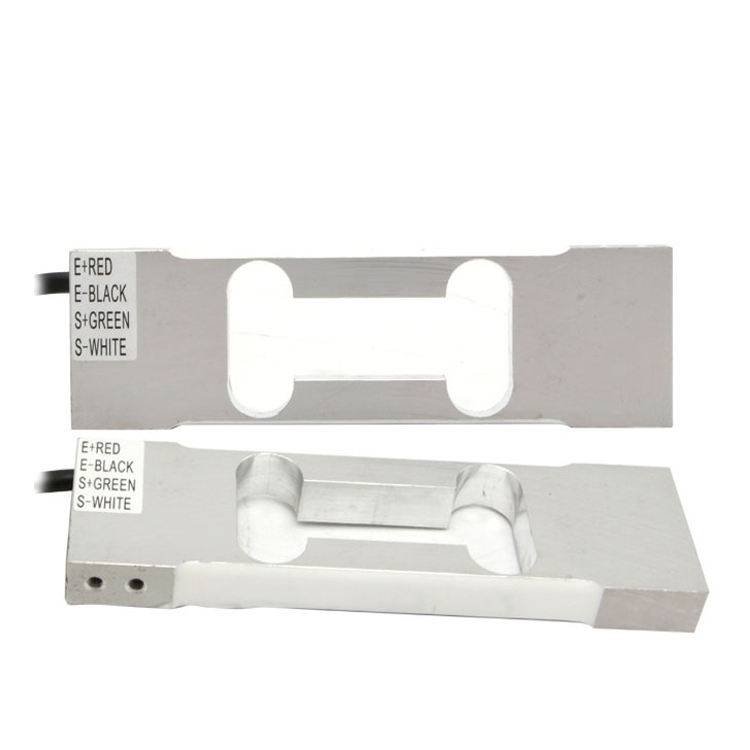
WST209 — Precision Note-Tray Cell
A laboratory-balance-grade single-point cell in a 110 × 33 × 10 mm aluminium body. This is the cell for the note tray and the strap check, where one note has to be visible in the reading.
- Capacity: 0.3, 0.6, 1, 1.5, 3 kg
- Class: C3 · comprehensive error ±0.02% FS
- Repeatability: ±0.015% FS · hysteresis ±0.015% FS
- Creep: 0.03% FS / 30 min
- Output: 1.0 ± 0.1 mV/V · 405 Ω in / 350 Ω out
- Temperature: compensated -10 to +40 °C, operating -20 to +60 °C
- Sealing: IP65, potted gauge cavity · 4-wire shielded, φ4 × 250 mm
Best for: the note tray, the 100-note strap check, and any station where 0.1 g resolution on a 1–2 kg span is the requirement.
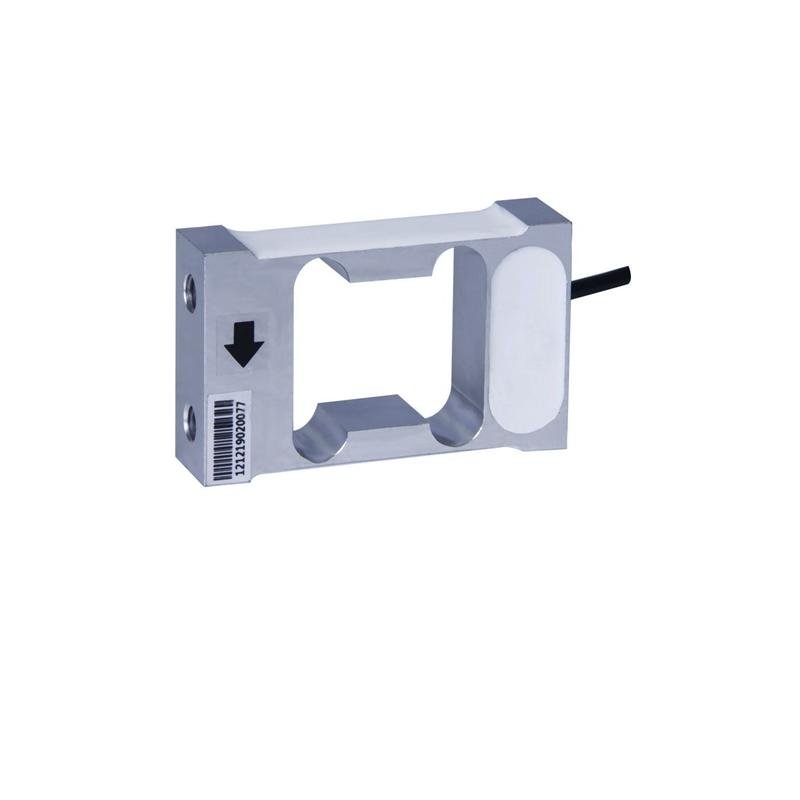
WST216 — Coin Cup / Bulk Tray Cell
A 200 × 200 mm platform cell that suits a coin cup, a rolled-coin tray or a bagged-coin station. Its 2.0 mV/V output gives the front end twice the signal of the tray cell, which is what you want on a heavier span.
- Capacity: 4, 8, 10, 15, 20, 30 kg
- Class: C3 · comprehensive error ±0.02% FS
- Repeatability: ±0.02% FS · hysteresis ±0.02% FS
- Creep: 0.02% FS / 30 min
- Output: 2.0 ± 0.2 mV/V · 406 Ω in / 350 Ω out
- Temperature: compensated -10 to +40 °C, operating -35 to +70 °C
- Material: anodised aluminium · IP65 · 4-wire shielded, φ3.8 × 150 mm
Best for: loose and bagged coin counting, where the statutory coin mass spec makes weight a genuinely primary measurement.
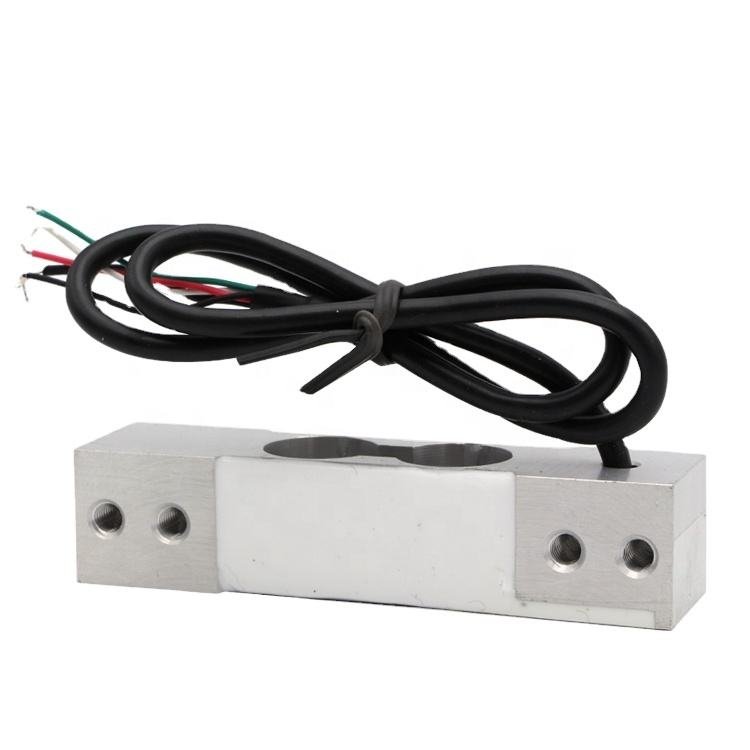
WST207 — Reconciliation Platform Cell
Designed for counting scales and 250 × 350 mm platforms, which is exactly the size of a till drawer or a coin bin. Use it where the number only has to be right to the nearest coin.
- Capacity: 3, 5, 6, 10, 15, 20, 30, 40, 50, 60, 100 kg
- Class: C2 · comprehensive error ±0.03% FS
- Repeatability: ±0.03% FS · hysteresis ±0.03% FS
- Creep: 0.03% FS / 30 min
- Output: 2.0 ± 0.2 mV/V · 405 Ω in / 350 Ω out
- Temperature: -10 to +40 °C operating range
- Platform: 250 × 350 mm · IP65 · 4-wire shielded, φ4 × 400 mm
Best for: end-of-day till reconciliation, bagged coin and mixed cash by weight, on a bench-top machine.
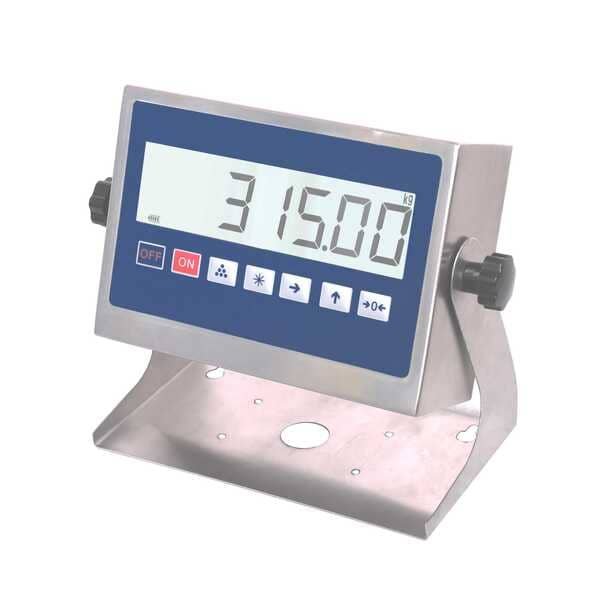
WST1502 — High-Resolution Weighing Controller
The front end that makes 0.1 g resolution on a kilogram tray practical. Isolated RS-485 Modbus RTU means the machine’s own controller polls the weight instead of the operator reading a display.
- Conversion: Σ-Δ A/D · input range ±10 mV
- Resolution: 5,000,000 internal counts
- Speed: 10 / 20 / 80 conversions per second, selectable
- Excitation: 5 V DC, drives up to 4 × 350 Ω or 8 × 700 Ω cells
- Interface: isolated RS-485 Modbus RTU · optional Modbus TCP, 4–20 mA, set-points
- Functions: counting function, programmable digital filter, programmable zero tracking, accumulation
- Power: battery operation up to 30 hours · stainless steel housing
Best for: embedded weighing inside the machine — the programmable filter and bounded zero tracking are what let you run an eight-hour shift without drift.
10. FAQ
Do banknote counters actually use load cells?
Yes, but not in the way most people assume. The load cell is not the counter. It is the verification layer sitting behind the optical count, plus the primary counter for coins. Machines in this class typically carry a precision platform cell for the note tray and bundled notes, a mid-capacity cell for the coin cup, and sometimes a larger platform cell for bulk reconciliation. The optical head counts notes as they pass; the weighing channel asks whether the pile weighs what that count implies.
Can you count banknotes by weight alone?
On a single known denomination, approximately — a 100-note strap of one denomination is a legitimate and very useful weight check, and the useful window is around ±1.5%. Across mixed denominations, generally no. Every United States note weighs about 1.0 g regardless of value, so weight cannot distinguish a dollar from a hundred. Euro and sterling series are size-graded and therefore give a usable mass separation between denominations, but it is a corroborating signal rather than a certified answer. Treat weight as the second opinion, never the sole count.
Why does a stack of 100 notes not weigh exactly 100 grams?
Because banknote substrate is a cotton-linen blend and it is hygroscopic. The nominal 1.0 g per note for US currency is an average of a paper that absorbs and releases moisture with the room; the same strap can differ by 2–3% between a dry office and a humid branch. Coins do not have this problem — their mass is a statutory specification controlled at the mint — which is precisely why coins count well by weight and notes need a tolerance window.
What resolution does the weighing tray actually need?
As a rule of thumb, about one part in ten thousand of the working span — the point at which a single note or coin becomes visible in the reading. On a 1–2 kg note span that is 0.1 g; on a 30 kg coin span, 2 g. Then check that your A/D can carry it: divide the signal per division by the converter’s resolution per count and make sure you have a comfortable margin, not just a passing one. Our own working figure runs to a few hundred A/D counts per division.
How do you stop paper dust from drifting the zero?
Three layers. Seal the cell properly, with a potted strain-gauge cavity rather than a housing that only covers it. Shield the load pivot with a lip in the tooling so the dust film never reaches the working surface. And give the firmware a bounded automatic zero tracker — active only below a small threshold and only outside a counting cycle, with a capped correction rate. An unbounded zero tracker on a loaded tray will quietly eat part of the load, which is a worse failure than the drift you were trying to fix.
The reading jumps when the transport motor runs. Is the cell faulty?
Almost never. A millivolt signal sharing a cable loom with a PWM motor and a high-voltage static eliminator will report exactly that noise, faithfully. Fix the path before you replace the transducer: shielded four-wire cable with the shield earthed at the indicator end only, physical separation from the motor harness, ferrite sleeves at the motor, and — usually the most effective change — take the weight only in the settle window between feed cycles, requiring three consecutive stable readings before accepting the result.
Which load cell class do I need for a counting machine?
For the tray, C3 with repeatability around ±0.015% FS and creep no worse than 0.03% FS per 30 minutes. For the coin station, C3 with creep of 0.02% FS per 30 minutes where available. For a reconciliation platform, C2 is usually adequate because the requirement is only to the nearest coin. Note that creep is specified as a percentage of full scale per half hour — multiply it out across an eight-hour shift before you decide it does not matter, because on a light span it very much does.
Does VektorForce supply the complete money counting machine?
No, and we are deliberate about it. We supply the weighing core — load cells, single-point cells, high-resolution controllers and indicators with RS-232 / RS-485 outputs, junction boxes, and a calibration protocol with a traceable record per unit. The note transport, the authentication sensors, the count-arbitration firmware, the enclosure, the EMC testing and any machine-level approval or central-bank machine listing belong to the OEM who builds and sells the machine. We would rather be excellent at the measurement layer than mediocre across the whole chain.
Send me the machine — I’ll size the weighing layer
Tell me the stations you need (note tray, strap check, coin cup, reconciliation platform), the currencies, the working span at each station, the resolution you want and how the machine is powered. That is enough for a cell selection, a mounting sketch and a signal-per-division calculation against your converter.
We supply the weighing core: load cells, force sensors, junction boxes, transmitters and indicators — with a traceable calibration record. Custom dimensions and capacities on request. Trial orders welcome.
Get a weighing layer sized for your machine →
Email Robin directly
VektorForce · Load cells, force sensors, junction boxes, transmitters & indicators · www.vektorforce.com