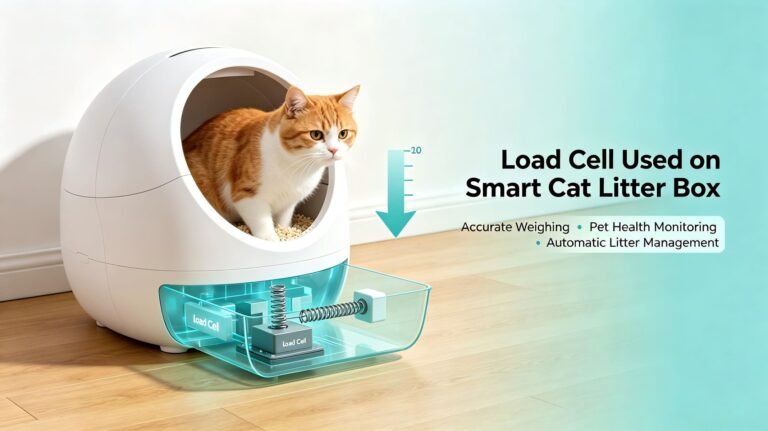


Load Cells for Smart Water Bottles: You Are Weighing a Difference, Not a Bottle
A 21 oz insulated bottle weighs 454 g empty and 1,073 g full, and the thing your product actually sells — one sip — is about 20 g. But the app never uses the weight: it uses one weight minus another. That single fact cancels most of the datasheet you were about to buy, and it promotes two numbers nobody puts in a headline. Almost every smart bottle I have been asked to quote went wrong somewhere other than the load cell.
A 20 g sip on a 1,073 g bottle
Event detection, not legal metrology
1,000 Ω micro cells
IEC 60529 · IEC 62133-2 · RED 2014/53/EU
1. “Smart Bottle” Is Four Different Weighing Jobs
The enquiry arrives as one sentence — “we need load cells for our smart water bottle” — and it can mean four quite different pieces of hardware. They share a word and almost nothing else.
A. The bottle’s own base — the cell is inside the product, under a sealed floor, and the user never sees it. B. A tray, coaster or dock — the bottle is not modified and the surface decides the accuracy. C. A dispenser or fountain base — a large reservoir where the question is “how much is left”, not “how much did you drink”. D. An accessory platform — a filling station counter, a gym rack, a fridge shelf — where the question is whether a bottle is there at all.
Before any of that, there is a fork in the road that decides whether the rest of this article applies to you. The industry builds two families of smart bottle sensors, and only one of them is a weighing problem:
| Sensing family | What it actually measures | Is it mine? |
|---|---|---|
| Level / charge sensing — a rod or strip inside the bottle | Water level, by capacitance change as liquid rises past the sensor | No. This is a legitimate competing architecture and I do not build it. |
| Weight sensing — a cell in the base or the dock | The mass of bottle plus contents, sampled when the bottle is set down | Yes — this is the whole subject of this page. |
| Motion / tilt counting — an accelerometer | That the bottle was tilted, and how many times | No. Nothing is measured and nothing is weighed; it is cheap and it is sometimes enough. |
Family one deserves an honest sentence rather than a dismissal. A capacitive rod reads the level from the inside, so it does not care what the bottle is standing on, it does not care who is holding it, and it will give you a number while the bottle is still in someone’s hand. The weight-based family has one advantage that the level family cannot match — mass is mass regardless of geometry, foam, ice or a bottle that is not a cylinder — and one weakness that no sensor choice can repair: it only knows what happens while the bottle is resting on it. Everything the user does between put-downs is invisible.
The public description of how the best-known product in this category works is a fair summary of the whole family: the sensor puck “weighs the bottle each time it is set down on a flat surface”, and the app works from the difference. Holding the bottle is not measured. Pouring water out of it is not measured as pouring. Sharing it with a colleague is not measured at all. That is not a limitation of a particular brand; it is what a scale under a bottle can know.
Does this number ever determine a price, a dose or a clinical decision? If the answer is no — and for a hydration bottle it is no — then you need no instrument approval, no accuracy class and no certificate, and the entire specification collapses onto two numbers I will get to in section 3. If the answer is yes, stop reading this as a bottle article: you have a medical or a trade-measurement device and the architecture has to change before the sensor does.
I should state my own boundary here, because it is the most useful thing I can say to an OEM. I make the sensing element and the parts that go around it — load cells, weighing modules, junction boxes, indicators. I do not make bottles, I do not write Bluetooth firmware, I do not write the app, and I do not certify the appliance. When a project goes wrong it is usually in one of those, not in the cell. If you want the general selection logic before the bottle-specific parts, the project selection guide covers it without the bottle context.
2. A 20 g Sip on a 1,073 g Bottle
Here is the whole product in one table. Every row is a real container size, and the last two columns are the numbers that decide whether your idea is buildable.
| Container | Empty | Full (gross) | Tare as % of gross | A 20 g sip as % of gross |
|---|---|---|---|---|
| 500 mL single-wall Tritan | 120 g | 618.5 g | 19.4 % | 3.23 % |
| 21 oz (621 mL) insulated steel | 454 g | 1,073.2 g | 42.3 % | 1.86 % |
| 750 mL insulated steel | 530 g | 1,277.8 g | 41.5 % | 1.57 % |
| 32 oz (946 mL) insulated steel | 703 g | 1,646.2 g | 42.7 % | 1.22 % |
| 1.5 L insulated | 1,100 g | 2,595.6 g | 42.4 % | 0.77 % |
| 1 US gal (3,785 mL) insulated dispenser | 2,270 g | 6,043.8 g | 37.6 % | 0.33 % |
Two things stand out, and they pull in opposite directions from the way most weighing projects behave.
The tare is 42 %, and it is the part you already know. In a silo or a hopper the tare is the enemy because it drifts and you cannot see it. Here the bottle is a moulding with a mass your supplier controls to a gram or two, and it is the same bottle every time. What you do not know is how much water is in it — which ranges from nothing to everything. So the instrument has to be honest across the entire 454–1,073 g band, and it visits both ends every day. In fact it spends far more minutes at the low end than at the high end, because a bottle is usually part-full or empty and only briefly full. Remember that in section 9, because it turns a small drift into a visible one.
The sip is 1.9 % of the bottle — and “a sip” is not one number. The clinical literature on swallowing measured one mouthful of water at about 21 mL in men and 14 mL in women, while the average volume per swallow during continuous drinking comes out lower still, around 12 mL and 8 mL. Natural sip volumes are reported across a 6–34 mL range depending on age and instruction. So if you design your event detector around a 20 g sip, you have designed for the average and you will lose the small ones: the case you actually have to survive is closer to 8 g, which is 0.75 % of a full 21 oz bottle. Section 6 turns that into a hard ceiling on container size.
People are not good at estimating what they have drunk. In a controlled study, participants asked to estimate how much water they had just swallowed underestimated by an average of 52 %, with agreement limits running from −90 % to +124 %. That is the honest commercial case for a weighing bottle — not that it is accurate to a millilitre, but that a log with a known error beats a memory with an unknown one. It is also why “within 5 %” is a perfectly good spec for a hydration bottle and a hopeless one for a beverage dispenser that charges money.
3. You Are Weighing a Difference, Not a Bottle
This is the part I wish every smart-bottle spec sheet started with. Your app never uses the weight of the bottle. It uses one weight minus another weight. The quantity your product sells is Δm = mafter − mbefore, and it is on the order of 20 grams.
That single observation redistributes the entire datasheet. Most of what a load cell manufacturer puts in a table — the accuracy class, the comprehensive error, the linearity, the hysteresis, the rated-output tolerance — describes how far the absolute reading can be from the truth. When you subtract two readings taken moments apart on the same cell at almost the same load, those terms either cancel outright or move so little across a 20 g interval that they disappear into the rounding.
Let me do that arithmetic on a real cell rather than assert it. Take a micro cell in the 2 kg range — the WST109 class, 1.0 mV/V, recommended 5 V excitation, so a 5 mV full-scale output. Every term below is converted into grams, because %FS is not comparable between ranges and grams are.
| Term on the datasheet | On a 2,000 g range | What it does to a 20 g difference |
|---|---|---|
| Comprehensive error ±0.05 %FS | ±1.00 g | Its load-dependent part changes by 0.02 g across a 20 g interval |
| Linearity ±0.05 %FS | ±1.00 g | 0.02 g for the same reason — 2 g peak-to-peak over 2,000 g is a slope of 0.001 g/g |
| Hysteresis ±0.05 %FS | ±1.00 g | The loop is traversed the same way both times, so it cancels |
| Rated output tolerance ±0.15 mV/V on 1.0 mV/V | ±15 % of span | Calibrated out. Only the calibration-mass uncertainty survives — about 0.01 g on a 20 g sip |
| Repeatability ±0.05 %FS | ±1.00 g | ±1.41 g — the one term that is genuinely random, and it averages down to 0.22 g over a 40-event day |
| Creep ±0.1 %FS/3 min | ±2.00 g | Small on a 20 g load change; it only bites when the two readings have very different dwell times |
| Temp. effect on span ±0.05 %FS/10 °C | ±1.00 g | 0.54 g per 10 °C of change between the two readings |
| Temp. effect on zero ±0.2 %FS/10 °C | ±4.00 g | The largest term that survives subtraction. It is a bias, so it never averages away |
Add it all up honestly and the datasheet costs you about 4 grams on a difference measurement — a fifth of one sip, and half of a small 8 g sip. The two numbers that matter are the two that are not in any headline: zero stability and short-term repeatability. Everything you would be tempted to spend money on — a higher accuracy class, a lower comprehensive error, a laboratory-grade beam — is the specification you cannot use.
It explains a question that confuses people in this industry: why a ±0.5 % button cell and a ±0.02 % laboratory cell can both end up working in a bottle, and why the more expensive one often does not help. Their datasheets are not equivalent — the difference is real and sometimes forty-fold — but most of what separates them is exactly the part that cancels in a subtraction. If you buy up for the wrong reason you have bought a better absolute reading, which is not a thing your product uses.
Two practical consequences follow, and they are worth writing next to your firmware spec.
First: “full” is not a reference and you can never zero at it. There is no such thing as a full bottle. Filled to the neck, filled to the shoulder, filled in the sink with the tap running, and filled from a filtered jug are four different masses, and the app cannot know which one it is looking at. Any calibration routine that starts from “assume a full bottle” is assuming something the user is not obliged to supply.
Second: the difference is only as good as the two states being comparable. Everything in the next five sections — where the bottle sits, how the water is still moving, whether the hand has let go, what the temperature did, whether the lid is on — is about making the before and the after genuinely the same measurement. That, not the cell, is the engineering. It is also why the same load cell appears in a product that tracks beautifully and in one that reports sips all night: the sensor was identical, the state machine was not.
4. Resolution Is Not the Bottleneck, and Never Was
Almost every second email I get in this category asks for more resolution. It is the easiest thing to ask for and the least useful thing to buy, and three lines of arithmetic show why.
Take that same 2 kg-range micro cell at 1.0 mV/V with 5 V excitation. Full scale is 5 mV. A good modern ΣΔ converter runs a 24-bit conversion over a ±10 mV input window with around 5,000,000 counts, which puts one count at 4 nV. Divide: 5 mV over 4 nV gives 1,250,000 counts across 2,000 g, or 625 counts per gram. A small 8 g sip is 5,000 counts. A 20 g sip is 12,500.
| Cell / range | Full-scale output | Counts per gram | An 8 g sip is… |
|---|---|---|---|
| 300 g, 0.7 mV/V | 3.5 mV | 2,917 | 23,333 counts |
| 1,000 g, 1.0 mV/V | 5.0 mV | 1,250 | 10,000 counts |
| 2,000 g, 1.0 mV/V | 5.0 mV | 625 | 5,000 counts |
| 5,000 g, 1.0 mV/V | 5.0 mV | 250 | 2,000 counts |
A count is 0.00008 % of full scale. On the worst line in that table — a 5 kg cell in a tray — a small sip is still two thousand counts deep. There is no converter upgrade, no 32-bit front end and no averaging scheme that changes anything here, because resolution is four orders of magnitude away from being your limit.
The legal-metrology version of the same number makes the point in the other direction. The minimum verification interval for a cell is Vmin = Emax ÷ Y, where Y is an empirical factor — around 10,000 for C3 and 5,000 for C2 on beam-type cells. On a 2 kg range that puts the legal floor at 0.2 g for C3 and 0.4 g for C2. Field minimums for micro cells are in the same territory: a typical 100–750 g pocket-scale cell is quoted down to 0.01 g, and miniature cells are commonly listed with 0.1 g minimums below 3 kg. The finest resolution you can legally claim is 50 to 200 times finer than the smallest sip you have to detect.
If a sip is five thousand counts deep and your product still reports phantom drinks, then the error is being introduced somewhere a converter cannot reach: in the geometry of the seat, in the settling time, in the state machine, or in the conversion from grams to millilitres. Put the budget there. It is nearly always cheaper and it is the only place it does anything.
5. Three Load Paths, Five Cells
There are only three ways to put a scale under a drink, and they differ in what sits on the sensor rather than in what the sensor is.
| Load path | What is on the scale | Typical gross | Cell I would start with |
|---|---|---|---|
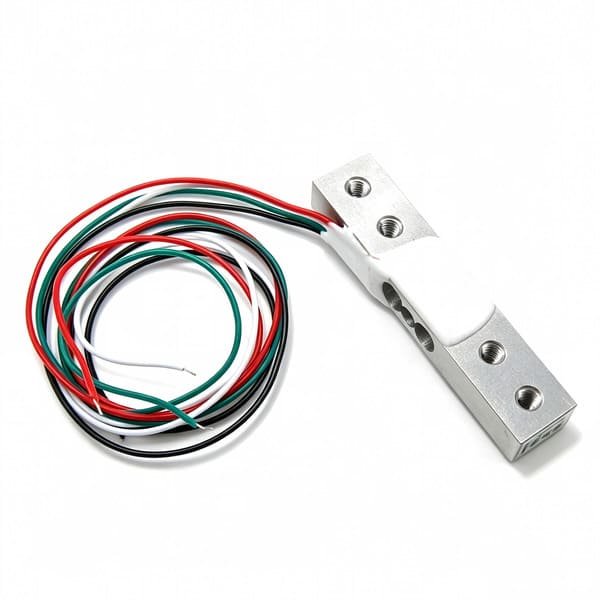
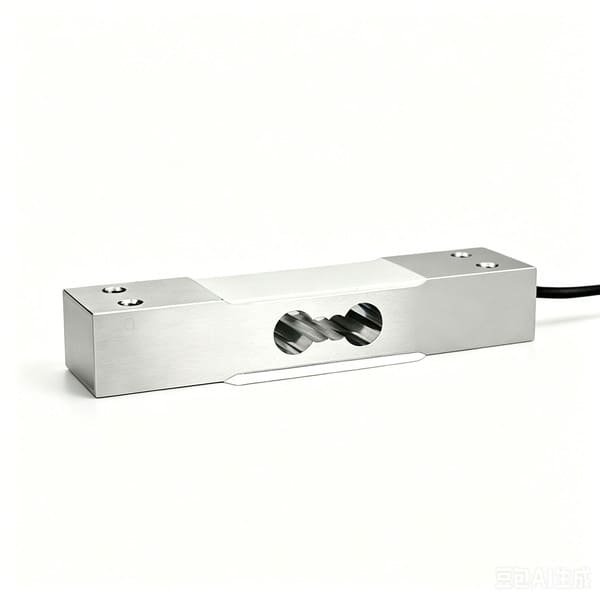
| Inside the bottle base — one cell under a sealed floor plate | The bottle and its contents | 0.6–1.7 kg | WST109 — 300 g to 5 kg micro cell, 1,000 Ω bridge, IP65 |
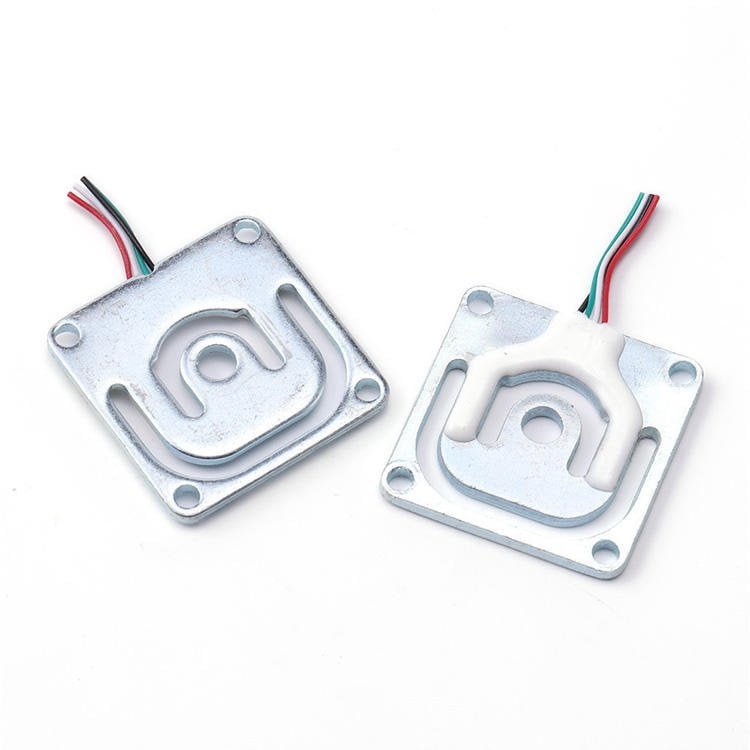
| A tray, dock or coaster — the bottle is untouched | Bottle plus the tray that carries it | 1–5 kg | WST101 — flat micro cell, 5–200 kg, corner mounting holes |
| A dispenser or fountain base — a reservoir, and people lean on it | Reservoir plus base structure | 5–20 kg | WST601 — stainless button cell, 0.1–20 kN, 200 % ultimate overload |
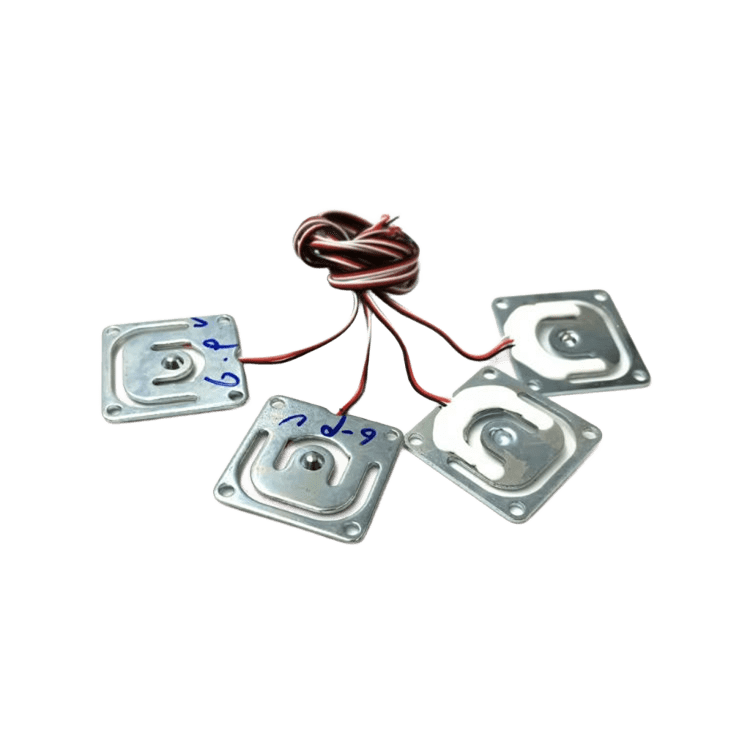
| A four-corner platform — a larger tray, a rack, several bottles | Everything on the plate, spread over four points | 4–40 kg | WST102 × 4 — 3-wire half bridges in series, one full bridge |
| A station with a digital bus — several weigh points, one cable | Depends on the station | 3–50 kg per point | WST1201 — digital single point, RS485/RS232, factory calibrated |
WST109 is the one I would put in a bottle. Its ranges start at 300 g, which is a bottle-sized scale rather than a person-sized one, and its input resistance is 1,000 Ω rather than the usual 350 Ω — that matters more than any accuracy figure, for reasons I will get to in section 10. It is aluminium with a silicone seal, IP65, and its published applications already include water coolers and coffee scales. One honest caveat before you design around it: its safe overload is 120 % of range and its ultimate overload 150 %, so on a 2 kg range you are protected to 2.4 kg and you survive 3 kg. A full 32 oz bottle is 1.65 kg — fine. A 1.5 L jug on the same cell is not.
WST101 is the tray cell. Its flat frame with a mounting hole at each corner is exactly what a coaster or a weighing dock wants, and its 5–200 kg range covers anything up to a catering tray of bottles. Two things I will not pretend about: its datasheet publishes an ultimate overload of 150 % but no separate safe overload, so if your design leans on the cell you need that number from us in writing before you finish the housing; and its input resistance is not published, which is an odd gap for a battery-powered product and one I would rather flag than paper over.
WST601 is the abuse cell, not the accuracy cell. This is the most counter-intuitive recommendation on the page, so let me put the number in front of you. It is stainless, IP66, rated 0.1–20 kN, with a comprehensive error of ±0.5 %FS — and on its smallest range, 0.1 kN, that is 51 grams, or two and a half sips. As an absolute reading it is worse than useless for tracking hydration. What you are actually buying for a dispenser base is the 20.4 kg ultimate overload, the 15.3 kg safe overload, and the 5.1 g zero stability — you are buying the day somebody leans on the fountain, not the day somebody drinks from it. If your dispenser is a bottle-scale in disguise, use WST109 and put a mechanical stop under it instead.
For completeness: four half-bridge cells wired in series make one full bridge and one 4-corner platform, which is the plumbing behind almost every bathroom scale ever built — and it is a genuinely good answer here, because a four-point platform averages an off-centre load by construction instead of levering it into one cell. Section 6 is about why that matters more than anything on the datasheet. The same idea appears in the smart home products and smart coffee machine write-ups, where the same load path sits under very different products.
6. The Error Nobody Puts in a Datasheet
Section 3 concluded that the entire datasheet costs about 4 grams on a difference measurement, and section 4 showed you have four orders of magnitude of resolution in hand. So if your product is missing sips, something is delivering an error that is not in either place. It is.
The largest error in a bottle scale is where the bottle lands. Not the cell, not the converter — the seat. Three mechanisms do it, and none of them has a column on any datasheet I have ever been sent:
1. A second load path that comes and goes. If the base plate deflects enough to touch the housing rim on one side, part of the bottle’s weight bypasses the cell — and whether it does depends on where the user put the bottle down. 2. A seating surface that dishes or rocks. A thin plate that has to carry a point load dishes under it, and the dishing changes the moment arm to the cell. 3. Screw torque on the cell’s mounting feet. Over-tighten one foot and the cell is pre-bent before any water arrives.
All three produce the same signature: the reading depends on the position of the load rather than its size. That makes for a beautiful, zero-cost test that needs no certificate, no master weight and no supplier. Fill the bottle to a known level, then weigh it in eight positions around the base — north, north-east, east and so on. Log all eight. Your maximum minus your minimum is your real position repeatability, and in my experience it is between ten and fifty times bigger than every term on the datasheet combined.
Why that particular number is the one that matters: a difference measurement needs the same reading to be reproducible, not a true one. Position error is reproducible in the worst possible way — it is stable, it looks tidy, it never announces itself as a fault, and it is different every time the user puts the bottle down slightly differently. It is exactly the “it’s very repeatable and still wrong” situation, and here it is the dominant term, by a factor of ten.
Now combine that with the sip size and you get a hard, honest ceiling on container capacity. If a difference is only worth trusting when it clears roughly three times the position repeatability, then:
| Position repeatability | Largest gross load for a 20 g sip | Largest gross load for an 8 g sip |
|---|---|---|
| 0.05 % of load — a stiff seat, well supported | 13.3 kg | 5.3 kg |
| 0.10 % — the realistic target for a good base | 6.7 kg | 2.7 kg |
| 0.20 % — what you get if nobody checked | 3.3 kg | 1.3 kg |
| 0.70 % and above — the 1 L jug in section 13, before it was fixed | 0.95 kg | 0.38 kg |
Read the bottom row again, because it is the punchline of this whole article. With a bad seat, you cannot build an honest scale for a 500 mL bottle. With a good one, a one-gallon dispenser is comfortable. The load cell is the same in both cases. Your bottle’s capacity limit is set by how well you control where the user puts it down, and by nothing else.
A calibration certificate describes the machine you calibrated, on the fixture you calibrated it on. If the load path changes with position, a six-point calibration is a very precise description of something the user does not have. In multi-cell platforms the equivalent rule is that calibration cannot correct an eccentric-load error — only a mechanical change can. And if you have four cells, the equivalent of “check the geometry” is to load each corner with the same weight and adjust the corner potentiometers, remembering that a corner adjustment can only ever bring a high corner down, never lift a low one. A junction box with those adjustments is the WST1513; if you are building a four-corner platform it is worth having.
7. Slosh, and Why Your Settling Window Is Too Short
Put a bottle of water down and the water keeps moving. Everybody knows this. Almost nobody puts it in the timing budget, and it is the second-largest error in the product after the seat.
The first slosh mode of a cylinder is easy to work out. For a bottle with a 73 mm bore the mode number is k = 1.841 ÷ R, which gives about 50.4 m−1, and the natural frequency is ω = √(g k tanh(k h)). The tanh term saturates almost immediately, so the answer barely depends on how much water is in there:
| Water depth in a 73 mm bore | First slosh mode | Period |
|---|---|---|
| 60 mm (nearly empty) | 3.53 Hz | 0.283 s |
| 100 mm | 3.54 Hz | 0.283 s |
| 150 mm | 3.54 Hz | 0.283 s |
| 200 mm (full) | 3.54 Hz | 0.283 s |
So a half-empty bottle is just as bad as a full one, and the disturbance repeats every 0.28 seconds. Now the part that reaches the sensor. Sloshing water moves its centre of mass up and down, and a mass accelerating vertically presses on the base with m (g + az) ÷ g. The vertical acceleration scales as ω2 times the surface amplitude, and ω2 here is about 494 s−2 — a big multiplier for a very small wave.
| Surface wave amplitude | Vertical acceleration | Apparent load ripple on a 21 oz bottle |
|---|---|---|
| 3 mm, a quarter of the water moving | 0.151 g | ±23 g — 1.2 sips |
| 5 mm, a quarter of the water moving | 0.252 g | ±39 g — 2.0 sips |
| 5 mm, half the water moving | 0.252 g | ±78 g — 3.9 sips |
| 8 mm, half the water moving — a hard set-down | 0.404 g | ±125 g — 6.2 sips |
A ±40 to ±125 gram oscillation at 3.5 Hz, arriving every time the user sets the bottle down. Your cell’s contribution to the same measurement was 4 grams. This is where the error actually lives.
There are two ways to handle it and only one of them is expensive. The cheap way is arithmetic: average over an integer number of slosh periods. A 0.8 second window is 2.83 periods, which leaves 2.8 % of the fundamental behind; 1.4 seconds is 4.96 periods and leaves 0.12 %; 3.4 seconds is 12 periods and leaves 0.03 %. Averaging is nearly free and it destroys the error almost completely.
A single point sample taken at an arbitrary phase of an oscillation carries an expected error of 2 ÷ π times the amplitude — 64 % of it. On the numbers above that is 15 g for a gentle set-down, 25 g typical, 50 g when half the water is moving and 80 g after a hard one. So firmware that waits for the reading to sit inside a ±1 g deadband for two samples and then keeps that value is not averaging at all; it is point-sampling during the largest transient the product will ever see. The window was not too short. The window was never used.
There is a second trap hiding in the sample rate, and it catches people who are being careful about power. If your firmware runs at about 3.5 Hz to save battery, then a 3.5 Hz slosh aliases to zero — a standing offset that slowly wanders with the envelope of the slosh. From the app’s side that is indistinguishable from a drift, and a slow drift in a bottle is indistinguishable from drinking. Sampling at 5 Hz moves the slosh to 1.46 Hz where a filter catches it; sampling at 2 Hz puts it at 0.46 Hz, which is worse than doing nothing. In other words, the cheapest sample rates are the dangerous ones.
The physics also tells you something useful about mechanics. Slosh frequency goes as 1 ÷ R, so a wider container sloshes more slowly — a 130 mm tray of water runs nearer 2 Hz, and a narrow bottle near 4 Hz. If you are designing a dock rather than a bottle, the two are not the same problem and they do not want the same time constants. And if you want to know your own numbers instead of my arithmetic, tape a phone to the base with an accelerometer app running and set the bottle down a few times. That measurement costs nothing and it beats any assumption.
8. Presence, Stillness, and “Is the New Level Still There?”
Sections 6 and 7 say that the seat and the liquid dominate the error. Both of them are conditions on when you are allowed to read. So the practical form of everything above is a three-state machine, and I would write it into the requirements document rather than leave it to firmware.
| State | Condition | The number that has to be right |
|---|---|---|
| Present | Load above the empty-base threshold | The threshold, in grams — and it needs hysteresis, or a bottle at the boundary flickers |
| Still | Change smaller than the deadband for N consecutive samples and at least Tmin elapsed | Tmin, and the deadband in grams |
| Settled | No upward excursion larger than X after stillness began | X, and how long the level must persist before the app believes it |
Tmin is the big one. Three different settling times are in play: the converter’s own settling time, which is a few hundred milliseconds; the time it takes the user’s hand to leave the bottle, which is about half a second to a second and a half; and the slosh settling time, which from section 7 is two to four seconds. Firmware people naturally pick the first one, because it is the one the electronics manual mentions. Tmin has to be the largest of the three. Three to four seconds, minimum, and I would write “at least 12 slosh periods” into the spec so that a later firmware optimisation cannot quietly walk it back.
The deadband must be sized to the ripple, not the resolution. A ±1 g deadband on a 2 kg cell is 0.05 %FS, which is finer than the room you are standing in and far finer than the water. After settling, the residual ripple on a bottle is a few grams, so a deadband around 8–10 g is honest. A too-small deadband does not make the product more sensitive; it makes it fire more often, on nothing.
The “is it still there” test is the one that removes the last class of phantom drinks. The rule is to test the new level rather than the transition: a hand pressing on a bottle, a bottle leaning against a wall, a bottle being nudged — all of those produce a short pulse, whereas a genuine drink produces a step that stays. If the level comes straight back, it was not a drink. This is the same reasoning used in gravity-sensing retail shelves, where a press is a narrow pulse and a real pick-up is a step, and the discriminator is whether the new level persists rather than how big the change was. That write-up is worth reading alongside this one: load cells for smart shelves.
If the user’s fingers are still touching the bottle when the reading is taken, part of the weight is on the hand and the cell reads light. One percent of a 1,073 g bottle is 10.7 g; five percent is 53.7 g, or 2.7 sips. Because it always reads light, it always looks like drinking, and because it is systematic it never averages out — the daily total simply comes in high, every day, forever. There is no sensor fix. The settling window and the persistence test are the fix, and they cost nothing but a specification.
9. Zero Policy and Temperature: What Actually Drifts
Let me start with the temperature question, because the industry worries about it in the wrong direction and I can show that with five lines of arithmetic.
A bottle lives between about 4 °C in a fridge and 60 °C in a car parked in the sun — a 56-degree swing. Take the zero temperature coefficient of the three cells I recommended in section 5 and multiply each by its own range, because that is the only honest way to compare them:
| Cell | Zero coefficient | Per 10 °C | Over a 4–60 °C swing |
|---|---|---|---|
| WST109, 2 kg range | ±0.2 %FS/10 °C | 4.0 g | 22.4 g — 1.1 sips |
| WST101, 5 kg range | ±0.1 %FS/10 °C | 5.0 g | 28.0 g — 1.4 sips |
| WST601, 0.1 kN range | ±0.05 %FS/10 °C | 5.1 g | 28.6 g — 1.4 sips |
Look at what just happened. The published coefficients differ by a factor of four — 0.05 %FS against 0.2 %FS, which reads like a night-and-day difference on a spec sheet. But the actual drift in grams differs by only 27.5 %, because the cells’ ranges differ by a factor of five in the opposite direction. %FS coefficients are not comparable between cells. Multiply by the range, or do not compare at all. I have watched people choose a cell on a coefficient and get a worse number in grams.
All of these micro cells are compensated from −10 to +40 °C. A car interior in summer is not inside that window. The drift you can predict is the drift inside the compensated band; above +40 °C you are extrapolating from a curve nobody published. If your users genuinely leave bottles in hot cars — and they do — the honest engineering answer is not a better cell, it is to make the app treat “I have just come back from somewhere very hot” as a reason to distrust the next reading and wait for a re-zero, rather than publishing a number that means nothing.
Now the zero policy, which is the single highest-value paragraph in this article for anybody commissioning firmware. Recall from section 2 that the bottle spends most of its minutes part-full or empty, and only briefly full. That matters here:
Ten grams of zero error is 0.9 % of a full 1,073 g bottle — invisible, inside the noise. The same ten grams on an empty 454 g bottle is 2.2 % of the reading. So zero drift is most deceptive exactly when the bottle is nearly empty, which is most of the day. And an empty bottle is precisely the state your app uses to decide “nothing has happened”. This is the same arithmetic that makes a fixed error on a dairy scale dangerous at the low end of a milking, and it is worth internalising: with a subtracting instrument, the bottom of the range is not the easy part.
Which leaves one rule, and I would put it in writing and get somebody senior to sign it: the only honest zero is an empty bottle. Not “full”, because full is not defined. Not “as delivered”, because the user will not repeat it. An empty bottle is the one state that is mass-defined, repeatable and reachable, and it is the state the product should re-zero to whenever it can be sure of it. In practice that means three conditions together: the load is inside the empty-bottle band, it has been still for hours rather than seconds, and the temperature has been stable to within about a degree. If all three hold, re-zero and log it. If not, do not — a re-zero taken with a dead fly on the plate is worse than no re-zero at all.
The same discipline shows up in every outdoor container I have worked on — beehive scales, LPG cylinders, feed hoppers — and the reason is always identical: nobody can press a zero button at a moment they control. The smart beehive scale and smart LPG cylinder articles both end up in the same place, for the same reason.
10. The Battery Arithmetic: You Are Optimising 0.3 mAh/day
The other email I get constantly in this category is about power, and it is asked in the form of a sensor request: “we need a lower-power load cell so we can hit our battery claim.” Let me do that arithmetic properly, because it usually ends with me selling nothing, and I would rather you found that out here than after a redesign.
A strain-gauge bridge is a resistor, so it is easy to cost. Take a 1,000 Ω micro cell at its recommended 5 V: 5 mA, 25 mW while energised. Take the alternative, a 350 Ω cell at the 10 V its datasheet recommends: 28.6 mA and 286 mW. Now put it against a battery. A 1,000 mAh cell at 3.7 V holds 3.7 Wh, and the two designs behave completely differently:
| Design | Average power | Per day | Battery life |
|---|---|---|---|
| Bridge energised continuously | 25 mW | 162 mAh | 6.2 days |
| Energised only during the window — 40 events/day × 2 s | 0.023 mW | 0.15 mAh | 2.10 mAh over 14 days — 0.21 % of the cell |
The first row is the important one, and it is a design decision rather than a component decision: a continuously energised bridge on its own breaks a fourteen-day claim. 162 mAh a day against a 1,000 mAh cell is six days of battery, and you have not powered a radio yet. So switched excitation is not an optimisation; it is the entry ticket.
Once you have switched it, though, the sensing chain becomes almost invisible in the budget. Forty measurement events a day at two seconds each is 80 seconds of excitation out of 86,400 — a duty cycle of 0.09 %. That is 0.023 mW averaged, which is 2.1 mAh across a full fourteen days, or 0.21 % of the cell. A fourteen-day claim on a 1,000 mAh battery needs 71.4 mAh a day, which is a 2.98 mA average draw across everything in the product — radio, display, LEDs, MCU and sensor together. The sensor’s share of that is about 0.15 mAh a day.
Because measuring is nearly free, you can afford to measure properly. Stretching the window from 2 seconds to 4 so the water actually stops moving, and from 40 to 50 events a day, moves the sensing chain from 2.1 to about 5 mAh over a fortnight — a quarter of one percent of the battery, in exchange for the difference between a product that counts sips and one that invents them. There is no other trade in this whole design where you get so much for so little.
If you want the counter-intuitive version: the 1,000 Ω bridge is worth more to you than any accuracy grade in this catalogue, not because of what it measures but because of what it does not draw. It is roughly a seventh of the current of a 350 Ω cell at the same voltage, which is why I led with it in section 5. And if you are building a fountain or a dispenser with a 350 Ω button cell, run it at the lowest excitation your converter can tolerate rather than the highest the datasheet allows — the sensitivity you lose is worth nothing here, as section 4 explained.
The one genuine sensor-side change worth making has nothing to do with battery life at all. Switched excitation also removes a slow self-heating term. A bridge left energised inside a sealed base warms its own elastomer by a fraction of a degree, and a fraction of a degree is a few grams of zero shift on a 2 kg range. Energising only for the measurement window means the cell is always at ambient when you read it. That is a zero-stability improvement, which per section 3 is one of the only two numbers that survives subtraction. Do it for that reason and the battery comes along for free.
11. Ice, Milk and Condensation: Not the Sensor’s Errors
Everything so far has been about making the gram number right. Your app does not show grams. It shows millilitres, a percentage of a goal, and a hydration score, and every one of those is a conversion the software performs. That is where the biggest percentage errors in the product live, and none of them can be fixed with a load cell.
Start with the one everybody asks about, which turns out to be a non-issue. Water is 0.99705 g/mL at 25 °C and 0.99997 g/mL at 4 °C — a spread of 0.29 % across the entire range a person will ever drink at. On a 20 g sip that is 0.06 mL. The density of water is a rounding error; if somebody is proposing to compensate for it, they are selling you something.
The real conversion error is every drink that is not water. Milk is about 1.030 g/mL, orange juice around 1.045, a cola around 1.04. Weigh 20 g of milk and call it 20 mL and you are 3 % low; on a 250 mL glass you are reporting 7 mL less than the customer poured. If your app offers dozens of drink types, then the conversion factors are doing more work to your accuracy than the sensor is, and they should be treated as a first-class part of the specification rather than a table somebody filled in. The hydration factor for a given drink is a nutrition assumption, not a measurement, and it is fair to say so in the app.
Ice. Thirty grams of ice occupies 32.7 mL but melts into 30.1 mL of water, so weighing it is actually correct — the trouble is physical: ice dropped into a full bottle displaces water out of the spout, and the scale sees a loss of 10 to 40 g, up to two sips, which the app can only read as drinking. Condensation. Only on a single-wall bottle — a vacuum-insulated one does not sweat. On a 73 mm by 200 mm body the condensing area is about 0.054 m², so a 50 µm film is 2.7 g, a beaded 200 µm film is 10.9 g, and it arrives slowly and monotonically all day. Evaporation from an open bottle is under 2 g a day, which is genuinely negligible and I am not going to pretend otherwise.
Those three share a property that defines the outer boundary of any weighing bottle: they change the mass without anyone drinking. A scale sees a mass; it cannot see intent. Ice being added, water condensing, a second person drinking, water poured into a glass and drunk from there — the load cell reports all of them identically, and the inference is the OEM’s job, not mine. The published advice from the category leader is disarmingly honest about this: pouring out, adding ice, refilling partially, sharing, and setting the bottle down on an unstable surface all affect the reading, and the app measures bottle movement rather than who consumed it. That is not a marketing failure. It is the correct description of the instrument.
It is the same family of problem as weighing a gas cylinder or a trash bin: the container’s mass and the thing you actually care about are not the same quantity, and the gap between them is where all the interesting engineering sits. The smart LPG cylinder and smart trash can write-ups both start from that same observation.
12. Case: Every Put-Down Became a Sip
A tooling shop in Dongguan building a 600 mL insulated bottle for a US direct-to-consumer brand, late 2025. The bottle base held a single micro cell under a sealed floor plate, the firmware was theirs, and the support tickets were all the same shape: “the app says I drank 200 mL while I was asleep.” By the time they came to me they had already decided the answer was a better cell and asked for a 0.02 % part.
The first thing I asked for was not a datasheet. It was the raw event log — every reading the firmware had committed, with timestamps, for one bad night. That took ten minutes to read and it ended the conversation about the sensor.
The log did not contain eleven separate drink events. It contained eleven pairs, and inside each pair the two events were about 0.9 seconds apart. The second reading in every pair was between 12 and 60 grams lighter than the first, and the amount was different every time. Nothing had been drunk. The firmware had logged the same bottle twice.
What was happening was section 7, exactly. Setting the bottle down on the base excites the first slosh mode at about 3.5 Hz, so the force on the cell oscillates with an amplitude of tens of grams for a couple of seconds while the water settles. Their settle logic waited for the reading to stay inside a ±1 g deadband for two consecutive samples, then stored that value. On a 3.5 Hz wave, two samples a few tens of milliseconds apart can easily both land near a trough. So the firmware captured the bottom of the oscillation as “the bottle as you left it”, and then captured the recovery 0.9 seconds later as a new, lighter level. A phantom sip, with a plausible size, in a plausible time. The deadband was measured in grams of resolution when it needed to be measured in grams of water movement.
The fix took an afternoon and changed no hardware. The window went from a sample-and-hold to a genuine average over 3.4 seconds — twelve slosh periods, which per section 7 leaves about 0.03 % of the fundamental behind. The deadband went from 1 g to 10 g. And the persistence test went in: a new level had to still be there three seconds later before the app was allowed to call it a drink. The phantom events fell from roughly eleven a night to under one a fortnight, and the “better cell” conversation ended.
The cell they already had contributed roughly 4 grams of error to a difference measurement, as we worked out in section 3. The slosh was throwing 40 to 75 grams at the same measurement. They wanted to buy away the 4. The thing eating them was eighteen times bigger, and it was in their firmware. It is the cleanest example I have of the general rule in this category: the sensor is rarely the reason the number is wrong.
One thing I did agree to supply, and it was not a load cell. They had been assuming the slosh behaviour instead of knowing it, so I asked them to tape a phone to the base with an accelerometer app running and set the bottle down twenty times: on a bench, on a tablecloth, on a desk mat, from 1 cm and from 5 cm. Twenty minutes of work, no equipment, and it told them their real settling time and how much of it came from how the user puts the bottle down. Every project in this category should do that before writing the state machine, and almost none do.
13. Case: The Same Jug, 24 g Heavier One Position Over
A fitness brand in Ningbo, 2026, scaling a successful bottle design up to a 1 L gym jug. The sensor was unchanged, the firmware was unchanged, and the product did not work. Their own testers could not reproduce the app’s totals with a kitchen scale, and short sips had started disappearing. They sent me a three-page specification asking for 0.01 g resolution and a six-point calibration, which told me they had already diagnosed the problem as accuracy.
I asked for one thing instead: a photograph of the loaded base, from the side, taken while the jug was standing on it. It came back the next morning and it was enough. The jug’s base was a 1.2 mm aluminium plate, and with 1.7 kg of water sitting on it you could see the plate had dished — bowed down in the middle where the cell was, lifting at the rim where it met the housing. That is the first mechanism in section 6: a second load path that appears and disappears. Whether the rim was carrying part of the jug’s weight depended entirely on where the user had put it down.
The diagnosis cost nothing and needed no instrument. I asked them to fill the jug to a marked level and weigh it in eight positions around the base — north, north-east, east, south-east and so on — writing down every reading. It took about ten minutes:
| Same jug, same water, eight positions | Reading | What it is worth |
|---|---|---|
| Heaviest position | 1,706 g | — |
| Lightest position | 1,682 g | — |
| Spread | 24 g | 1.41 % of the load, or 1.2 sips |
Twenty-four grams of error, introduced purely by the position of the jug, on a 1,697 g gross. For scale: the maximum and minimum landed on opposite sides of the base, which is the signature of a rocker or a rim contact rather than anything electronic. And the number is roughly six times the entire datasheet error budget from section 3, in a product that was being asked to resolve 8 g sips.
Their proposed fix — a six-point calibration with laboratory weights — would have produced a beautiful certificate for a machine that did not exist. What we actually did was three mechanical things: a 2 mm base plate with a turned rib so it could not dish, four-point support instead of a single cell in the middle so the seat averages the load instead of levering it, and a specified screw torque on the cell mounting feet so that no two units were pre-bent differently. No electronics changed and the accuracy grade did not move. The spread went from 24 g to 3 g — eight times better — and the short sips came back, because they had never been missing.
It is the cheapest diagnostic in this entire product family. It needs no master weight, no certificate and no supplier, it takes ten minutes, and it separates the two things that everybody conflates: the scale reads the wrong number versus the scale reads a different number depending on where you put the thing. Those have completely different fixes and only one of them involves buying anything. When a customer tells me their bottle is inaccurate, this is the first test I ask for, and it is astonishing how often the answer has nothing to do with the load cell.
14. Case: The Battery Complaint That Was Not About the Sensor
A German brand, spring 2026, building a counter-top hydration station with a 1.5 L reservoir. Their headline claim was fourteen days per charge. The product was shipping at nine. They asked two suppliers, me and one other, for a lower-power load cell to claw the difference back, and their assumption was that the sensing chain was the culprit.
I did the arithmetic from section 10 out in front of them, on a call, with their own numbers. A 1,000 mAh cell. Fourteen days needs 71.4 mAh a day. Nine days means they were drawing 111.1 mAh a day, so they had to find 39.7 mAh a day from somewhere. And the sensing chain — a 1,000 Ω micro cell, energised only during measurement, forty events a day — was costing them 0.15 mAh a day.
Which means the honest answer was the one nobody wants to give: if you removed the load cell entirely — no sensor, no excitation, no conversion, nothing — the product would go from 9.0 days to 9.01 days. About twenty minutes of battery, for the entire measurement function. It is a slightly absurd way to make the point, which is why I used it, and it landed. They had been optimising 0.1 % of the problem because it was the part with a supplier attached to it.
What was actually drawing the current was, in order, the Bluetooth connection interval, the LED animation, and the sleep current of everything else on the board — and none of that was mine to fix. I told them so. They went back to their firmware and radio settings, and the product came back at fifteen days without a new sensor in it. The only sensor-side change I made was switching the excitation so the bridge is only energised inside the measurement window.
They asked me for a component and the correct answer was that my catalogue had nothing for their problem, which I said on the first call rather than the third. That is a worse quarter and a better decade. It is also the honest version of “we do weighing solutions”: a weighing solution sometimes consists of telling a customer that the weighing part of their system is not the part that is broken. If you want the general version of that argument, it is the same one I made in the connected home appliances piece about appliances where the scale was never the bottleneck either.
One thing did come out of that project that I now recommend to everyone building a sealed base. Because the excitation is switched, the cell is only warm while it is measuring, and it is otherwise at ambient. On a 2 kg range that is worth a few grams of zero stability — exactly the term we identified in section 3 as one of the only two that survives subtraction. It cost nothing. I would do it even if the battery were free.
15. The Worksheet, and What I Supply
Every quotation conversation I have about a smart bottle reduces to nine numbers. If you can answer them, I can tell you in one reply whether a load cell is the right answer at all — and if it is, which of the two or three terms in section 3 will be the one that limits you.
| Question | Which decision it settles |
|---|---|
| 1. Gross mass of the heaviest bottle you will ever support, in grams | The range, and therefore the grams-per-percent of every datasheet term |
| 2. Empty (tare) mass of that same bottle | The tare share. Above roughly 40 % of gross, zero temperature coefficient becomes the dominant error, not accuracy class |
| 3. The smallest addition or removal you must report, in grams | The signal. Around 20 g for a human sip; 1–3 g if you are counting from a fountain |
| 4. Which of the four architectures in section 1 you are building | Base, tray, dispenser or platform — decides the position-error budget and the cell family |
| 5. Does the reading have to survive the bottle being picked up and put back down? | Whether you need a stillness gate at all, or can drop the whole of section 7 and 8 |
| 6. Coldest and hottest the product sees in the field, in °C | Zero drift over the swing. A fridge-to-car range is 56 K, which is five and a half tens of degrees |
| 7. Battery capacity, target life, and how often the radio wakes | Duty cycle. Continuous excitation is 162 mAh/day on a 1,000 mAh cell; switched is 0.21 mAh over 14 days |
| 8. Is the number ever used for money, dosage, or a compliance claim? | Whether you need an instrument-level metrology route, or only repeatability against a single user |
| 9. Annual volume, and the sensor cost you have to hit | Whether a catalogue part is right or a custom micro cell with your own mounting pattern is cheaper |
“What does the app do when the number is wrong by 20 g?” If the answer is “it shows 20 g more water and nobody dies”, we are optimising an event detector and I will happily sell you a 0.05 % cell and stop there. If the answer is “someone is billed”, the conversation moves to a legal-metrology instrument and a different supplier, and I will say so on the first call rather than the third. “What is the bottle made of, and what happens when it is 60 °C in a car?” This one is not a sensor question at all, but it determines whether the zero reference you established in the factory still means anything by the time the user opens the app.
If you want the general version of this worksheet rather than the bottle-specific one, I wrote a longer load cell selection guide that walks the same questions in a different order. The bottle version above differs in one way: the mass range is small enough that mechanical architecture matters more than the sensor, and that is unusual.
What I supply, and what I do not
I make weighing components. I do not make bottles, and I am not going to pretend that the interesting engineering in a smart bottle is the sensor — it is not. Here is the honest split, in the same form I use on calls.
| I supply (and can quote from a specification) | I do not supply (and who owns it) |
|---|---|
| Micro, miniature and button load cells in the ranges below — aluminium, alloy steel and stainless steel | The bottle, lid, gasket and the sealed floor plate the cell sits under. Mechanical design is yours. |
| Half-bridge (3-wire) cells for four-corner trays, and full-bridge cells for single-point mounting | Firmware: the state machine, the stillness gate, the zero policy. I describe what it must do; I do not write it. |
| Digital (RS485 / CAN) single-point cells with factory calibration, so the MCU reads a number instead of a millivolt | BLE / ANT+ stack, GATT definitions, phone app. The radio is the product; it is not a weighing part. |
| Junction boxes and multi-channel summing and trimming boards for multi-cell trays | IEC 62133-2 battery certification, RED 2014/53/EU and the EMC file. A load cell is a passive bridge with no radio and no firmware, so it carries none of those obligations by itself. |
| Weighing indicators and controllers, including small-panel and RS-485 versions, for dock and dispenser products | Food-contact approval for the tank and mouthpiece. That is about the parts touching the drink, and I do not make them. |
| Selection support: I run the arithmetic in sections 2 to 4 with your numbers and name the limiting term | Legal-for-trade approval of the finished instrument (OIML R76 / EN 45501 / MID 2014/32/EU). A component certificate is not an instrument certificate. |
| Cable, connectors, mounting screws, and the wiring colour code documented in writing with the part | Injection-moulded housings, custom PCBs, cloud and app back end. I can work inside your enclosure; I cannot design it. |
One. WST101’s ingress protection is not stated on the current datasheet. It is a flat alloy-steel cell with corner mounting holes, and for a dock that lives on a wet counter I would confirm the sealing in writing before you design it in — or use a cell that already publishes IP65. Two. WST601’s comprehensive error is ±0.5 %FS, which is ten times worse than the micro cells in relative terms. It is in this list for its mechanical envelope — a stainless button you can bolt through a dispenser base — not for its accuracy. Three. WST109’s safe overload is 120 % of range and its ultimate overload 150 %. On a 2 kg range that means 2.4 kg of protection. A full 1.5 L insulated bottle at about 2.6 kg will exceed it, so size the range for the real gross mass rather than for habit. Four. Nothing on this page is legal-for-trade out of the box, and I will not describe it as if it were.
16. Questions I Get From Bottle Builders
Can a load cell in the bottle base really detect one sip?
Yes, and it is the easy part. On a 1,000 g range a 20 g sip is 25,000 counts of a 24-bit converter, so resolution was never the problem. What limits you is everything that happens around the sip: whether the bottle was still moving when you sampled, whether your hand was still on it, and whether the zero you subtracted was taken at the same temperature. Those three terms are 100 to 1,000 times larger than the sensor’s own noise. If a supplier’s answer to this question is a resolution figure, they have not built one.
My prototype logs drinks nobody drank. Is the load cell drifting?
Almost certainly not. Phantom drinks are the signature of a settling window shorter than the slosh period. In a 73 mm bottle the first slosh mode sits at about 3.5 Hz, so a 0.8 s window catches only 2.83 periods and leaves 2.8 % of the ripple — enough to walk a 1 g deadband, while 1.4 s takes you to about 5 periods and 0.1 %. Test it before you blame the sensor: log the raw weight at 20 Hz for five seconds after a set-down. If it rings, it is slosh; if it is a straight line that steps, it is the cell or the electronics.
Do I need a legal-for-trade approved load cell for a smart bottle?
No, and you should be careful about buying one by accident. Trade approval (OIML R76, EN 45501, MID 2014/32/EU) is a property of a finished instrument, not of a component, and it brings obligations — sealed calibration, an approved zero range, restrictions on how much the user may re-zero. A hydration tracker that re-zeroes whenever the bottle is empty would violate most of them. Buy repeatability against one user’s own baseline, not traceability to a national standard.
Why would I choose a 1,000 Ω cell instead of the usual 350 Ω?
Because the bridge resistance sets the current, and the current sets the power your battery has to supply. At 5 V a 1,000 Ω bridge draws 5 mA and dissipates 25 mW; a 350 Ω bridge at the same voltage draws 14.3 mA and dissipates 71 mW. The 1,000 Ω cell is also less self-heating, so its zero returns to ambient faster. The trade is a lower output at the same excitation, which is irrelevant once you are already at 25,000 counts per sip. On a battery product this is the single most useful number on the datasheet after the range.
Will weighing by weight give me an accurate millilitre figure?
For plain water, yes — within a rounding error, because density changes only 0.29 % between 4 °C and 25 °C, which is 0.06 mL on a 20 g sip. For anything else, no, and the error is bigger than the sensor’s. Milk is about 1.030 g/mL, so treating 20 g as 20 mL under-reports by 3 %: a 250 mL glass reads 7 mL short. If your app reports volume, report it as volume of water equivalent, or store a density per drink type. Do not quietly divide grams by 1,000 and call it millilitres.
The reading changes when I put the same bottle down in a different spot. Is that the cell?
Test it and you will know in an hour, and the test costs nothing. Put the same filled bottle down eight times, turning it 45 ° each time, and log every reading. If the spread is small compared with one sip, your seat is fine and the sensor cannot be blamed for what you were about to blame it for. If the spread is on the order of a sip, the load is being shared between the rim and the cell, or the cell is being side-loaded by a restrained bottle. That is a mechanical fix in the seat, and no load cell on the market will solve it.
Ice and condensation keep breaking my totals. Anything you can do?
Only by telling you the truth: those are not sensor errors and no load cell will remove them. Dropping ice into a full bottle displaces water out of the spout, so the scale correctly sees a loss — 10 to 40 g, which is half a sip to two sips. Condensate on the outside of a single-wall bottle is worth 2.7 g at a 50 µm film and 10.8 g at 200 µm. Both are real mass on the sensor. The fix is in the state logic: ignore mass changes that arrive simultaneously with a lid event or a temperature step, and never attribute them to drinking.
Can you supply a complete smart-bottle weighing module, or only the sensor?
The sensor, and the weighing chain around it: cells, junction or summing board, digital cell, and an indicator where a dock needs a display. I do not supply the bottle, the sealed plate the cell mounts on, the firmware or the app, and I will not quote a “complete solution” that hides those in a single number. What I will do is the part that is genuinely mine — tell you which cell fits your mechanism, which term in the error budget is the one you cannot beat, and whether the number you want is achievable at all. That is still a weighing solution. It is just not a bottle.
Recommended Models
The five parts below cover every load path in section 5. Ranges are per model; if none of them brackets your bottle mass and the sip size you need to resolve, send me the nine numbers from section 15 and I will tell you honestly whether we have something that fits.

Tell me the gross mass, the empty mass, one sip in grams, which of the four architectures you are building, and the temperature range the product really sees. I will run the arithmetic in this article with your numbers and reply with which cell fits, which term will limit you, and whether the number you want is reachable at all — including when the honest answer is that the load cell is not your problem.