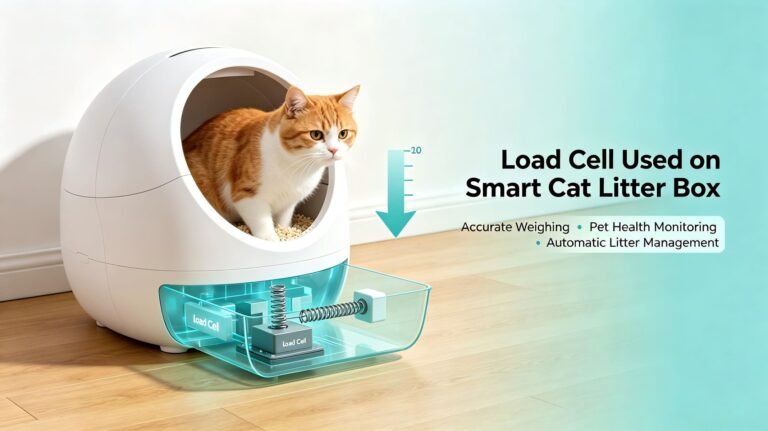


The machine cooks in motion. The scale only reads true in stillness.
A cooking robot cooks in motion — a 360° planetary stirrer at up to 120 rpm, a wok holding 3.5–10 kg of food, eight or nine seasoning lines firing grams of oil and soy into a bowl at 160 °C. Everything that makes the machine worth buying is everything that makes a scale read nonsense. I have quoted six cooking-robot programmes since 2024, and the single rule that decided all of them was this: the machine cooks in motion, and the scale only tells the truth in stillness. Every gram of accuracy you buy has to be spent inside the seconds between moves.
8–9 dosing lines on one machine
1 g in 3,000 g is the market spec
GB/T 46718-2025 · IEC 60335-2-9
Steam, jets and the 120 rpm toss
1. One brief, four weighing islands
The market first, because it explains why these enquiries arrive in a rush. China’s commercial stir-fry segment alone passed 30,000 installed storefronts in 2025, and the China Food Industry Association projects the domestic intelligent stir-fry machine market growing from about ¥3.7 billion in 2025 to ¥11.7 billion by 2030, with penetration in group catering expected to reach 50 % within three years. The pull is labour: the China Hotel Association reports 78 % of restaurant operators run staffing gaps above 30 % in peak season, and vendors document labour savings of 40–60 % with payback in 10–18 months. Globally, the automatic cook-processor market was about USD 3.2 billion in 2025, heading to USD 5.5 billion by 2032; Vorwerk’s TM7 took roughly 860,000 first-year orders and market analysts place the Thermomix installed base above 15 million units. At the far end of the price spectrum, Moley sells dual-arm robotic kitchens for USD 105,000–335,000. Somewhere between a ¥40,000 canteen wok robot and a quarter-million-dollar London kitchen sits every OEM reading this.
Now the brief. When an engineer writes “we need a load cell for our cooking robot”, that sentence quietly bundles four separate weighing systems that share nothing but the enclosure:
| Island | What sits on it | Typical gross | Smallest quantity that matters |
|---|---|---|---|
| A. Bowl / wok batch | Bowl or wok plus everything in it, stirred and heated in place | 1.5 – 12 kg | an ingredient addition, 100–500 g; a finishing oil pour, 20 g |
| B. Seasoning lines | Oil, soy, vinegar, wine, sauce — typically 8–9 pressurised lines from 1.9–3 L canisters | 2 – 3 kg per canister | a 10 g salt dump; a 20 g oil dose |
| C. Ingredient cassettes | Pre-portioned trays of vegetables and protein pushed into top slots | 0.5 – 3 kg each | presence, and a dose difference of ~100 g |
| D. Presence and safety | Is the bowl seated; is the wok tilted; is something overloaded | same as A | a binary threshold, 200–500 g |
Island D is free — it rides on the same cells as island A and costs only firmware. Islands A through C, though, want different capacities, different accuracies and often different mounting positions, and the market has already voted on one of them: the consumer flagship of the category, the Thermomix, carries an integrated scale rated ±1–3,000 g in 1 g steps (the TM5 generation stepped at 5 g). Three thousand divisions — the same ratio we found on bread makers and the same ratio a C3-rated cell delivers by construction. The spec is settled; what is not settled is whether those grams survive the machine around them.
One more credibility note, because readers ask. This cluster is not new to us: the same tray-level weighing we build for smart vending machines ships in delivery robots — where load cells replaced infrared presence sensors precisely because IR has blind zones for small items — and our cells sit in the self-service weighing stations now common in Chinese canteens, where the diner serves themselves and the till charges by the gram. A cooking robot is the same physics with a hotter, wetter, angrier environment around it.
I supply the load cells for all four islands, the junction box when a platform runs multiple cells, weighing modules and digital boards with tare-and-gate firmware hooks, matched output sets, custom cable lengths and connectors — plus the arithmetic and the test plan that tell you which island your drawing is actually solving.
I do not supply the bowl, the planetary drive, the pumps, valves or hoses, the heater, the robot arm, the control board, the enclosure, the app, or the CE/GB technical file. If you need the machine designed, that is a different supplier. If you have the machine and need the weighing inside it to be true, we should talk.
2. You cannot weigh a moving wok
Start with the toss, because it is the most quoted feature in the category — 360° planetary stirring, self-rotation plus orbit, the machine imitating a chef’s flick of the wok. Put numbers on it. Take a 4 kg swinging load (a 2.2 L bowl plus a wet charge is in that neighbourhood) on a 100 mm orbit radius at 120 rpm. The centripetal acceleration is ω²r = 15.8 m/s², which is 1.61 g. The apparent force through the mount swings by ±6.4 kgf — about 4,300 times the 1.5 g error floor of a decent 3 kg cell. During the toss, the scale is not reading food. It is reading the motion, Fourier-folded into a load signal.
The stirrer is quieter but worse, because it is quieter. A 500 W drive at a kneading-speed 100 rpm produces a shaft torque of about 47.7 N·m. If even one per cent of that reaction leaks through the bowl mount into the weighing path — a bolt, a skewed spacer, a foot resting on the seal — and acts through a 50 mm lever, the scale sees roughly 974 g of phantom weight. That is about 650× the instrument floor, and it scales with dough viscosity, temperature and speed, so it will not calibrate out. This is the same law I documented in bread makers (a kneading shaft coupling 30–80 g of drift into the pan) and in mixer wagons before that: drive torque never belongs in the weighing path.
The industry’s own architecture agrees with me, whether by intention or not. Look at how the finished machines actually work: the ingredient cassette is pushed into a slot while the wok is idle; the seasoning line fires while the stirrer pauses between intervals; the Thermomix knead programme deliberately alternates direction with rest gaps. Every successful machine I have worked on converges on the same pattern, which I would state as a design rule:
The scale is read only in scheduled stillness: drive stopped, wok level, hot plate unchanging. Tare, dose, confirm, resume. Weighing is an event in the recipe timeline — “seconds, grams, degrees, revolutions per second”, as one robot-restaurant operator put it — not a continuous background signal.
Everything the marketing page claims about gram-level dosing is bought and paid for inside those windows. Outside them, the best cell in the world is a vibration meter.
This has a specification consequence most teams miss: what you need from the cell is not bandwidth. You need a stable, repeatable reading the instant the motion stops — fast settling, low creep, a zero that did not wander while the machine cooked. Sampling at 150 Hz during a toss gives you beautifully precise garbage. Sampling once, 300 ms after the drive stops, gives you the gram you can actually put in a recipe.
3. The tare chain and what it inherits
A cooking robot doses by progressive tare. Tare the empty bowl, add the flour, tare again, fire the oil line, tare, fire the soy, tare — twelve ingredients, twelve tares. It is elegant, and it hides a trap that I wrote about at length in smart coffee machines and bread makers: the error floor is set by the range, and every dose in the chain inherits it. On the market-standard 3 kg bowl scale at 0.05 %FS, that floor is a fixed 1.5 g, and it does not care what you just dropped into the bowl:
| Dose on the 3 kg bowl scale | Typical size | 1.5 g floor as % of dose | On a dedicated 500 g line cell (0.25 g floor) |
|---|---|---|---|
| Flour or rice, one charge | 500 g | 0.30 % — fine | n/a — stays on the bowl scale |
| Cooking oil, one dose | 30 g | 5.0 % | 1.25 % |
| Salt, one dish | 10 g | 15.0 % | 2.5 % |
| Dried spice or stock powder | 5 g | 30.0 % | — below the useful floor |
Read the right-hand column, because it is the whole engineering argument for the architecture the best Chinese machines have already adopted — giving each liquid seasoning line its own independent small cell instead of weighing everything through the bowl. The bowl scale, sized for a 10 kg commercial wok charge, cannot rescue a 10 g salt dump; upgrading it to C3 only moves the salt from 15 % error to about 10 % (a 3 kg C3 cell still divides its range into 1 g intervals). You cannot buy your way out of a range. You can only move the small doses onto a small platform.
Why does a 10 g salt error matter commercially? Because the health arithmetic is unforgiving. Chinese dietary guidelines cap adults at 5 g of salt and 25–30 g of cooking oil per day. A 3.5 kg restaurant dish carries roughly 1 % salt by mass — 35 g — which a canteen serves as eight portions of 4.4 g each. One careless salt dose at the wok stage, twenty per cent high, and a single serving covers a whole day’s allowance. The cooking robot’s entire pitch to a chain operator is the same dish in every store; the salt line is where that promise is kept or broken. Machine builders advertise dosing errors of ±0.5 g and better; the flagship robot-restaurant in Tangshan claims seasoning precision to 0.1 g. Section 8 shows what hardware those claims require.
One more entry for the same law. Cassettes are usually weighed by difference — weigh the tray before the slot dispenses, weigh it after. Two readings, two floors: a 20 g dose from a cassette on a 3 kg cell carries a combined 3 g floor, 15 % of the dose, even though the cassette itself weighs 2 kg. Difference weighing multiplies floors; it never divides them.
4. Case 1: the seasoning line that lied
A Suzhou OEM, early 2025, eighth-generation canteen machine, eight seasoning lines. Their architecture weighed the whole canister rack — eight 1.9–3 L containers on a platform carried by four planar-beam cells — and computed each dose by subtracting the rack weight before and after each pump pulse. Clean idea. In the field, the oil line delivered 20 g targets with errors swinging to ±6 g — 30 % of the dose — while the soy line next to it held ±1 g. Same pumps, same firmware, same cells. Their quality lead was three days from blaming the load cells when the enquiry reached me.
I asked for two things before anyone touched a sensor: the hose routing photographs, and a log of dose error against the time of day. The log showed the oil error worst at opening and again after the lunch rush; the photos showed a rigid PTFE line running straight from the canister outlet down to the manifold, clamped to the frame. That was the whole story. The oil was the coldest line in the rack at opening and the most warmed by the compressor at noon; the hose’s bending stiffness changes with temperature, and every millimetre of that stiffness pushes or pulls on the canister — which is to say, on the scale. The hose was a second load path with an opinion, and subtraction made its opinion look like an oil dose. (The soy line was more compliant and forgave the design; the oil line did not.)
The fix cost two brackets and a week: a horizontal decoupling loop in the line so the canister never sees hose tension or compression, plus a guided vertical outlet so the nozzle loads the canister axially only. No sensor was replaced. Dose error settled at ±0.8 g on the 20 g target — 4 %, inside their specification and inside the ±0.5 g class their next model advertises at half the doses. The lesson generalises: anything that touches a weighed tank is part of the weighing system — hoses, cables, ducts, foam seals. I have written the same sentence about silo fill pipes and washing-machine water inlets; a seasoning canister is just a 2-litre silo with a nozzle. (For the tank-style version of this problem at industrial scale, see our tank weighing guide.)
5. Case 2: the induction base that raised the zero
A Foshan builder of countertop hot-stir machines, late 2024. The symptom was clockwork: the scale passed calibration every morning at 8 a.m., and by the middle of lunch service the same 1 kg check weight read 30 g heavy. Between 11:30 and 13:30 the machine performed exactly as designed — searing at full power, bowl surface near 200 °C — and the induction coil under the bowl was warming the weighing deck the whole time. I asked for one measurement they had not taken: base temperature under the deck at 8 a.m. and at 13:00. It was 22 °C in the morning and about 70 °C after service.
Now the arithmetic that ended the argument. The cell on the deck was a compact aluminium kitchen-scale type — the right economic choice for a countertop machine — with a thermal zero coefficient of 0.2 %FS per 10 °C. On a 5 kg working range that is 10 g per 10 °C; across a 48 °C warm-up, 48 g of zero shift, 32 times the 1.5 g instrument floor. Nothing was broken. The cell was doing exactly what its datasheet promised, in a place no datasheet imagined. (If your own machine shows this signature, our guide on telling a drifted cell from a damaged one walks the differential diagnosis.)
Three changes, none of them the sensor. First, a thermal break: the cell moved off the induction deck onto a stand-off bracket in glass-fibre reinforced PEEK, with a slotted stainless shim that carries the load but stars the heat path. Second, an auto re-zero inside the still window: before the first dose of every recipe, with the drive idle and the deck hot but stable, the firmware re-tares. Third, gated readings — no weighing accepted while the coil was at full duty. Residual drift after the changes: about 3 g across a full service, two floors’ worth, most of it creep in the warm aluminium rather than the cell. The same recipe applies verbatim to any machine that cooks and weighs in the same chassis: seal the heat out, re-zero in the window, and never trust a number taken during firing.
6. Case 3: built for the jet wash, not the splash
A Hebei group-catering account, spring 2025, sixteen pilot machines in school canteens. The prototype had passed an IP-splash bench test; two weeks in the field, three machines reported intermittent readings, and one junction area was visibly damp. The missing variable was the machine’s own hygiene loop: these robots pressure-rinse their own woks after every charge — high-pressure jets, hot rinse water, detergent — a cycle the bench test never simulated. Every cook raises the chassis toward 160 °C; every rinse dumps it back toward 20 °C. A 140 °C swing per cycle is a condensation pump: the air inside the enclosure cools, pressure drops, and it pulls in wet rinse-room air through any path available.
The paths available were three, and all three were ours to fix without touching the cells. The cell cable on the wettest machine ran upward from the cell with its gland facing the wok — a funnel. The junction box sat in the rinse shadow of the wok rim, so the jets parked a wet film against its lid every cycle. And the cable had no drip loop, so rinse water walked down the jacket and leaned on the gland. Re-route the cable with the gland down and a siphon loop below the box; move the box out of the jet shadow; add a drip loop and a ventilated, gasketed box. That was the whole remedy — plus specifying IP65 cells like the WST107 for anything inside the wash zone, because a splash rating is a weather rating and a self-rinsing kitchen is weather. The principle is the same one we document for washing machines in the connected kitchen article: water rarely enters where the rating says it cannot; it enters where the installation invited it. Our junction box wiring guide covers the box-side details.
IP65 on the datasheet, IP0 in the installation: an upward-facing gland converts any cable into a rain gauge. In a machine that washes itself, routing discipline outrates sealing every time.
7. Case 4: the order I turned down, and what I sold instead
Late 2025, a Shenzhen team building an arm-style cooking robot — two articulated arms over a hob, the Moley architecture at a start-up budget. Their spec asked for a load cell under the pan mount that would report ingredient mass continuously, including during the toss, so the recipe engine could log real-time yield and dose mid-motion. The maths of section 2 already says no: a 4 kg load in a 120 rpm toss swings ±6.4 kgf of apparent force, and any torque leak adds another kilogram of ghost. I told them plainly: a cell under a moving wok does not measure dinner, it measures the choreography — and I would rather lose the order than ship a sensor that lies every time the wok moves.
What I sold them instead was a rearrangement of the same budget into three still stations. The pan cradle got a proper cell pair for pre-cook tare and post-cook yield — two honest numbers instead of a continuous fiction. Each arm’s tool dock got a compact cell so the gripper could verify which utensil it held (a 40 g spatula and a 900 g ladle are trivially distinguishable — presence, not recipe). And the ingredient cassettes moved to a weighed magazine, so every dose became a before-and-after difference taken while the machine stood still. Nothing about the robot’s show changed on the outside; the data underneath it became true. For the force-control questions on the arms themselves — gripping, contact, collision — that is a different instrument entirely; see our guide to 3-axis and 6-axis force-torque sensors. Weight is a scale’s job; force is an F/T sensor’s job, and a cooking robot usually wants one of each, in different places.
8. What a cooking-robot scale can and cannot report
Buyers conflate these constantly, so here is the honest split. A properly installed weighing system in a cooking robot can report:
- Dose truth per line — what each seasoning line actually delivered, per dish, trended across stores. This is the feature chain operators buy.
- Cassette inventory and stuck-slot detection — a tray that entered the slot and never got lighter is a jam; a canister that stops losing weight is empty. Same signal, two alarms.
- Per-serving nutrition arithmetic — the machine knows the salt it added, so it knows the 4.4 g per serving, not the recipe’s guess. Oil is the same story against the 25–30 g daily guideline.
- Yield and evaporation — post-cook mass minus pre-cook mass, taken in the still window, is a real reduction number and a real portioning number.
- Presence and safety — bowl seated, cassette inserted, wok tilted, overload — free with island A.
It cannot report: doneness (that is temperature and vision), browning or wok hei (chemistry and optics), ingredient quality, or any mass reading taken while the drive is moving. And it cannot support one specific piece of marketing I keep being asked to make true: the 0.1 g seasoning claim. A 0.1 g advertisement needs an error floor comfortably below 0.1 g — a 200 g micro cell at 0.05 %FS has a 0.1 g floor, which just barely carries the claim on that line alone. On the bowl scale it is fiction, for the range arithmetic in section 3. If your datasheet wants the number, buy the hardware that owns it: a per-line micro cell, not a better adjective.
9. Which rules actually apply
China consolidated this category in 2025: national standard GB/T 46718-2025, Commercial intelligent stir-frying machine, published 31 October 2025 and effective 1 November 2026, drafted under the national household-electrics committee with more than thirty manufacturers at the table. Note the /T : it is a recommended standard, not mandatory — but it is already appearing in procurement documents for canteen and chain tenders, so treat it as the de-facto floor for anything sold into Chinese group catering.
| Requirement | Household / countertop (2.2 L class) | Commercial (canteen / chain class) | Whose file it lives in |
|---|---|---|---|
| Electrical safety | IEC 60335-1 + 60335-2-9 | GB 4706 series (commercial kitchen appliances) | OEM |
| Machinery / robot arm safety | — (enclosed appliance) | Machinery Directive 2006/42/EC; ISO 10218 + ISO/TS 15066 for collaborative arms | OEM |
| EMC | EN 55014-1/-2 (induction makes this the hard one) | same | OEM |
| Radio (Wi-Fi/BLE) | RED 2014/53/EU / SRRC | same | OEM |
| Food contact | Reg (EC) 1935/2004 / GB 4806 series | same | OEM |
| Weighing element | OIML R60 C3 if you market it; otherwise none | same — no verified-scale requirement | cell supplier (R60) |
The last row is the one that saves money. Nothing in this category sells by weight at a till; the machine charges by the dish, not the gram, so there is no legal-metrology requirement — no OIML R76, no MID, no NTEP. This is now the fourth category in a row where the correct answer to “do we need a verified scale?” is no, and where I would rather talk you out of the certificate than into it. What you do want from the cell supplier is R60-grade element consistency (C3 where you spec it), matched outputs for multi-cell platforms, and a datasheet whose thermal and creep figures are honest — because sections 2, 3 and 5 consumed those figures directly.
10. Mechanical notes that decide the sensor’s fate
These are the six details I now put on the first drawing review, because every one of them has cost somebody a redesign:
- One cell or four under the bowl. A single-point cell carries an off-centre bowl honestly up to roughly a 40×40 cm platform; beyond that, or on tilting mechanisms, go to three or four cells with a junction box and matched outputs.
- Overload stops for the toss and the dump. Cassette insertion and wok dumping are impact events; the mechanical stop must engage well before the cell’s safe load limit (120–150 % of rated capacity on the cells I recommend for this machine).
- Thermal break under any radiant or induction source. PEEK or equivalent stand-off, slotted shim, cell out of the direct flux path — section 5 is the receipt.
- Cable discipline in the wash zone. Gland down, drip loop, siphon loop, box out of the jet shadow — section 6 is the other receipt.
- Second load paths declared, not discovered. Every hose, cable, duct and seal that touches a weighed member goes on a checklist with its decoupling loop. The seasoning line in section 4 was invisible until photographed.
- A settle-time budget, written down. The firmware gate needs a number: how long after drive-stop before the reading is trusted? Measure it on the real chassis with the real bowl; 300–500 ms is typical for small platforms with damped mounts.
11. Nine questions before you specify
This is the checklist I send back with every quotation request in this category. If your team can answer all nine, the cell selection takes an afternoon. If it cannot, the drawing is not ready — and that is cheaper to learn now than in a canteen in Hebei.
- How many weighing islands does the drawing have? Bowl, seasoning lines, cassettes, presence — name them, or the brief will average them into one wrong cell.
- What is the smallest dose, in grams, and on which island? The 10 g salt dump, not the 5 kg flour charge, sets the requirement.
- Where does the scale read? Still windows only, or during motion? If anyone answers “during”, re-read section 2.
- What is under the bowl? Induction coil wattage, deck material, the temperature at the cell after 90 minutes of service — measured, not estimated.
- Does the machine wash itself? Jet pressure, detergent, rinse temperature, cycle frequency — and where does the cable run?
- Where is each seasoning line weighed — at the canister, at a manifold, at the nozzle? How long and how stiff is the hose between the weighed member and everything that is not?
- What are the peak apparent loads? Toss, tilt, dump, cassette insertion — and where does the mechanical stop engage relative to the cell’s safe limit?
- What accuracy do you advertise, and on which island? If the datasheet says 0.1 g, name the line that delivers it.
- Analog or digital output? mV/V into your own board, or a digital module with tare, gating and settle-time firmware handled at the cell?
For the general version of this walk-through, the selection guide and the complete load cell guide cover the families in depth.
12. What I supply, and what I do not
Because this category blurs “appliance” and “robot”, the boundary is worth stating exactly. I sell the weighing chain — sensing, summing, digitising, and the numbers that make it honest. I do not sell the machine around it.
| I supply (weighing chain) | I do not supply (OEM’s scope) |
|---|---|
| Load cells for all four islands — single point, planar beam, flat micro, miniature IP65 | Bowl, wok, planetary drive, blades, tilting mechanism |
| Junction boxes and matched output sets for multi-cell platforms | Pumps, valves, hoses and nozzles for the seasoning lines |
| Weighing modules / digital boards with tare and gating hooks; indicators | Induction or resistance heating system |
| Custom cable lengths, connectors, gland and routing advice | Robot arms, grippers, force-control functions |
| Calibration plan, error-floor arithmetic, test record per shipment | Enclosure, hygiene loop, app, cloud, CE / GB technical file, food-contact certification |
13. Questions I get asked about cooking-robot weighing
Can one load cell weigh the bowl, the seasoning canisters and everything else?
Technically yes, commercially no. The error floor is set by the range, so a cell big enough for a 10 kg commercial wok charge carries a floor of grams — fatal for a 10 g salt dose. The machines that hit their advertised dosing accuracy use separate small cells for the seasoning lines and keep the bowl cell for batch mass.
Why does the scale read fine in the morning and drift by lunch service?
Almost always thermal zero shift. The induction or resistance heater warms the weighing deck through a service, and the cell’s zero walks with it — in one case I documented, a 48 °C deck rise produced 48 g of shift on a 5 kg range. The fixes are a thermal break, an auto re-zero inside the still window, and gated readings at full heat.
Is a C3 load cell required for a smart cooking robot?
No. Nothing in this category sells by weight at a till, so there is no legal-metrology requirement — no R76, no MID, no NTEP, in any market I have quoted. C3 is a useful marketing shorthand and an honest consistency grade, but it is a choice, not a compliance item. And C3 does not fix small doses anyway: a 3 kg C3 cell still divides its range into 1 g intervals.
Can we weigh during stirring if we average long enough?
No. A 4 kg load in a 120 rpm toss produces ±6.4 kgf of apparent force, and torque leak through the mount adds hundreds of grams that scale with viscosity. Averaging a signal that is dominated by motion gives you the motion, not the mass. Dose into stillness — the recipe timeline already contains the pauses you need.
How does a 0.1 g seasoning claim work in hardware?
Only with a dedicated micro cell per line. A 200 g cell at 0.05 %FS has a 0.1 g floor — just enough to carry the claim on that one line. On a bowl scale sized in kilograms, a 0.1 g advertisement is not achievable at any grade, because the floor scales with the range you bought.
What IP rating do we need if the machine rinses itself?
IP65 for anything in the wash zone — but routing matters more than the rating. A 140 °C cook-to-rinse swing pumps condensation through any upward-facing gland. Glands down, drip loops, siphon loops, junction boxes out of the jet shadow. Three of our field failures trace to routing, zero to the seal itself.
Can the scale detect an empty canister or a stuck cassette?
Yes, for free. A canister whose weight stops changing between doses is empty; a cassette that entered the slot and never lost weight is jammed. Both are threshold alarms on the same cells that dose, and they cost nothing but firmware.
One cell or four under the bowl platform?
Single point cells carry off-centre loads honestly up to roughly a 40×40 cm platform — fine for a 2.2 L bowl machine. Commercial wok stations with tilting mechanisms usually want three or four cells plus a junction box, with matched outputs so corner errors do not eat your floor. The wok’s own mass is tare; the corner error is not.
Recommended load cells for smart cooking robots
Six parts cover the bowl platform, the seasoning lines and the cassette deck, from a 2.2 L countertop machine to a 10 kg canteen wok station. Capacities and accuracy figures are from the current datasheets; matched output sets, cable lengths, connectors and mounting patterns are all customisable.
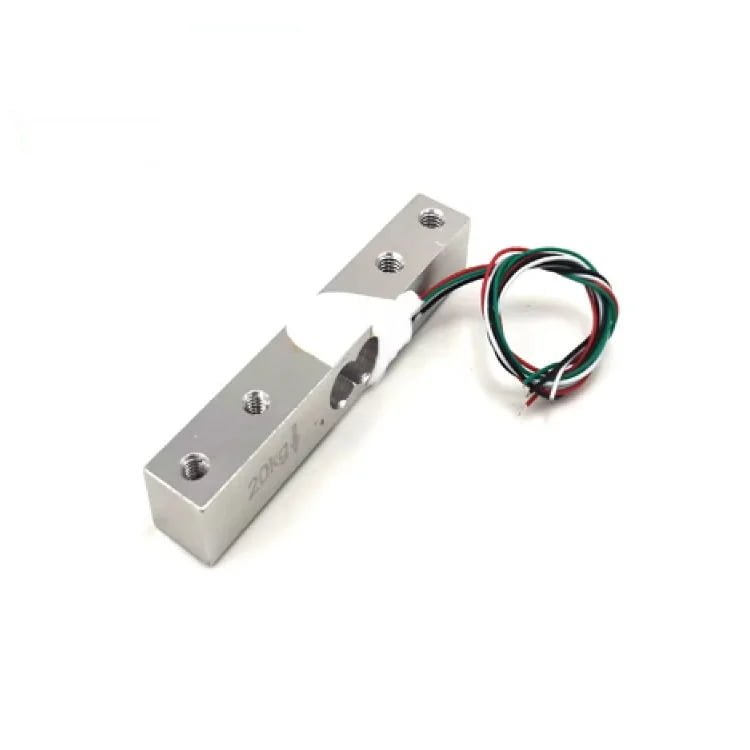
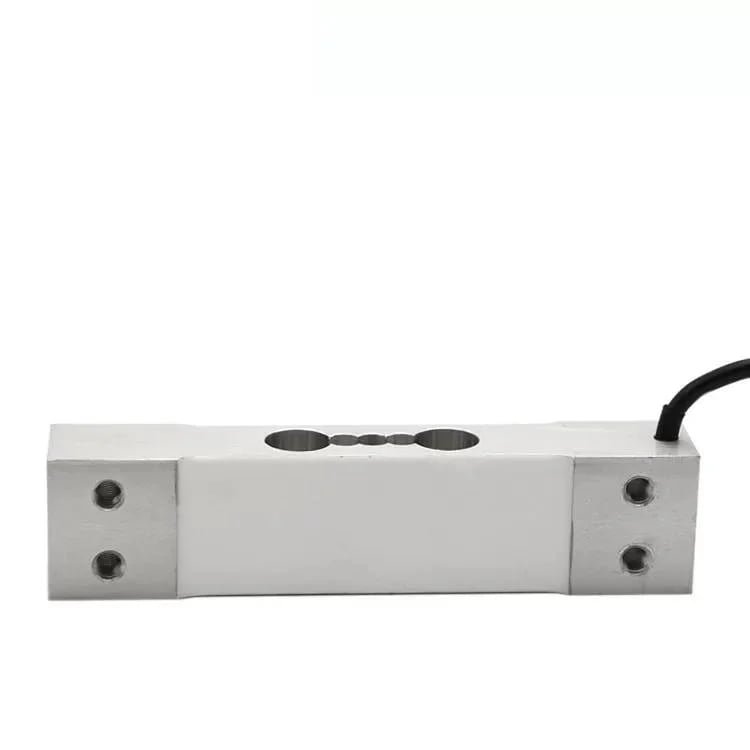
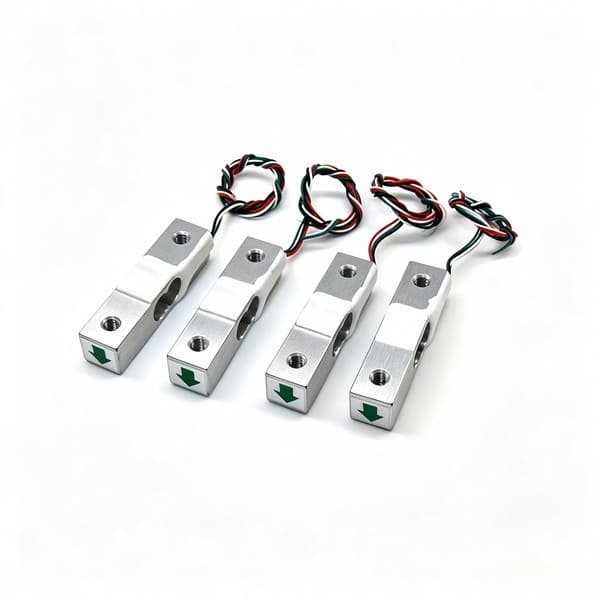
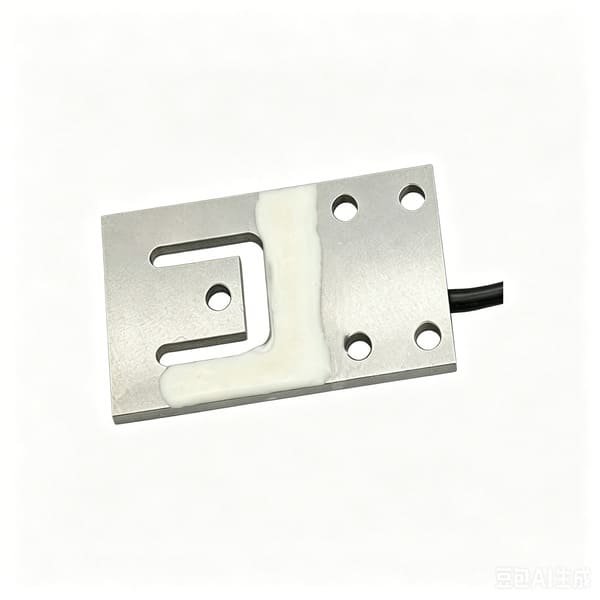
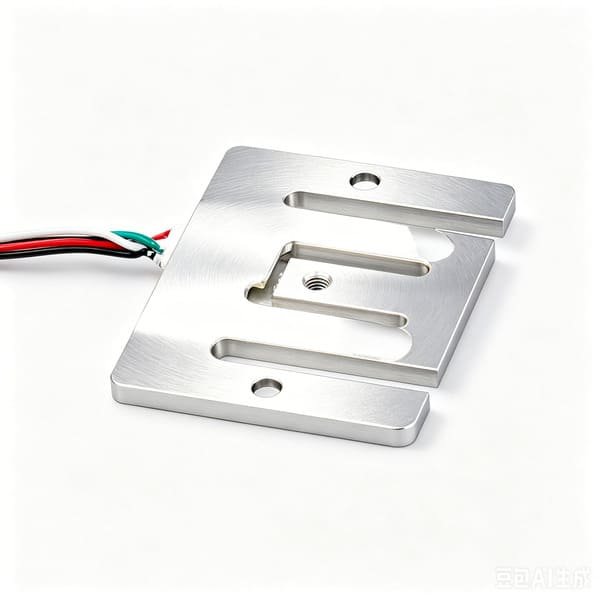
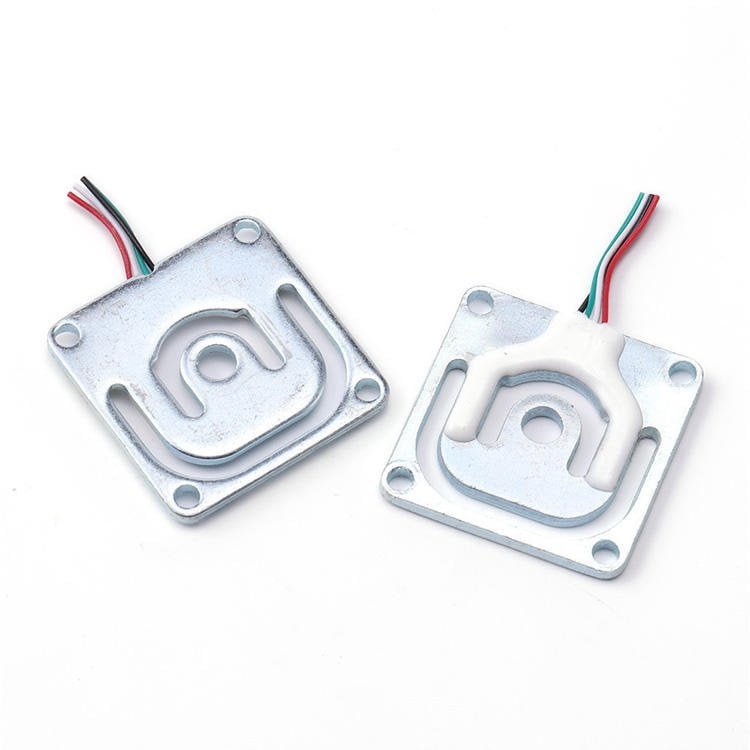
If you want the wider picture before choosing, the complete guide to load cells covers the families and their principles, and the selection guide walks the trade-offs between them.
Bowl platform, seasoning-line cells, cassette deck, junction box, weighing module with tare and gating hooks, matched output sets, cable and connector assemblies — plus a test plan with the numbers recorded per shipment. Tell me the bowl gross, the smallest dose, the heater layout and whether the machine washes itself; usually answered within 12 hours. Custom capacities, mounting patterns and cable lengths are routine work, and trial orders are welcome.