
Precision Weighing in Agriculture: How load cells installed on a TMR feed mixer wagon for precision feeding
Written by: Robin — Load Cell Export Specialist, Vektorforce
Reading time: 12 minutes | Last updated: August 2026
In This Article
- Why Precision Weighing Matters in Agriculture
- Case Study: A Dairy Farm’s TMR Weighing Challenge
- 7 Critical Factors for Agricultural Load Cell Selection
- Common Load Cell Types for Farm Equipment
- Beyond the Sensor: The Weighing Ecosystem
- Agricultural Machinery That Needs Load Cells
- FAQ: Agricultural Weighing Sensors
1. Why Precision Weighing Matters in Modern Agriculture
I still remember the first time I walked into a mid-sized dairy farm in Hebei Province back in 2018. The farm manager — let’s call him Mr. Li — showed me a stack of crumpled notebooks where his workers manually recorded how many kilos of corn silage, alfalfa, and mineral supplements went into each batch of feed. “Some days the cows produce 32 liters,” he said, “other days it drops to 27, and I don’t know why.”
That conversation stuck with me because it captures the fundamental problem that precision weighing solves in agriculture: you cannot manage what you cannot measure.
Did you know? Feed represents up to 60% of a dairy farm’s total production cost. A weighing error of just 2–3% on a medium-sized farm can translate to tens of thousands of dollars in wasted feed each year — not to mention the health and productivity impact on the herd.
The global shift toward precision agriculture is not a buzzword — it’s an economic necessity. With farmland shrinking and labor costs rising, farmers need every kilo of input to count. Companies like Dinamica Generale have built entire ecosystems around this principle: load cells that capture weight data, indicators that process it, cloud software that analyzes it, and NIR sensors that measure feed quality — all working together to squeeze maximum value from every batch of feed.
But at the heart of this entire system sits a humble component: the load cell. Without accurate, durable load cells, the entire precision feeding chain collapses. And after spending over a decade helping agricultural OEMs and farmers select and deploy load cells for everything from TMR feed mixers to forage wagons, I’ve learned that choosing the right sensor is both an art and a science.
2. Case Study: A Dairy Farm’s TMR Weighing Challenge
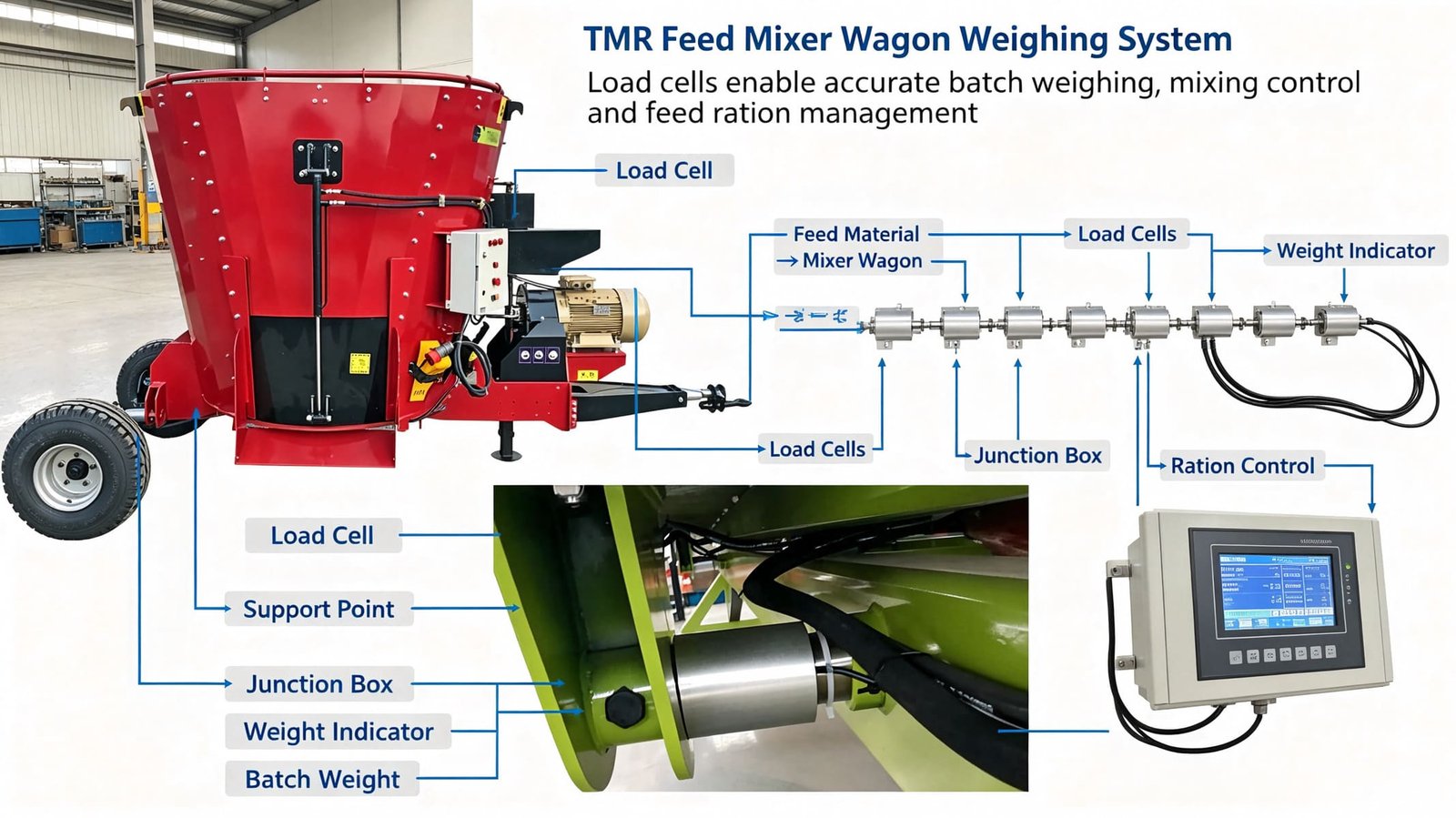
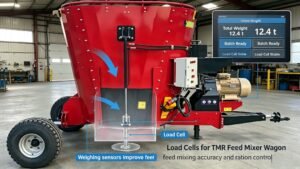
Two years ago, an agricultural machinery manufacturer from Shandong approached me with a problem. They were building a fleet of TMR (Total Mixed Ration) feed mixer wagons — the kind towed behind a tractor, with a vertical auger inside that blends roughage, concentrates, and mineral additives into a uniform feed mix. Their end customer, a 500-head dairy operation, was losing money because inconsistent feed rations were causing milk yield fluctuations.
The Challenge
The manufacturer had initially tried using shear beam load cells mounted under the mixer body. The sensors worked fine on smooth pavement. But here’s the reality of a working dairy farm: these wagons bump over potholes, navigate muddy tracks, and brake suddenly with a full load. Within three months, two of the four shear beam elastic elements had cracked from impact fatigue.
The farmer was frustrated. The OEM was embarrassed. And they both called me.
The Diagnosis
After visiting the farm and inspecting the failed sensors, the root cause was clear. Shear beam load cells are excellent for static weighing — they’re precise, cost-effective, and easy to install. But they have a critical weakness: the shear web is a stress concentration point. When subjected to the kind of multi-directional shock loads that occur during tractor braking, acceleration, and rough-terrain travel, the elastic element fatigues and eventually fractures.
Here’s a quick comparison of the two structures:
| Feature | Shear Beam | Bending Beam (Round Bar) |
|---|---|---|
| Structure | I-beam with shear web | Solid round bar / bending beam |
| Shock Resistance | Moderate — stress concentration at web | Excellent — uniform stress distribution |
| Accuracy Class | C3–C4 (0.02–0.03%) | C1–C3 (0.1–0.5%) |
| Best Use Case | Platform scales, hopper weighing (static) | On-board vehicle weighing, trailers, wagons |
| Customizability | Limited by I-beam geometry | Highly customizable dimensions |
The Solution
We recommended switching to a custom round bar / bending beam load cell arrangement — four sensors per wagon, one at each corner of the mixer body. Here’s why this approach made sense:
- Mechanical robustness. A solid cylindrical bending beam has no shear web to fail. It flexes as one continuous piece of alloy steel, distributing stress evenly. Think of it like a sturdy rod bending under load rather than a notched beam concentrating stress.
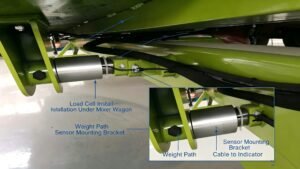
- Installation geometry. The round bar design allowed us to mount the sensor between the wagon frame and the axle beam, with one end fixed to the chassis and the load end supporting the mixer body. This 4-point setup gave the wagon excellent lateral stability while isolating the sensors from twisting forces.
- Overload headroom. We specified sensors with 150% safe overload rating. Why? Because a TMR wagon with 8,000 kg of feed hitting a pothole generates momentary loads far exceeding static weight. Building in headroom is the single cheapest insurance policy in load cell selection.
- Custom dimensions. The OEM had specific mounting hole patterns inherited from their original shear beam design. We manufactured the bending beam sensors to drop-in dimensions, eliminating the need to re-drill or weld the wagon frame.
The result? Six months after the retrofit, the farmer reported consistent TMR rations within ±1% target weight, and milk yield stabilized at 33–34 liters per cow per day — a measurable improvement from the previous 27–32 liter fluctuation. The OEM went on to standardize this sensor configuration across their entire product line.
3. 7 Critical Factors for Agricultural Load Cell Selection
Agricultural environments are unforgiving. Unlike a clean factory floor or a calibrated laboratory, farm equipment operates in mud, dust, rain, freezing cold, and scorching heat — often all within the same week. Here are the seven factors I always evaluate when recommending sensors for agricultural applications:
3.1 Temperature Range and Compensation
Farm equipment sits outside. In northern China and Europe, winter nights drop to -30°C. In summer, the metal body of a wagon parked under direct sun can reach 60°C or higher. Standard commercial load cells typically compensate for -10°C to +40°C, which is not sufficient for agricultural use. I always specify sensors with temperature compensation from -30°C to +60°C at minimum, using nickel-based strain gages with matched thermal expansion coefficients to the elastic element material.
3.2 IP Rating — Go for IP68, Not IP67
The difference matters. IP67 means protection against temporary immersion (30 minutes at 1 meter). IP68 means protection against continuous immersion under pressure — which is what happens when a forage wagon gets pressure-washed daily, or when sensors sit under accumulated mud and manure for weeks. For agricultural load cells, IP68 is the baseline, not a premium feature. I’ve seen IP67 sensors fail within a season simply from moisture ingress through the cable gland.
3.3 Material: Alloy Steel vs. 17-4PH Stainless
For general agricultural use, heat-treated alloy steel with a high-quality coating (480+ hours salt spray resistance) offers the best price-performance ratio. However, for applications involving fertilizers, manure, silage acids, or coastal/saline environments, I recommend 17-4PH stainless steel. It costs roughly 3–5x more than alloy steel, but the corrosion resistance eliminates premature failures. The decision tree is simple: if your customers wash equipment with water and the sensors are exposed to corrosive materials, go stainless.
3.4 Capacity — Always Over-Spec for Shock Loads
This is the mistake I see most often. An OEM calculates the static weight of a full wagon — say 8,000 kg — and selects 4 × 2,500 kg sensors. That works on paper. In the field, dynamic shock loads during transport can reach 1.5–2x the static load. I always recommend selecting sensors where the individual sensor capacity exceeds the maximum per-corner static load by at least 50%, preferably 100%. For that 8,000 kg wagon split across 4 corners (2,000 kg each), I’d specify 4,000–5,000 kg per sensor minimum.
3.5 Cable: PUR, Not PVC
PVC cables crack in sub-zero temperatures and degrade under UV exposure. Polyurethane (PUR/PU) cables offer a working temperature range of -40°C to +70°C, excellent abrasion resistance, and resistance to oils and agricultural chemicals. Yes, they cost about 20% more, but replacing a failed sensor because of a cracked cable costs an order of magnitude more in downtime and service calls.
3.6 Strain Gage Sealing
The strain gage cavity must be hermetically sealed with industrial-grade potting compounds. We use a multi-layer approach: first, a thin conformal coating over the gages themselves, then a flexible silicone sealant layer, and finally a rigid epoxy or polyurethane potting compound that fills the entire cavity. This triple-layer protection is standard in agricultural specification sensors but often skipped in budget commercial units.
3.7 Custom vs. Off-the-Shelf
Agricultural machinery — unlike a laboratory balance or a retail scale — comes in wildly varied shapes, sizes, and mounting configurations. A standard off-the-shelf load cell might have the right capacity but the wrong bolt pattern, the wrong cable exit direction, or the wrong overall profile. Custom-engineered load cells that match the OEM’s specific mechanical envelope often eliminate costly frame modifications. At our company (Winsentek), roughly 70% of our agricultural projects involve some degree of customization — from modifying mounting dimensions to designing entirely new elastic element geometries.
Pro Tip: If you’re developing a new piece of agricultural equipment, involve your load cell supplier during the design phase, not after the frame is welded. We’ve saved OEMs thousands in rework by suggesting minor frame modifications that simplified sensor integration.
4. Common Load Cell Types for Agricultural Equipment
Different machines demand different sensor architectures. Here are the three most common types I deploy in agricultural applications, and where each one shines:
A. Round Bar / Bending Beam Load Cell
Best for: TMR feed mixers, forage wagons, grain carts, seed tenders, spreaders.
This is the workhorse of on-board agricultural weighing. The cylindrical bending beam design handles multi-directional forces without stress concentration. Four sensors per vehicle create a stable weighing platform. Typically offered in capacities from 2t to 20t per sensor, with accuracy class C1–C3 (0.1–0.5%).
B. Draw Bar / Towing Eye Load Cell
Best for: Trailed forage wagons, balers, spreaders, grain carts.
A specialized load cell integrated into the towing hitch or drawbar eye. It measures the tongue weight and calculates the total load on the trailer. This is a clever retrofit solution — you get weighing capability without modifying the vehicle frame. Dinamica Generale’s Draw Bar sensor is a prime example in this category.
C. Pin / Hinge Pin Load Cell
Best for: Tipper trucks, trailers, any application with existing pivot points.
A pin load cell replaces a standard hinge pin or pivot shaft. It measures shear force at the pivot, allowing real-time load monitoring without taking up additional space. Ideal for retrofit applications because you simply swap out the existing pin for an instrumented one. Typically manufactured from 17-4PH stainless steel for the high-wear pivot environment.
| Load Cell Type | Accuracy | Shock Resistance | Retrofit Friendly | Typical Price Range |
|---|---|---|---|---|
| Round Bar / Bending Beam | 0.1–0.5% | Excellent | Moderate — needs frame mounts | $80–$250 / sensor |
| Draw Bar / Towing Eye | 0.2–0.5% | Good | Excellent | $200–$500 / sensor |
| Pin / Hinge Pin | 0.3–0.5% | Excellent | Excellent — drop-in replacement | $300–$800 / sensor |
5. Beyond the Sensor: The Complete Weighing Ecosystem
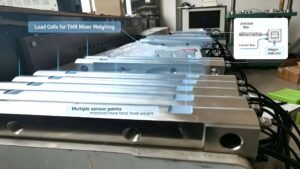
A load cell alone doesn’t solve a farm’s weighing problem. It needs to be integrated into a system. Here’s what the full picture looks like, and why successful OEMs think about the entire chain:
Weight Indicators: The Brain of the Operation
The weight indicator (also called a weighing terminal or junction box with display) takes the mV signals from each load cell and converts them into meaningful weight readings. For agricultural use, I recommend indicators that can:
- Handle 4–6 load cells simultaneously with digital junction / summing capability
- Store 20+ recipes with 15–20 components each — critical for TMR operations
- Generate distribution programs that track which pen received which ration
- Log overload events and working hours for predictive maintenance
- Export data wirelessly via 4G modem or Wi-Fi to cloud software
Indicators like the DG500 (for small/medium farms, 24 recipes) and DG8000-IC (for large operations, touchscreen, full IoT connectivity) represent the spectrum available in the market today.
Wireless Connectivity and Mobile Apps
Modern agricultural weighing is increasingly mobile. Farmers don’t want to climb down from the tractor to check a display — they want the data on their phone. Solutions like Dinamica Generale’s DinaTEL 3 (wireless remote with display at up to 25-meter range) and FarmCHEF (cloud-based ration management app) are becoming standard. When working with OEMs, I always ask: “Does your indicator talk to mobile devices? Does it upload to the cloud?” — because those questions are increasingly non-negotiable for end customers.
Cloud Software — The Real ROI
The load cell gives you a number. The indicator records it. But feed management software like DTM (Daily TMR Manager) turns that data into actionable insights: feed cost per liter of milk, dry matter intake trends, inventory tracking, and feeder performance analytics. This is where the ROI of precision weighing becomes undeniable. Farms that adopt cloud-based feed management typically achieve 15–20% reduction in feed waste within the first year.
NIR Integration — Weighing Meets Quality Analysis
A scale tells you how much feed you loaded. Near-Infrared (NIR) analysis tells you what’s in it. Systems like EvoNIR mount on the feed mixer to measure dry matter, protein, starch, fiber, and ash content in real time — and then automatically adjust the loading weights to compensate for ingredient variability. This is the cutting edge of agricultural weighing, and it’s why load cells in modern farm equipment are not standalone devices but part of a closed-loop precision feeding system.
6. Agricultural Machinery That Needs Precision Load Cells
Here’s a practical field guide to the most common agricultural machines that benefit from on-board weighing, organized by application type:
| Machine Type | Application | Recommended Sensor | Typical Capacity |
|---|---|---|---|
| TMR Feed Mixer | Precision ration blending for dairy/beef | 4 × Bending Beam | 3t – 10t each |
| Forage Wagon | Yield monitoring during harvest | Draw Bar + Bending Beam | 5t – 15t total |
| Grain Cart | Yield tracking, load-out weighing | 4 × Bending Beam or Pin | 5t – 20t each |
| Seed Tender | Seed inventory management | 3 × Bending Beam | 1t – 3t each |
| Fertilizer Spreader | Variable rate application control | 3–4 × Bending Beam (SS) | 2t – 8t each |
| Manure Spreader | Application rate monitoring | 4 × Bending Beam (SS) | 3t – 10t each |
| Baler / Bale Wrapper | Bale weight monitoring, yield mapping | 2 × Pin + Draw Bar | 1t – 5t total |
| Trailer / Tipper | Load verification, legal compliance | Pin Load Cells at pivot | 10t – 30t total |
| Compactor | Compaction density monitoring | Custom spindle / bending beam | Application-specific |
7. Frequently Asked Questions About Agricultural Load Cells
Q: What accuracy class do I need for agricultural weighing?
For most agricultural applications (feed mixing, yield monitoring, spreader control), C1 to C3 (0.1% to 0.5%) is sufficient. You don’t need laboratory-grade precision on a vibrating tractor. What you do need is repeatability — the sensor should give the same reading for the same load every time. For pharmaceutical or high-value additive weighing, step up to C4 or better.
Q: How long do agricultural load cells typically last?
A properly specified, IP68-rated, PUR-cabled load cell in an agricultural application should last 5–8 years under normal conditions. The primary failure modes I see are: (1) cable damage from abrasion or animal interference, (2) moisture ingress through improperly sealed connectors, and (3) mechanical overload from accidents. All three are preventable with good design.
Q: Can I retrofit weighing to an existing feed mixer?
Yes, and it’s a common request. The easiest retrofit path is using pin load cells at existing pivot points (no frame modification needed) or draw bar load cells integrated into the towing hitch. Frame-mounted bending beam sensors require welding mounting brackets, which is more invasive but offers better accuracy for multi-point weighing.
Q: What’s the difference between static and dynamic weighing on farm equipment?
Static weighing = the vehicle is stationary, suspension settled, no movement. You get the best accuracy (±0.1–0.5%). Dynamic weighing = the vehicle is moving, loading, or unloading. Accuracy drops to ±1–3% depending on vibration and motion. Most TMR and forage wagon systems are designed for static batch weighing (stop, load, weigh, go). True dynamic weighing on rough terrain requires accelerometer compensation and is significantly more complex.
Q: Stainless steel or alloy steel — which should I choose?
Use alloy steel with high-grade coating (480h+ salt spray) for general feed-related applications where sensors are not exposed to corrosive chemicals. Choose 17-4PH stainless steel for fertilizer spreaders, manure spreaders, silage environments, coastal farms, and any application with frequent high-pressure washing. The 3–5x material cost premium is justified by much longer service life in corrosive environments.
Q: How do I protect load cell cables from damage on farm equipment?
Three practical measures: (1) Route cables inside protective conduit or along frame rails away from moving parts. (2) Use PUR-sheathed cables — they resist abrasion, oil, and temperature extremes far better than PVC. (3) Install strain relief loops at each connection point so that pulling on the cable doesn’t pull on the gland or connector. On manure spreaders and silage equipment, I also recommend adding a secondary spiral wrap over the cable for extra mechanical protection.
Final Thoughts: Get the Sensor Right, and Everything Else Follows
In the rush to adopt cloud software, mobile apps, and NIR analysis, it’s easy to overlook the component that starts the entire data chain. But as I’ve learned from countless farm visits and OEM projects: if the load cell is wrong, everything that depends on its data is wrong too.
Take the time to evaluate the operating environment. Talk to the farmers who will use the equipment. Understand the failure modes of previous designs. And don’t be afraid to go custom — the cost of a tailored load cell solution is almost always lower than the cost of field failures and warranty claims from a standard part that doesn’t quite fit.
At Vektorforce, our engineering team — with decades of combined experience from companies like Zemic, Flintec, and Anyload — specializes in developing custom load cell solutions for agricultural OEMs. From strain gage selection to elastic element design to final environmental testing, we manage the entire development process in-house.
Whether you’re designing a new TMR mixer, retrofitting an existing grain cart, or exploring precision agriculture for the first time, I’d be happy to discuss your project and help you find the right weighing solution.
Need a Custom Load Cell Solution for Your Agricultural Equipment?
We provide OEM-customized load cells for TMR mixers, forage wagons, grain carts, spreaders, and more.
Alloy steel or 17-4PH stainless | IP68 sealed | PUR cabled | Custom dimensions available.
About the Author
Robin is a load cell export specialist at Vektorforce with over 10 years of experience in designing and supplying precision weighing sensors for agricultural machinery, industrial automation, and smart equipment. He has personally managed load cell customization projects for OEMs across 20+ countries, helping farmers and equipment manufacturers achieve measurable improvements in feed efficiency and operational control.