
Load Cells for Reverse Vending Machines (RVMs): A Complete OEM Guide
Discover how load cells enable accurate container-weight monitoring in reverse vending machines, reduce service visits, and help operators run profitable deposit-return schemes worldwide.

Table of Contents
1. What Is a Reverse Vending Machine?
A reverse vending machine (RVM) is an automated collection point that accepts used beverage containers—PET bottles, aluminum cans, glass bottles—and gives consumers an immediate reward such as a deposit refund, voucher, charity donation, or loyalty points.
Unlike a normal vending machine that dispenses products, an RVM receives them. It uses a combination of technologies to identify, sort, compact, and store containers:
- Barcode / RFID / vision recognition – identifies container material and deposit value
- Infrared sensors – detect inserted items and prevent misuse
- Compaction / shredding module – reduces storage volume
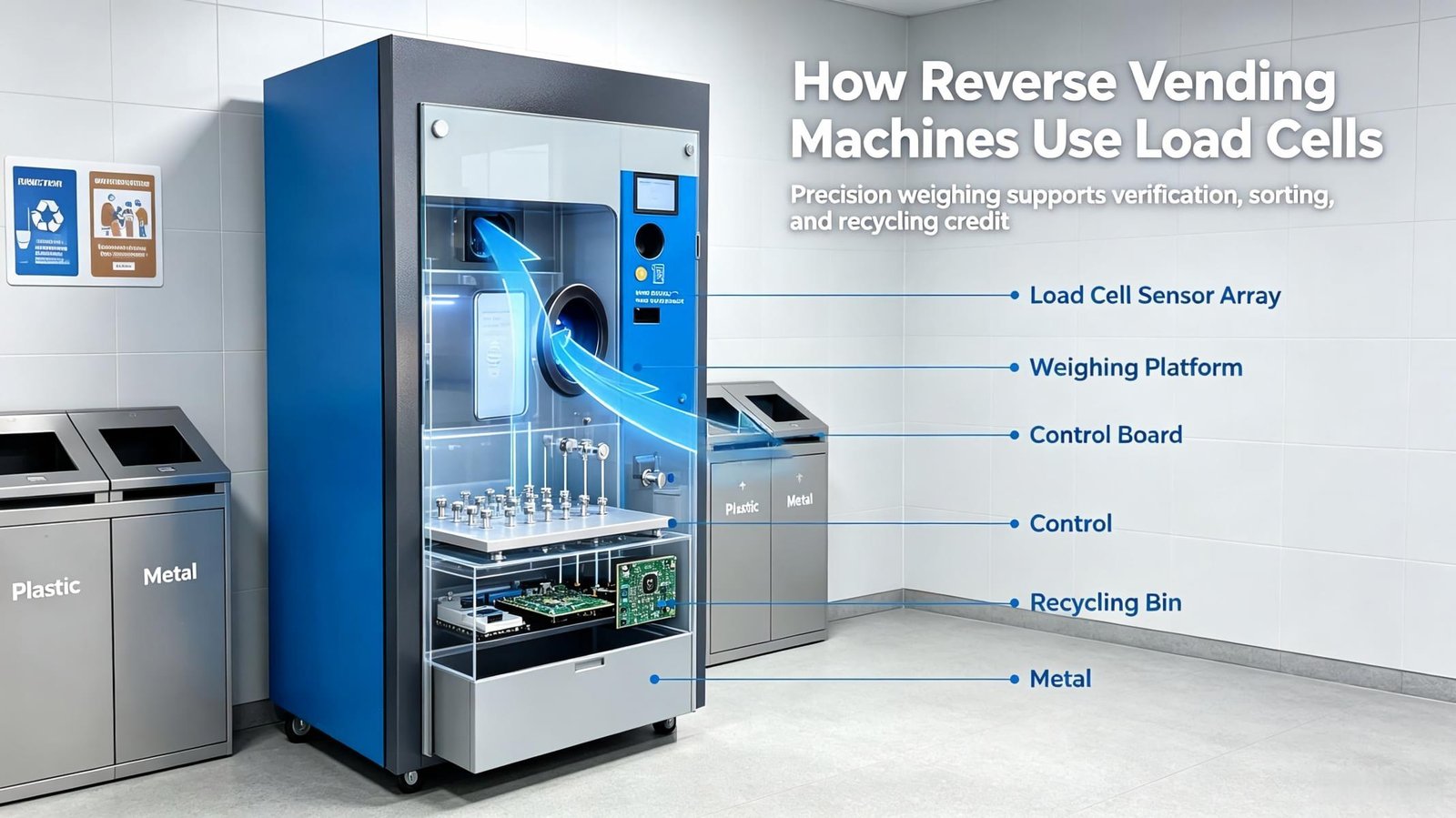
- Load cells / weight sensors – measure the collection bin weight in real time
- Cloud-connected controller – reports status and triggers collection alerts
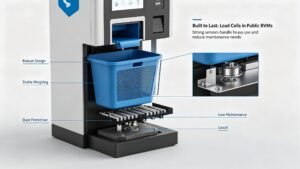
Load cells sit at the bottom of the internal collection container. As bottles and cans accumulate, the measured weight rises. When the container reaches a preset threshold, the machine sends an alert so staff can empty it before it overflows.
2. Why Load Cells Are Critical in RVMs
Why not just use a simple level sensor? Because weight is the most reliable proxy for bin fill level in an RVM. Vision and ultrasonic sensors can be fooled by oddly shaped bottles or compaction. A load cell measures the actual mass inside the bin, giving the operator a precise, drift-free reading.
Specifically, load cells help RVM operators:
- Optimize collection routes – empty bins only when full, reducing fuel and labor costs
- Prevent jams and overflows – stop acceptance before the container is physically full
- Detect container removal – sudden weight drop flags maintenance or theft events
- Verify compaction efficiency – compare weight before and after compaction cycles
- Enable predictive maintenance – long-term weight trends reveal wear or sensor drift
3. How a Load Cell Works Inside an RVM
The weight measurement chain in a reverse vending machine follows five clear steps:
1. Force Applied
Bottles and cans collect in the bin, pressing down on the load cell platform.
2. Strain Gauge Deforms
The metal beam bends microscopically, changing electrical resistance on bonded strain gauges.
3. mV Signal Output
A Wheatstone bridge outputs a low millivolt signal proportional to the applied weight.
4. ADC Conversion
An amplifier (HX711, ADS1232, etc.) converts the analog signal into a digital value.
5. Cloud Alert
The MCU compares weight to thresholds and sends fill-level alerts to the operator dashboard.
4. 6 Key Benefits for Operators & OEMs
Reduce Service Costs
Route collection teams only to machines that are actually full. Typical operators cut collection visits by 30–50%.
Prevent Overflow & Downtime
Set multiple thresholds (e.g., 70%, 90%, 100%) and stop accepting containers before the bin jams.
Verify Deposit Integrity
Combine weight data with barcode recognition to detect unusual container weights or fraud attempts.
Compact Design
Parallel beam and single-point load cells fit slim RVM footprints without sacrificing accuracy.
Long-Term Stability
Quality alloy-steel or aluminum load cells maintain calibration over millions of cycles.
Environmental Impact
Higher uptime means more containers recycled and less landfill waste.

5. Load Cell Types & Selection Guide
Not every load cell suits the RVM environment. The bin base is exposed to vibration from compaction, occasional liquid residue, temperature swings, and high cycle counts. Here is how the most common sensor types compare:
7-Point OEM Selection Checklist
- Capacity: Rate the sensor for at least 1.5× the maximum expected bin weight.
- Accuracy class: C3 or C6 OIML is sufficient for fill-level monitoring; use C6 for deposit-refund verification.
- Environmental sealing: IP65 minimum; IP67/IP68 if the bin may collect liquid residue.
- Overload protection: 150% safe overload and 300% ultimate overload are standard for public-use machines.
- Cable & connector: Shielded 4/6-wire cable with strain relief; optional M12 connector for service swaps.
- Output signal: 2 mV/V analog for cost-sensitive designs; RS-485 / CAN for smart connected RVMs.
- Certifications: OIML, NTEP, CE, RoHS for global deployment.
6. Recommended Load Cells for RVMs
Below are load cell families commonly used by RVM manufacturers. Exact model numbers can be customized by capacity, cable length, and connector.
Note: Model names are representative. Contact our engineering team for datasheets and custom mechanical integration.
7. Wiring & Signal Conditioning
Most RVM load cells use a 4-wire or 6-wire configuration. The table below shows the standard color code for a 4-wire analog load cell connected to an HX711 or similar ADC module:
Important: Manufacturers sometimes swap black and white. If readings are inverted or near zero, swap the signal wires (S+/S−) or use a multimeter to identify the excitation pair (higher resistance, typically 350 Ω) versus the signal pair.
Signal Conditioning Tips
- Place the ADC as close to the load cell as possible to reduce electrical noise from the compaction motor.
- Use a shielded cable and connect the shield to ground at one end only.
- Average 3–5 samples per second; RVM fill-level monitoring does not need high-speed sampling.
- Apply a dead band (e.g., ignore changes below 50 g) to avoid false alerts from vibration.
- Implement tare reset after every bin change to maintain long-term accuracy.
8. OEM Integration Best Practices
Building an RVM is a mechanical, electrical, and software challenge. Based on deployments with RVM OEMs, here are the integration points that matter most:
- Mechanical mounting: The load cell must sit on a flat, rigid frame. Avoid side forces caused by bin sliding. Use overload stops to protect the sensor during service.
- Cable routing: Keep sensor cables away from motor power lines. Use cable chains or grommets at every bend point.
- Calibration: Calibrate with empty bin (tare) and a known weight equal to 80% of rated capacity. Store the calibration factor in non-volatile memory.
- Software logic: Define fill-level states (Empty → Normal → Near Full → Full → Service Required). Add hysteresis to prevent state flapping.
- Remote monitoring: Send weight, state, and error codes to the cloud dashboard via MQTT or HTTPS.
- Field service: Design the bin and sensor assembly for quick swap. A plug-in connector reduces mean maintenance time from 30 minutes to under 5 minutes.
9. Market Trends & Real-World Examples
The global reverse vending machine market is growing rapidly as deposit-return schemes (DRS) expand across Europe, North America, and Asia-Pacific. Key data points for OEMs and investors:
Leading regions and programs include:
- European Union: Single-use plastics directive pushes member states toward 90% collection rates for beverage bottles by 2029.
- Norway & Germany: Long-running DRS systems achieve 95%+ return rates, with RVMs deployed in supermarkets and public spaces.
- United States: States like California, Maine, Oregon, and New York continue to expand bottle-bill programs.
- India & Southeast Asia: Growing pilot programs in malls and metro stations address plastic waste at the source.
Companies such as RVM Systems and Envipco are examples of global RVM solution providers driving this infrastructure expansion.
10. FAQ
How many load cells does an RVM need?
Most compact RVMs use a single platform load cell under the collection bin. Larger machines or multi-compartment models may use one sensor per compartment or four corner cells under a large bin.
What accuracy is required for RVM fill-level monitoring?
±1% of full scale is usually sufficient for fill-level alerts. If the machine also verifies deposit value by weight, aim for ±0.5% or better and use a C6-class load cell.
Can load cells survive vibration from compaction?
Yes, provided the sensor has adequate overload protection and the software filters out transient vibration with averaging and dead bands.
What happens if liquid residue enters the load cell area?
Choose IP67 or IP68 sealed stainless steel load cells, route cables upward, and include drainage channels in the frame design.
Is a digital load cell better than analog for RVMs?
Digital cells simplify calibration and long-distance communication, but they cost more. Analog + HX711 is still the most common choice for cost-sensitive RVMs.
How often should RVM load cells be calibrated?
At installation, after every bin replacement, and during annual maintenance. A one-button tare function built into the UI makes routine recalibration simple.
Can you customize load cells for our RVM design?
Yes. Capacity, cable length, connector type, mounting holes, and output signal can all be customized for volume OEM orders.
Ready to Source Load Cells for Your RVM Project?
Whether you are designing a compact indoor reverse vending machine or a high-capacity outdoor recycling station, the right load cell is critical for reliability, accuracy, and total cost of ownership. Our parallel beam and platform load cells are already used in RVM deployments worldwide.
Get a tailored quotation for your RVM sensor requirements:
By Vektorforce | Published: