
Sep 9, 2026
9 min read
Smart Gas · IoT Weighing
Load Cells for Smart LPG Gas Cylinders: Creep, Battery Life, and the Truth About Weighing Cooking Gas
A 1,200-base pilot in India taught me more about permanently loaded load cells than ten years of catalog spec sheets. Here is the whole engineering story — the creep drift that triggered false “empty” alarms, the battery problem nobody budgeted for, and how we made cylinder scales that hold ±0.15 kg for six months outdoors.
In this article
- Why everyone suddenly wants to know how much gas is left
- Why weight beats pressure and ultrasonic for LPG
- The project: 1,200 smart cylinder bases in India
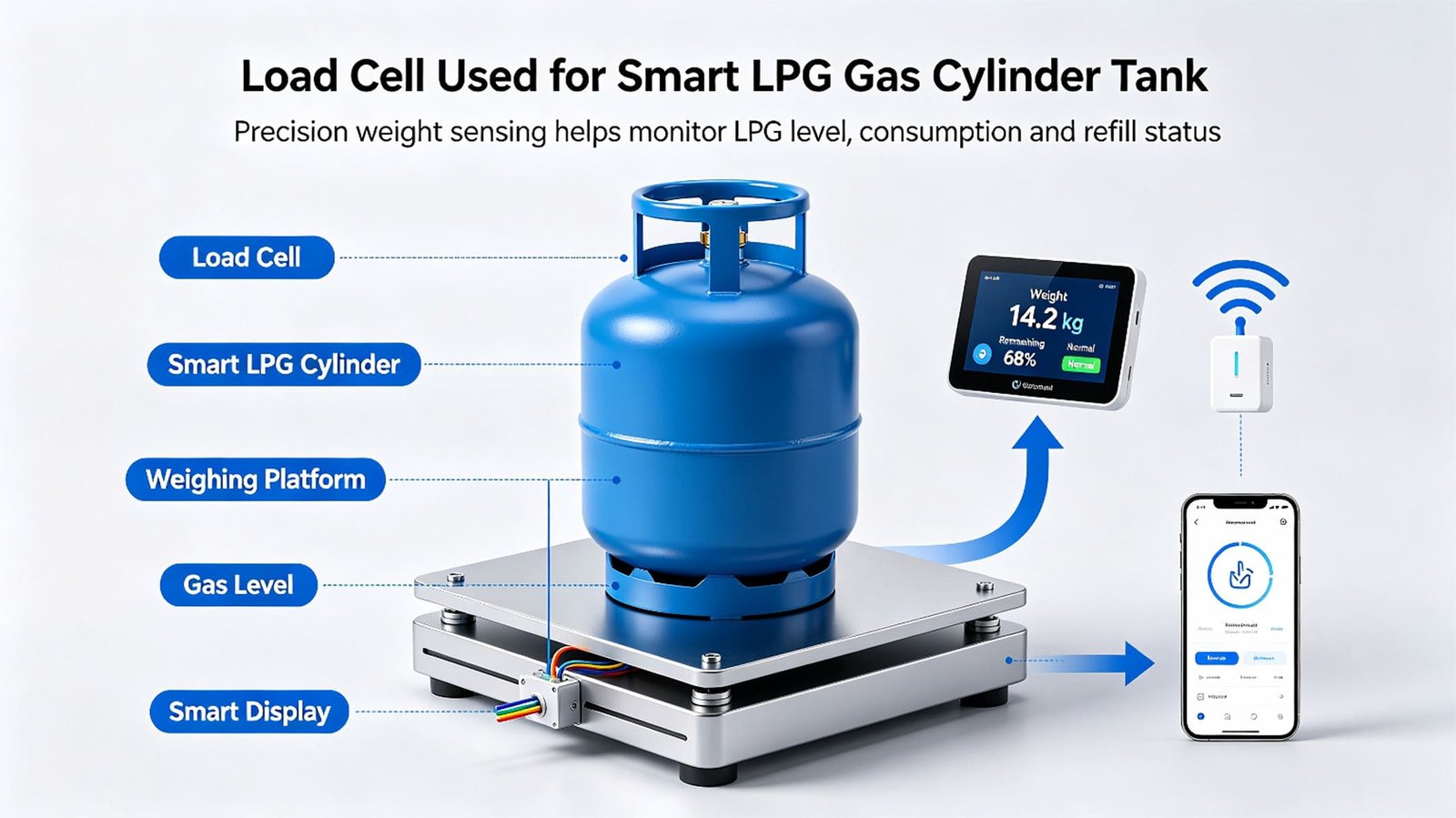
- How a smart cylinder scale base is built
- The creep problem nobody specs for
- Three field failures and how we fixed them
- Where the weighing core ends
- Load cells for smart gas cylinder projects
- FAQ
1. Why Everyone Suddenly Wants to Know How Much Gas Is Left
Nobody checks their gas cylinder until the flame dies mid-dinner. That single moment — the run-out — is expensive for everyone in the chain: the family orders an emergency delivery, the distributor sends a truck for one bottle, and the half-used cylinder gets swapped early because nobody trusts the guesswork.
The numbers behind this are bigger than most engineers expect. Market researchers at Market Intelo value the global smart LPG cylinder market at $4.2 billion in 2025, heading to $7.9 billion by 2034 (7.8% CAGR), with the LPG segment alone worth $1.36 billion. Asia Pacific holds 42.3% of that revenue — India, Indonesia, Vietnam — where LPG is the primary cooking fuel for hundreds of millions of households. A second research house (Growth Market Reports) is even more aggressive: $2.36 billion in 2024 growing at 15.2% CAGR. And the remote tank-monitoring layer that carries all this data is expected to reach $3.21 billion by 2026 at a 23.3% CAGR, with roughly 80% of fuel dealers already using tank monitors to plan delivery routes.
What is actually being sold is not a sensor. It is certainty: “5 days till empty,” an automatic reorder before the customer notices, fewer wasted delivery runs. Products like GasOwl in New Zealand (two stainless scales under a pair of 45 kg bottles, a battery-powered comms hub, an app that shows kg and % remaining) and GasVisor in Munich (strap-on sensors plus a precision base-plate scale for CO₂ cylinder fleets, LTE-M, TRGS 510-compliant dashboards) are already proving the category in residential and commercial markets.
I have spent the last year supplying the load cells that sit inside scales exactly like these. This article is everything I wish someone had written before my first smart-cylinder project — especially the part about creep, which is where most of these projects quietly fail.
2. Why Weight Beats Pressure and Ultrasonic for LPG
Before you pick a load cell, it is worth being sure that weight is the right measurement. For LPG, it is — and the physics is more interesting than most people think.
An LPG cylinder is a liquid + vapour system. As long as any liquid remains, the pressure inside is set almost entirely by temperature, not by how much liquid is left. A cylinder at 20% fill and a cylinder at 80% fill sit at nearly the same pressure on the same afternoon. That is why a pressure gauge on an LPG cylinder tells you nothing useful — right up until the day it suddenly tells you everything, because the liquid is gone and the pressure collapses.
| Method | What it actually measures | Typical accuracy | Catch |
|---|---|---|---|
| Pressure transducer | Vapour pressure ≈ temperature, until liquid runs out | Near-useless for level | Flat reading at every fill level; may require tapping the valve |
| Ultrasonic / sonar (e.g., Mopeka-class) | Liquid line through the tank wall | ≈ ±1% (vs ±5% for mechanical gauges) | Mounting position and tank geometry sensitive; reads level, not mass |
| Weight (load cell base) | Remaining gas mass — directly | ±0.1–0.25 kg on a 14.2–45 kg cylinder | Needs base hardware; must survive permanent load for years |
Weight is the only method that measures what the customer actually pays for — kilograms of gas — with no dependence on cylinder shape, mounting angle, or the weather. Ultrasonic is a fine companion technology, and several of our customers combine both. But when an LPG distributor wants to bill, forecast, and schedule trucks on real numbers, they end up weighing.
3. The Project: 1,200 Smart Cylinder Bases in India
In early 2024 an IoT device maker in Pune — they build smart metering hardware for an LPG distributor — came to us with a deceptively simple brief: “We are building a residential gas cylinder scale that alerts users when they are running out of gas.” Domestic 14.2 kg cylinders (about 30 kg gross) plus 19 kg commercial bottles, a base under each cylinder, a battery-powered hub, and an app that reads in kg and percent-full.
Their first prototype was already built — with four off-the-shelf bathroom-scale half-bridge cells, chosen because they were cheap and in stock. It worked beautifully on the bench. Then 300 pilot units went into real kitchens in Nagpur and Pune, and three months later the field data came back:
The bases were reading an average of 0.9 kg low after 8 weeks of continuous load — on a cylinder that only holds 14.2 kg. That is a 6% error generated by the sensor, not the gas. Customers were getting “cylinder empty, order now” alerts with roughly two kilograms of gas still inside. Others, whose cells drifted the other way, saw the app insist they had gas the day the flame died. The distributor paused the rollout.
When they showed me the drift curves, the diagnosis was quick because I had seen this exact shape before in hospital bed weighing and in beehive scales: classic creep under permanent load, combined with a zero reference that was set once at the factory and never revisited. Nobody had asked the cell supplier for long-duration creep data, because nobody realized a gas cylinder scale is not a kitchen scale — it is a weighing device that stays loaded for months between cylinder swaps.
We rebuilt the sensing core around that reality. Six months later the pilot restarted at 1,200 bases; the fleet now holds ±0.15 kg over six months outdoors, batteries are clearing two years, and the distributor is planning the city-scale rollout. The rest of this article is how we got there.
4. How a Smart Cylinder Scale Base Is Built
Strip the plastics off a smart gas scale and the architecture is the same almost everywhere in the industry, from Auckland to Munich:
- 3 or 4 low-profile load cells inside the base — micro or flat/planar type, mounted between a top plate (the cylinder sits on it) and the bottom shell. Planar beams are the classic choice: 10–15 mm tall, arranged in sets of three or four per scale, giving the platform unlimited footprint without corner adjustment.
- A matched-output set — all cells in one base are supplied as a group with matched sensitivity and zero, so the summing board does not fight corner-to-corner imbalance.
- A small summing PCB or junction box, then a low-power ADC or digital transmitter — increasingly RS485 straight into the hub MCU.
- A battery-powered communication hub (BLE to the home, LTE-M/LoRaWAN to the cloud, or both) with a temperature sensor of its own.
Three cells on a triangle is the smarter geometry for outdoor use — it cannot rock on an uneven patio, and the math is self-levelling. Four cells suit rectangular retail-style bases. Capacity is sized so the cylinder gross weight sits at 30–60% of rated load, leaving genuine headroom for the day a delivery crew drops the bottle.
Rule of thumb from this project: for a 14.2 kg domestic cylinder (≈30 kg gross), a 4-cell base of 50 kg cells per corner is comfortable; for a 45 kg bottle (≈90–100 kg gross), 75–125 kg planar beams or a single 100–200 kg single-point cell under a 350 × 350 mm plate. Our WST1506 miniature indicator (Modbus RTU, 9–30 VDC, up to 1,280 readings/s) is a good fit when the OEM wants a display on the commercial units.
5. The Creep Problem Nobody Specs For
Here is the spec-sheet trap. A typical miniature load cell datasheet quotes creep as ±0.05% F.S. per 30 minutes (or per 3 minutes for the cheapest half-bridges). That number is measured in a lab, at room temperature, over half an hour. Your gas cylinder base will sit at 85–100% of full scale for 2 to 6 months straight, through summer kitchens and winter patios. The two situations are not related by any simple multiplication — creep is not linear in time, and it accelerates with temperature.
In our Pune case, the cells were quoted at ±0.05% F.S./30 min. Sounded tiny. Under eight weeks of continuous 30 kg load, the aggregate zero had walked 0.9 kg. Nothing was “defective” — the cells were simply never characterized for the job. When we ran the same cells through a 72-hour loaded creep bench, the long-term drift component was visible within a day, which is exactly why we now supply 72-hour creep curves with matched sets for smart-cylinder projects.
The fix has two halves — buy the right metal, then teach the software what a gas scale is:
- Specify creep over long windows. Ask for 72 h loaded data at 30 °C, not the 30-minute catalogue line. Cells built on aviation-grade aluminium with proper age-hardening hold ±0.02% F.S./5 min class performance on the bench and, more importantly, stay flat on the multi-month curve. Our planar beams for this market are held to that grade.
- Treat every cylinder swap as a free zero event. A swap is a 5-second unload-load cycle that the hub can detect unambiguously (load drops below 2 kg, then jumps above 15 kg within a minute). Capture the fresh tare at every swap, and the zero never ages more than one refill cycle — 4 to 8 weeks instead of 4 years. This single software habit erased most of the drift complaint volume in the pilot.
The combination that works: long-window creep data at purchase + matched-output sets + swap-event re-tare + a slow zero-tracking filter between swaps. Field result after these changes: ±0.15 kg over six months on 14.2 kg cylinders, confirmed on the full 1,200-base fleet.
6. Three Field Failures and How We Fixed Them
The creep was the headline, but three quieter failures taught us just as much.
Failure 1 — The battery that lasted three weeks
The first firmware excited the bridge continuously: 3 V across four 350 Ω cells is ~34 mA, around the clock. Two AA cells were dead in three weeks, and the pilot’s whole “set and forget” value proposition died with them. The fix was two-sided:
- High-impedance cells. We moved to 1,000 Ω-class half-bridge and planar cells (the WST102 runs 1,000 Ω, the WST1104 runs 1,130 Ω). Same excitation voltage, ~65% less excitation current — a real, free battery win that most teams leave on the table.
- Pulsed excitation. Gas level does not change in minutes. The hub now wakes the bridge for 300 ms once every four hours, sleeps the ADC between readings, and averages three samples per wake. Average system current landed under 25 µA, and 2× AA lithium now clears two years with margin for the radio.
Failure 2 — The 30 cm bottle drop
Delivery crews do not lower cylinders onto bases; they drop them, from roughly 30 cm, every single time. That is a 5–8 g shock on a structure whose sensing elements are 6–8 mm aluminium flexures. Two pilot bases came back with shifted zeros after their first delivery cycle. The fix: cells with 150% safe / 200% ultimate overload ratings (the WST1104 grade), 3 mm silicone isolators between top plate and frame acting as mechanical low-pass, and — because we already had it — the post-swap zero verification from Section 5, which catches any residual shift within one refill cycle instead of letting it poison consumption data for months.
Failure 3 — 8 °C mornings, 38 °C afternoons
Nagpur in March swings thirty degrees between dawn and mid-afternoon. The cheap cells carried a zero tempco of ±0.1% F.S./10 °C — on a 50 kg base that is a ±0.3 kg reading swing from weather alone, indistinguishable from a real “family cooked two meals” signal. We moved to cells compensated at ±0.02% F.S./10 °C (WST1104 class, on both zero and span), added the hub’s own temperature sensor as a compensation reference in the app, and the weather-driven noise floor fell to ±0.05 kg. The distributor’s data science team noticed immediately: usage curves stopped breathing with the thermometer.
7. Where the Weighing Core Ends
I want to be precise about what we do, because in this industry overpromising is dangerous. VektorForce supplies the weighing core: the load cells, matched-output set data, junction boxes, transmitters and miniature indicators, and the creep / temperature characterization behind them — plus custom mechanical variants when your base geometry demands it.
We do not supply the smart cylinder device, the hub electronics, the app, or the gas-side engineering. If your product goes near LPG, the hazardous-area and gas-safety responsibilities stay with the device maker:
- Hazardous-area conformity (ATEX / IECEx zoning assessment) — the system integrator’s obligation, because it depends on the whole installation, not on one component.
- Pressure-vessel and valve compliance — the cylinder and its fittings, never part of a weighing core.
- IoT platform, cybersecurity, and data privacy — the hub maker’s domain.
- Regional radio and battery transport certifications for the finished product.
We will happily hand you 72-hour creep curves, matched-set certificates and mounting drawings so your certification file is strong. What we will not do is sign your appliance directive paperwork — and any load cell supplier who offers to should be audited carefully.
8. Load Cells for Smart Gas Cylinder Projects
These are the four cells I actually quote for gas cylinder scale bases — one for each architecture and budget tier. Every one is available in custom dimensions, capacity windows, mounting-hole patterns, cable lengths, connectors and IP boots, and every matched set ships with test data.
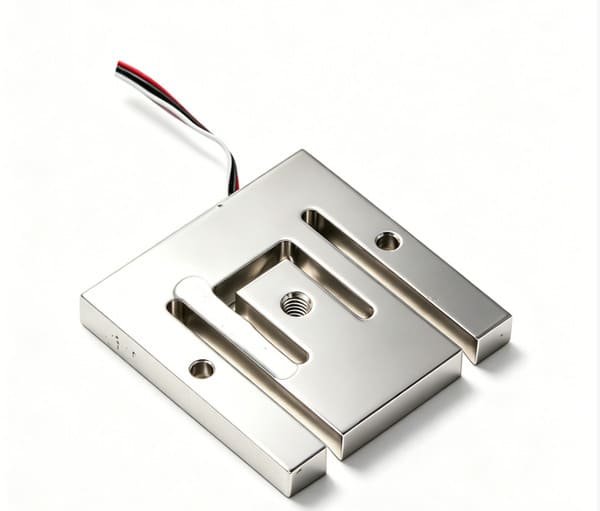
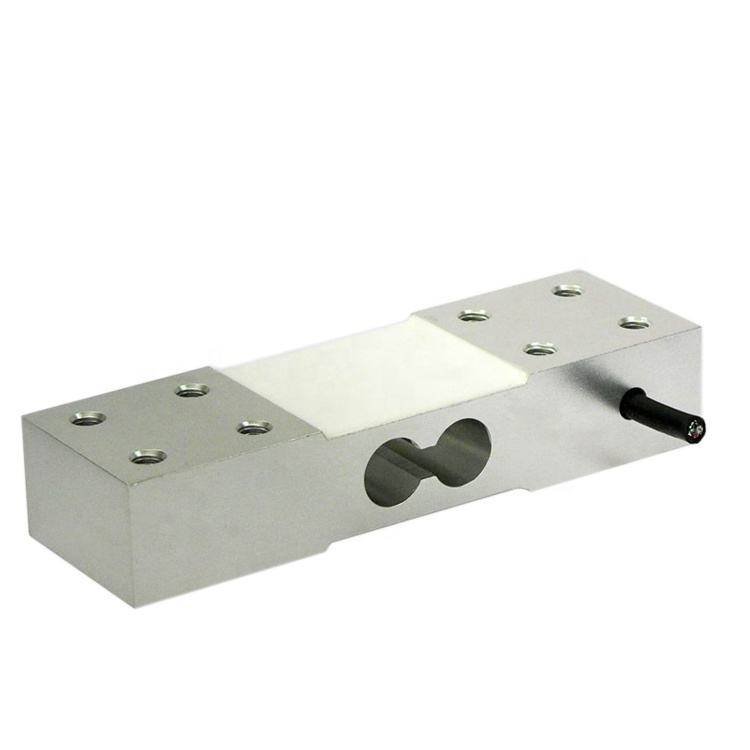
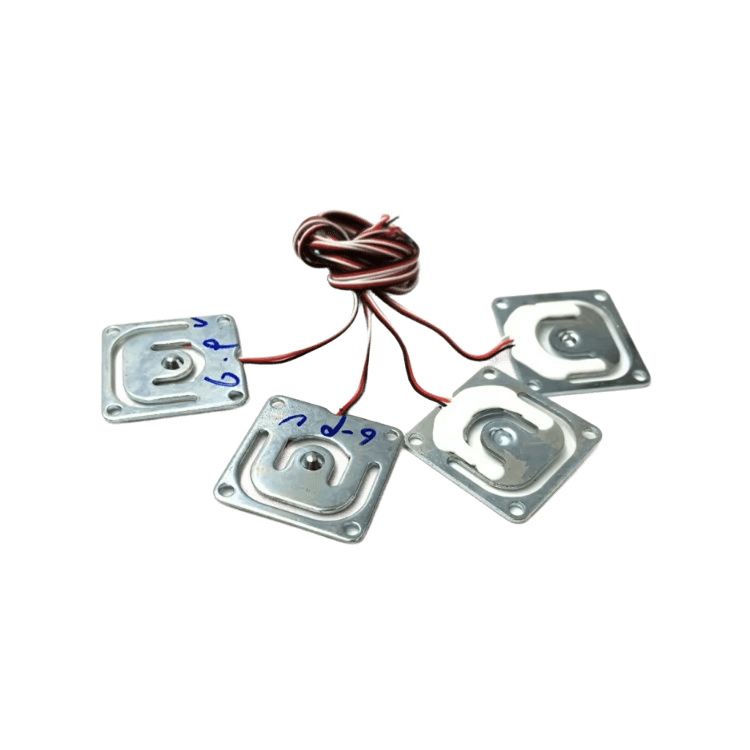
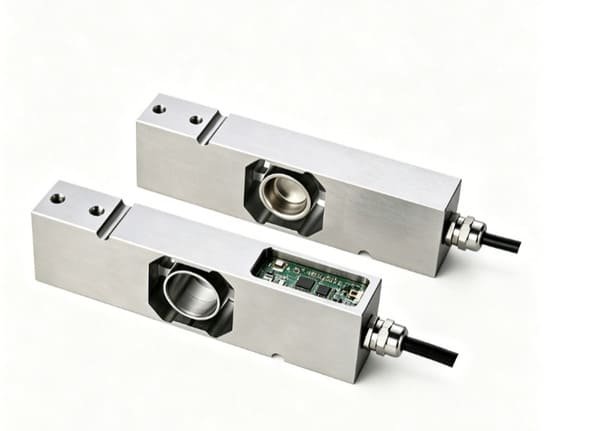
All four accept customization: envelope dimensions, capacity windows between catalogue steps, M3/M4/M5 mounting patterns, axial / radial / 90° cable exits, 40 mm–2 m cable lengths, JST / Molex / Dupont connectors, and IP66/67 silicone boots. If your base geometry is fixed, send the drawing — matched sets are built to your stack height.
FAQ
How accurate is weight-based LPG gas level monitoring?
With matched cells and swap-event re-taring, ±0.1–0.25 kg on a 14.2–45 kg cylinder is achievable in the field — roughly 0.5–1.5% of fill. That is at or better than the ±1% class of consumer sonar gauges, and unlike pressure-based methods it stays accurate across the whole fill range.
How many load cells does a smart gas cylinder scale need?
Three or four. Three on a triangular frame self-levels on uneven patios; four suits rectangular bases. Single-point cells (one per platform, corner-adjusted up to ~350 × 350 mm) are the alternative when you want to delete the summing board entirely.
What is creep, and why does it matter so much for gas cylinder scales?
Creep is the slow output drift of a loaded strain-gauge cell over time. Kitchen scales are unloaded between uses; a gas cylinder base carries 85–100% of its rating for months. A ±0.05% F.S./30 min catalogue line says nothing about that regime — always request 72-hour loaded creep data, and re-zero the scale at every cylinder swap.
Can the scale really run on batteries for years?
Yes, if you pick cells for it. High-impedance bridges (1,000 Ω class) cut excitation current ~65% versus 350 Ω cells at the same voltage. Combine with pulsed excitation — 300 ms every 4 hours is plenty for gas — and the whole sensing chain sits under 25 µA average. Two AA lithium cells clearing two years is a solved problem.
What happens when the bottle is dropped onto the base?
Assume a 5–8 g shock from ~30 cm, every delivery. Specify 150% safe / 200% ultimate overload cells, isolate the top plate with silicone dampers, and let the swap-detection logic verify zero after every exchange. That combination survived the full pilot with two shifted zeros out of 1,200 bases.
Do the cells survive outdoors?
IP65 minimum for covered patios, IP66–IP69K for exposed or wash-down commercial sites. Just as important as sealing is temperature compensation: demand ±0.02% F.S./10 °C on both zero and span, or a 30 °C daily swing will masquerade as gas consumption in your data.
Do you supply the complete smart cylinder device or platform?
No. We supply the weighing core — load cells, matched-output sets, junction boxes, transmitters and indicators, with the test data behind them. The hub, app, connectivity, hazardous-area (ATEX / IECEx) assessment and gas-safety compliance belong to the device maker. That boundary is deliberate: it keeps your certification file honest and our engineering honest.
Can the cells be customized to our base design?
Yes — this is routine OEM work for us: custom envelope and stack height, capacity windows between catalogue steps, mounting-hole patterns, cable exit direction, length and connector family, and IP66/67 boots. Matched sets of three or four are built and tested to your drawing, typically with 72 h creep characterization included.
Building a Smart Gas Cylinder Scale?
Send us your base drawing and target cylinder size. You will get a cell shortlist, matched-set pricing, and 72-hour creep data — within 12 hours.
Written by Michael, Export Sales Engineer at VektorForce. We design and manufacture load cells, force sensors, junction boxes and weighing instruments for OEMs worldwide — including matched, creep-characterized sets for smart gas cylinder scale programs.