
Load Cells for Smart Shelves: A Complete Weighing Solution Guide (OEM)
By Robin Updated: Reading time: 9 min
Smart shelves turn every shelf into a real-time scale. By integrating load cells into retail shelves, warehouse bins, and vending machines, businesses can track inventory automatically, reduce stock-outs, and enable grab-and-go checkout. This guide explains how the weighing system works, how to select the right load cell, and how to wire it for OEM projects.

What Is a Smart Shelf?
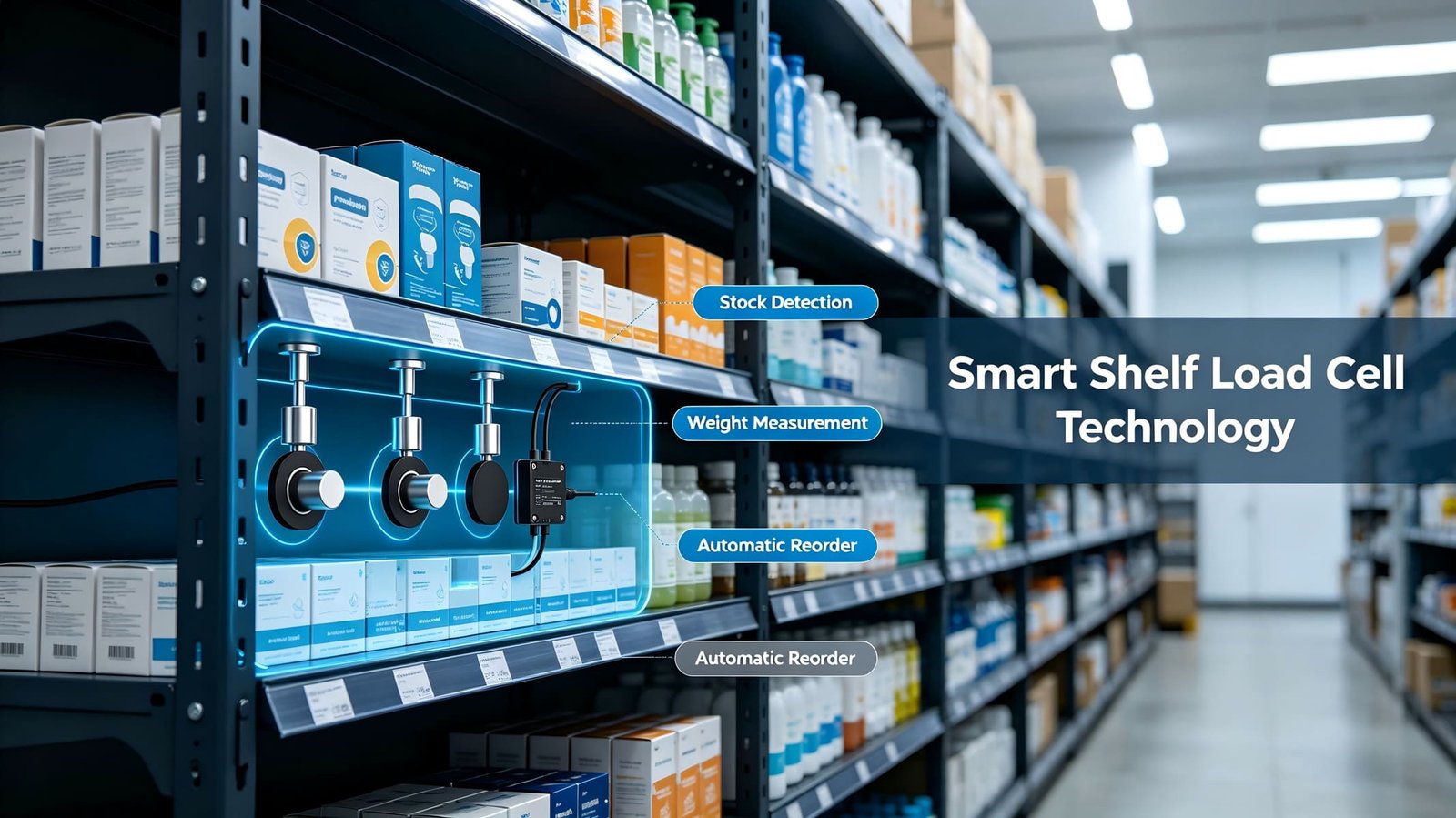
A smart shelf is a storage location equipped with one or more load cells that continuously measures the weight of the items placed on it. When a product is removed or added, the weight change is detected in real time, converted into inventory data, and sent to a cloud platform or local software.
Unlike traditional shelving that requires manual counting or barcode scanning, smart shelves provide:
- Real-time stock visibility for every SKU at every location
- Automatic reorder alerts when inventory drops below a threshold
- Loss prevention by detecting unexpected weight changes
- Grab-and-go checkout in unmanned stores and vending machines
- Data analytics on product popularity, dwell time, and restocking efficiency
Why Load Cells Are the Core of Smart Shelving
The rise of unmanned supermarkets, vending machines, and smart warehouses is closely tied to the growth of IoT. Since COVID-19, demand for contactless, automated inventory systems has accelerated. Data about product availability and shelf stock is now one of the most important indicators of a well-run retail or logistics operation.
Load cells provide the foundation of this data. They convert physical weight into an electrical signal that can be processed, transmitted, and turned into actionable inventory information. Without accurate, stable weighing, smart shelves cannot tell whether a customer picked up one item or ten, or whether a bin in the warehouse is empty.
Core System Components
A complete smart shelf weighing system includes five main building blocks:
1. Load Cell
The weight sensor that detects the force applied by products. Common types include single-point, parallel beam, and digital load cells.
2. Weighing Frame & Platform
A mechanical structure that holds the load cell and provides a flat surface for goods. The platform can be a single shelf or a multi-compartment tray.
3. A/D Module / Transmitter
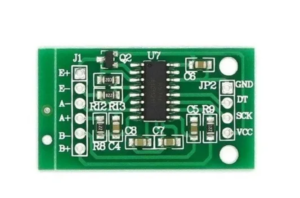
Amplifies the small mV/V signal from the load cell and converts it into a readable value. HX711 is the most common analog example.
4. Controller
A microcontroller, Arduino, or PLC that runs calibration, filtering, and communication logic.
5. Cloud / Software Platform
Receives weight data, converts it into product counts, and displays inventory dashboards, alerts, and reports.
How a Smart Shelf Works Step by Step
Step 1: Select the Load Cell
Choose a load cell based on platform size, expected product weight, accuracy requirement, and output signal type. A single-point load cell is often enough for small shelves; larger platforms may use four sensors with a junction box.
Step 2: Build the Weighing Frame and Platform
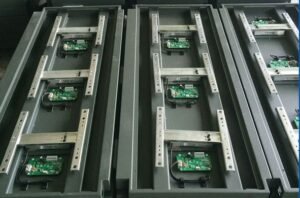
The load cell is mounted between a rigid frame and a flat platform. The platform must be free to move vertically with the load while remaining stable horizontally. Figure 2 shows a four-compartment smart shelf tray, where each compartment can host an independent weighing channel.
Step 3: Add the A/D Module or Transmitter
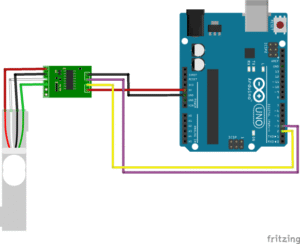
Analog load cells output a tiny millivolt signal. An A/D module such as the HX711 amplifies this signal and converts it into a digital value the microcontroller can read. For digital load cells, the A/D conversion is built inside the sensor, and the output is RS232 or RS485.
Step 4: Connect to a Microcontroller or PLC
For prototyping, an Arduino reads the HX711, runs zero and calibration routines, and sends data to the cloud. For production systems, a PLC or industrial controller is more common.
Step 5: Calibrate and Upload to the Cloud
Set the zero point with no load, then apply a known standard weight to calibrate the system. Once calibrated, the controller uploads weight data to the cloud platform, which translates weight changes into product counts and inventory events.
How to Choose a Load Cell for Smart Shelves
Getting the sensor specification right is the most important part of an OEM smart shelf project. Use this checklist:
| Selection Factor | What to Consider | Typical Choice |
|---|---|---|
| Platform Size | Larger platforms need higher capacity or multiple sensors | Single sensor under 300×250 mm; 4 sensors for larger trays |
| Capacity | Total weight the shelf will hold including safety margin | 10-300 kg depending on application |
| Accuracy / Min. Weighing | Smallest weight change you need to detect reliably | 0.02% to 0.05% FS for retail; higher for parts counting |
| Temperature Range | Indoor warehouse, cold storage, or outdoor use | -10 C to +40 C standard; wider for cold chain |
| Output Signal | Analog mV/V or digital RS232/RS485 | Analog for simple projects; digital for multi-node systems |
| Sensor Count | Single sensor vs. multiple sensors with summing | 1 sensor per small bin; 4 sensors per large platform |
| Calibration | Factory-calibrated sensors reduce installation time | Digital sensors with factory calibration for scale fleets |
Analog vs. Digital Load Cells
Analog Load Cells + HX711
Analog load cells output a low-level mV/V signal. They are low-cost and widely used for prototyping and small systems. The HX711 is a popular 24-bit A/D amplifier that connects directly to Arduino and other microcontrollers.
Digital Load Cells
Digital load cells integrate A/D conversion and temperature compensation inside the sensor. They communicate over RS232 or RS485, making them ideal for systems with many shelves or long cable runs.
Key advantages of digital load cells for smart shelving:
- Built-in digital temperature and creep compensation
- High A/D sampling rate (e.g., 640 samples/second) and resolution (300,000 divisions)
- Factory calibrated — no on-site calibration needed
- Gravity acceleration correction for use in different regions
- Adjustable filter, zero range, and division settings via commands
- Single command zeroing and remote configuration
System Architecture: Wired, Wireless & Aggregators
Smart shelf deployments vary from a few bins in a store to hundreds of shelves across a warehouse. The communication architecture must match the scale.
Wired Communication
For small systems or short distances, RS232 or RS485 cabling connects each digital load cell or A/D module directly to the host controller or industrial PC. RS485 supports multi-drop wiring, so many sensors can share one bus.
Wireless Communication
When sensors are spread over a large area or more than 100 meters from the host, wireless transmission avoids expensive cabling. A wireless receiver near the host converts the signal back to RS232/RS485.
Data Integration Converter / Aggregator
A data integration converter groups multiple digital sensors into weighing channels and outputs a single stream of weight values to the host. For example, one converter can scan 50 digital sensors in 0.5 seconds by reading each sensor in about 10 ms. This dramatically reduces the workload on the host computer and simplifies software development.
Typical architecture: Load cells > A/D module or digital output > data integration converter > RS232/RS485 bus or wireless > industrial PC / cloud gateway > inventory management software.
Wiring Guide: HX711 & Digital Sensors
HX711 Wiring (4-Wire Load Cell)
The standard 4-wire load cell color code connected to an HX711 module is:
| Load Cell Wire | Color | HX711 Pin |
|---|---|---|
| Excitation + | Red | E+ |
| Excitation – | Black | E- |
| Signal + | Green | A+ |
| Signal – | White | A- |
Note: Some manufacturers use different color codes. Always verify with the sensor datasheet or use a multimeter to identify excitation and signal pairs.
Digital Sensor Aggregator Wiring
For digital load cell systems, the integration converter typically provides three connectors:
| Connector | Pins | Function |
|---|---|---|
| 2-pin power | VP (9-12 V), GND | Converter power supply |
| 6-pin sensor | VP, D1+, D1-, RX1, TX1, GND | Digital sensor communication (RS485 + RS232) |
| 5-pin host | D2+, D2-, RX2, TX2, GND | Host communication (RS485 + RS232) |
Recommended Load Cell Models
The following models are commonly used in smart shelf, smart bin, and light warehousing projects. Exact specifications should be confirmed against your platform size and accuracy target.
| Model | Capacity | Accuracy | Size | Output / Notes |
|---|---|---|---|---|
| WST101 | 50 kg | 0.05 | 34 x 34 x 2.5 mm | 0.9 +/- 0.1 mV/V analog |
| WST103 | 10-25 kg | 0.03 | 80 x 12.7 x 12.7 mm | 1.0 +/- 0.15 mV/V analog |
| WST201 | 100 kg | 0.02% FS | 130 x 30 x 22 mm | 2.0 mV/V analog |
| WST1101 | 30-300 kg | 0.05 | 70 x 45 x 5.5 mm | 1.0-1.5 mV/V analog |
| WST1204 | 100-200 kg | 0.02% FS | 150 x 38 x 22 mm | Digital RS232/RS485 output |
| WST1201 | 0-50 kg | 0.02% | 130 x 30 x 22 mm | Digital RS232/RS485 output |
Need a different capacity, platform size, or connector? Most load cells can be customized with cable length, mounting holes, and communication protocols for OEM orders.
Typical Applications
- Unmanned retail stores — grab-and-go shopping with automatic checkout
- Smart vending machines — detect which product was removed and charge accordingly
- Warehouse kanban bins — automatic replenishment signals when stock is low
- Tool cribs and smart lockers — track who borrowed which tool by weight
- Pharmacy and hospital inventory — secure, trackable storage of high-value consumables
- Industrial vending for PPE and MRO parts — 24/7 controlled access without on-site staff
FAQ
How many load cells does a smart shelf need?
A small bin or single-product shelf can use one load cell. Larger platforms (over ~300 x 250 mm) usually use four load cells, one at each corner, summed through a junction box or digital aggregator.
Can one load cell measure multiple products on the same shelf?
One load cell measures total weight, not individual items. If you need to track multiple SKUs on one physical shelf, use a multi-compartment tray with a separate load cell or weighing channel for each compartment.
What is the difference between HX711 and a digital load cell?
HX711 is an external analog-to-digital converter for standard analog load cells. A digital load cell has the A/D converter built in and outputs a serial signal such as RS485. Digital sensors are better for large deployments because they reduce wiring, support bus networking, and are factory calibrated.
How accurate does a smart shelf load cell need to be?
For retail inventory and grab-and-go checkout, an accuracy of 0.02% to 0.05% of full scale is usually sufficient. The more important spec is often the minimum weight increment — the system must reliably detect the removal of one unit of your lightest product.
Can smart shelf load cells work wirelessly?
Yes. Digital load cell systems can transmit over wireless links when cabling is impractical. A wireless receiver near the host converts the signal back to RS232/RS485, which is useful in large warehouses or temporary installations.
Do digital load cells need calibration on site?
Most digital load cells are calibrated at the factory and can be used without on-site calibration. You may still need to set the zero point and verify with a test weight after installation, but the process is much faster than analog systems.
Can load cells be customized for my shelf size?
Yes. Load cells can be customized for capacity, platform size, cable length, connector type, output signal, and mounting hole pattern. Most OEM smart shelf projects benefit from at least some level of mechanical or electrical customization.
Need Load Cells for Your Smart Shelf Project?
We supply analog and digital load cells, weighing platforms, HX711 modules, and OEM integration support for smart retail, warehousing, and vending systems.