
🔧 Technical level: Intermediate |
📌 Topic: Load cell applications in smart beekeeping
Bees have existed on our planet for over 150 million years. Yet today, honeybee populations are declining at an alarming rate worldwide — more than half of wild bee species are now threatened with extinction. The consequences would be catastrophic: bees pollinate over 75% of global food crops, meaning approximately one in every three bites of food we eat depends on them.
The good news? Technology is stepping in. Smart beehive monitoring systems — equipped with load cells, temperature sensors, humidity sensors, and IoT connectivity — are transforming how beekeepers care for their colonies. A beekeeper who could once manage 50 hives can now monitor 500 or more from a smartphone, receiving real-time alerts when a hive’s weight suddenly drops (indicating swarming) or spikes (indicating a strong nectar flow).
In this comprehensive guide, we’ll explore how load cells and weighing technology are revolutionizing beekeeping — from selecting the right sensor to interpreting weight data, installing a beehive scale, and building a complete IoT monitoring solution.
📋 Table of Contents
- Why Smart Beehive Monitoring Matters
- The Role of Load Cells in Smart Beehives
- How to Interpret Beehive Weight Data
- Load Cell Selection Guide for Beehive Scales
- Installation Guide: How to Set Up a Beehive Scale
- IoT Connectivity Options for Remote Monitoring
- Power Management: Solar & Battery Solutions
- Environmental Protection & Weather Compensation
- Calibration & Maintenance for Outdoor Scales
- Real-World Case Studies
- Recommended Load Cells for Beehive Scales
- Cost-Benefit Analysis & ROI
- Frequently Asked Questions
- Conclusion
1. Why Smart Beehive Monitoring Matters
Traditional beekeeping relies on physical hive inspections every 3–4 weeks. By the time a beekeeper discovers a problem — disease, pest infestation, queen loss, or starvation — it’s often too late. Studies show that if professional beekeepers could monitor and treat their hives in real time, mortality rates could drop from 30–40% down to single digits.
The main drivers of bee colony collapse include:
| Threat Factor | Impact on Colonies | Detectable via Smart Monitoring? |
|---|---|---|
| Climate change | Disrupted foraging seasons, temperature stress | ✅ Temperature + weight sensors |
| Pesticides | Colony weakening, navigation disruption | ✅ Weight decline pattern |
| Diseases & pests | Varroa mites, foulbrood, nosema | ✅ Weight loss + temp anomalies |
| Swarming | Loss of 50–60% of worker bees | ✅ Sudden weight drop alert |
| Starvation | Winter food stores depleted | ✅ Gradual weight decline |
| Queen loss | No new brood, colony decline | ⚠️ Weight stagnation (indirect) |
A smart beehive system typically monitors four key parameters: weight (honey accumulation & colony health), internal temperature (brood health), humidity (ventilation needs), and external weather conditions (foraging feasibility). Among these, weight is the most critical — it’s the single most informative metric for understanding what’s happening inside a hive without opening it.
2. The Role of Load Cells in Smart Beehives
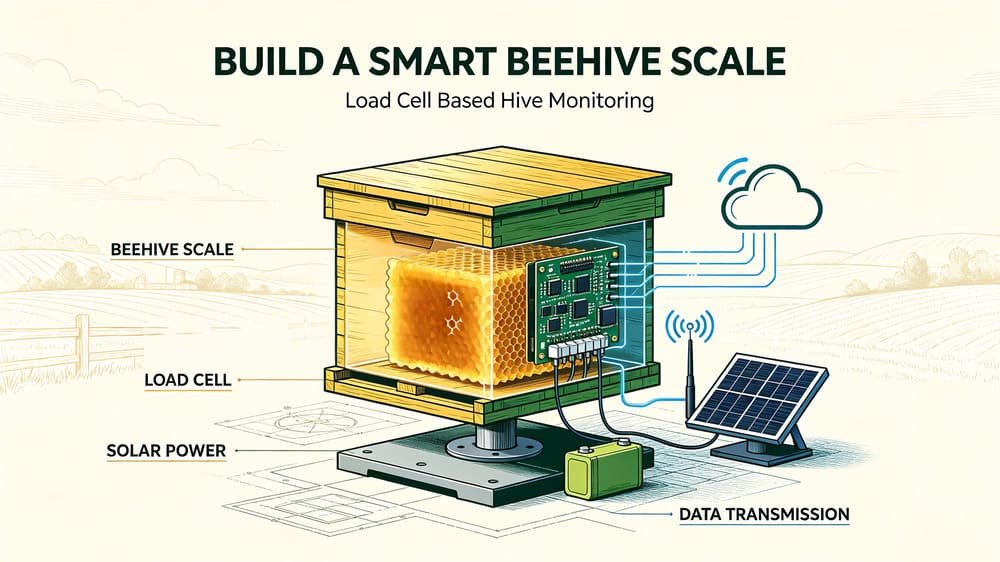
A load cell is a transducer that converts mechanical force (weight) into an electrical signal. In smart beehive applications, load cells are installed beneath or integrated into the hive stand to continuously measure the total weight of the hive — including the wooden structure, bees, honey, wax, and brood.
The core working principle involves a strain gauge bonded to a metal spring element. When weight is applied, the element deforms microscopically, causing the strain gauge’s electrical resistance to change. This change is measured via a Wheatstone bridge circuit and converted into a weight reading.
💡 Key Insight: A typical beehive weighs between 15–80 kg (empty to full of honey). The load cell must accurately detect weight changes as small as 100–200 grams — the daily nectar intake of a strong colony during peak flow. This requires a sensor with high resolution and excellent temperature stability.
In a complete smart beehive system, the load cell signal chain works as follows: Force (hive weight) → Strain gauge deformation → mV signal output → Amplifier (ADC) → Microcontroller → IoT transmitter (LoRa/NB-IoT/WiFi) → Cloud platform → Mobile App. The beekeeper sees real-time weight data on their phone, with charts showing hourly, daily, weekly, and monthly trends.
3. How to Interpret Beehive Weight Data
Weight is the most telling metric in beekeeping. Here’s what different weight patterns reveal about colony health:
| Weight Pattern | What It Means | Recommended Action |
|---|---|---|
| Steady daily increase (0.2–2 kg/day) | Strong nectar flow; colony is productive and healthy | Monitor for harvest timing |
| Sudden drop (1–3 kg overnight) | Swarming event — colony has split | Check for queen cells; capture swarm if possible |
| Sudden drop (0.5–1 kg daytime) | Robbing by other bees or wasp attack | Reduce entrance; check hive defenses |
| Gradual decline over days/weeks | Colony dying, queen lost, or starvation | Inspect immediately; feed if starving |
| Weight stable, no change | No nectar flow (dearth) or colony is dormant | Feed syrup if during dearth period |
| Weight fluctuates with rain | Rainwater absorption by wooden hive | Apply weather filter; consider plastic hive |
| Slow winter weight loss (0.5–1 kg/month) | Normal winter consumption of honey stores | Ensure stores last until spring |
⚠️ Pro Tip: Always correlate weight data with temperature and weather data. A 0.5 kg overnight drop in summer might be swarming; the same drop during a winter warm spell might just be bees taking cleansing flights. Context is everything.
4. Load Cell Selection Guide for Beehive Scales
Choosing the right load cell for a beehive scale requires considering several factors unique to the beekeeping environment:
Key Selection Criteria
| Factor | Why It Matters | Recommendation |
|---|---|---|
| Maximum capacity | A full Langstroth hive can weigh 50–80 kg; capacity should exceed max weight with 50% safety margin | 50–150 kg per load cell |
| Number of load cells | 1-point (corner load), 3-point (stable platform), or 4-point (full platform) | 3 or 4 cells for stability; 1 for budget |
| Platform size | Must fit the hive base dimensions (typically 40×50 cm for Langstroth) | Match sensor footprint to stand |
| Operating temperature | Hives experience -20°C to +50°C seasonally | -20°C to +60°C with temp compensation |
| Accuracy class | Need to detect 100–200g changes on a 50+ kg hive | Accuracy ≤ 0.05% of full scale |
| Protection rating | Outdoor exposure to rain, humidity, insects | IP65 or higher (IP67 preferred) |
| Material | Corrosion resistance for long-term outdoor use | Aluminum alloy (budget) or stainless steel (durable) |
| Sensitivity | Higher sensitivity = better signal-to-noise ratio | 1.0–2.0 mV/V |
Single-Point vs. Multi-Point Configuration
| Config | Pros | Cons | Best For |
|---|---|---|---|
| 1-point (single sensor) | Lowest cost, simplest wiring, low power | Corner-loading errors, less stable | Hobbyists, small apiaries |
| 3-point (3 sensors) | Self-leveling, good stability, moderate cost | Slightly more complex wiring | Commercial beekeepers (recommended) |
| 4-point (4 sensors) | Highest accuracy, full platform support | Highest cost, needs junction box | Research, precision monitoring |
5. Installation Guide: How to Set Up a Beehive Scale
Proper installation is critical for accurate weight readings. Follow these steps for a typical 4-point beehive scale setup:
Step-by-Step Installation
Step 1: Prepare a flat, level surface for the hive stand. Uneven ground causes measurement errors.
Step 2: Install 4 load cells at the four corners of the hive stand platform, with the loading direction facing up.
Step 3: Connect all 4 load cells to a junction box (summing box). The junction box combines the signals and allows corner adjustment (trimming) to equalize readings.
Step 4: Connect the junction box output to your amplifier module (HX711 is common for Arduino/ESP32-based builds).
Step 5: Connect the amplifier to your microcontroller (ESP32, Raspberry Pi, etc.), then connect the IoT transmitter module.
Step 6: Place the hive on the platform. Power on the system.
Step 7: Perform initial calibration using known weights (e.g., a 20 kg calibration weight or bag of feed).
Step 8: Set up your cloud platform and mobile app. Configure weight-change alerts (e.g., alert if weight drops > 1 kg in 2 hours).
⚠️ Important: If using a single load cell in a corner-loading configuration, ensure the hive’s center of gravity stays directly above the sensor. Wind can cause lateral forces that affect readings — use a wind shield or install in a sheltered location.
6. IoT Connectivity Options for Remote Monitoring
Beehives are often located in remote rural areas with limited infrastructure. Choosing the right connectivity technology is essential for reliable data transmission:
| Technology | Range | Power Use | Data Cost | Best For |
|---|---|---|---|---|
| LoRaWAN | 2–15 km | Very low | Free (self-hosted) | Large apiaries, rural areas |
| NB-IoT (SIM) | Cellular coverage | Low | $2–5/month per hive | Scattered hives, no gateway needed |
| WiFi | 50–100 m | High | Free | Backyard beekeepers |
| BLE (Bluetooth) | 10–50 m | Very low | Free | Walk-up data collection |
| SIGFOX | 3–10 km | Very low | $1–3/year per device | Low-data applications |
| 4G/LTE (SIM) | Cellular coverage | High | $5–15/month | Video monitoring, high data needs |
💡 Recommendation: For most commercial beehive monitoring, LoRaWAN offers the best balance of range, battery life, and cost. If hives are scattered across multiple locations without LoRa coverage, NB-IoT with a SIM card is the next best choice — it works anywhere there’s cellular coverage and only transmits small data packets (weight readings every 15–60 minutes).
7. Power Management: Solar & Battery Solutions
Since beehives are in remote locations without grid power, the monitoring system must be self-sufficient. The two main approaches are:
Option A: Battery-Powered (LoRaWAN)
A 3.7V 18650 lithium battery (2,600–3,500 mAh) can power a LoRaWAN sensor node for 6–12 months if the system wakes up every 15 minutes, takes a reading, transmits it, then goes back to deep sleep. This is the lowest-maintenance option.
Option B: Solar-Powered (NB-IoT / WiFi / 4G)
For higher-power connectivity (NB-IoT, WiFi, 4G), a small solar panel (5–10W) paired with a LiFePO4 battery (3.2V 10Ah) provides year-round operation. The solar panel charges the battery during the day, and the system runs continuously. Even in cloudy winter conditions, a properly sized solar system can maintain operation for weeks without sunlight.
💡 Power Budget Tip: The load cell amplifier (HX711) draws about 1.6 mA when active and <1 µA in sleep mode. The microcontroller (ESP32) draws 10–40 mA when active and 10 µA in deep sleep. An NB-IoT module draws 200–500 mA during transmission (lasting 2–5 seconds). By duty-cycling all components, average power consumption can be kept under 5 mW — perfect for battery + solar operation.
8. Environmental Protection & Weather Compensation
Beehive load cells operate outdoors year-round, exposed to rain, humidity, temperature extremes, insects, and animals. Several measures ensure reliable long-term operation:
| Challenge | Solution |
|---|---|
| Rain & moisture | Use IP67-rated load cells; seal cable exits with silicone; install under hive body for natural rain protection |
| Temperature drift | Select load cells with built-in temperature compensation (-20°C to +60°C range); apply software correction algorithms |
| Wind forces | Install wind breaks; use averaging filters (take median of 5 readings); secure hive to platform |
| Insects & animals | Seal all cable entry points; use metal conduit for cables; elevate electronics in weatherproof enclosure |
| Wood moisture absorption | Wooden hives absorb rainwater (adds 0.5–2 kg); apply software rain filter or use polystyrene hive bodies |
| UV degradation | Use UV-resistant cable jackets; protect plastic components from direct sunlight |
| Ground frost heave | Install on concrete piers below frost line; use flexible mounting to accommodate ground movement |
A common issue is that wooden hives absorb rainwater, causing false weight increases of 0.5–2 kg during rainy periods. Advanced systems use local weather data to filter out rain-related weight changes, or apply a “rain correction” algorithm that detects sudden symmetric weight gain and loss patterns.
9. Calibration & Maintenance for Outdoor Scales
Calibration Procedure
Beehive scales should be calibrated at installation and re-calibrated at least once per year (ideally at the start of each beekeeping season):
1. Remove the hive from the scale platform. Record the zero reading.
2. Place a known calibration weight (e.g., 20 kg certified weight) on the platform. Record the reading.
3. If the reading deviates by more than 0.1% from the known weight, adjust the calibration factor in the software.
4. Repeat with additional weights (e.g., 40 kg, 60 kg) to verify linearity across the range.
5. For multi-point systems, use the junction box trimmer pots to equalize corner readings (corner calibration).
Maintenance Checklist
✅ Monthly: Check for physical damage, water ingress, cable wear
✅ Quarterly: Clean sensor surfaces; check mounting bolts for tightness
✅ Seasonally: Verify calibration with known weight; check battery/solar panel condition
✅ Annually: Full system inspection; replace batteries if needed; update firmware
✅ After extreme weather: Inspect for water damage, misalignment, or debris on platform
10. Real-World Case Studies
Case Study 1: Apiago (France) — Autonomous Smart Beehive
Apiago is a French startup that developed a unique autonomous smart beehive designed for beginners — it can be installed in a garden without any beekeeping knowledge. The system integrates load cells to automatically monitor the hive’s weight, providing real-time data on honey accumulation and colony health. By integrating strain gauge load cells, Apiago enables continuous health monitoring without disturbing the bees. Their vision is to build an organic beekeeping system without chemicals — sustainable and accessible to everyone.
Case Study 2: Beewise (Israel) — AI-Powered Robotic Beehive
Beewise developed a redesigned beehive that includes precision robotics, computer vision, and AI. The system continuously monitors bees using cameras, while AI identifies their needs in real time. Load cells are integrated to track honey production and colony weight. The robotic system can automatically feed and water bees, treat diseases and pests, control climate, harvest honey, prevent swarming, and manipulate frames — all without human intervention. It’s as if every bee has its own beekeeper available 24/7.
Beewise reports that their system has reduced bee mortality rates significantly compared to traditional beekeeping, while increasing honey yield. The company’s mission: for every cent of profit, they save 2.7 bees.
Case Study 3: Commercial Apiary Scale-Up
A commercial beekeeper managing 500 hives across 10 locations implemented smart beehive scales with LoRaWAN connectivity and solar power. The system cost approximately $120 per hive (including load cells, IoT module, and solar panel). Within the first season, the beekeeper: reduced physical inspections by 70%, caught 23 swarming events early (saving an estimated $8,000 in lost bees), optimized honey harvest timing (increasing yield by 12%), and identified 8 colonies with health issues before they collapsed. The ROI was achieved within the first year.
11. Recommended Load Cells for Beehive Scales
Based on the selection criteria above, here are three recommended load cell models ideal for smart beehive applications:
| Model | Capacity | Accuracy | Dimensions | Sensitivity | Best For |
|---|---|---|---|---|---|
| WST101 | 50 kg | 0.05% | 34×34×2.5 mm | 0.9±0.1 mV/V | Micro load cell, small/nuc hives, budget builds |
| WST201 | 100 kg | 0.03% | 130×30×22 mm | 2.0 mV/V | Standard Langstroth hives, multi-point systems |
| WST202 | 200 kg | 0.03% | 150×40×35 mm | 2.0 mV/V | Heavy/large hives, commercial apiaries |
💡 How to Choose: For a single Langstroth hive (typical max weight 50–60 kg), the GST201 (100 kg) is the sweet spot — it provides 40% safety margin, excellent accuracy (0.03%), and standard 2.0 mV/V sensitivity that’s compatible with most amplifiers (HX711, NAU7802, etc.). Use 3 or 4 units for a multi-point platform. For nuc hives or budget builds, the WST101 (50 kg) single-point sensor is compact and cost-effective.
12. Cost-Benefit Analysis & ROI
For commercial beekeepers considering smart beehive monitoring, here’s a realistic cost-benefit breakdown:
| Component | Cost Range (USD) | Notes |
|---|---|---|
| Load cells (4× WST201) | $30–60 | 3-point configuration |
| Junction box + amplifier | $10–20 | HX711 module + summing box |
| Microcontroller (ESP32) | $5–10 | WiFi/BLE built-in |
| IoT module (LoRa/NB-IoT) | $15–35 | Depends on technology |
| Solar panel + battery | $15–30 | 5W panel + LiFePO4 battery |
| Enclosure + wiring | $10–20 | IP67 enclosure, cables, connectors |
| Total per hive | $85–175 | DIY build; commercial systems: $200–500 |
| Cloud platform (annual) | $0–50/hive/year | Some platforms are free; others charge per hive |
Expected Returns
📈 Swarm prevention: Catching 1 swarm event early saves ~$300–500 in lost bees and honey
📈 Optimized harvest timing: 10–15% increase in honey yield by harvesting at peak weight
📈 Reduced labor: 60–70% reduction in physical hive inspections
📈 Early disease detection: Saving even 5% of colonies from collapse = $150–750 per 100 hives
📈 Typical payback period: 1–2 beekeeping seasons for commercial operations
13. Frequently Asked Questions
14. Conclusion
Smart beehive monitoring with load cells is not just a technology trend — it’s becoming an essential tool for modern beekeeping. With bee populations under threat from multiple stressors, the ability to monitor colony health in real time without disturbing the bees is a game-changer. A beekeeper who once managed 50 hives can now oversee 500+, catching problems early and optimizing honey production with data-driven decisions.
The technology is accessible: a DIY beehive scale costs under $175 per hive, pays for itself within 1–2 seasons, and uses readily available components. Whether you’re a hobbyist with 2 hives or a commercial operation with 5,000, load cell-based weight monitoring provides the single most valuable data point for understanding what’s happening inside your beehives.
As a load cell manufacturer and exporter, we supply sensors to smart beekeeping companies worldwide — from startups like Apiago to large-scale commercial apiaries. If you’re building a beehive monitoring system and need help selecting the right load cell, contact our technical team for free consultation and sample requests.
Need Load Cells for Your Beehive Project?
Get free technical consultation, product samples, and competitive wholesale pricing for your smart beehive monitoring system.
🔗 Partner References — Smart Beehive Companies
BeehiveMonitoring.com — Remote hive monitoring systems
Beewise.ag — AI-powered robotic beehives
Tianfu Honey — Smart beekeeping solutions
KaptarGSM — IoT beehive monitoring devices
About the Author
Our team specializes in load cell manufacturing and export, supplying weighing sensors to smart agriculture, industrial automation, and IoT companies worldwide. With over 10 years of experience in strain gauge technology, we help customers select the optimal sensor for their application — from beehives to industrial scales.
This article is for informational purposes only. Product specifications may vary by batch. Contact us for the latest datasheets and certification documents. All trademarks and company names mentioned are property of their respective owners.