
How Load Cells Power Smart Cat Litter Boxes: A Complete Guide for Pet-Tech OEMs
Smart cat litter boxes have moved from a niche gadget to a fast-growing segment of the global pet-tech market. At the heart of every self-cleaning, app-connected litter box sits a tiny but critical component: the load cell. This guide explains how load cells work inside a smart litter box, why they matter, and which sensor specifications to look for when sourcing for an OEM project
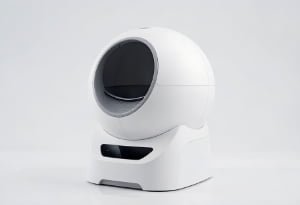
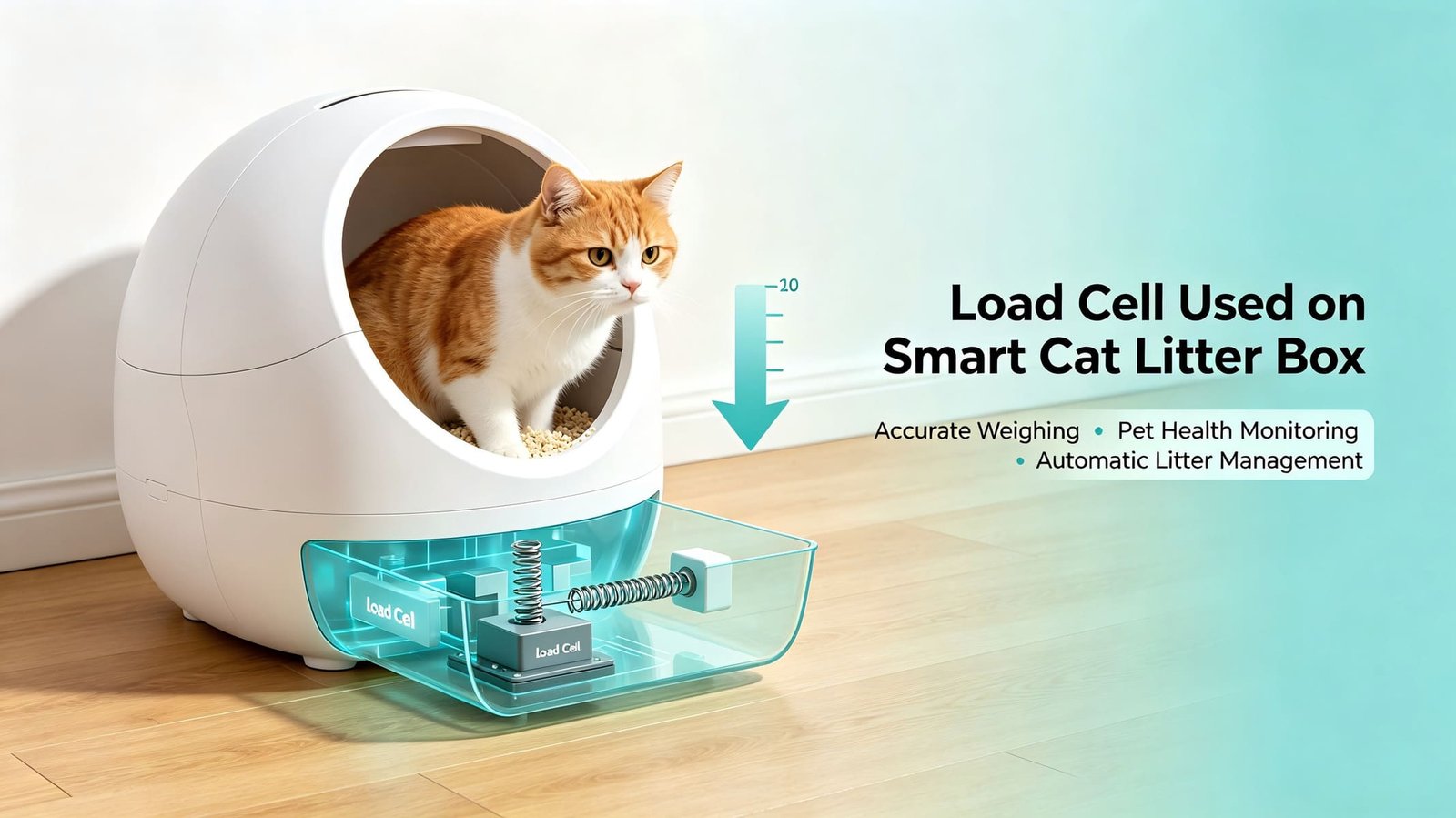
A smart cat litter box identifies the cat, rotates after each use, and tracks litter level — all driven by load cells.
From Sandbox to Smart Box: A Brief History of Cat Litter
Cats have buried their waste in sand for thousands of years — an instinct that helps them hide their scent from predators. The modern indoor litter box is simply a container that holds the litter and keeps your home clean. But a litter box is more than a tray:
- Size matters. A box that is too small makes the cat uncomfortable, and the cat will refuse to use it.
- Location matters. Cats prefer a quiet, low-traffic spot; a noisy corner will lead to “toilet accidents” elsewhere in the house.
- Cleanliness matters. Cats are fastidious. A box that isn’t scooped daily will be rejected — and may breed bacteria that harm both cat and owner.
Daily scooping is the single biggest reason cat owners give up or downgrade pet care. That pain point created the market for the smart cat litter box — and created an entirely new role for the load cell.
What Is a Smart Cat Litter Box?
A smart cat litter box (also called an automatic, self-cleaning, or app-connected litter box) is a self-contained unit that detects when the cat has finished using the box, sifts the clumps from the clean litter, and deposits the waste into a sealed drawer or bag — without any human scooping.
Working Principle
Most smart litter boxes work like a slow-rotating cement mixer. After the cat leaves, the drum rotates a small angle; a sifting screen or filter holds back clean litter while clumps fall through into a waste compartment. The cycle takes 30–90 seconds and runs quietly so as not to scare the cat.
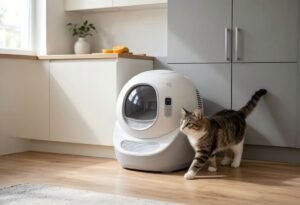
A smart litter box fits seamlessly into a modern home and serves multiple cats from one unit.
Key Advantages for Cat Owners
- Hands-free cleaning. The owner only needs to empty the waste drawer, sometimes once a week instead of every day.
- Better odor control. Waste is sealed immediately after each use, so the smell doesn’t spread through the house.
- Travel-friendly. Owners can leave the cat alone for a few days without asking a neighbor to scoop.
- Less plastic bag waste. One liner per week instead of one per day.
- Multi-cat capable. One box can serve up to 5 cats — and the app tells you which cat used it last.
- Health insight. The same weight data that triggers cleaning also tracks each cat’s weight over time, which is invaluable for early detection of kidney disease, diabetes, or weight loss.
Why Load Cells Are the Heart of a Smart Litter Box
A smart litter box looks like a piece of consumer hardware, but inside it is essentially a four-point weighing scale with a software layer. The load cell is what turns the box from a passive container into a smart device. Four functions are impossible without an accurate, repeatable weight signal:
1. Cat Presence Detection
The cycle only starts after the cat has left the box. A load cell detects the weight drop from “cat inside” back to “empty drum” and triggers the cleaning cycle — protecting the cat from injury.
2. Multi-Cat Identification
Each cat has a distinct weight. The system logs the weight of every visit and assigns it to a known profile in the app — so you see “Bella: 4.2 kg, Luna: 5.8 kg” in the visit history.
3. Litter Level Monitoring
By tracking the baseline empty weight of the drum over time, the app knows how much litter is left and sends a “refill litter” alert — no extra sensor needed.
4. Cat Health Monitoring
A gradual weight drop across many visits can flag early-stage kidney disease or diabetes — common in older cats — long before symptoms are visible.

How a Load Cell Works Inside the Litter Box
A load cell is a transducer that converts force into a tiny, proportional electrical signal. Inside a smart litter box, four load cells are typically mounted under the four corners of the drum platform — the same arrangement used in industrial platform scales. This is sometimes called a four-point weighing platform.
The Sensing Chain
- Excitation voltage (typically 5 V DC) is applied to the strain gauges inside each load cell.
- When a cat steps onto the drum, the load cell body deforms by a few micrometers. This stretches and compresses internal strain gauges.
- The change in resistance unbalances a Wheatstone bridge and produces a differential mV/V signal — typically 0.9–1.5 mV/V at full scale.
- The four signals are summed and amplified by a junction box (a load cell summing board) into a single, clean signal.
- An ADC in the litter box microcontroller reads the signal at high speed and turns it into a stable weight reading.
Why Four Load Cells, Not One
A single load cell only sees the force directly above it. A cat standing in one corner would give a very different reading than the same cat standing in the opposite corner — an effect called corner error. Four load cells, one at each corner, automatically cancel that effect: as the cat shifts weight, three cells lose a little and one gains a little, and the sum stays constant. This is why almost every smart litter box on the market uses a four-point platform, and why our recommended models below are sold in sets of four.
Half-Bridge vs. Full-Bridge
Load cells come in half-bridge and full-bridge configurations. Smart litter boxes typically use half-bridge load cells in sets of four wired together as a full bridge on the summing board. The combined output of four half-bridge cells gives:
- Total capacity = single cell capacity × 4
- Total sensitivity = single cell sensitivity × 2
- Built-in temperature compensation across the platform
- Better long-term drift performance than a single full-bridge cell of the same total capacity
Load Cell Selection Guide for OEMs
Not every load cell fits a smart litter box. Here is the specification checklist our customers use when qualifying a sensor for a new OEM project:
| Specification | Recommended Range | Why It Matters |
|---|---|---|
| Single-cell capacity | 10–50 kg | Combined 40–200 kg covers most cat breeds plus litter mass. |
| Accuracy class | C3 or better (≤ 0.05% FS) | Needed to resolve a 50 g weight change (one kitten’s visit). |
| Sensitivity | 0.9–1.5 mV/V | Higher sensitivity means a stronger signal at low cost ADCs. |
| Cell size | Ultra-thin, ≤ 12.7 mm height | Sits between the drum platform and base without raising the box. |
| Creep (5 min) | ≤ 0.05% FS | A cat may stay in the box for 60–120 s; reading must not drift. |
| Temperature range | −10 °C to +50 °C | Covers garage, balcony, and indoor A/C environments. |
| Protection | IP65 / humidity sealed | Cat urine leaks are inevitable over the product’s lifetime. |
Recommended Load Cell Models
Below are the half-bridge load cell models we most commonly ship for smart litter box OEM projects. All are supplied in matched sets of four with a calibration sheet. The combined output follows the rule: capacity × 4, sensitivity × 2.
| Model | Single-Cell Capacity | Accuracy | Size (L × W × H) | Sensitivity | Notes |
|---|---|---|---|---|---|
| WST101 | 50 kg | 0.05% FS | 34 × 34 × 2.5 mm | 0.9 ± 0.1 mV/V | Compact platform scale; our top-seller for mid-size litter boxes. |
| WST103 | 10 kg | 0.05% FS | 80 × 12.7 × 12.7 mm | 1.0 ± 0.15 mV/V | Single-point load cell; ideal for very compact, slim litter box designs. |
| WST106 | 50 kg | 0.3% FS | 30 × 25 × 2.5 mm | 1.2 ± 0.15 mV/V | Cost-optimized for entry-tier litter boxes; sufficient for cat detection. |
| WST1101 | 30 kg | 0.05% FS | 70 × 39 × 3.5 mm | 1.5 ± 0.1 mV/V | Higher sensitivity — best for cat health-monitoring features. |
Setup rule for all four models: use four matched half-bridge cells wired as a full bridge. Total platform capacity = single cell × 4; total output sensitivity = single cell × 2.
OEM Integration & Customization
If you are designing or sourcing for a smart litter box line, the load cell choice affects more than just the weight reading. Here are the integration points our OEM partners typically ask us to support:
- Custom cable lengths and connectors — pre-wired with the litter box’s existing harness to remove a manual step on your assembly line.
- Pre-calibrated matched sets — cells are matched and trimmed so that four cells in series read zero on the platform, eliminating the corner-adjustment step.
- Compact summing board — a junction box sized to fit inside the litter box base, with surge protection for the cat urine environment.
- Documentation pack — calibration sheet, RoHS / REACH compliance, and a 12-month warranty for B2B sales.
Most of our OEM customers start with a 50-piece sample run, validate the sensor in their first prototype, and move to a 1,000+ unit production run within 6–10 weeks.
Frequently Asked Questions
Do all smart cat litter boxes use load cells?
Most do — load cells are the most reliable way to detect the cat’s presence and weight. A few low-end models use only infrared or radar sensors instead, which can detect motion but cannot track weight for health monitoring or per-cat identification.
Why are load cells sold in sets of four?
A smart litter box is essentially a four-corner weighing platform. One cell at each corner cancels corner error automatically and gives a stable, accurate reading regardless of where the cat stands.
What capacity do I need for a litter box with one cat?
A domestic cat weighs 3–7 kg; add 5–10 kg for litter and the box itself. Four 10 kg cells in a full-bridge arrangement give 40 kg total — more than enough for a single-cat unit. For multi-cat boxes up to 5 cats, use four 30–50 kg cells.
How accurate does a load cell need to be?
At minimum, 0.3% FS for cat detection only. For health monitoring and per-cat identification, 0.05% FS (C3 class) is recommended so the system can resolve a 50 g weight change reliably.
Will urine damage the load cell?
A standard bare aluminum cell will corrode over time. For litter box applications, specify cells with humidity-resistant sealing (IP65 or higher) or a conformal coating on the strain gauge area, and mount them with the cable gland facing down.
Half-bridge or full-bridge for a new design?
Half-bridge in matched sets of four is the most common choice — lower unit cost, easier sourcing, and the junction box handles the full-bridge configuration for you. Choose a pre-built full-bridge cell only if your platform is mechanically constrained to a single mounting point.
Can I customize the cable and connector?
Yes. We supply cells with custom cable lengths, stripped ends, or pre-installed connectors (JST, Molex, PH2.0, etc.) to match your harness design. Custom MOQs typically start at 200 pieces.
Sourcing Load Cells for a Smart Litter Box Project?
Your Company Name has supplied load cells and weighing solutions to pet-tech OEMs in 30+ countries since 2015. Tell us your capacity, accuracy, and form-factor requirements — we’ll send a datasheet, a sample kit, and a quotation within 24 hours.