
Silo Weighing System
A silo weighing system turns a storage vessel into a scale: weigh modules under the support legs convert the weight of the vessel and its contents into mV/V signals, and a weighing transmitter turns them into 4–20 mA or RS485 Modbus RTU for your PLC or DCS. This page covers how to size the module capacity, which module type fits your vessel, how the signal wires into your controller — and the strain-sensor installation method for vessels you cannot modify.
What Is a Silo Weighing System?
A silo weighing system measures the contents of a silo, hopper or tank by weight instead of by level. One weigh module is installed under each support leg — typically three or four per vessel — and their combined signal gives the gross, net and tare weight continuously, with an accuracy a radar or ultrasonic level sensor cannot reach.
Weigh Modules
A weigh module integrates the load cell, mounting plate and load header into one unit. The mounting hardware absorbs thermal expansion and side forces, so the weight reading stays accurate on a vessel that breathes, shakes and moves with the weather.
Weighing Transmitter
The transmitter supplies excitation to the load cells, amplifies their mV/V output and digitizes it at 24-bit resolution with 1/10,000 comprehensive precision. Output is 4–20 mA, 0–10 V or RS485 Modbus RTU — whatever your PLC speaks.
Junction Box & Summing
On a three- or four-leg silo, the cells are wired in parallel through a stainless junction box, which sums the corner loads into one signal and allows corner adjustment. For multi-vessel sites, a multi-channel transmitter sums digitally instead.
How to Size the Weigh Module Capacity
Sizing is the step most silo projects get wrong. Four inputs decide everything: the number of support points, the dead load, the live load, and the dynamic factor. Work through them in order and the silo weighing module selection becomes arithmetic, not guesswork.
Count the support points
Most silos stand on three or four legs. One weigh module per leg — never three modules on a four-leg vessel, or the zero will drift as the product shifts.
N = 3 or 4 legsAdd dead and live load
Dead load is the empty vessel: steel, ladder, cage, dust collector and attached piping. Live load is the maximum product weight at full density — use bulk density, not loose density.
Dead + Live + PipingDivide and apply the factor
Per-point load = total load ÷ N. Then multiply by a dynamic factor of 1.2–1.5 to cover wind, seismic loads, vibration from discharge and uneven product buildup on the walls.
× 1.2–1.5 factorKeep a working range of 40–70%
Pick the next standard capacity above the factored load. A module working at 40–70% of rated capacity keeps good linearity and leaves overload margin — safe overload is 150% F.S on our modules.
40–70% working rangeTwo details that decide long-term stability
First, rigid piping: the vessel must hang on the modules only — connect product inlet and outlet through flexible connectors, or the pipe will carry part of the weight and the reading will run low. Second, check rods: on outdoor silos above roughly 5 m, add horizontal check rods between vessel and foundation so wind load cannot tip the vessel off the modules. Our modules restrain horizontal movement; they are not designed to catch a falling vessel.
Which Weighing Module Fits Your Vessel
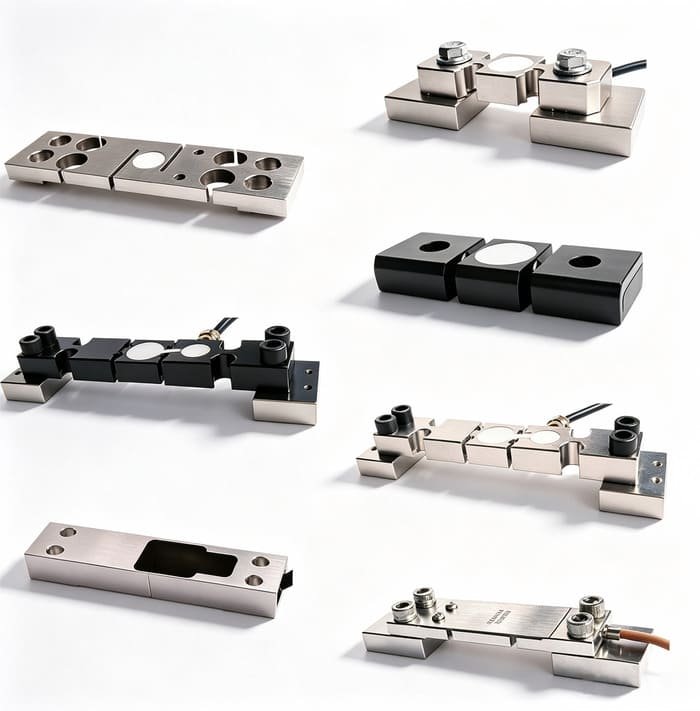
Choosing a silo weighing module is two decisions in one: the shape decides how the load enters the cell and how much installation height you need; the capacity comes from the sizing steps above. Every model below ships as a complete module — load cell, mounting plates and hardware included. If the vessel cannot be modified, skip to the strain-sensor method in the next section.

Bellows · ≤ 0.5 t
Compact profile for small hoppers and dosing stations where installation height is tight. Low capacity, high sensitivity — the standard pick for batching heads and ingredient bins.

Shear Beam · 0.5–5 t
The integrated module for new weighing systems or full tank conversion: load cell, connectors and mounting plate in one unit — no scale frame or foundation work required.

Shear Beam · 3 / 5 t
The economical choice for standard silo legs. Automatic centering and an anti-eccentric-load structure keep full load cell accuracy — installation errors are designed out, not tuned out.

Shear Beam · 0.2–10 t
One module family covering charging buckets up to large storage tanks. IP66 sealing makes it the pick for outdoor installations and wash-down areas.

Spoke · 0.3–10 t
Spoke (pancake) module sealed to IP68 for milk tanks and hygienic vessels — built for wash-down and condensation in dairy, food and chemical plants.

Column · 10 t and up
Column cells carry the highest loads in the smallest footprint — the choice for reactors, large material tanks and anything above ten tonnes per point.
From Load Cell to PLC: How the Signal Wires In
The signal chain is four links. Get each one right and the silo weight appears in your SCADA as just another Modbus register — no dedicated weighing instrument on every vessel, no analog drift to chase.
Load cells output mV/V
Each module outputs 2.0 mV/V at rated load — a signal too small and too fragile to run a cable to the control room directly.
Junction box sums the corners
The WST1513 joins three or four cells in parallel, sums their signals and provides corner adjustment so off-center product does not skew the reading.
Transmitter digitizes
The WST1510 samples at 1,280 Hz with 24-bit resolution, 1/10,000 precision, and outputs 4–20 mA plus RS485 Modbus RTU simultaneously. IP65 housing mounts on the silo or in the panel.
PLC / DCS reads weight
Modbus RTU networks up to 32 nodes — one cable loop for a whole tank farm. The eight-channel WST1511 handles up to eight vessels from one unit.
An Equal Alternative: Strain Sensing on the Support Legs
Weigh modules are one way to weigh a silo — not the only way. The WST703 weldable strain transducer is a separate installation method with the same goal: it bolts or welds directly to the support legs and reads vessel weight from leg strain. No module under the vessel, no lifting, no plumbing changes — and the same reading doubles as structural monitoring of the legs themselves.
WST703 Weldable Micro Strain Transducer
A weldable foil strain transducer for the silo leg: 300–1000 με measuring range, standard Wheatstone full-bridge output, IP65, alloy or stainless steel. Installed while the silo stays in service, calibrated against one known fill at first use, and wired into the same WST-series transmitter family as a module system.
When to choose it over modules
The vessel cannot be jacked or modified, piping is rigid, or you need weighing plus long-term leg-stress monitoring in one reading — aging vessels, seismic zones, overload protection on old frames. For legal-for-trade custody transfer, weigh modules remain the requirement.
How it installs — in service
Grind the leg with 300-grit paper and wipe with ethanol, weld the pad block through its fixture, then bolt the transducer on with Loctite 638 and thread-locked bolts, torqued alternately in two steps: 20 N·m, then 40±2 N·m. The plant keeps running throughout.
What it returns — and what it needs
Continuous weight trend and level-by-weight, plus early warning of leg over-stress. Bench accuracy is ±0.3% F.S; expect 1–2% F.S in installed service after on-site calibration. Monthly visual check of the anti-loosening marks keeps it there.
| Measuring range | 300–1000 με (strain range −500…+500 με) |
|---|---|
| Rated output | 2.0 ± 0.3 mV/V, standard Wheatstone full bridge |
| Combined accuracy / repeatability | ±0.3% F.S on the bench; 1–2% F.S in installed service (after on-site calibration) |
| Excitation | 5–10 V DC (10 V DC recommended) |
| Response time | ≤ 100 ms — follows fast discharge cycles |
| Safe / breaking overload | 150% F.S / 300% F.S |
| Temperature range | −20°C…+65°C operating and storage |
| Protection / material | IP65 · alloy steel or stainless steel body |
| Wiring | 4-wire shielded cable |
| Placement guideline | One transducer per load-bearing member — silos typically use 3–4 measuring points, one per support leg, on the main stress axis of the web or flange |
A complete retrofit chain from one supplier
Each WST703 connects through its pre-wired 4-wire shielded cable to the WST1513 stainless junction box (4/6/8-way entry), which trims and sums the signals into one output. The WST1514 weighing indicator digitizes it at 24-bit resolution (±0.05% F.S), drives a 6-digit LED display and two freely assignable relay setpoints, and talks to your PLC via 4–20 mA / 0–10 V and RS485 Modbus RTU. Sensor, junction box and indicator are engineered and calibrated to work together — no compatibility risk between brands — and the whole chain runs from a single 12–36 V DC supply.
Where Silo Weighing Systems Are Used
The physics is the same everywhere; the details are not. Product density decides the live load, washdown decides the housing, and discharge behavior decides how much dynamic factor you need.
Feed mills weigh raw grain intake silos and finished meal bins on the same Modbus loop. Dense packed grain means the live load is set by bulk density at compaction, not by the weight of the first delivery — and the sizing must reflect that.
Cement silos are tall, outdoor and wind-loaded. Column modules WST808/WST809 take the per-point load; check rods handle the wind; dust and vibration decide the IP65 sealing and the dynamic factor.
Loss-in-weight dosing on pellet blenders uses bellows or shear beam modules feeding a 1,280 Hz sampling transmitter — fast enough to follow discharge, stable enough for batch records.
Milk tanks and food-grade hoppers run the WST807 spoke module with washdown-friendly stainless hardware, summed through a stainless WST1513 junction box rated for the same environment.
Silo weighing, answered
The six questions system integrators ask before specifying. If yours is not here, our engineers answer application questions within 12 hours.
Ask about your application →How many load cells does a silo weighing system need?
How do I calculate the capacity of each silo weighing module?
4–20 mA or RS485 Modbus RTU — which output should I choose?
Do I need complete weigh modules, or just load cells?
Can weighing be added to an existing silo without shutting it down?
How is the WST703 strain sensor installed and calibrated?
Sizing a silo this week?
Send us the vessel weight, support count, product density and required output — our engineers will come back with a module selection and quotation within 12 hours. OEM/ODM configurations welcome.