
Load Cells for Rehabilitation Testing Equipment & Smart Fitness Machines: How a 7-Device EU Platform Forced Us to Rethink Catalogue Specs
Ten years of selling load cells into handheld dynamometers, force plates and cable-based fitness machines have taught me one thing: the catalogue cell almost never fits the enclosure. Below is the exact five-model portfolio I now carry to rehab and fitness OEMs — and what the spec sheet didn’t tell me until I shipped it.
Updated · 8 September 2026
Audience · OEM engineers, product managers, sports-science integrators
By Robin — Export Sales Engineer, VektorForce
- Why rehab and fitness equipment strain off-the-shelf load cells
- The 7-SKU EU platform that broke three catalogue assumptions at once
- The five load-cell families our rehab/fitness portfolio covers
- Picking the right cell: a 60-second decision tree
- Three failure modes I keep seeing on the bench — and how to mitigate each
- What “custom by dimension” actually looks like in our factory
- Where the weighing core ends and the OEM’s liability begins
- The four cells I quote most often — straight from our 2026 rehab portfolio
- FAQ — capacity, accuracy, sample policy and integration
1 · Why rehab and fitness equipment strain off-the-shelf load cells
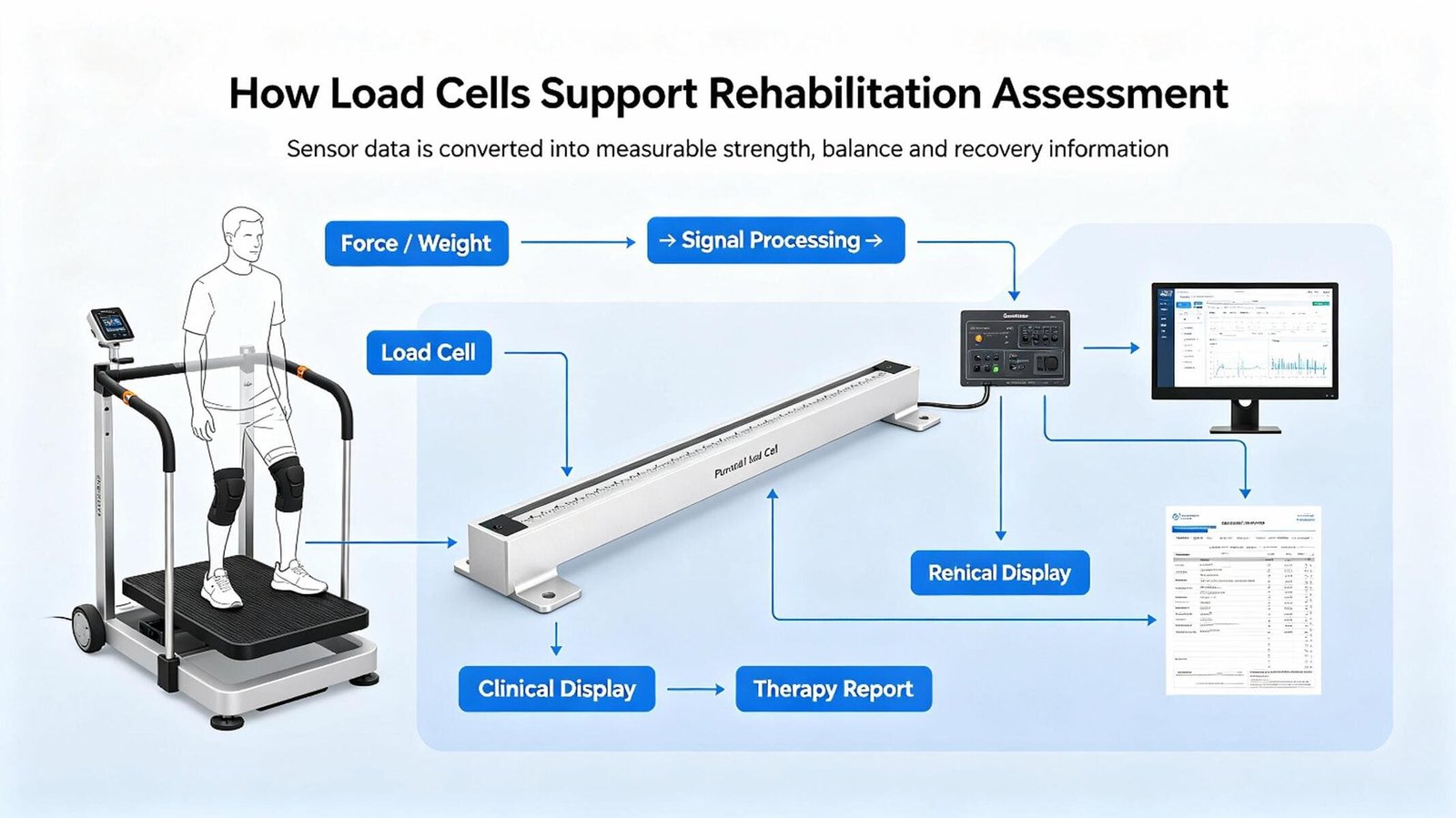
I keep the same opening line for every OEM meeting in this space: “your device is the spec sheet, the load cell only has to fit inside it.” Three categories of force measurement sit inside almost every modern rehab or strength-testing product, and each pulls a load cell in different directions:
Handheld dynamometers (push / pull / grip / pinch): 2–100 kg range, bidirectional (tension + compression), small mounting envelope, ~30 minutes of continuous skin contact.
Force plates & balance platforms: 7.5–600 kg per corner, three or four cells per platform, low profile, very low corner-to-corner drift, athlete body heat.
Cable-based trainers & smart fitness machines: 100–300 kg inline tension, repetitive shock loads from reps, cable whip generating lateral and torsional artefacts, integration into pulley housings, not lab benches.
High-load test stations (IMTP, leg press, squat rack): 500–1000 kg with dynamic peaks hitting 150–200 % overload, frame-mounted, often wall-attached and used in physiotherapy clinics or pro-sports labs.
A catalogue cell that survives one of these environments will likely fail the others. The portfolio that ships well for rehab and fitness today is the union of all four — not a single SKU. That is the lens I want to use for the rest of this article.
2 · The 7-SKU EU platform that broke three catalogue assumptions at once
In late 2025 I onboarded a European OEM that does connected rehab and sports-performance hardware. Their plan was a platform of seven SKUs sharing one Bluetooth indicator and one Android app:
- A handheld push-pull dynamometer (limb strength)
- A handheld grip and pinch attachment
- A sit-to-stand force platform (geriatric rehab)
- A single-leg return-to-sport force platform (post-ACL)
- A cable-based shoulder rehab trainer (reps and power)
- A seated step-climb power rig (cardio-pulmonary)
- A wall-mounted IMTP / isometric mid-thigh pull frame
The first engineering samples we shipped used a single off-the-shelf S-type cell we had in catalogue — ±0.1 % FS accuracy, ±0.05 % FS/10 °C temperature effect, IP65. Three weeks of bench data later, three of the seven SKUs had measurable problems. I’ll walk through each of those failures in section 5. The short version: the cell wasn’t wrong, it was just the wrong cell for that load point.
By the end of the project we replaced the cells in six of the seven SKUs with one or more of the five families covered in our 2026 rehab/fitness portfolio PDF. The seventh kept a customised variant. That project is the spine of the rest of this article.
3 · The five load-cell families our rehab/fitness portfolio covers
Below is the exact family table I sent the EU OEM at kickoff, drawn from our 2026 rehab/fitness portfolio brochure. If your device fits one of these four application slots, one of these five cells is the right starting point.
| Model | Structure | Capacity range | Accuracy | Output | Material / IP | Where it fits in rehab |
|---|---|---|---|---|---|---|
| WST401 | S-type (tension + compression) | 5–20,000 kg (this variant 500 / 1000 kg) |
±0.02–0.05 % FS | 2.0 mV/V | Alloy / stainless steel, IP66 | Isometric test stations, leg press / squat frames, wall-mounted rigs |
| WST408 | Flat-type tension | 100–300 kg | 0.1 % FS | 1.5 ± 0.2 mV/V | Aluminium alloy, IP65 | Smart fitness / cable-column trainers — pull force, rep counting, power estimation |
| WST404 | S-type (tension + compression) | 2 / 5 / 10 / 20 / 30 / 50 / 100 kg | ±0.02–0.03 % FS | 2.0 ± 0.1 mV/V | Aluminium alloy, IP65 | Handheld dynamometers, limb-strength attachments, light pull testing |
| WST1101 | Planar beam (compression) | 7.5 / 15 / 30 / 75 / 150 / 300 / 600 kg | 0.05 % FS | 1.0 / 1.5 mV/V | Aviation-grade aluminium, IP65 | Force plates & balance platforms — 3 or 4 units per platform |
| WST101 | Flat-type micro | 5 / 10 / 30 / 50 / 100 / 200 kg | 0.05 % FS | 1.0 ± 0.2 mV/V | Alloy steel, 34 × 34 mm footprint | Compact handheld devices, grip & pinch gauges, pedals, small platforms |
Wiring note (all five models): 4-wire shielded cable, mV/V ratiometric output. Standard colour code Exc+ Red, Exc− Black, Sig+ Green, Sig− White. Pairs with 24-bit ADC front-ends, our WST1505 / WST1513 indicator modules, or any standard weighing amplifier.
Five families, three mechanical structures (S-type / flat / micro), capacity span 5 g-class handheld sensors up to 20,000 kg-class test rigs. Custom capacities, cable lengths and connectors are available on every row — see section 6.
4 · Picking the right cell: a 60-second decision tree
Engineers always ask “what’s the most popular model?” The honest answer in this portfolio: the four cells in section 8 account for ~85 % of rehab/fitness quotes I’ve sent this year. WST101 covers the remaining 15 % where the device envelope is under 35 mm in one direction. The decision logic:
Step 1 — Force range and direction.
- Bidirectional push / pull and the load peaks above ~150 kg → WST401 family (5–20,000 kg, IP66, 150 % / 200 % overload).
- Single-axis inline tension on a cable from ~100–300 kg → WST408 (smart fitness / cable trainers).
- Bidirectional, ≤100 kg, handheld enclosure → WST404 family (2–100 kg, aluminium, light body).
- Vertical compression only, on a force plate, multiple cells per platform → WST1101 family (7.5–600 kg per corner, matched output).
- Footprint < 35 mm, capacity ≤ 200 kg → WST101 (micro, 34 × 34 mm).
Step 2 — Environmental fit.
Sweat, cleaning wipes and humidity in a clinic or gym? All five families are IP65 minimum; WST401 ups to IP66 for harsher cleaning cycles. Stainless option available on WST401 for saltwater / outdoor rehab pools.
Step 3 — Calibration / matched output for multi-cell platforms.
Force plates need cells that respond within ±0.05 % FS of each other so corner-summing works. WST1101 ships with a matched-output selection service on request — three or four cells tuned together, calibration report per set. This saves you a day of programming in your test rig.
5 · Three failure modes I keep seeing on the bench — and how to mitigate each
Out of the seven SKUs in the EU platform, three needed a cell swap. I’m listing the failures here because each maps to one of the families above — and the fix is the same one our rehab/fitness customers use.
Failure 1 · Hand warming drift on a handheld push-pull
Symptom: device held continuously by a physiotherapist for a 5-minute assessment, output drifts upward as the cell absorbs hand heat through the aluminium housing. Catalogue spec ±0.05 % FS / 10 °C was technically met, but body contact plus integrated PCB heat gave a real reading of +0.8 % over 4 minutes — far outside the ±0.3 % the EU OEM’s software was correcting for.
Fix: swap to WST404 (±0.02 % FS nonlinearity, ±0.02 % FS hysteresis and repeatability, ±0.05 % FS / 10 °C temperature effect), add 1.5 mm silicone thermal pad between cell and enclosure, and move the cell 18 mm away from direct palm contact. Result: +0.18 % over 5 min, well inside spec.
Failure 2 · Corner-summed shift on a force plate
Symptom: 3-cell force plate producing an offset of −0.9 kg after 200 drop-jump repetitions. The individual cells were well within spec; the platform was flexing the rubber dampers and shifting the load distribution.
Fix: switched to WST1101 with matched-output selection, specified a Shore-70 rubber foot (up from Shore-50), and added a 5-minute warm-up auto-zero in the indicator firmware. Result: ±0.15 kg over a 200-jump protocol, comparable to clinical-grade force plates three times our cell cost.
Failure 3 · 50 Hz mains pickup on a cable trainer in a commercial gym
Symptom: the cable trainer SKUs had ±0.4 kg of periodic noise whenever the gym’s lighting and motorised treadmill racks were running. The catalogue spec said “shielded cable” — true, but the shield was grounded at both ends, creating a ground loop.
Fix: WST408 (1000 Ω bridge, low source impedance), shielded 4-wire cable single-point grounded at the indicator end only, 100 Ω + 100 nF R-C network across the differential input of the ADC, cable run ≥ 8 cm from any AC mains. Result: ±0.02 kg noise floor in a working commercial gym, the EU OEM had to recall none of the units in the field.
The pattern across all three is the same: catalogue specs are written for steady-state lab conditions, and rehab/fitness equipment is the opposite of that. The five families above were chosen so that I have at least one cell per failure profile already covered.
6 · What “custom by dimension” actually looks like in our factory
Roughly 80 % of the rehab/fitness quotes I send use a catalogue cell with a cable or connector change. The remaining 20 % need a real custom build. Here is what I mean by “custom by dimension” on the five families above:
| Knob | Catalogue default | What we change on request |
|---|---|---|
| Capacity | 5–20,000 kg span across the five families | Tune any family to a non-standard kg rating within its working envelope |
| Body dimensions | Height 14–28 mm (depending on family) | Custom height, footprint or mounting hole pattern to fit your enclosure |
| Cable | 4-wire shielded, 3 m (≥5 t: 6 m), 4-colour PVC | Length 0.4 m – 2 m, silicone jacket for autoclave / sweat resistance, armour braid |
| Connector | Bare-wire tinned ends | M8 / M12, aviation plugs (GX12 / GX16), JST / Molex / Dupont, or your connector PN |
| Output calibration | Per-cell calibration report | Matched-output selection for multi-cell platforms (3- or 4-cell sets, ±0.05 % FS of each other) |
| Ingress protection | IP65 (IP66 on WST401) | Up-rated sealing for autoclave, pool or chemical-clean environments |
| Branding & marking | VektorForce laser marking | Private-label laser marking, custom part numbers, retail packaging |
How a custom request runs: send your mechanical drawing or a sketch with target capacity, dimensions, cable length, connector and quantity. Our engineers respond with an engineering feasibility note within 12 working hours on business days. Quotation and lead time within the same window for most cases.
7 · Where the weighing core ends and the OEM’s liability begins
The five-cell portfolio above is what VektorForce — a Chinese load cell manufacturer with 10+ years of OEM/ODM experience — builds and ships. We provide the load cell, junction box, amplifier / indicator module, calibration report, and matched-output data when you order a set. We do not design, validate, certify or warranty the dynamometer, force plate, cable trainer or IMTP frame you build around it.
What we don’t cover
- Patient-contact biocompatibility testing (ISO 10993)
- Electrical safety certification of the finished device (IEC 60601-1)
- FDA 510(k) submission, MDR 2017/745 technical file, CE marking as a system
- Software validation, rep-counting algorithms, overload alarms
- Calibration of the device as a whole in clinical environments
- Product liability insurance on the finished device
Those deliverables — and the regulatory liability that goes with them — sit with the device OEM. The cell we ship is not a pre-certified component for your finished device; it is a calibrated force-measurement core you integrate and certify.
We are happy to share RoHS, REACH, material traceability and individual-cell calibration documents you can file in your technical documentation. What we will not do is sign a system-level regulatory statement on a device we did not build. That boundary is what makes our quotes honest.
8 · The four cells I quote most often — straight from our 2026 rehab portfolio
If I had to pick four cells to quote by default for almost any new rehab or fitness OEM design, I would pick these — all from the five-family portfolio in section 3, all available in stock, all customisable per section 6.
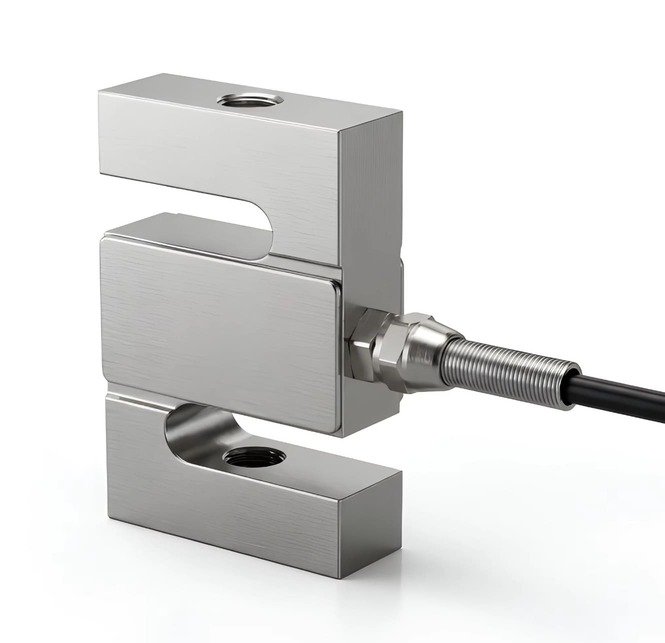
- Capacity: 5–20,000 kg (this variant 500 / 1000 kg)
- Accuracy: ±0.02–0.05 % FS
- Output: 2.0 mV/V, 380 Ω bridge
- Temp effect: ±0.02 % FS / 10 °C
- Safe / Ultimate overload: 150 % / 200 % FS
- Material / IP: Alloy or stainless steel, anodised / IP66
- Cable: 4-wire shielded, 3 m (≥ 5 t: 6 m)
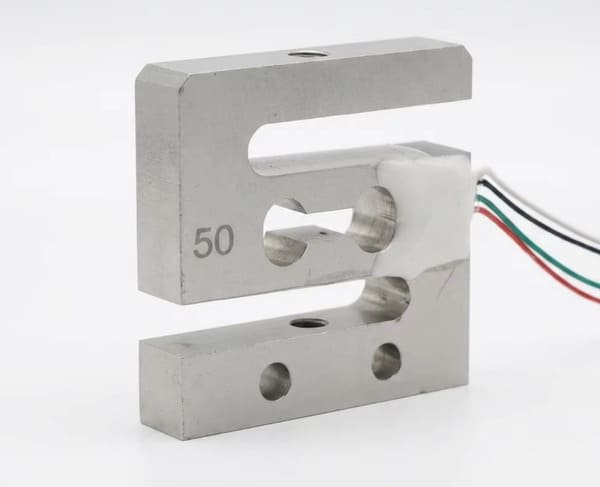
- Capacity: 2 / 5 / 10 / 20 / 30 / 50 / 100 kg
- Accuracy: ±0.02–0.03 % FS
- Output: 2.0 ± 0.1 mV/V, 395 Ω bridge
- Temp effect: ±0.05 % FS / 10 °C
- Safe / Ultimate overload: 150 % / 200 % FS
- Material / IP: Aluminium alloy / IP65
- Bidirectional: tension + compression with matched output
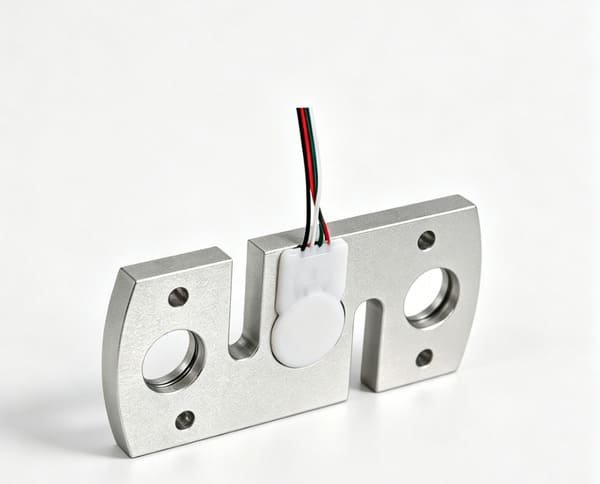
- Capacity: 100–300 kg
- Accuracy: 0.1 % FS
- Output: 1.5 ± 0.2 mV/V, 1000 Ω bridge
- Temp effect: ±0.1 % FS / 10 °C
- Safe / Ultimate overload: 120 % / 150 % FS
- Material / IP: Aluminium alloy / IP65
- Cable: 4-colour PVC wires, customisable
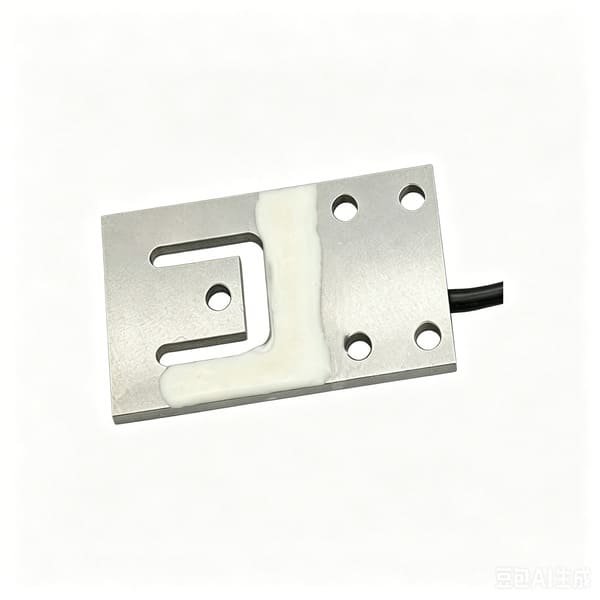
- Capacity: 7.5 / 15 / 30 / 75 / 150 / 300 / 600 kg
- Accuracy: 0.05 % FS
- Linearity / repeatability / hysteresis: ±0.05 / ±0.02 / ±0.02 % FS
- Output: 1.0 mV/V (≤ 75 kg); 1.5 mV/V (≥ 150 kg)
- Material / IP: Aviation-grade aluminium, anodised / IP65
- Safe / Ultimate overload: 150 % / 200 % FS
- Matched-output sets available for 3- / 4-cell platforms
About WST101: the fifth family in our rehab/fitness portfolio is the WST101 micro load cell (5–200 kg, 34 × 34 mm footprint). I keep it as a dedicated pick when the enclosure envelope is below 35 mm and the cable needs to exit in a specific direction — common in compact grip gauges and pedal-based strength trainers. It is not included in the four-card grid above because most rehab/fitness designs have enough vertical headroom for one of the four larger cells, but it is fully covered by the same OEM / ODM service in section 6.
9 · FAQ — capacity, accuracy, samples and integration
Which of these cells is closest to a clinical-grade force plate?
None of the four cards above is a finished force plate; all are load cells you integrate. If your design is a 3- or 4-cell platform expecting ±0.15 kg over a 200-jump protocol, the WST1101 with matched-output selection is the closest match in this portfolio — and it still costs you about a third of what a clinical-grade plate cell commands.
What about sampling rate? These all look like mV/V analog.
All five families output a ratiometric mV/V signal over a 4-wire connection. The bandwidth of the cell itself is several kHz; the bottleneck is your ADC front-end. We routinely pair WST404 / WST408 / WST1101 with a 24-bit ADC running at 1 kS/s per channel for cable-trainer rep counting and force-plate CoP analysis. Higher rates are possible, please specify in your inquiry.
Can you supply a matched set of 4 WST1101 cells pre-calibrated together?
Yes — the matched-output selection service tunes 3 or 4 cells to within ±0.05 % FS of each other on a shared calibration report. Specify the platform dimensions and we ship the set pre-paired.
What’s the smallest and largest capacity in the portfolio?
Smallest is WST101 at 5 kg (factory-tuned to 300 g–5 kg in some specialty builds); largest is WST401 at 20,000 kg, with 500 / 1000 kg being the most common high-load variant. Across the five families, the capacity span is roughly five orders of magnitude — from a handheld pinch gauge to a wall-mounted IMTP frame.
Do you sell finished dynamometers, force plates or cable trainers?
No. VektorForce designs and manufactures load cells (and matching junction boxes, indicator modules and amplifiers). We do not produce finished rehab or fitness devices. We also do not certify or warranty the finished device — patient-contact biocompatibility, electrical safety, software validation and clinical-grade calibration sit with the device OEM. See section 7 for the full boundary.
Do you support IEC 60601-1 documentation bundles?
We can supply RoHS / REACH statements, material traceability, individual-cell calibration reports and IQ/OQ paperwork for the load cell itself. We do not issue IEC 60601-1 system-level compliance statements — the finished device’s regulatory status is the OEM’s responsibility. If your QA team needs a particular document format to file, send your template; we will tell you upfront what we can fill.
What is your typical lead time?
Catalogue cells from stock ship within 5–10 business days. Custom variants (capacity, cable, connector, marking) add 2–4 weeks depending on complexity. Matched-output sets add another week for the joint calibration report. Lead times are quoted firm in our 12-hour response.
How do I start a custom feasibility evaluation?
Send capacity range, target accuracy, mounting envelope, cable length, connector (or PN), operating environment and annual quantity. Our engineering team returns a feasibility note within 12 working hours on business days. A short sketch or 2D drawing helps if you have it; a paragraph describing the device is enough to start.
Tell us what you are building. Send a sketch, send a spec.
Rehab dynamometer, force plate, cable trainer, IMTP frame or something I have not seen yet — get a feasibility note, a draft datasheet and pricing within 12 working hours on business days.
VektorForce · Precision Weighing Solutions & Load Cell Manufacturer · Xi’an, China · www.vektorforce.com · info@vektorforce.com · +86 15829026027
Load cells, junction boxes, weighing controllers and digital transmitters exported to 50+ countries. Direct manufacturer, 10+ years OEM/ODM experience. Factory tour, calibration reports and technical files available on request.