
Load Cell Weighing Solutions for Smart Trash Cans & Smart Waste Sorting Systems
Discover how load cells power intelligent waste sorting, recycling rewards, and fill-level monitoring in smart trash cans and recycling containers — from sensor selection and RS485 networking to OEM integration.

Table of Contents
1. What Is a Smart Trash Can / Smart Waste Sorting System?
A smart trash can or smart waste sorting system is an IoT-enabled refuse container that automatically identifies, weighs, sorts, and records waste disposal data. Unlike conventional bins, these systems connect to a central software platform, reward users for proper recycling, and help cities monitor waste generation in real time.
The most common deployment is the multi-compartment recycling station. It separates waste into categories such as:
- Recyclables — paper, cardboard, plastics, metals, glass
- Kitchen / organic waste — food scraps and compostables
- Other / residual waste — non-recyclable, non-hazardous items
- Hazardous waste — batteries, chemicals, medical waste
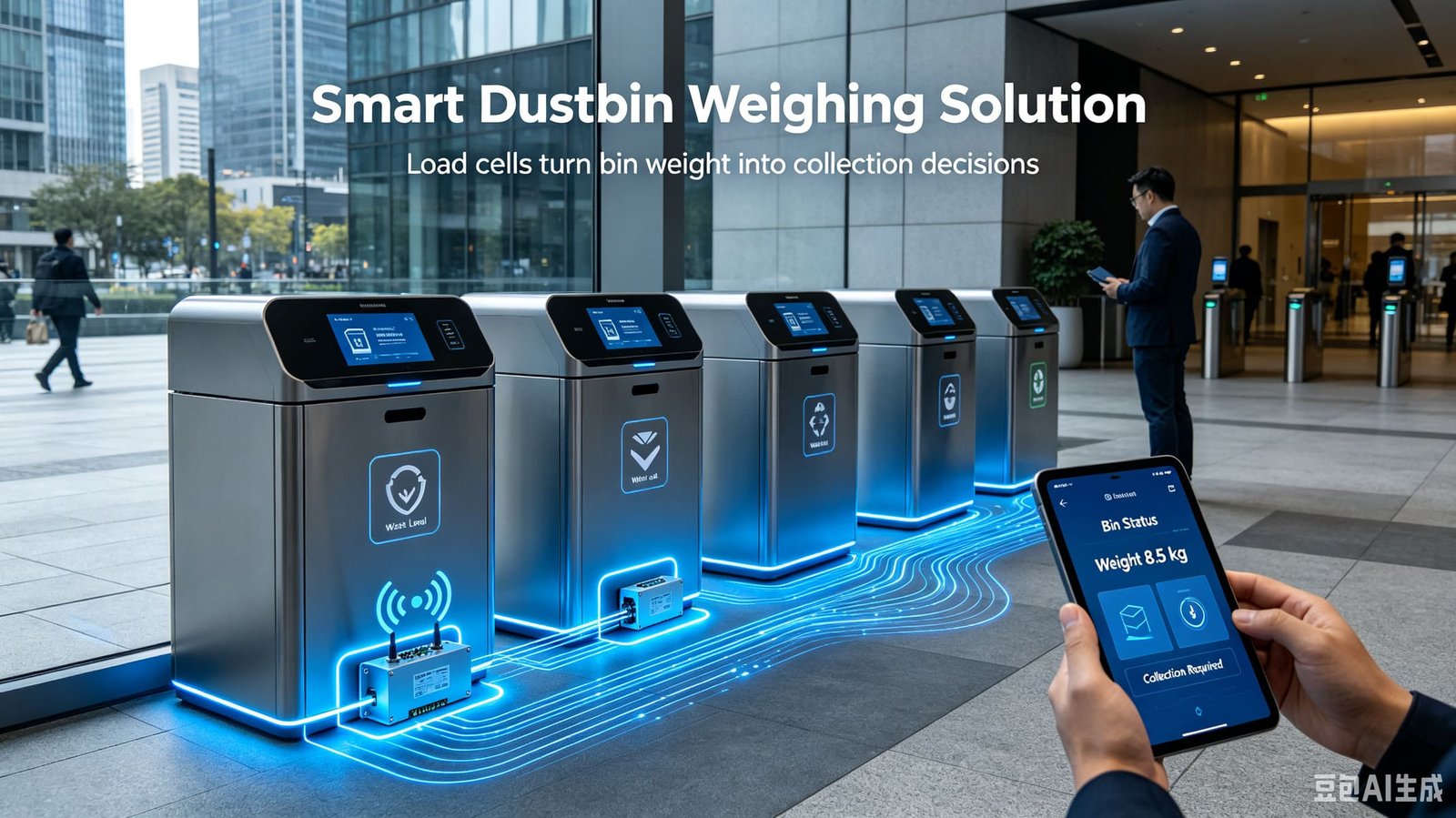
Each compartment sits on one or more load cells (weighing sensors). When a user deposits waste, the system records the weight, identifies the compartment, converts the measurement into credits or points, and displays the result on a mobile app or station screen. This gamification encourages residents to sort waste correctly and recycle more.
Smart trash cans are used in residential communities, shopping malls, airports, campuses, parks, and industrial facilities. They are a key building block of the smart city and circular economy infrastructure.
2. Why Accurate Weighing Matters in Waste Management
Weight measurement is the foundation of every smart waste business model. Without a reliable load cell, the system cannot calculate credits, trigger collection routes, or generate accurate waste audits. Here is why precision weighing matters:
Fair Reward Credits
Users earn points based on the actual weight of recyclables deposited. Accurate sensors build trust and prevent disputes.
Optimized Collection
Real-time fill-level data lets fleets route trucks only to full bins, cutting fuel and labor costs.
Waste Analytics
Cities and facility managers track waste volume by type, time, and location to design better policies.
Higher Recycling Rates
Transparent feedback and rewards motivate users to separate recyclables from general waste.
For an OEM, the load cell is not just a sensor — it is the billing and trust engine of the entire platform. A 0.5% accuracy class is usually sufficient for credit systems, but long-term zero stability and environmental sealing are equally important.
3. How Load Cells Enable Smart Waste Sorting
The operation of a smart trash can weighing system follows a clear sequence:
- User identification — The resident scans a QR code, RFID card, or face-ID to link the deposit to their account.
- Compartment selection — The user opens the correct compartment for the waste type (plastic, paper, metal, etc.).
- Weight capture — Load cells under the bin floor measure the weight before and after the deposit.
- Net-weight calculation — The controller subtracts the initial weight from the final weight to obtain the deposited mass.
- Credit conversion — The back-end software converts net weight into reward points using a predefined formula.
- Cloud upload — Transaction data is sent to the server via 4G, Wi-Fi, Ethernet, or LoRa.
- User feedback — The app or station screen shows the earned credits and environmental impact.
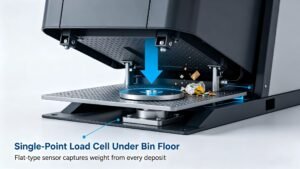
The load cell must tolerate dynamic impacts from dropped bottles and cans, moisture from food waste, and temperature swings from outdoor installation. Rugged construction and proper mechanical mounting are therefore critical.
4. System Architecture (5 Layers)
A complete smart waste weighing system can be divided into five layers:
The architecture scales from a single smart bin in a residential lobby to a network of hundreds of sorting stations across a city. RS485 bus wiring is especially popular because it supports long cable runs and multi-drop topology with dozens of bins on one controller.
5. Load Cell Types & Selection Guide
Two load cell configurations dominate smart trash can design: the single digital load cell and the four-cell flat-platform arrangement. The choice depends on bin size, capacity, accuracy needs, and cost targets.
Decision rule: Use a single-point digital load cell for compact indoor bins and reward-based sorting stations. Use four flat-type load cells for large outdoor containers, heavy recyclables, or when the load footprint is uneven.
6. Installation Guide for Smart Trash Can Load Cells
Proper mechanical installation is the biggest factor in weighing accuracy and sensor lifetime. Follow these steps for a reliable smart trash can weighing module:
6.1 Single-Point Digital Load Cell Installation
- Mount centrally — Position the load cell under the geometric center of the bin floor so the center of gravity stays within the rated eccentric load zone.
- Use a rigid frame — Weld or bolt a steel bracket to the bin base. The bracket must not flex under load.
- Isolate from side forces — Add flexible conduit for cables and avoid hard pipes that transmit vibration or wind loads to the cell.
- Seal against moisture — Use IP65/IP68 load cells for outdoor bins and route cables through waterproof glands.
- Calibrate with known weights — Apply at least two test masses (for example, 10% and 80% of capacity) and verify linearity.
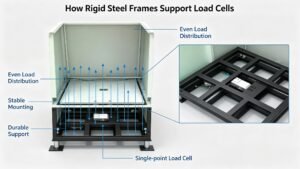
6.2 Four Flat-Type Load Cell Platform
- Place one cell per corner — Install flat cells at the four corners of a rectangular platform.
- Level the platform — All four cells must contact the ground evenly. Use adjustable feet and a spirit level.
- Corner-load adjust — After wiring, apply the same weight at each corner and trim the corner-error to within ±0.5 division.
- Protect from overload — Add mechanical stops so shock loads (for example, a full garbage bag thrown in) do not exceed 150% of rated capacity.

7. RS485 Bus & IoT Communication
One of the strongest advantages of digital load cells is the RS485 bus. RS485 uses differential signaling, supports cable lengths up to 1,200 meters, and allows up to 32 (or more, with repeaters) devices on a single two-wire bus. This makes it ideal for outdoor sorting stations spread across a neighborhood or campus.
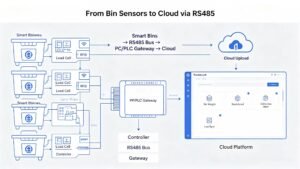
A typical RS485 fieldbus configuration looks like this:
- Bus topology — All load cells connect in parallel across one twisted-pair cable (A and B).
- Termination — Add 120 Ω termination resistors at both ends of the bus to prevent signal reflections.
- Biasing — Use weak pull-up/pull-down resistors if the network is long or noisy.
- Addressing — Each digital load cell has a unique Modbus-RTU address set by DIP switches or software.
- Gateway — An RS485-to-4G/Wi-Fi gateway forwards weight data to the cloud platform.
With the growth of 5G and NB-IoT, many operators are now replacing the final wired hop with wireless gateways. The load cell and RS485 network remain the same; only the gateway changes.
8. Recommended Load Cells & Specifications
Below is a practical selection guide for load cells used in smart trash cans and recycling containers. Contact your supplier to confirm exact models and customizations.
When specifying a load cell, always confirm: rated capacity, accuracy class (C3/C4), operating temperature, cable length, connector type, and whether the firmware supports your target protocol (Modbus-RTU, custom ASCII, or analog).
9. Wiring & Signal Connection
9.1 Digital RS485 Load Cell Wiring
Wire colors vary by manufacturer. Always refer to the load cell datasheet before connecting power. Reversing A and B will not damage the sensor, but communication will fail until the lines are swapped.
9.2 Analog 4-Cell Wiring (via Junction Box)
For analog flat-type load cells, the four cells are wired into a junction box that sums the signals. The combined output goes to an analog input module or an HX711 / industrial weight transmitter:
- Excitation — Parallel all E+ and E- wires to the supply.
- Signal — Connect S+ and S- from each cell to the corresponding junction box terminals.
- Corner trim — Use the trim pots in the junction box to balance corner errors.
- Shield — Connect cable shields to earth at one point only, usually the controller end.
10. OEM Integration Best Practices
If you are designing a smart trash can product for export, the load cell subsystem deserves attention early in the mechanical design phase. Use this checklist to avoid common integration problems:
Smart Trash Can Load Cell Integration Checklist
- Define maximum expected load including overload margin (typically 120% – 150%).
- Choose IP rating based on installation environment: IP65 for covered indoor, IP67/IP68 for outdoor.
- Reserve space for the load cell height, mounting feet, and cable bend radius.
- Design mechanical overload stops to protect cells from dropped objects.
- Plan cable routing away from sharp edges, heat sources, and moving doors.
- Implement digital filtering to suppress vibration from lid closing or bin emptying.
- Add a tare routine that runs automatically when the bin is emptied.
- Verify EMC compliance for RS485 or wireless transmitters.
- Source load cells from a supplier with CE, RoHS, and OIML certification.
- Request sample calibration reports before mass production.
Getting the mechanical and electrical integration right reduces warranty claims and improves user satisfaction. Most field failures in smart bins come from water ingress, mechanical overload, or poor grounding — all avoidable with good design.
11. Market Trends & Applications
The global smart waste management market is growing rapidly as cities tighten environmental regulations and seek operational efficiency. Key drivers include:
- Mandatory waste sorting laws — China, the EU, and an increasing number of U.S. states now require source separation of recyclables and organics.
- Carbon reduction targets — Accurate waste data helps municipalities measure diversion rates and report progress.
- Smart city budgets — Governments are allocating funds for connected public infrastructure, including intelligent bins.
- Deposit-return schemes — Reverse vending and smart recycling kiosks reward consumers with deposits or credits.
Beyond public recycling, load-cell-based smart bins are used in:
- Hospital and pharmaceutical waste tracking
- Airport security bin material control
- Industrial hazardous waste inventory
- Retail reverse logistics packaging returns
- University campus sustainability programs

12. FAQ
Q1: What is the best load cell type for a smart trash can?
For small to medium sorting bins, a single-point digital load cell with RS485 output is the best choice because it simplifies wiring and bus networking. For large outdoor containers or uneven loads, use four flat-type load cells with a junction box.
Q2: How accurate does the weighing need to be for recycling reward systems?
Most credit systems work well with C3 accuracy (0.03% – 0.05% of full scale). What matters more is repeatability and long-term zero stability, because small drift can accumulate into large credit errors over time.
Q3: Can one controller read many smart bins at once?
Yes. RS485 supports multi-drop topology, so dozens of digital load cells can share one bus. Each cell has a unique Modbus address, and the controller polls them sequentially. This is how large sorting stations and campus deployments are built.
Q4: How do you protect load cells from rain, dust, and food waste?
Choose IP65 or higher load cells, use sealed cable glands, slope the bin floor so liquids drain away from the sensor, and add a protective cover over the load cell cavity. Stainless steel cells are recommended for organic or coastal environments.
Q5: What communication protocol should I use?
Modbus-RTU over RS485 is the most common choice for digital load cells in smart waste systems. It is robust, well-documented, and supported by most PLCs and industrial gateways. For cloud connectivity, add an RS485-to-4G/Wi-Fi gateway.
Q6: How is the reward credit calculated from weight?
The controller captures the bin weight before and after the deposit. The difference is the net weight. The cloud software multiplies net weight by a conversion rate (for example, 1 point per 100 g of recyclable plastic) and credits the user’s account.
Q7: Can I retrofit a standard bin into a smart bin?
Yes, if there is enough space under the bin floor and the structure can support the load cell mounting frame. A single-point digital load cell kit is the easiest retrofit option because it requires only one mounting point and two-wire RS485 cabling.
Need Load Cells for Your Smart Trash Can Project?
We supply single-point digital load cells, flat-type load cells, and complete weighing platforms for smart waste sorting systems. Whether you are building a prototype or preparing mass production, we can help with sensor selection, mechanical integration, RS485 communication, and calibration.