
Load Cells for Livestock Scales: Field Notes From Weighing Something That Does Not Want to Stand Still
A livestock scale is not a platform scale with an animal on it. It is a measurement of a load that is actively trying to leave. Every kilogram the animal transfers to a rail, a gate or your own hand disappears from the reading — permanently, and invisibly.
9 October 2026
~40 min read
Sheep · Cattle · Pigs · Dairy
Why a livestock scale is a different instrument
I have sold load cells into a lot of weighing jobs over the years, and livestock is the one where the sensor is almost never the problem. I mean that literally. In the projects I have been involved with, the load cell was at fault in a small minority of cases. What was at fault was one of three things: the structure the animal stood on, the way the animal was restrained, or the environment the scale lived in.
There is a reason for that. A standard platform scale measures a load that has agreed to stay where you put it. A bag of cement, a pallet, a gas cylinder — the load is passive. It sits. When you put an animal on a scale you have a load with its own opinions: it shifts, it steps, it leans on the nearest solid object, it lowers its head, it defecates, and it will walk off the moment it decides it has had enough.
The consequence is that a livestock scale has two error sources a normal scale does not have, and both of them are larger than anything on a load cell datasheet:
1. Transfer error. Part of the animal’s weight never reaches the load cells. It goes into the head gate, the side rails, the race, or the ground under the deck. The scale is not lying — it is faithfully reporting the load it can see — but the animal has quietly exported 10 to 20 percent of itself to somewhere else.
2. Motion error. A standing animal is not a static mass. Its load on the platform swings, and the swing is proportional to body weight, not to the quality of your electronics. Average it out well and you still cannot beat what the animal will allow.
Both of these are invisible in a product photograph and both are invisible on a datasheet. That is exactly why they cause so many arguments between buyer and seller on this product line, and why I now ask a very specific set of questions before I quote anything. I will go through the arithmetic of both, then walk through three projects where they showed up, and then tell you where the limit of a component supplier starts.
One framing point before the numbers. The livestock scales market is around USD 1.05 billion in 2025 heading to about USD 1.60 billion by 2032, growing at roughly 6 percent a year, and platform scales alone account for about 41 percent of it. Cattle and beef operations are the largest application at just under half the market, and North America (about USD 363 million) plus Europe (about USD 294 million) together are two thirds of the world total. The driver is not new farms; it is that precision livestock farming has turned a weighing point into a day-to-day decision tool for feed conversion and slaughter timing. Which means the accuracy of these scales now has money attached to it in a way it did not thirty years ago.
The four weighing jobs on a livestock farm
Before we talk about load cells, we have to be honest that “livestock scale” is not one product. I count four distinct jobs on a typical livestock operation, and the requirements are different enough that the same load cell can be exactly right for one and wrong for the next.
| Job | What it is really for | The binding constraint |
|---|---|---|
| 1. Individual weighing Weigh crate, crush, squeeze chute |
Medication dosing, breeding selection, gain monitoring, condition scoring | Transfer error and motion. The animal is restrained, which creates both. |
| 2. Group / pen weighing Whole-pen platform, alley scale |
Average weight of a mob, load planning for transport, supplement budgeting | Capacity and platform area. Not accuracy — you are measuring an average. |
| 3. Trade weighing Auction mart, sale barn, truck scale |
Payment. The number is a legal document. | Certification. The instrument, not the cell, carries the approval. |
| 4. Feed weighing Feed tower, TMR mixer, feed belt |
Feed conversion ratio, ration accuracy, intake monitoring | None of the above. This is the easy one — see section 11. |
Notice the asymmetry. Jobs 1, 2 and 3 all involve an animal physically on or in the weighing structure, and all three have their hardest problem outside the sensor. Job 4 involves no animal at all, and it is straightforward engineering. If you are reading this because you are designing a farm weighing system, the single most useful thing I can tell you is: spend your engineering budget on jobs 1 and 3, because those are where the money leaks, and take the free win on job 4.
A quick word about the hardware shapes, because buyers often start in the wrong place. There are three mechanical formats, and they are not interchangeable:
- Four cells, one per corner of a platform. The default for a weigh crate, a floor platform or a pen deck. Four corners means the reading is more stable when the animal stands off-centre, and it lets the indicator average the corners.
- Two weigh bars under an existing chute or crate. Each bar contains two load cells, so two bars is effectively a four-cell system. This is the standard cattle answer because you keep the handling equipment you already own. The bars must sit narrower than the chute opening, or the animal will stand on the ends of the bars and skew the reading.
- A single-point cell with a central column. Compact and cheap, best for small ruminants and individual weighing of small stock, but it is more sensitive to off-centre loading and has lower capacity headroom.
Capacity: what the arithmetic says vs what the animal does
Almost every guide you will find gives the same capacity formula, and it is a good one:
Cell capacity ≥ ( heaviest animal + platform or crate tare ) × safety factor ÷ number of cells
Safety factor: 1.25 to 1.5 for livestock. Then round up to the next standard cell capacity.
Let me run it for the species that actually get weighed, assuming four cells and a 1.5 factor:
| Species | Heaviest | Crate / deck | Total | ×1.5 | ÷ 4 cells | Choose |
|---|---|---|---|---|---|---|
| Sheep / lamb | 80 kg | 60 kg | 140 kg | 210 kg | 53 kg | 100 kg |
| Goat | 90 kg | 60 kg | 150 kg | 225 kg | 56 kg | 100 kg |
| Calf | 200 kg | 150 kg | 350 kg | 525 kg | 131 kg | 200 kg |
| Sow | 300 kg | 120 kg | 420 kg | 630 kg | 158 kg | 200 kg |
| Beef cow | 700 kg | 250 kg | 950 kg | 1,425 kg | 356 kg | 500 kg |
| Mature bull | 1,100 kg | 250 kg | 1,350 kg | 2,025 kg | 506 kg | 1 t, and read on |
For the sheep, the calf and the sow, that formula gives the right answer and you can stop here. For the bull it gives you a number that is technically correct and practically wrong, and I want to spend a paragraph on why, because it is the most common sizing mistake I see.
The formula assumes the load stands still
Take a 1,100 kg bull. Static arithmetic says each corner carries 1,350 ÷ 4 = 338 kg, so a 500 kg cell sits at 68 percent of its rating and looks comfortable. Now watch him step onto the deck. He lands on his front feet first. His front feet are roughly 60 percent of his body weight, so the transient on two corners is about 1,100 × 0.6 = 660 kg before any dynamic amplification — and a walking animal’s peak vertical ground reaction force is typically 1.2 to 1.5 times body weight, while a startled or jumping animal can exceed 2 times. It also does not divide evenly: one corner takes more than the other.
Put the numbers together on the worst corner and you land somewhere around 800 kg in a normal walk and 1,500 kg or more on a startled step. A 500 kg cell in that position is at 160 to 300 percent of its rating. A 1 t cell is at 80 to 150 percent — which is inside its safe overload window of 150 percent but well outside anything I would want as a daily event. A 2 t cell sits at 40 to 75 percent and is the number I would actually quote for a bull deck.
The static formula sizes the cell for an animal standing still. Your animals do not stand still. Size for the step, not the stand — and remember that the step lands on one corner, not on four. On a cattle deck that is usually four times the static number, not the same number.
There is one more reason not to run an animal cell close to its rating, and it is not about accuracy. It is about fatigue. Every time an animal steps on the platform that is one load cycle, and every cycle spends a little of the cell’s life. A busy crush works 300 head a day; 300 cycles a day, 250 days a year, is 75,000 cycles a year. A cell running at 80 percent of its rating under that pattern will not see its nominal life. A cell running at 40 percent will. Oversizing an animal load cell is not waste in the way that oversizing a kitchen scale is; it is how you buy years of service, and it also protects you against the day a second animal squeezes on beside the first.
The transfer error — the biggest error nobody measures
This is the section I would ask you to read twice, because it is the one that decides whether your livestock scale is a measuring instrument or a very expensive random number generator.
Here is the mechanism. When you restrain an animal — head gate closed, side rails tight, an operator with a hand on its flank — the animal does not simply rest its full weight on your platform. It pushes. It leans forward into the head gate, sideways against a panel, or back against the rear gate. Each of those pushes is a load path that bypasses your load cells entirely. The animal is still 600 kg. Your scale is not lying. But your scale is only being asked to weigh the part of the animal that is standing on it, and that part is not 600 kg.
A 600 kg cow stands in a chute with the head gate closed. She pushes forward, as cattle do. Suppose 15 percent of her weight goes into the head gate.
Your scale reads 600 × 0.85 = 510 kg. The error is 90 kg, or 15 percent — sixty times larger than the cell’s own non-linearity.
And here is the dangerous part: it is consistent. It does not look like a fault. Every animal weighed the same way on the same day reads about 15 percent light, so the numbers look tidy and repeatable. The fault never announces itself. It just quietly becomes the truth you do business on.
Now the second half, which is worse. That 15 percent is not a constant. It depends on how tight the head gate is set, how hard the animal pushes today, how calm it is, how a different operator handles it. Assume it wanders between 10 and 20 percent. On a 600 kg animal that is a 60 kg spread between weighings of the same animal.
Put that next to what livestock scales are actually used for. A finishing steer gaining 1.3 kg a day for 90 days gains about 117 kg. If your weigh-to-weigh noise floor is 60 kg, then more than half of the change you are trying to measure is instrument error. You cannot measure feed conversion, you cannot detect a sick animal early, and you cannot select breeding stock on growth rate, because the noise is the same size as the signal. This is why some producers conclude that “scale weights are unreliable”. The weights were not unreliable; the load sharing was.
The second transfer path: the ground under the deck
The other version of transfer error is not the animal at all. It is whatever has built up underneath the platform. Manure, mud, packed bedding, gravel, ice. A layer of compacted muck under one corner of the deck becomes an extra support: the deck now rests partly on the ground and partly on your load cell. That corner reads light, and it reads progressively lighter as the layer thickens over the season. Stones are worse than muck because they are a hard, near-rigid path — a single 20 mm stone under a deck can take a large share of the load off that cell.
This is the reason a livestock scale should sit on a proper concrete pad with drainage, not on a yard surface, and the reason the deck should never have anything packed underneath it. It is also the reason for a check that costs nothing and finds the fault every time: jump on each corner and watch the display. If you load a corner and the reading barely moves, that corner is not on a load cell — it is on the ground.
The half-floated chute, and why it is worse than either extreme
There is a hybrid arrangement I have seen several times and I want to be blunt about it: two load cells under the deck and two under the chute frame, with the chute still bolted to the same concrete as the deck. This is the worst of all worlds. Where the animal stands decides how its weight splits between the two pairs, and the split changes every time. The scale is not measuring the animal; it is measuring the animal multiplied by a ratio nobody controls.
Float all of it, or float none of it.
If you want the chute weighed, then the chute, the head gate, the rear gate and the operator’s platform must all be on the same set of load cells, and the assembly must touch the ground only through those cells. If you want only the deck weighed, then nothing else — no gate, no rail, no post, no water pipe — may touch the deck. Half a float is a random number generator. It will be plausible, it will be repeatable within a day, and it will be wrong.
The same logic explains why the design of the restraint matters as much as the design of the scale. A narrow race that guides the animal into one position reduces movement and reduces the transfer. Calm handling reduces it further — a stressed animal pushes harder and more variably than a quiet one. In this product line, animal handling practice is part of the measurement system, and I say that as someone who sells hardware, not handling advice.
What the animal is doing to your signal
Now imagine the scale is perfect. No transfer error, a rigid deck, four cells on a concrete pad. You still cannot read a number, because the load is moving.
A standing animal is not still. It breathes, so its chest rises and falls. It shifts weight from one leg to another. It turns its head, and a cow’s head is heavy. The load cell sees all of it. In practice the instantaneous load on a platform under a standing animal swings by roughly 2 to 5 percent of body weight, at something around 1 hertz — call it a mix of breathing, sway and small steps. On a 600 kg animal that is a swing of 12 to 30 kg, all day long, invisible to the eye and enormous on a display with 0.5 kg divisions.
The fix is not a better load cell. The fix is time. If the fluctuation is roughly a 1 Hz signal with a standard deviation of about 9 kg on a 600 kg animal, then averaging over a window of T seconds gives you roughly T independent samples, and the standard deviation of the average falls as the square root of that count. Here is what that looks like:
| Averaging window | Samples at ~1 Hz | Resulting uncertainty on 600 kg | As percent of body weight |
|---|---|---|---|
| 1 s | 1 | ±9 kg | ±1.5 % |
| 2 s | 2 | ±6.4 kg | ±1.1 % |
| 5 s | 5 | ±4.0 kg | ±0.67 % |
| 10 s | 10 | ±2.8 kg | ±0.47 % |
| 30 s | 30 | ±1.6 kg | ±0.27 % |
| 225 s | 225 | ±0.6 kg | ±0.1 % — won’t happen |
Read the last row carefully, because it is the whole argument. To get a 600 kg animal to ±0.1 percent you would need it to stand essentially still for nearly four minutes. That is not a sensor problem. No load cell, no A/D converter, no filter setting will change how long an animal will stand still. The achievable accuracy of a livestock scale is set by the animal, not by the electronics, and the honest working figure is roughly ±0.3 to ±0.8 percent of body weight — which matches what the industry actually reports in the field: about 2.5 kg on a full-sized animal in a well-set-up crush, and 5 to 9 kg for high-capacity weigh bars in rougher setups.
Sheep and lamb work sometimes needs ±0.2 kg, which looks impossible next to the numbers above — and it is, if the animal is loose. The trick is that a well-designed sheep crate restrains the animal so completely that the motion falls to a fraction of a free-standing animal. You are not buying accuracy with a better sensor; you are buying it with the animal’s immobility. That is a mechanical design decision, made long before the load cell is chosen.
Two practical consequences follow, and both change how a livestock scale should be operated:
- Be consistent, or the numbers are not comparable. Weigh at the same time of day, with the same fill state. A full rumen or a recent drink moves an animal’s weight by several percent with no change in body condition at all. If you weigh after feeding on Monday and before feeding on Friday, you will “discover” a growth trend that is actually a meal.
- Compare trends, not single readings. Because the noise floor is a few kilograms and real growth is a few kilograms, a single weight is weak evidence and a sequence of weights is strong evidence. This is precisely what precision livestock farming software assumes, and it is why the indicator’s data output matters more than most buyers expect.
Resolution, once and for all
Every month or so a customer writes to me asking for “a load cell with better resolution” for a livestock scale. I want to close that conversation permanently, because the arithmetic is short and it always ends the same way.
Take the cell I would actually put under a cattle deck: a Class C3 shear beam, 1 t, rated output 2.0 mV/V, running on 10 V excitation. Full scale output is 2.0 mV/V × 10 V = 20 mV. Class C3 means 3,000 verified divisions over that capacity, so one division is:
20 mV ÷ 3,000 divisions = 6.67 µV per division
and in mass terms: 1,000 kg ÷ 3,000 = 0.33 kg per division.
So the cell gives you about 20 µV per kilogram of animal.
Now the electronics. Our own stainless indicators document a 24-bit sigma-delta converter with a ±10 mV input range and 5,000,000 internal counts. That is:
20 mV span ÷ 5,000,000 counts = 4 nV per count
One division of the load cell (6.67 µV) = 1,667 counts.
Read that again. The electronics resolve one load-cell division into 1,667 steps. The scale is running with roughly a thousand-fold margin between what the converter can see and what the cell can guarantee. Adding a 24-bit converter to a 16-bit one, or a 5,000,000-count meter to a 100,000-count one, changes nothing you can observe, because you are already two to three orders of magnitude below the noise that the animal and the structure put on the signal.
Does not matter: the live weighing of an animal. Here the limit is motion and load sharing, both of which are mechanical.
Does matter: the small-animal end. A 20 kg lamb on a 100 kg cell has a much smaller signal in absolute microvolts, and a low-capacity cell with a matched output is genuinely the right choice — not for resolution in the abstract, but because the signal is smaller in proportion to the fixed noise of the system.
If you take one purchasing rule from this section, take this one: when a livestock scale reads badly, the problem is almost never the converter, and buying a “higher resolution” instrument is the most common way to spend money without changing the outcome. The things that will change the outcome are a corner test, a look under the deck, and a longer holding window. All three are free.
The indicator’s job: animal mode, hold and lock time
Here is the division of labour that took me a while to explain clearly to customers. On a livestock scale, the load cell has two jobs only: be honest (linear, repeatable, stable with temperature) and be able to take the abuse. Everything else — deciding which number to believe — belongs to the indicator.
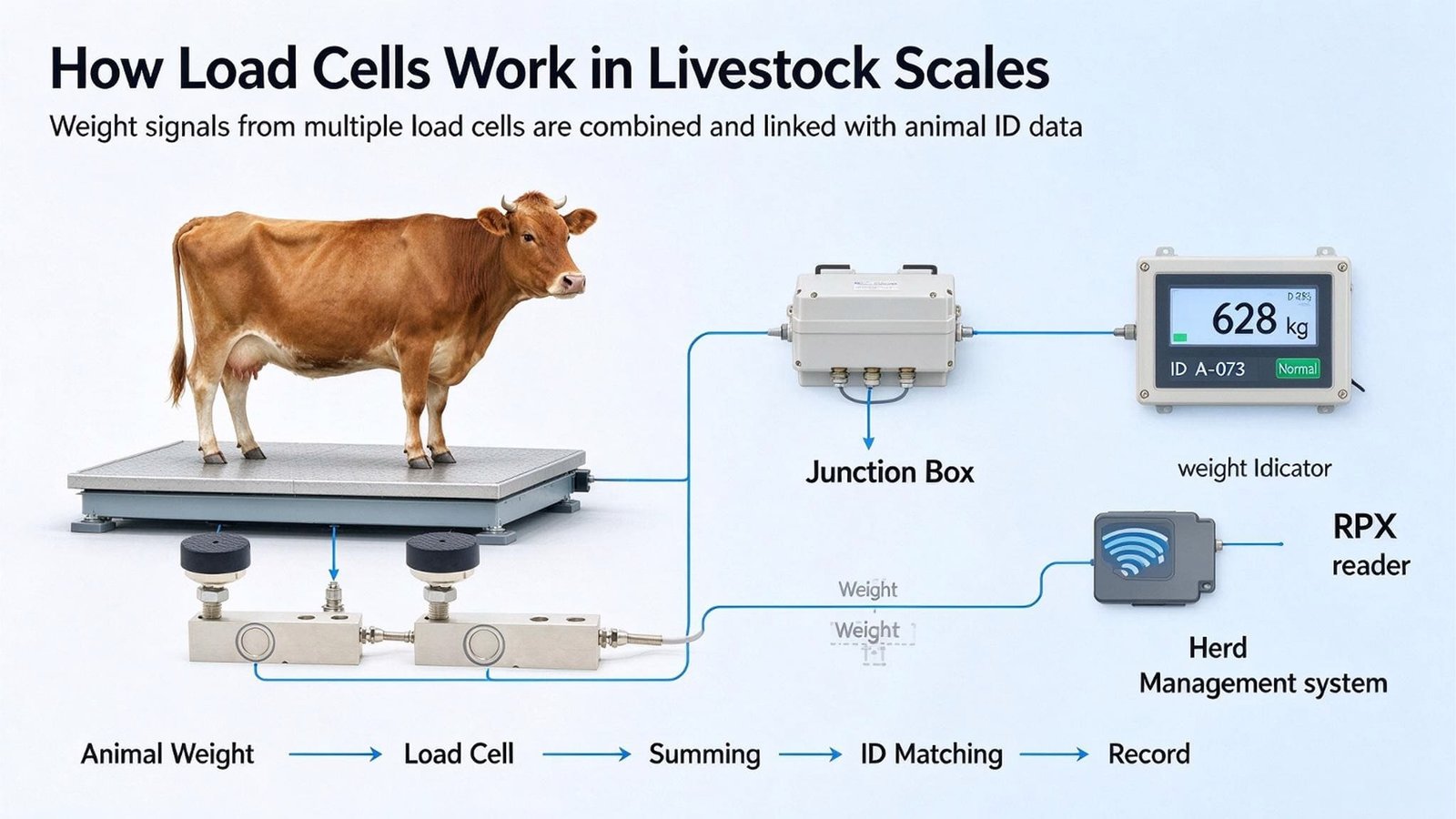
That is why the feature that matters most on a livestock indicator is not the resolution, and it is not the display size. It is the motion handling. In our own range this feature is listed simply as “animal weighing” plus “hold function”, and it appears on the platform indicator and the stainless RS-485 and printer models alike. What it does is conceptually simple: the indicator watches the signal, waits until it stays inside a narrow band for a defined period, then freezes and displays the result instead of chasing the live value.
The filter is a trade-off, not a setting
This is where a lot of installations get set up wrong, and it is fixable in ten minutes at the keypad. Every motion filter trades stability against speed, and the right point on that trade-off depends entirely on which of the four jobs from section 2 you are doing:
| Job | Setting that works | Why |
|---|---|---|
| Restrained animal (crush, weigh crate) | Longer window, tight motion band — 3 to 5 s | The restraint already limits movement. This is where you can afford several seconds and get the tightest number. |
| Loose animal on a platform | Shorter window, slightly wider band — 1 to 2 s | If you wait for a 5 s stable band on a loose animal you will never get a lock. Better a slightly noisier number than no number. |
| High throughput (hundreds of head a day) | Aim for a lock under about 3 seconds | A 10 s lock per animal cuts your throughput to a fraction. Lock time is throughput on this job. |
| Static feed or silo weighing | Animal mode off, long filter | Nothing is moving. Turn the trade-off all the way to stability. |
Notice that the correct setting for a crush and the correct setting for a loose platform are opposite, and a scale used for both will be wrong for at least one of them. This is the whole reason I now tell customers to buy an indicator with a stored animal-weighing mode and spend an afternoon setting it under real animals, rather than treating the filter as a factory default to leave alone.
An animal-weighing mode is not magic, and I never present it as such. It cannot fix a deck that is grounded, a chute whose gate is bolted to the ground, a platform on soft uneven surfacing, a scale that is out of level, or a cable so long that the excitation has sagged. Every one of those produces a plausible lock on a wrong number. A good indicator tells you when the load was stable; it has no way to tell you that the load was never all on the scale.
Case 1: a sheep crate in Angus, Scotland
Let me start with the project that taught me the most, because it is the one where the customer was certain he needed a different load cell and the answer was that he needed to stop his crate from binding.
The customer builds sheep and cattle handling systems in Angus, in Scotland — the same class of machine as the well-known Ritchie equipment from that part of the country, which has been refined in that market for decades. He was integrating a weigh crate into a sheep race: animal enters, the crate holds it, the weight appears on the display, the operator reads it and releases. Sheep run 40 to 90 kg in his market, and for breeding selection he wanted ±0.2 kg so he could track ewe condition and lamb growth properly.
I quoted four 100 kg shear beam cells and one platform indicator with animal weighing. He fitted it. Two weeks later he was on the phone: the same ewe, weighed ten minutes apart, had come out at 61.4 kg and then 63.2 kg. He was convinced the cells were “not accurate enough” and wanted to know what a tighter cell would cost.
I did not quote him a better cell. I asked for two things instead: a corner test with test weights, and a short video of the crate with a sheep in it. Both of those answered the question in about an hour, and neither involved a new part.
What the two tests found
The corner test cleared the cells. With 20 kg placed over each corner in turn, the four corners agreed to within 0.15 percent. That is close to the limit of what the test weights could resolve, and it meant the load cells were behaving exactly as specified. It also told me the cells had not been damaged, and that the junction box rigging was intact.
The video found the real fault, twice. First, I could see that the crate’s side panels were touching the outer fixed frame. The crate had taken a knock in transit and the panel clearance had closed up to almost nothing. When the sheep pushed sideways — which sheep do, constantly — part of its weight travelled through the panel and into the frame, which was standing on the ground. That is a textbook transfer error, and it explains the reading being light and unstable at the same time: light because some weight bypassed the cells, unstable because how much bypassed them changed with every shove.
Second — and this is the part I had not asked about — the indicator was still on its factory setting for static weighing: a one-second window with a tight motion band. On a sheep whose natural load swings by a kilogram or two at about one hertz, a one-second window does not measure the sheep, it measures whichever instant it happened to catch. The reading depended on when the indicator chose to lock, not on what was on the scale.
What we changed, and what it was worth
Three changes, none of them a new load cell:
- Restore the panel clearance and add a positive hard stop so the crate can no longer bind against the outer frame in any position.
- Set the indicator’s animal-weighing filter to a five-second window with a 0.5 kg motion band — the restrained-animal setting from the table above.
- Re-trim the corners through the junction box with the 20 kg weights, and re-zero, so the electrical side matched the mechanical fix.
He then weighed the same ewe ten times. The standard deviation across those ten readings went from about 0.9 kg to about 0.06 kg, and the readings all fell inside a ±0.15 kg band. That is roughly a thirty-fold improvement in repeatability, achieved with the same four load cells, the same indicator, and the same resolution.
He asked me to sell him a more accurate load cell. I could have. It would have made his scale worse, because a cell with a tighter spec would have reported the binding more precisely, not less. The binding was the measurement.
I now open every livestock enquiry with two requests before I quote: a corner test with whatever test weights the customer has, and a look at how the animal is restrained. Those two pieces of information predict the outcome of the project far better than the accuracy class of the cell.
Case 2: load bars under a Brazilian feedlot chute
The second project is the one with the largest number attached to it, and it is a pure transfer-error case with a second, entirely mundane cause layered on top.
A finishing feedlot in Goiás, in central Brazil, weighing cattle through a squeeze chute on load bars. Roughly 4,000 head per cycle, weighed on entry to the feedlot and again before sale. The complaint was twofold: the same animal weighed twice a few minutes apart could differ by up to 18 kg, and the herd average came out consistently about 4 percent below what the owner expected from the numbers on his truck scale.
The second complaint was the expensive one. Four percent on a 450 kg finishing animal is 18 kg of live weight, per head, on 4,000 head. At roughly R$ 3.20 per kilogram of live weight, that is about R$ 230,000 per cycle — on the order of forty thousand US dollars — and because he sells finished cattle by weight, he was the one absorbing it. A scale reading light is not a neutral fault; it moves money from the seller to the buyer.
Two faults, and how we separated them
We ran the diagnostic in the order I would always run it, cheapest test first:
- Corner check by jumping on the deck. All four corners responded, so nothing was grounded at that point. But two corners responded noticeably less than the others — a hint.
- Look underneath. Under one load bar there was about 8 mm of compacted dung and gravel. That is an extra support path: the bar was partly resting on the ground instead of entirely on its cell. This explained the lighter, stickier corner.
- The head-gate test. This is the test I would ask every chute owner to run once. We weighed a known animal with the head gate closed and again with the gate held open, and then with the gate latch post disconnected from its ground anchor. The reading changed by about 14 kg depending on the gate. That is a transfer path — the head gate’s reaction was going into a post that was anchored to the same concrete the scale bars sat on, so part of the animal’s effort bypassed the bars entirely.
The fixes were mechanical and cheap. We cleared the buildup from under the bars and re-set them on a proper concrete pad with drainage so it could not accumulate again. We removed the head-gate post’s ground anchor so the post loads only through the floating frame. And we re-tuned the indicator: because an animal in a chute is far more restrained than one on an open platform, we could use a 2-second window with a tight motion band and still get a fast lock, which mattered at 4,000 head a cycle.
Repeat weighing on the same animal went from up to 18 kg apart down to about ±2.5 kg, and the herd average moved up by roughly the 4 percent that had been disappearing into the posts and the muck. Same load bars. Same indicator. No new part was purchased.
A four percent error is small enough to be believable and large enough to be expensive, and it is entirely invisible on a datasheet. There is no load cell specification in the world that will tell you that the head gate is anchored to the ground.
Two tests would have found it before the first animal was weighed: weigh a known animal with the gate closed and with it open, and jump on each corner and watch the display. Both take under five minutes and neither needs any equipment.
Case 3: an Irish dairy yard that killed three cells
The third project is the one where I have to be honest about the limits of a catalogue part, because the customer’s conclusion was “your load cells are weak” and my conclusion was different.
A 220-cow dairy in Munster, Ireland, weighed cows on a deck in the collecting yard, with the indicator inside the parlour building and a cable run of about 42 m. Over fourteen months, three load cells failed. The symptom each time was the same: the scale would not return to zero, and after a while the zero would creep further than the operator could correct.
What was actually happening
A farm yard has three enemies that a load cell datasheet does not list, and this site had all three.
The first is high-pressure water. The cells we had quoted were IP65, which is splash and dust protection — and IP65 is exactly what our own datasheet states for that model, so I am not going to pretend it is something else. IP65 is fine on a covered indoor deck. A yard that is power-washed weekly with slurry everywhere is not a splash environment; it is a jetting environment. The sealing eventually lost.
The second, and the one that mattered most, was the junction box. It was a plastic enclosure mounted low on the frame with its cable glands facing upward. Water ran down the cables, through the glands, and sat in the bottom of the box. When we opened it, the trim potentiometers were green and the terminations were corroded. The cells were getting wet, but the box was drowning. This is such a common failure on farm scales that I now ask about the junction box before I ask about the load cells.
The third was vermin. The cable crossing the yard had been chewed at two points where it ran against a wall, and where it passed under a gate the PVC jacket had abraded through to the shield. Rodent damage is a genuine design input on a farm scale in a way it is not on a factory scale, and it is why I would rather see that run in steel conduit or armoured cable than in a bare PVC-sheathed run.
The fixes, and the honest boundary
We replaced the plastic box with a stainless junction box and mounted it high on the frame with the glands facing down and a drip loop in each cable, which is a ten-minute change that removes an entire failure mode. We routed the yard run in conduit. And for the two positions that sit in the wash path, we used sealed stainless cells with a polyurethane-jacketed cable rather than the standard PVC-sheathed catalogue part.
Before any of that, I also checked the cable run itself, because a 42 m run is the kind of thing that gets blamed for everything. Our platform indicator documents a maximum cable length per conductor cross-section of (L/A)max = 150 m/mm². For a 0.5 mm² conductor that allows 75 m per conductor, so the 42 m run was comfortably inside the limit. The cable was not the problem. The box was. I mention it because “the long cable” is a diagnosis that gets applied reflexively and is usually wrong — check the limit before you re-cable a yard.
“Our catalogue cells are IP65 with a PVC cable. On a covered indoor deck, that is the right part and it will last. In a yard that gets hosed, with slurry underfoot and rats in the walls, it is the wrong part, and if I sell it to you I will be back in a year. What you want there is stainless, sealed, with a polyurethane cable and a stainless junction box. That is a different part and it costs more.”
I would rather say that in the quotation than discover it in a failure report. It has cost me a few orders and it has earned me repeat business.
Both of the changes that mattered on that farm — the junction box and the cable routing — cost less than one load cell. The three cells that died were not the cause of the problem; they were the symptom. That is worth remembering when the failure report says “load cell failed”: the cell is usually the last thing in the chain to break and the first thing to be blamed.
The easy half: feed towers and TMR mixers
After three hard cases I want to make the contrast explicit, because it explains why I get so many enquiries for farm weighing that turn out to be straightforward. The hardest weighing job on a livestock farm is the animal. The easiest is the feed.
A feed tower — feed silo, feed bin — is a galvanised or carbon steel vessel for storing dry or pelleted compound feed on the farm, with an outlet conveyor that delivers to the sheds. It is an outdoor, static vessel: cylinder on top, cone at the bottom, on three or four legs. Nothing walks on it, nothing leans on it, and its centre of gravity does not move. In measurement terms, it is a silo, and I have written before about weighing silos and feed towers because the engineering is the same family.
A feed tower with a 6 t feed capacity and an 800 kg tare, on three legs:
Capacity per cell = K × (tare + feed) ÷ legs = 1.5 × 6,800 kg ÷ 3 = 3,400 kg, so 5 t cells.
Resolution: the useful daily signal is feed consumed, maybe 2 percent of the tower, or about 120 kg a day. Against that, the electrical error is small: at 0.03 %FS on a 5 t cell that is 1.5 kg per cell, and combined across three cells (worst case additive) 4.5 kg, or about 2.6 kg if the errors are uncorrelated. So the daily intake signal is twenty to forty times the error floor. This job is easy.
That is the arithmetic in a nutshell: on the feed side you are measuring a 120 kg daily signal with a 3 to 5 kg error floor, and on the animal side you are trying to measure a few kilograms of daily gain with a several-kilogram error floor set by biology. Same load cells, same family of indicator, completely different difficulty.
The TMR mixer is the other feed-side job and sits in between. A total mixed ration mixer blends several ingredients to a ration, and the accuracy target is usually stated as ±0.1 to ±0.5 percent per ingredient, with three or four load cells (shear beam or pin type) at the support legs or at the chassis connection of the mixing tank. That is a genuine requirement, and on many mixers the weighing system is not the bottleneck — the loader operator is. If a loader puts two bucketfuls instead of 1.8, no amount of load cell accuracy rescues the ration. I have covered the detail in a separate piece on load cells for TMR feed mixer wagons, and we build a pin-type cell for exactly that mounting.
The feed tower measures a 120 kg daily signal against a 3 – 5 kg error floor. That is a ratio of about 30:1.
The animal scale measures a few kilograms of daily gain against a 2 – 9 kg error floor set by motion and load sharing. That is a ratio near 1:1 — or worse.
Cables, junction boxes, water and rats
A livestock scale has a longer, wetter, more chewed cable run than almost any other weighing job, so it deserves its own section. Five things I now insist on before a farm scale leaves the drawing board:
- The junction box goes high and dry, with the glands facing down. A junction box mounted low with upward-facing glands is a bucket. Put it on the high side of the frame, glands downward, with a drip loop in every cable so water cannot track down the sheath into the box. Where the site is wet, a stainless box with a sealed cover is not an upgrade, it is the correct part.
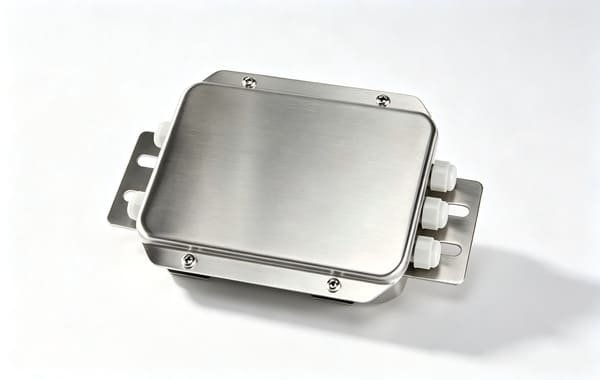
- Corner trim belongs in the junction box, not in the software. The multi-channel boxes we supply have potentiometer trim per channel and a stainless shell with sealed joints. The procedure is simple and it is the same on every scale: put the same test weight over each corner in turn, note the readings, and trim the high channels down to match the lowest one. Potentiometers are one-way attenuators, which is why you trim down and never up. Note too that calibration cannot fix a corner error — only a corner trim can.
- Know your cable limit before you blame the cable. The (L/A)max figure of 150 m/mm² per conductor is the documentable limit, so 0.5 mm² gives you 75 m. If you are inside it, an excitation drop is not your problem. If you are near it, six-wire connection with separate sense lines compensates for the lead resistance and is the correct answer. And whatever you do, calibrate in place: never on the bench and never with a different cable length than the one you will use.
- Protect the run from teeth and tyres. Steel conduit across open yard, armoured cable where a vehicle can cross it, and a visual inspection of the whole run once a season. Rodent damage is the single most under-quoted cause of “intermittent” faults on farm scales, because a chewed shield produces symptoms that come and go with the weather.
- Use anti-surge protection in the box where the run is long or overhead. Our weighbridge-grade junction box boards carry anti-surge and anti-inductive components precisely because a long outdoor run is an antenna. On a farm that sits under a wide sky with a 40 m cable, that is not a luxury.
And a diagnostic habit worth building: when a farm scale misbehaves intermittently, look at the junction box first and the load cells last. The box is cheap, exposed, and the place where water collects. You will fix more scales by drying out a junction box than by replacing load cells. If you do suspect the cells, I have written a step-by-step on how to tell whether a load cell is actually damaged, and the short version is: measure the bridge resistance and the zero output, and compare the four cells against each other, before you unscrew anything.
Installation and the ten-minute field diagnostic
Everything in this article eventually reduces to a short list of things to get right at installation and to check whenever the numbers stop making sense. I will give you both.
Installation, in order of how much it matters
- Foundation first, hardware second. A level concrete pad with drainage. A scale on soft, uneven ground will not hold calibration no matter what you bolt to it, and this is the single most common cause of “my scale drifts” that customers attribute to the sensor.
- Level the base, then check it again after loading. Load cells are not designed to be levelled out by the indicator; they are designed to be level. Also remember that temperature moves steel: a long unsupported column or an outdoor deck in a wide temperature swing will change its geometry seasonally.
- Isolate the weighing assembly completely. The floating frame must touch the ground only through its load cells. No shared anchors, no pipework, no cable conduit strapped between the floating frame and a fixed post. This is the mechanical version of the “float all of it or none of it” rule.
- Leave clearance around the deck. A deck that touches a kerb, a rail or a gate post has transferred some of its load to the ground. Clearances are not cosmetic; they are calibration.
- Consider the animal’s footing. Anti-slip decking and a low restraint bar across the front keep the animal still, which reduces motion error. A slip also produces a genuine impact transient that stresses the cells, so good footing protects the hardware as well as the reading.
- Protect the cell from anti-lift and side force. Animals rock a platform. A keeper or anti-lift arrangement stops the deck from lifting the cell off its seat, and a lateral restraint stops side loading from reaching the element. Both are part of a correct mounting, not accessories.
- Clear the deck and zero it. Does it return to zero within a division? If not, something is on the deck, something is under it, or something is loaded.
- Jump on each corner in turn. Every corner must make the display move. A corner that barely responds is resting on the ground, not on its load cell.
- Put a known weight in the centre, then over each corner. If the corners differ by more than about one percent, trim them at the junction box.
- Weigh a known animal, twice. The spread between the two readings is your real repeatability — not the datasheet number.
- Repeat with the head gate open, then closed, then unanchored. If the reading changes with the gate, you have a transfer path. Find and cut it.
- Look underneath the deck. Manure, packed bedding, stones, gravel, ice. Anything hard under a corner is a support path.
- Open the junction box. Water, condensation, green terminals, a chewed cable entry. Dry it, re-seal it, mount it higher, glands down.
- Only then, suspect a load cell. Unplug each cell and measure its bridge at no load: compare input and output resistance and the zero output against the others. A cell that has shifted or changed resistance is your fault, and it is the last thing to check, not the first.
The questions I ask before I quote a livestock scale
If you are specifying one of these, this list is the difference between a scale that works and a scale that argues. I ask all eleven of these before I put a number on paper, and the answers change the parts list every time:
- Which species, and what is the heaviest animal you will ever put on it?
- Platform, weigh bars under an existing chute, or a full deck — and what is its tare weight?
- What restrains the animal, and what does the animal touch besides the deck? (Head gate, side rails, operator, water trough.)
- Is every part of that restraint on the load cells, or anchored to the ground?
- Is the weight used for payment, or only for management? (This decides whether you need a certified instrument.)
- Where does the scale live: covered indoor deck, open yard, washdown zone, or slurry?
- How far is the indicator from the scale, and is that run protected from water, vehicles and rodents?
- How many head a day, and how many seconds can you afford per animal?
- Does the weight need to go anywhere — herd management software, EID reader, printer, or a drafting gate?
- Who will calibrate it, with what test weights, and how often?
- What is the routine for clearing muck out from under the deck, and who owns it?
Legal for trade: classes, tickets and what “certified” means
There are two completely different regimes for a livestock scale, and confusing them is how people waste money in both directions.
If you weigh animals for your own management — growth monitoring, dosing, breeding selection, feed budgeting — then no legal certification is required anywhere in the world. Buy the most accurate system you can justify and get on with farming.
If you weigh animals and the number determines payment — a sale barn, an auction mart, a truck scale at a packing plant, a feedlot settling with a buyer — then you are in legal metrology territory, and the requirements are specific. In the United States, livestock weighed for purchase, sale, payment or settlement fall under the USDA Packers and Stockyards Program, and the scale has to be an approved type — which in practice means NTEP type evaluation and conformance with NIST Handbook 44. The requirement is not just about the instrument either: a scale ticket for a livestock transaction must carry the date, the weighing agency, the seller or consignor, the buyer, the number of head, the kind of livestock, the actual weight, and the weigher’s name or initials, with the required scale tests reported on the appropriate form. In the EU and UK the same idea runs through MID as the Non-Automatic Weighing Instrument requirements.
Which accuracy class, and why livestock often lands in a coarse one
Legal metrology puts weighing instruments into four classes. Class I is the analytical end; class II is laboratory and pharmaceutical; class III is the ordinary commercial class you meet on a shop counter; class IIII is the ordinary or coarse class, and it is the one classically associated with livestock weighing and with site hopper scales. The trade-off is stated right there in the table: you accept a large verification scale interval e in exchange for an instrument that can survive rough handling, dust and wide voltage swings.
| Class | Typical livestock-adjacent use | Maximum permissible error (OIML R76) |
|---|---|---|
| III medium | Small-animal and laboratory weighing; trade where a finer division is required | ±0.5 e up to 500 e; ±1.0 e 500–2,000 e; ±1.5 e 2,000–10,000 e |
| IIII ordinary | Livestock weighing; site hopper scales; coarse commercial work | ±0.5 e up to 50 e; ±1.0 e 50–200 e; ±1.5 e 200–1,000 e |
Two practical consequences fall out of that table. First, a class III approval is not something a manufacturer can declare for itself: it comes from a notified body or an equivalent approved body after type evaluation against OIML R76, and the test covers off-centre loading, repeatability, creep, temperature effect and supply variation. Second, the maximum permissible errors are expressed in divisions e, which means a coarse class with a big e can have a very ordinary absolute tolerance — which is exactly why a livestock scale can be legally compliant and still be useless for detecting a 5 kg gain. Legal compliance and fitness for your purpose are two different questions.
OIML R60 is a load cell certificate. OIML R76 is the instrument certificate. They are different documents approving different things, and one does not imply the other. A load cell with an R60 module certificate is a correctly characterised component; it does not make the platform, the indicator, the wiring and the firmware into an approved instrument, and it cannot be presented as if it did.
Two more details worth knowing before you plan a verification. Legal verification of a non-automatic instrument is normally carried out at the place of installation, because local gravity is part of the calculation — so you cannot verify on a bench and ship. And the standard weights used for the test must be accurate to better than a third of the maximum permissible error at the applied load, with their own traceable certificates. That last point alone tells you that verification is a metrology exercise, not a matter of borrowing something heavy.
And here is the sentence I would put above every livestock scale in a market or a barn: a scale can be perfectly repeatable and still be wrong. Repeatability is not accuracy. Two errors on a livestock scale are entirely consistent from animal to animal — a head gate that takes 15 percent of every animal, and a muck layer of constant thickness under one corner — and both will give you beautiful, tidy, reproducible, incorrect numbers. The only defence is to test with a certified mass, not to compare this week’s reading with last week’s. I would put that test at least every six months, and every season for an outdoor scale, because temperature swings move a farm scale more than most owners expect.
What we supply and what we deliberately do not
I am going to be very explicit here, because the most common misunderstanding in this product line is about where a weighing component supplier’s job ends. We make weighing components: load cells, weighing modules, junction boxes and indicators. We are not a livestock handling manufacturer and we are not a farm systems integrator, and I would rather lose an enquiry than blur that line.
| What we do supply | What we do not supply |
|---|---|
| Load cells sized for the animal and the mounting Weighing modules for platforms and decks Multi-channel junction boxes with corner trim Indicators with animal weighing and hold Matched-output sets for multi-cell summing mV/V and bridge data so you can run your own front end Cable, connector and sealing specification Anti-lift and mounting guidance A corner-trim and calibration procedure Honest limits, stated at quotation time |
The crate, crush, chute, race or pen structure Animal handling and restraint design Automatic drafting and sorting gates EID / RFID readers and herd management software Farm-system integration and cloud platforms The legal verification, NTEP approval or R76 type approval of your instrument Any national certification of your complete weighing system Veterinary, welfare, dosing or nutrition advice A guaranteed field accuracy on a free-standing animal |
There is a design implication buried in that second column which is worth saying plainly: the person who designs the crate, the crush or the chute owns the accuracy of the animal weighing system. Whether the head gate floats, whether the panels can bind, whether the deck can be bridged by muck — those decisions are made by the handling-equipment designer, and they determine the result more than any part we sell. When a customer sends me a drawing and asks me to guarantee an accuracy, this is what I tell them.
- You want to weigh animals while they walk past. That is an in-motion system with its own trade-offs and its own suppliers. A static platform plus a hold function is not a substitute, however well it is tuned.
- You want 0.05 kg on a 700 kg cow standing loose. The animal sets the floor at roughly ±0.5 percent of body weight. If you need tighter, you need to restrain the animal or weigh a smaller animal — not a better load cell.
- You want individual weights from weighing a whole pen at once. That needs a walk-over system with individual identification, one animal at a time. A group pen scale gives you an average and nothing else.
- You want a cheap light-duty cell because it is cheaper. Cells designed for light industrial duty lack the fatigue allowance and the impact tolerance for animal use, and I will not pretend otherwise to win the order. We will both spend a year arguing about warranty.
- You want the electronics to fix a mechanical problem. A grounded deck, a half-floated chute, an uneven floor, a cable strapped to a fixed post — no filter, no converter and no indicator setting will address any of those. Fix the mechanics first; the electronics have very little left to do.
The parts I would quote for this job
These are the five parts I would put on a livestock weighing quotation, in the order I would explain them to a customer: the cell, the thing that makes it usable, the farm’s other scale, the part that decides whether it survives, and the low-capacity option.


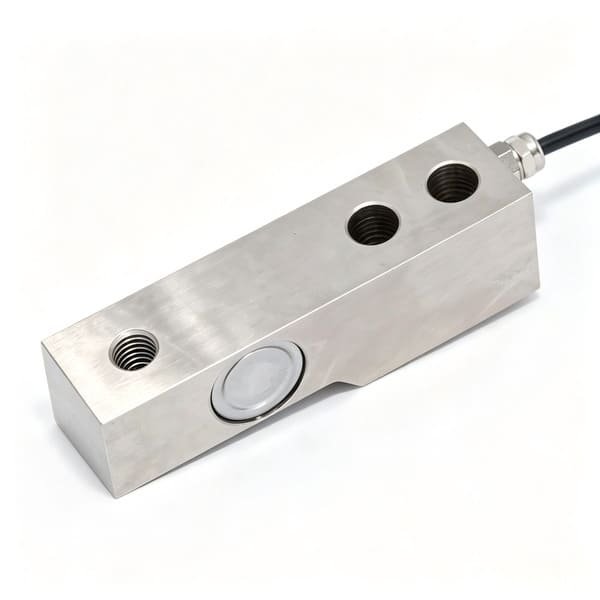

WST1103 is a low-profile planar beam cell with “livestock scale” written into its own product page: 1 to 3 t, matched output, alloy steel, and cheaper than a shear beam. It is genuinely good on a low sheep platform where you want the deck as low as possible. But be careful with it on a cattle crate: its safe overload is only 120 percent, which is low for an application whose loads are transient. Its low profile and matched output are the reason to buy it; the overload margin is the reason to think twice.
WST708 is a stainless pin-type double shear beam built to replace the existing hinge or shear pin on a TMR feed mixer, with IP67/IP68 sealing and a compression range down to −35 °C. If you are weighing a feed mixer rather than a feed tower, that is the part, and there is a separate article on load cells for TMR feed mixer wagons. For indicators with data output, our stainless range adds RS-485 Modbus, a built-in printer, or WiFi — all of them carrying the same animal weighing and hold functions.
Questions I get asked every month
How many load cells does a livestock scale need?
Four is the standard, one under each corner of the platform or deck. Two weigh bars under an existing chute or crate is the usual cattle alternative, and each bar contains two load cells, so two bars is effectively a four-cell system. Very small alleys for sheep or goats can run on two cells, but four gives noticeably better stability when the animal stands off-centre. Four corners also let the indicator average, which is what keeps “dancing feet” from wrecking the reading.
What capacity load cell should I choose for cattle?
Start with (heaviest animal + platform tare) × 1.25 to 1.5, divided by the number of cells, then round up. But do not stop there, because that formula sizes the cell for an animal standing still. Size for the step as well: an animal landing on its front feet can put a large share of its body weight on one corner, so on a mature-cattle deck I would not go below 1 t per cell and 2 t is the comfortable choice. A useful rule of thumb is capacity at least twice the heaviest animal. Running an animal cell near its rating also costs you fatigue life — 300 head a day is 75,000 load cycles a year.
Can I weigh an animal that will not stand still?
Yes — that is exactly what an animal weighing mode and a hold function are for. The indicator watches the signal, waits until it stays inside a narrow band for a defined period, then freezes the result instead of chasing the live value. What you cannot do is beat the animal. Averaging over one second leaves roughly ±1.5 percent of body weight; five seconds gets you under ±0.7 percent; thirty seconds gets you to about ±0.3 percent. Achieving ±0.1 percent would need the animal to stand still for nearly four minutes, which is why the honest working figure for a livestock scale is around ±0.3 to ±0.8 percent of body weight.
Why does my cattle scale give a different weight every time?
Three causes account for almost all of it, and none of them is the load cell. First, the animal is leaning on the head gate, a side rail or the operator, so part of its weight never reaches the platform — that alone can be 10 to 20 percent, and it varies with how hard the animal pushes. Second, muck, bedding, gravel or stones have built up under the deck, creating an extra support path so the cell carries less than the full load. Third, the hold window is set too short, so the indicator locks a single instant of a moving signal. Test for the first by weighing a known animal with the head gate closed and open; test for the second by jumping on each corner and watching the display; fix the third at the keypad.
Do livestock scales need to be NTEP certified or legal for trade?
Only if the weight determines payment. If you weigh animals for your own records, dosing, breeding or feed budgeting, no certification is required anywhere. If you buy or sell by weight, then in the United States the USDA Packers and Stockyards Program applies and the scale needs to be an approved type, which in practice means NTEP evaluation and conformance with NIST Handbook 44 — and a livestock scale ticket has to carry the date, weighing agency, seller, buyer, number of head, kind of livestock, actual weight and the weigher’s name. In the EU and UK the equivalent route is MID as a non-automatic weighing instrument, with a class set by OIML R76.
What IP rating do I need for a livestock scale load cell?
IP65 is splash and dust protection, and it is adequate on a covered indoor deck — that is what many catalogue cells specify. It is not adequate for a yard that gets pressure-washed with slurry underfoot; there you want IP67, IP68 or IP69K, a stainless body, and a polyurethane or sealed cable rather than plain PVC. But here is the thing I would rather you remember: on the scales I have seen fail, the junction box mattered more than the load cell. Mount it high, face the cable glands downward, keep a drip loop in every cable, and use a stainless box in a wet area. That change costs less than one load cell.
How accurate can a livestock scale actually be?
Two answers, and it matters which one you are asking about. The component answer: a Class C3 load cell offers 3,000 verified divisions over its capacity, so a 1 t cell divides into 0.33 kg steps, and the electronics resolve that division into roughly 1,600 counts — resolution is never the limit. The system answer: repeatability on a live animal is set by motion and load sharing, and lands around ±0.3 to ±0.8 percent of body weight in practice, which is a couple of kilograms on a full-grown animal and 5 to 9 kg for high-capacity weigh bars in rough setups. Achieving tighter means restraining the animal more completely, not buying a better cell.
Can I turn my existing crush or chute into a scale?
Yes, and weigh bars are the usual route: two bars under the chute you already own, each with two load cells. Measure the inside width first, because the bars must sit narrower than the chute opening or the animal will stand on the ends of the bars and skew every reading. The rule that decides whether it works is this: float all of it or float none of it. If the chute is weighed, then the chute, head gate, rear gate and operator platform must all be on the same load cells, and the assembly must touch the ground only through those cells. If only the deck is weighed, nothing else may touch the deck. A half-floated chute — two cells under the deck and two elsewhere, with the frame still anchored to the same concrete — is the worst arrangement of all, because where the animal stands then sets a ratio nobody controls.
Do I need 4-wire or 6-wire, and how long can the cable be?
On a farm, long runs are normal, so check the limit before you blame the cable. Our platform indicator documents a maximum cable length per conductor cross-section of (L/A)max = 150 m/mm², which for a 0.5 mm² conductor allows 75 m per conductor. Inside that limit, an excitation drop is not your problem, and a 40 m yard run is comfortably fine. Near the limit, six-wire connection with separate sense lines compensates for the lead resistance. Whatever you use, calibrate in place with the cable you will actually run — never on the bench and never with a different length.
Why does my livestock scale not return to zero?
Work through four causes in this order, cheapest first. Something is on the deck, or muck has built up under it. Water has collected in the junction box — look inside before you do anything else, because this is the most common single cause on farm installations. A corner has become grounded, so the deck is resting partly on the ground — test by jumping on each corner and watching the display. And finally, a load cell has genuinely shifted: unplug each cell, measure its bridge resistance and zero output at no load, and compare the four against each other. The load cell is the last thing to check, not the first.
On a livestock scale, the load cell is the easy part. The hard parts are the animal, the structure it stands on, and the environment the scale lives in — and all three are decided by drawings and habits, not by specifications. Before you change a load cell, do a corner test, look under the deck, and check whether the animal is leaning on something. I have never regretted asking for those three things before quoting.
Send me your species, the heaviest animal, the platform or crate tare, whether anything floats or is anchored, and whether the weight is for payment or for management. I will come back with a cell capacity, a mounting arrangement, and the two tests I would run before you buy anything — usually within one working day.
Get a weighing recommendation →
VektorForce · load cells, weighing modules, junction boxes and indicators · www.vektorforce.com