
Load Cells for Smart Climbing Walls & Smart Hangboards: A Complete OEM Guide
By Robin | Updated August 2025 | 12 min read
El Capitan in Yosemite may be the ultimate test for outdoor climbers, but most people will never hang off a 3,000-foot granite wall. That is why indoor climbing has exploded globally—and why a new generation of smart climbing walls and smart hangboards is using load cells to turn every session into measurable, gamified training data. In this guide, we explain exactly how load cells power connected climbing gear, which sensor types work best, and what OEMs should know when building these products.
1. Why Indoor Climbing Is Booming
Outdoor climbing on legendary faces like El Capitan demands elite skill, significant risk, and weeks of preparation. For most people, that is not accessible. Indoor climbing gyms offer a safe, social, and weather-proof alternative—and the industry has grown rapidly.
25M+
Global indoor climbers
15%
Annual gym growth (CAGR)
2028
Sport climbing media peak
$2.5B
Climbing gear market size
The rise of sport climbing in the Olympics, fitness influencers, and boutique climbing studios has pushed demand even higher. As competition increases, gym owners and equipment brands are looking for differentiation—and data-driven training tools are the next frontier.
2. What Is a Smart Climbing Wall / Smart Hangboard?
Smart Hangboard
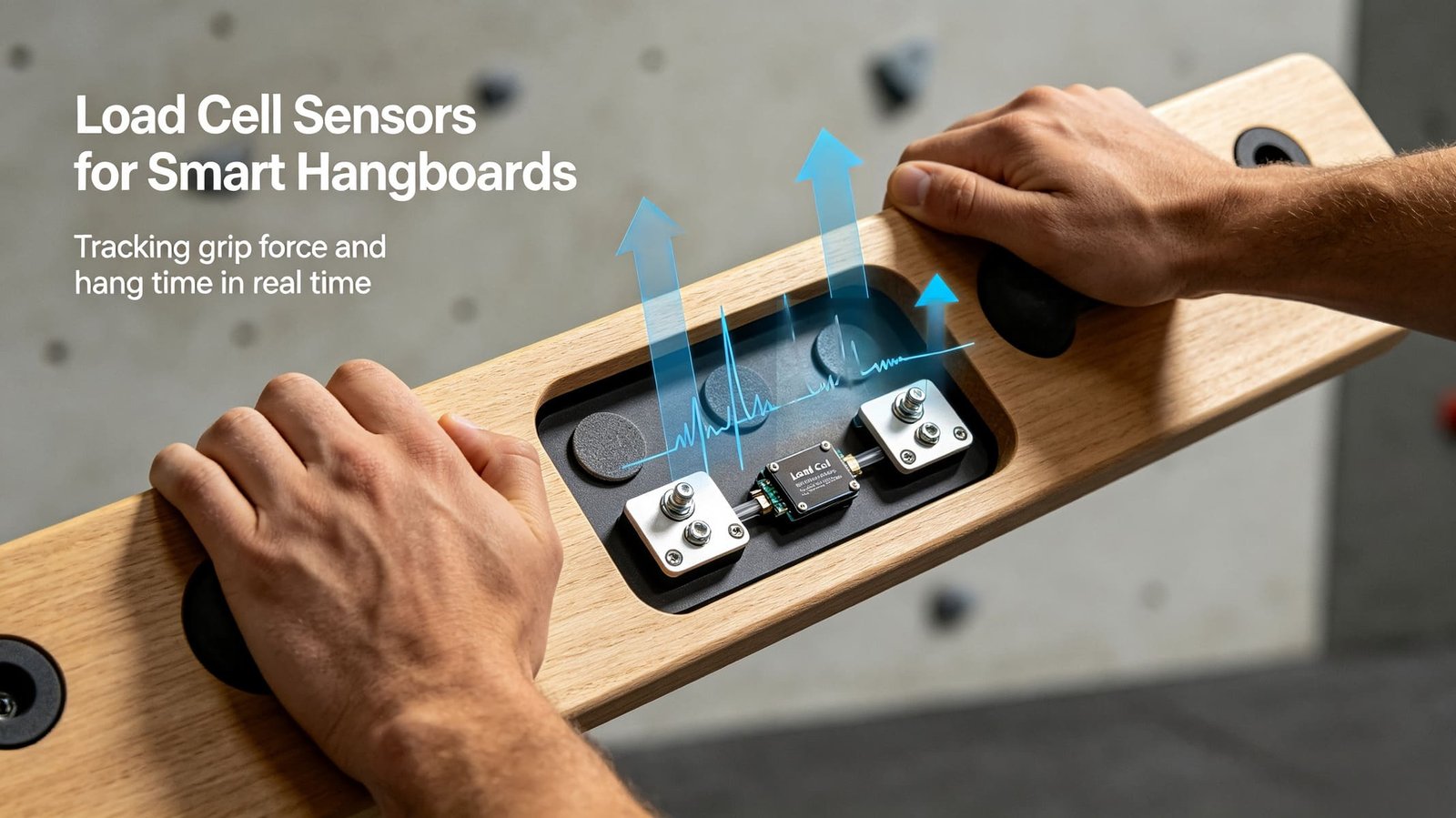
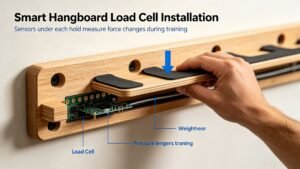
A smart hangboard is a mounted training device with various grip holes (slopers, crimps, pockets, jugs). Unlike a traditional wooden hangboard that only measures time, a smart version uses load cells embedded behind each hold or under the board to measure the force applied by each hand in real time.
Smart Climbing Wall
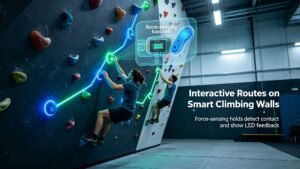
A smart climbing wall takes this concept larger. Individual climbing holds or wall panels are mounted on load cells. As a climber grabs, steps, or hangs on a hold, the system records force, direction, and duration. That data feeds into apps that track progress, suggest workouts, and enable multiplayer climbing games.
3. How Load Cells Work in Connected Climbing
The measurement chain in a smart climbing product follows the same principle as industrial scales, but with higher sampling rates, lower capacities, and tighter size constraints:
1
Force Applied
Climber pulls or steps on hold
2
Strain Gauge
Sensor deforms proportionally
3
mV/V Signal
Bridge outputs tiny voltage
4
Amplifier / ADC
HX711 or 24-bit ADC digitizes
5
App / Cloud
Real-time display + analytics
Because climbing forces are dynamic and often applied suddenly, the system needs a high sampling rate (typically 50–200 Hz) and fast signal conditioning to avoid missing peak forces. For hangboards, each hand is often measured independently, requiring at least two load cell channels.
4. Six High-Value Use Cases
1. Real-Time Force Feedback
Display left/right hand force during hangboard workouts to correct imbalances and prevent injury.
2. Max Hang Tracking
Record peak force per grip type over weeks to measure finger and forearm strength gains.
3. Interactive Climbing Games
Turn the wall into a console: light up holds, score points by reaching force targets, race friends.
4. Route Setting & Difficulty
Gym operators can assign objective difficulty ratings based on required force and hold sequences.
5. Injury Prevention
Detect asymmetry, overtraining, or sudden force spikes that indicate risky movement patterns.
6. Remote Coaching
Coaches review session data from anywhere, prescribe specific loads, and track athlete progress.
5. Best Load Cell Types for Smart Climbing Gear
Climbing products need sensors that are small, accurate, and robust enough to handle repeated dynamic loading. Here are the four most common configurations:
| Type | Capacity | Best Application | Why It Fits |
|---|---|---|---|
| Single-Point Beam | 50–200 kg | Wall panels, foot platforms | Handles off-center loads, proven durability |
| Thin Platform Load Cell | 20–100 kg | Hangboard mounting plate | Low profile, easy to hide behind wood |
| 4-Corner Body-Scale Cell | 50 kg each | Foot platforms, balance boards | Compact, low cost, 4-cell summing |
| S-Type / Tension Cell | 100–500 kg | Rope training systems, pulleys | Measures pulling force directly |
Selection tip: For hangboards, choose a sensor with a stiff mechanical structure. Climbers want to feel the wood, not a springy sensor. A deflection under full load should be less than 0.2 mm to maintain a natural training feel.
6. OEM Selection Guide
When sourcing load cells for a smart climbing product, these specifications directly affect user experience and product lifespan:
| Specification | What to Look For | Typical Requirement |
|---|---|---|
| Capacity | Maximum climber force + safety margin | Hangboard: 50–100 kg; Wall hold: 100–300 kg |
| Accuracy | Repeatability and linearity | ≤ 0.05% FS for training-grade data |
| Stiffness / Deflection | How much the sensor moves under load | < 0.2 mm at rated capacity |
| Overload Safety | Protection against shock loads | 150–200% rated capacity |
| Sampling Rate | How fast force is captured | ≥ 50 Hz; 100–200 Hz preferred |
| Size | Available mounting space | < 100×50 mm for hangboards |
| Cable & Connector | Routing from wall to controller | Shielded cable, JST or M8 connector |
7. Recommended Load Cell Models
Based on the embedded sensor types commonly used in smart hangboards and climbing walls, the following models are well-suited for OEM projects:
| Model | Type | Capacity | Application | Key Feature |
|---|---|---|---|---|
| WST201 | Single-point beam | 50 kg | Smart hangboard | Compact, high stiffness, 2.0 mV/V |
| WST213 | Single-point beam | 100 kg | Wall panel / foot platform | Off-center load tolerant, IP65 |
| WST1101 | Thin platform cell | 75 kg | Mounting plate behind board | 4.5 mm height, easy to conceal |
| WST101 | 4-corner body-scale cell | 50 kg each | Foot platform / balance board | Low cost, 34×34 mm footprint |
| WST408 | S-Type tension | 300 kg | Rope / pulley training | Direct pull-force measurement |
| WST107 | Miniature beam | 20 kg | Small holds / portable hangboard | ideal for portable |
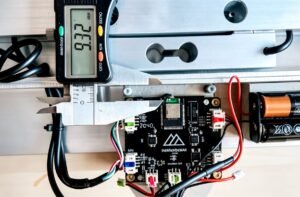
Thin platform load cells fit behind the mounting plate of a smart hangboard.
8. Wiring & Integration
Most climbing product OEMs start with an analog load cell + HX711 setup because it is low-cost and well-documented. Here is the standard 4-wire connection:
| Wire Color | Function | HX711 Pin |
|---|---|---|
| Red | Excitation + (E+) | E+ |
| Black | Excitation − (E−) | E− |
| Green | Signal + (S+) | A+ |
| White | Signal − (S−) | A− |
For products with multiple sensors (e.g., a smart wall with 20+ holds), use a multi-channel ADC or load cell junction box to simplify wiring. Some newer designs use digital load cells with built-in ADC and RS-485/CAN output, reducing cable count and improving noise immunity in busy gym environments.
System Architecture Example
- Load cells on each hold or hangboard grip (4-wire or digital)
- Junction box / multiplexer to combine cables near the wall
- ADC / signal conditioner (HX711 for 1–4 channels, or 24-bit multi-channel ADC)
- Microcontroller (ESP32, STM32, Raspberry Pi Pico) for sampling and BLE/Wi-Fi
- Mobile app / cloud for real-time display, history, and gamification
Engineering note: In climbing walls, cables are repeatedly flexed and stepped on. Use flex-rated cable with strain relief at both ends. Avoid running sensor cables alongside mains power to reduce electromagnetic interference.
9. Gamification & Training Analytics
The real value of smart climbing hardware is not the raw force number—it is the software layer on top. Leading products like Griptonite and Moon Climbing digital tools turn data into engagement:
- Leaderboards: Compare max hangs, endurance scores, and power endurance with friends or the global community.
- Structured workouts: The app prescribes hangs at 80% of max force for 10 seconds, then automatically verifies completion.
- Asymmetry alerts: If left/right force differs by more than 10%, the app warns the climber to avoid injury.
- Progress tracking: Long-term graphs show strength gains per grip type (half-crimp, open hand, pocket).
- Route replays: For smart walls, replay the exact sequence of holds and forces used during a climb.

10. Market Outlook & Key Players
The indoor climbing industry is maturing quickly. As of 2026, there are more than 6,000 commercial climbing gyms worldwide, with strong growth in North America, Europe, and Asia-Pacific. Smart training equipment is following the same trajectory as Peloton and Tonal—connected, app-driven, and subscription-friendly.
Griptonite
A digital climbing training platform that combines hangboards with force sensors and a mobile app for structured workouts and progress tracking.
Moon Climbing
Well-known climbing brand offering traditional and digital hangboards used by elite climbers for finger-strength training.
Climbing Gym Chains
Large operators are adding smart walls as premium attractions to increase member retention and justify higher membership fees.
For OEMs, this represents a clear opportunity. Gyms and consumers are willing to pay a premium for connected training tools, but they need hardware that is accurate, durable, and cost-effective at scale. The right load cell partner can make the difference between a prototype and a mass-market product.
11. Frequently Asked Questions
Q: How accurate does a smart hangboard load cell need to be?
For training-grade data, aim for ≤ 0.05% of full scale. A 50 kg sensor should resolve roughly ±25 grams. That is sufficient to track progressive overload and detect left/right imbalances.
Q: Can one load cell measure both hands on a hangboard?
No. To measure each hand independently, you need at least two load cells—one under each mounting point of the hangboard. Some high-end designs use four cells for redundancy and better off-center compensation.
Q: Will the sensor make the hangboard feel springy?
Not if you choose a stiff sensor. Look for load cells with deflection < 0.2 mm at rated capacity. The sensor should be mounted rigidly between the hangboard and the wall backing plate so the climber feels wood, not movement.
Q: What capacity should I choose for a smart climbing wall hold?
For hand holds, 100–150 kg is usually sufficient. For foot holds or large wall panels that support full body weight, 200–300 kg is safer. Always include a 150–200% overload margin because climbers generate dynamic forces well above body weight.
Q: Can load cells survive chalk, sweat, and gym humidity?
Yes, but choose cells with IP54+ protection and a sealed strain-gauge area. Aluminum-alloy cells with anodized or nickel-plated finishes resist corrosion from chalk and sweat better than bare steel.
Q: Is it better to use analog or digital load cells?
Analog (mV/V) with HX711 is cheaper and easier for prototypes. Digital load cells (with built-in ADC and RS-485/CAN) reduce wiring, improve noise immunity, and simplify calibration for large smart walls with 20+ sensors. Many commercial products move from analog prototypes to digital designs at scale.
Q: Can you supply custom load cells for a smart climbing product?
Yes. We work with climbing gear OEMs to customize capacity, size, mounting holes, cable length, connector type, and calibration. We also supply pre-calibrated sensor kits with HX711 modules for rapid prototyping.
Building a Smart Climbing Product?
We supply load cells and sensor kits to climbing gear OEMs worldwide. From hangboard prototypes to full smart wall deployments, we can help you choose the right components.
About the author: Vektorforce designs and exports load cells and weighing components for smart appliances, sports technology, industrial automation, and retail systems worldwide.
Disclaimer: The model numbers and specifications listed are for reference only. Contact us for the latest datasheets and custom solutions. All trademarks belong to their respective owners.