
Load Cells for Smart Lockers: Field Notes From Weighing Phones, Wrenches and Parcels Nobody Is Allowed to Open
📅 October 6, 2026
⏱️ 16 min read
🔐 Lockers, Cabinets & Compartments
A locker is a box that is designed so you cannot see inside it. That is the whole product. Which means the moment somebody wants the box to know something about its contents, you have taken on a sensing problem — and nine times out of ten the sensing problem lands on the floor of my inbox as one sentence: “Can you weigh it?”
In the past year I have quoted load cells into phone lockers in schools, staff lockers in hospitals, tool cribs in an aviation MRO, a launderette locker bank in a Nordic city, and a 96-door outdoor parcel bank that had to keep working at −20 °C. Almost nothing went wrong the way the customer expected. Nobody came back and said “the sensor is inaccurate”. They came back with a shelf that read 40 g heavier whenever a USB cable was plugged in, a load cell that died because a technician dropped a hammer into a drawer, a zero that walked half a gram an hour because the compartment was also a refrigerator, and a 1 g resolution target that turned out to be the least interesting number in the whole specification.
What follows is the working version of how I size and hand over a weighing channel for a locker now: how to decide what question you are actually asking, the one piece of arithmetic that settles the range, the two projects that taught me the most, the seven mechanical details that quietly decide whether the reading means anything, and an honest account of what weight can and cannot tell you about an object you are not allowed to look at.
I’m Robin from VektorForce. We supply load cells, force sensors, junction boxes and weighing indicators — the sensing layer. We do not build lockers, we do not write access-control software, and we do not certify a cabinet as a secure or compliant product. That division matters more in this category than most, and I’ll come back to it at the end.
1. Why a locker needs a scale at all
The enquiry that started this line of work for me arrived from a locker builder in the Netherlands in the middle of last year, and it was two lines long: “We are building phone lockers for secondary schools. The customer wants proof that the phone is still in the compartment. Can you weigh it?”
The timing is not a coincidence. More than half of American public school students now attend a school with a bell-to-bell phone restriction, and 26 or more US states have some version of the policy in place for the 2025–26 school year, following New York’s statewide “distraction-free schools” programme and California’s education code changes. The dominant mechanism in the United States has been the locked fabric pouch, which keeps the device on the student. A locker does something the pouch cannot: it takes the phone out of the room, out of the exam hall and out of the changing room, and it can put it on a charger while it is there. For a boarding school, a military facility, a hospital or a lab, the question is not “is the phone away” — it is “is the phone still there”, because a compartment that can be quietly emptied is worse than no locker at all.
So the request behind the request is always one of three jobs. It is worth being precise about which one you are being asked to do, because they carry different price tags.
The three jobs weight does in a locker
- Presence. Is there an object in this compartment, and roughly how heavy is it? A one-bit question with a mass attached — cheap to answer, and almost never worth more than a ±2 g channel.
- Removal. The door is shut, the compartment is closed, and the mass has changed anyway. This is the security case, and it is the one that drives power budget, sampling policy and zero stability, because to catch it you have to be watching all the time.
- Quantity and identity confirmation. For tool cribs, retail lanes and returns: not “is something there” but “did the same thing come back”. This one is a metrology question in disguise and it is where the real engineering effort goes.
Before any of that, though, it is worth being honest about what a strain-gauge weighing channel is good at compared with the two other technologies a locker project will already be considering. Most of my most useful conversations have been about which of the three gets to be the authority.
| Question | Weight (load cell) | RFID / barcode | Camera / vision |
|---|---|---|---|
| What it actually confirms | That the mass in the compartment changed by a known amount | That a tagged item passed a read point | That an object of a certain shape was in view |
| Works when the tag is missing or dead | Yes — that is the point. A weight has no tag to fall off | No. The tag that fails is exactly the tag that mattered | Sometimes, if the item is visible |
| Can be spoofed | Hard. You would have to substitute an object of the same mass and leave it there | Tags can be cloned, or left behind while the asset walks out | A printed image is not impossible |
| Tells you which item | No. Two identical phones are one number | Yes, if the tag is intact and unique | Often, but not reliably through a bag or a hand |
| Power when the compartment is shut | Only if you want the removal alarm — then it is continuous | Only at read points | High — always-on capture and inference |
| Typical failure | An item leans on the wall, a cable pulls the shelf, or temperature walks the zero | Tag removed, metal shielding, tag left behind to defeat the gate | Hand, bag, glare, or two objects that look alike |
My summary of that table, and the sentence I have used in more than one design review: weight is the one credential nobody can photograph. You cannot take a picture of it, you cannot clone it, and you cannot leave it behind while you walk out with the asset. What it cannot do is name things. So the architecture that survives contact with a real customer is almost never “weigh it and we’ll know what it is”. It is “the credential says who and which compartment; the weight confirms whether the thing is still in there”. Hold that thought, because it is the answer to the two-identical-phones question that arrives in every phone-locker enquiry.
The commercial reason all of this is suddenly worth writing about is that the hardware share of this market is unusually large and it is still growing. The smart parcel locker market was valued at about US$1,280 million in 2026 and is projected to reach US$2,970 million by 2034, a CAGR of roughly 11.1 %, with hardware accounting for about 52 % of that in 2026 and indoor deployments about 70 % (Fortune Business Insights). A second reading of the same category puts it at US$1.4 billion in 2026 growing to US$3.1 billion by 2033 at 11.8 % (Persistence Market Research), with residential and multi-family buildings the single largest end-user group at around 31 %. Employee lockers — the staff-room, hospital and hot-desking side, which is where most of my current enquiries sit — are a US$1,444 million market in 2026 heading to US$3,027 million by 2035 at 8.6 %, with roughly 28 million smart lockers deployed worldwide in 2025 and around 52 % of new installations now including smart locking and 34 % IoT monitoring. The healthcare slice of employee lockers alone runs from US$478 million in 2025 to about US$503 million in 2026 (Market Research Intellect). If you build lockers, that is your market. If you are the person inside that company who has been handed the sentence “can we detect if the compartment is empty”, this article is for you.
2. Five ways to put a sensor in a locker bank
Every locker weighing project I have seen comes down to one of five mechanical arrangements. They cost wildly different amounts, and they answer different questions. Choosing the arrangement is a bigger decision than choosing the load cell, and it is usually made by accident.
| Arrangement | The question it answers | Cells for a 60-door bank | Where it breaks |
|---|---|---|---|
| A. One cell per compartment shelf — the cell sits under the shelf plate behind each door | “Is this compartment occupied, and did its mass change?” Full localisation | 60 cells, 60 channels | Harness cost and connector count; every door is its own calibration record |
| B. One cell per column — the whole column of compartments sits on 1–4 cells at its base | “Which column changed?” Plus the door event, which narrows it to a compartment | 4–24 cells | You cannot attribute a change to a door without the door sensor agreeing; structural coupling between columns |
| C. Whole-cabinet weighing — the entire cabinet stands on cells at its feet | “Did anything at all enter or leave?” Cheapest possible answer | 3–4 cells | Cannot localise; a person leaning on the cabinet is an event |
| D. One cell per shelf layer / lane — a whole horizontal band of compartments on one beam | “Which lane lost stock?” The retail-cabinet and smart-shelf model | 8–20 cells | Lane cross-talk; a heavy item at one end unloads the other end of the beam |
| E. Hybrid — column-level cells plus every door event, arbitrated | “Something changed in column 3, and only door 3.7 opened” | 4–24 cells + N door switches | Needs the arbitration logic to be written and tested — which is the integrator’s job, not the sensor supplier’s |
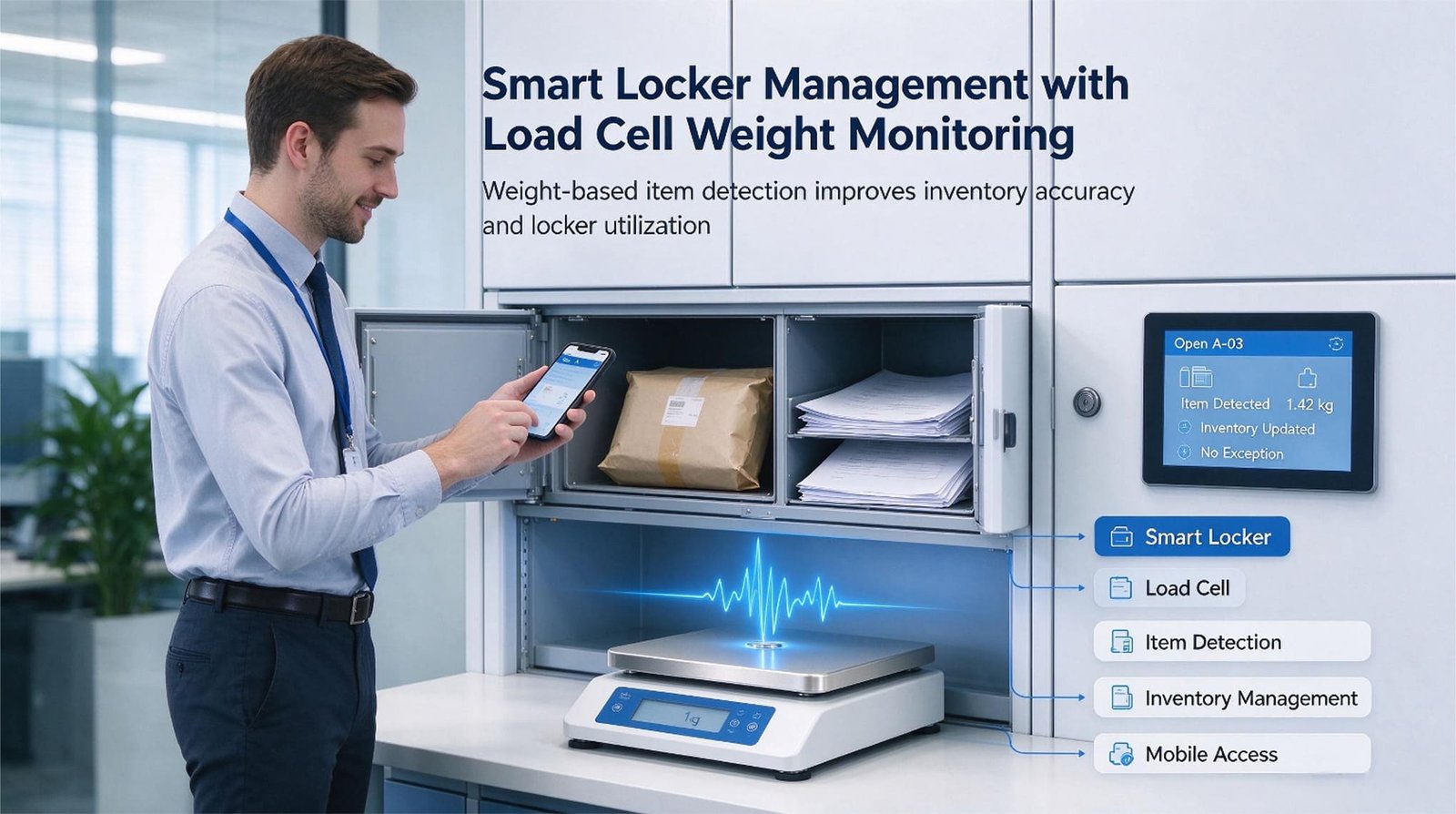
The single most common design I am asked to quote is arrangement A, and I understand why: it is the only one that gives an unambiguous per-door answer with no arbitration logic. The version of it that circulates in the industry is worth repeating, because it is a good design. It is also the one that came to me as a written solution: one load cell under the shelf plate of every door; all doors zeroed at commissioning; the phone is placed; the cell reads the weight and the value goes to the cabinet’s central processor, which now holds the weight of compartment 17; if the mass changes while the door is closed, the processor raises an alarm. That is the correct architecture. Everything that follows here is about the four things that decide whether it survives its first winter in a real building.
One more thing worth knowing about where you sit. The smart-locker platforms coming out of Germany — pareva.de is a clear example — have built their business on treating the intelligent lock as the hardware product and the software as the platform that sits on top of it, with use cases layered on afterwards: IT service points, click-and-collect, smart offices, staff and visitor lockers, internal mail, material issuing. That is the layer immediately above mine, and it is a good illustration of why the division of labour matters. A platform company benefits from a sensing layer that is a component with honest numbers attached, not a company trying to sell the whole cabinet.
The rule I give every locker builder before we discuss a part number
Decide whether you are answering a 1-bit question or a metrology question. “Is this compartment empty?” is 1-bit: 20 g of ambiguity will not hurt you, and arrangement C will do it for a tenth of the price. “How much did the customer take out of this lane?” or “is this the same wrench that went out?” is metrology: it needs a defined load introduction point, a documented zero, a creep budget and a calibration record. They are two different quotations, and blending them is how projects get expensive in the wrong places.
3. The one calculation that decides your range
The first physical sample that arrived in my hands for a phone-locker project had a 5 kg load cell under each shelf, watching for a 200 g phone. It came from a good engineer and it was chosen for a good reason — 5 kg was the range that was already on the shelf in the workshop. It is also the decision that shaped everything downstream, so let me show the arithmetic rather than the conclusion.
Three numbers determine the whole channel. The cell’s rated output S in mV/V, the bridge excitation Uexc in volts, and the ratio of the load you care about L to the cell’s rated capacity Max.
ΔV per division (µV) = 1000 × S × Uexc ÷ nd where nd = Max ÷ d
nd = number of divisions, d = the resolution you want. Divide the result by N if you are summing N cells in parallel.
Run that across the four cells I quote most often for lockers, with a 5 V excitation and a phone at 200 g, and something useful appears immediately.
| Cell | S (mV/V) | Max | Object | L ÷ Max | Signal at the object | ΔV per 1 g |
|---|---|---|---|---|---|---|
| WST103 | 1.0 | 1 kg | 200 g phone | 20 % | 1.00 mV | 5.0 µV |
| WST103 | 1.0 | 5 kg | 200 g phone | 4 % | 0.20 mV | 1.0 µV |
| WST201 | 2.0 | 3 kg | 200 g phone | 6.7 % | 0.67 mV | 3.3 µV |
| WST101 | 1.0 | 5 kg | 200 g phone | 4 % | 0.20 mV | 1.0 µV |
| WST101 | 1.0 | 30 kg | 700 g hammer | 2.3 % | 0.12 mV | 0.17 µV |
Now compare the smallest signal in that table — 0.17 µV per gram, the worst case, a hammer on a 30 kg cell — with a modern sigma-delta front end. A 24-bit converter with a ±10 mV input span and 5,000,000 counts resolves the span in steps of about 4 nV, which means even that worst case gives you roughly 42 counts per gram. The comfortable cases give you 250 to 1,250 counts per gram. Resolution is not your problem. I have never once had a locker project fail because the A/D was not good enough.
The problem is the specification that scales the wrong way. Creep, temperature effect on zero, and comprehensive error are all expressed as a percentage of full scale — which means the eraser gets bigger when you choose a bigger cell, even though the thing you are measuring has not changed.
| Cell | Creep, as published | On a 1 kg cell | On a 5 kg cell | On a 30 kg cell |
|---|---|---|---|---|
| WST103 / WST107 / WST101 | ±0.05 %FS / 3 min | 0.5 g | 2.5 g | 15 g |
| WST201 (C3) | ±0.02 %FS / 30 min | 0.2 g | 1.0 g | 6 g |
Put the two tables together and the 5 kg mistake becomes obvious. A 200 g phone on a 5 kg cell sits at 4 % of full scale, and a creep figure of 0.05 %FS is 2.5 g — 1.25 % of the object you are trying to detect. Move the same phone onto a 1 kg cell and it sits at 20 % of full scale, and the same published creep number is 0.5 g, or 0.25 % of the object. Nothing about the sensor changed. What changed is how much of your measurement the specification is allowed to eat. My rule of thumb, and I would rather have it challenged than skip it: convert every error term to grams at your actual load, and keep the total under a quarter of the smallest object you will ever put in that compartment.
Two honest caveats belong next to that rule, because they are the two things I have had to say out loud in customer meetings.
First: those creep figures are minutes, and a locker is hours. ±0.05 %FS/3 min tells you almost nothing about a phone sitting in compartment 17 from 08:00 until 15:00. Creep is not linear — it is roughly logarithmic and it flattens — but you cannot extrapolate a three-minute number into a seven-hour number and expect to be right. The only way to know is to measure it. The protocol I now ask customers to run before we finalise a part number: put a known 200 g mass in one compartment, leave the door closed, log the channel every 15 minutes overnight, and read it at the start of the next shift. On the Dutch school project that test came back with 0.4 g of movement across nine hours. That number — not the datasheet — is what went into the acceptance criteria, and it is the number I would quote to the next customer with the same application.
Second: the shelf weighs something too. A 320 g steel shelf plate plus its brackets is a permanent pre-load on the cell, and it is inside your range whether you like it or not. Tare it out at commissioning and record it — on a 1 kg cell that leaves about 680 g of usable span, and the 200 g phone is now 29 % of the usable span rather than 20 %. It also gives you a free diagnostic later: if the recorded empty-shelf weight drifts, something has moved or something is pulling on the shelf, and you want to know that before a customer does.
⚠️ The sizing mistake I see most often: choosing the load cell from the weight of the object instead of from the weight of everything the cell carries, and then comparing the resolution of the A/D instead of converting the error terms into grams. A 5 kg cell under a 200 g phone is not a sensor problem — it is a specification problem, and it is invisible until the creep and the zero drift start competing with the object.
4. Case 1: 480 phone lockers, and the problem was never the phone
The Dutch project went ahead, and it is the one I learned the most from because all three of its real problems were mechanical or architectural, and none of them were about accuracy. The installation is 480 compartments spread across twelve secondary-school campuses, in banks of 40 doors. Each compartment is about 300 × 250 mm, sized for a phone with a case, and each one has a USB outlet so the phone charges while it is stored. Resolution target: 1 g stable, held for a school day.
We ended up on 1 kg WST103 cells — one per shelf, arrangement A — after the arithmetic in section 3. The published accuracy of the cell is unchanged between the 1 kg and the 5 kg version, but the creep and zero terms shrunk by a factor of five in grams, and that was the whole decision. Then three things happened in the field.
Problem 1: the charging cable was a load path
The compartments have a USB cable, and a USB-C plug with two metres of cable behind it is not weightless — call it 30 to 40 g draped on a shelf. Worse than the constant part was the variable part: students pulled the cable, hung it over the shelf lip, or left the plug resting on the shelf plate, and the affected channel moved by 3 to 9 g depending on how the cable was lying. On a 1 g resolution target, that is not a rounding error. It is the entire signal-to-noise budget, and because the cable position changed every lesson, it looked like drift.
The fix was not in the sensor. The cable now passes through a grommet in the compartment’s back panel and is clamped to the cabinet frame, never to the shelf. The shelf carries exactly none of the cable, so neither the plug’s weight nor the pull of the cable reaches the cell. We added one acceptance test to their commissioning procedure because of it: weigh a known mass with the cable plugged in and again with it unplugged and draped — the two readings must agree within two digits of the displayed resolution. If they do not, the cable is loading the shelf and no amount of calibration will fix it.
The general principle behind that: the load cell measures everything that reaches it, not everything you meant to weigh. Every cable, hinge, gasket, charging lead and grommet in a compartment is either routed to the frame or it is part of your measurement. In a locker the usual culprit is a charging cable; in a retail cabinet it is the door gasket resting on the shelf edge; in a tool drawer it is the foam insert and the slide rails.
Problem 2: the door slam looked exactly like a phone being taken
Teenagers close doors. In the prototype, a door closing sent a transient through the cabinet frame into the neighbouring shelves, and channels briefly read anywhere from 60 to 200 g of apparent change. If the firmware sampled during that window, the cabinet logged an object inserted into, or removed from, a compartment where nothing had happened. This is not a load-cell defect; any strain-gauge channel that shares a frame with a slammed steel door will do it.
Three changes, in order of how much they helped. First, the sampling policy: the channel is only accepted when the door sensor reports closed and the reading has stayed within ±1.5 g for two seconds. That single rule removes nearly all false events because a slam is high and short and a phone is low and permanent. Second, decoupling: a 2 mm elastomer pad between the shelf bracket and the cabinet frame, so the shelf is not rigidly coupled to the steel of the door post. Third, a hard stop: the shelf cannot travel more than a few millimetres downward, which matters far more for the next case than it did here.
Problem 3: two identical phones, and no sensor on earth can separate them
This is the question that gets asked at every single phone-locker review, and the honest answer is worth writing down: two phones of the same model in the same case weigh the same. A strain-gauge channel can resolve a difference of a tenth of a gram and still be completely unable to tell you that the phone in compartment 17 has been swapped for an identical one from compartment 22.
The architecture that works does not try. The credential — the badge, the PIN, the QR code — binds a named phone to a named compartment at the moment of drop-off. The weighing channel then answers one narrow question, and answers it well: did the mass in compartment 17 change by roughly the mass that was recorded when it went in? The implementation we settled on was a delta window of ±25 g on a 200 g phone, about ±12 %, with a second slower check that flags any compartment whose door was opened and closed while the mass stayed constant. Weight is the confirmer, not the identifier. Once the customer’s software team accepted that division of labour, the whole specification simplified.
What the project came back with, roughly six months in: the nine-hour soak test moved 0.4 g; the 1 g resolution target was met with margin; and the site’s false-alarm rate fell from several events a day in the prototype to a handful a month across 40 doors. The part number never changed after the first sample. Everything that made it work was the cable routing, the sampling window and the stop.
5. Case 2: the tool crib where a dropped hammer beat the load cell
The second project is the one I use when a customer tells me their application is “nothing like a phone locker”. It is a tool-control cabinet for an aviation maintenance operation — the kind of crib where a technician checks out a torque wrench against a work order. If that sounds like a different industry, the sensing problem is identical and the stakes are simply larger.
Aviation foreign object debris is a good example of a problem that a weighing channel can partially solve. Industry estimates put FOD losses at roughly US$4 billion a year, and a single engine damaged by debris left inside it can cost over US$1 million to repair; one published figure for the average cost of a FOD-related engine removal event — repair, inspection and downtime combined — is around US$280,000, and roughly 78 % of FOD incidents in MRO environments involve an unaccounted tool or hardware item. The regulatory pressure is real: EASA Part-145.A.40(b) requires tools and test equipment to be controlled and calibrated to a recognised standard with traceable records, and the FOD programme side is covered by guidance such as FAA AC 120-72. A missing tool is not an inventory problem; it is a grounded aircraft until every tool on the job is accounted for.
RFID is the technology most cribs reach for first, and it is good at what it does. Weight does one thing RFID cannot: the tag that falls off is exactly the tag that mattered. If the 320 g combination wrench leaves its slot and its tag has been knocked loose or shielded, a gate reader sees nothing. A weighed slot notices that 320 g is missing, whether or not a tag was ever involved. We quoted WST101 flat cells under the drawer shelves and WST201 under the heavier shelf, and the customer built the arbitration logic. Three problems came back.
Problem 1: 5 g resolution in an 8 kg drawer is a specification, not an achievement
Their first drawer held about 8 kg of wrenches on a 10 kg cell, and the requirement was to resolve 5 g — a ratio of 1:2000. On paper it looks feasible. In practice the error terms ate it: a creep figure of 0.02 %FS/30 min is 2 g at 10 kg, and the temperature effect on zero adds grams on top, so before the drawer carries anything at all its zero can walk by about the resolution you were hoping for. Then we weighed the empty drawer: the slide rails plus the foam insert came to 1.4 kg of pre-load, which is 14 % of the range spent on furniture.
Three changes fixed it. Tare the furniture: the empty drawer is weighed and tared at commissioning, which turns 10 kg of range into 8.6 kg of usable span and removes the pre-load from every error term. Split the drawer: two cells under the two halves, summed in a junction box, so each cell sees about 4.3 kg — halve the load on a cell and every %FS figure on its datasheet becomes half as large in grams. Re-negotiate the resolution: we moved the target from 5 g to 10 g, because the difference that a tool crib actually needs to detect is a missing wrench, not a missing washer. Choosing a resolution you cannot hold in the field is how you buy a false-alarm generator.
Problem 2: the peak force of a dropped hammer has nothing to do with its weight
This is the calculation I now put in every tool-crib quotation, because it is the one that decides the range. A 700 g hammer dropped from about 150 mm does not apply 7 N. What it applies depends on how far the structure moves underneath it:
h = free-fall height, δ = the supporting structure’s deflection under the static weight W
With a 150 mm drop and a shelf system that deflects about 0.5 mm under the load, the dynamic factor n is about 25.5, and the peak lands at 0.7 × 9.81 × 25.5 ≈ 175 N. Now compare that with the hardware. A 5 kg cell is rated for about 49 N, and its ultimate overload at 150 %FS is about 74 N. The hammer beats the load cell by a factor of more than two. In the first month of the pilot they destroyed three cells in the same drawer, and not one of the failures looked like an accuracy problem — they looked like a channel that had gone 500 g heavy and stayed there.
The fix is not a bigger cell in the first instance. It is to limit h. A polyurethane stop that lets the shelf travel about 5 mm changes the same calculation to n ≈ 5.6 and a peak of about 38 N — comfortably inside the cell’s ultimate overload, and the stop itself takes the impact on the cabinet frame rather than through the strain gauge. That is the single most valuable sentence I can give a tool-crib builder: a strain-gauge load cell cannot be protected by a specification, only by a mechanical stop. We did also move the heavy wrench drawer up to a 30 kg cell, because a technician can drop a 4 kg torque wrench — and at a 5 mm drop that is 4 × 9.81 × 5.6 ≈ 220 N, which is inside a 30 kg cell’s 294 N rating but well outside a 10 kg one. Finally, a firmware overload flag that latches whenever a channel exceeds 120 % of its calibrated span, so a damaged channel is caught the same shift rather than at the next audit.
Problem 3: if the cabinet makes a claim, the channel becomes a controlled instrument
The moment a tool crib displays “13 mm combination wrench, slot 22, present”, that weighing channel is making a statement inside an audited maintenance process, and the audit trail follows the tool. The customer’s quality manager raised this before the customer’s engineer did, which I appreciated. What we hand over for that purpose is deliberately boring: the per-channel slope recorded at the factory, the empty-shelf weight as a service baseline, a single 500 g class-M check weight and a written field verification procedure, and an annual verification step. The per-channel slopes live in the controller, so a cell that is run over or crushed can be replaced and re-scaled without re-certifying the other 39 channels on the bank.
Outcome, twelve months on: check-out that used to be a paper log is about twenty seconds; the first month surfaced three untagged tools that the RFID system alone would have missed, which was the entire justification for the weighing channel; and no FOD findings since the installation. I will take a project like that over a project that only goes smoothly.
6. Case 3: outdoor parcel banks, cold chain and 96 doors of cable
The third pattern is the one that scales badly if you get the wiring wrong, because it is the biggest: an outdoor parcel bank, 96 compartments in three columns, in a Nordic city where February means −20 °C, with two of the three columns running as cold-chain compartments at about +4 °C.
Weight’s job in a parcel bank is narrower than in a phone locker but it is genuinely useful. The courier loads a compartment: the cell confirms that something heavy enough to be a parcel actually went in, which is doc evidence when a customer claims an empty box. Later, the same channel confirms a return, because a return shows up as mass coming back — and in reverse logistics, “something was put back in the compartment at 14:32” is often the only hard fact anybody has.
Problem 1: 96 cells is a harness problem before it is a sensor problem
Ninety-six cells at four wires each is close to 400 conductors to route, terminate and keep serviceable. On the first layout, that was most of the cabinet’s assembly time. The fix was structural rather than electrical: one 8-channel summing junction box per column, in a stainless enclosure with surge protection, taking the compartment cells and presenting a single summed signal; twelve junction boxes, and one RS-485 trunk per column running to a controller with Modbus RTU. The cable count collapses from roughly 400 wires to three trunks plus short compartment leads, and — more valuable than the saving in copper — a failed channel becomes a ten-minute swap at a junction box instead of a cabinet rebuild. If you are building banks bigger than a few dozen doors, the junction box and the multi-channel indicator are the two parts of the bill of materials that decide whether your field service is cheap or ruinous, and they are the parts most often left off the first quotation.
Problem 2: at −20 °C you are at the edge of the operating range, not the middle of it
This one is about saying an uncomfortable thing plainly. A cell like the WST201 has a compensated temperature range of −10 to +40 °C and an operating range of −20 to +60 °C. An outdoor cabinet in a Nordic winter spends weeks at the bottom of that second number, which is outside the compensated range. You should not pretend otherwise, and neither should your sensor supplier. What that means in practice is three things. Measure the temperature at the cell, not in the cabinet, and apply a per-channel correction using the cell’s own temperature coefficient — the temperature effect on zero is a published number in %FS per 10 °C, and it is the term that dominates a cold outdoor column. Lower the ambition at the extremes: at −20 °C you are not trying to resolve 20 g; you are trying to confirm that a 3 kg parcel is present, and that is a much easier question. Allow a longer stabilisation window at cold start, because a cabinet that has been at −20 °C overnight does not have the same zero as one that has been at +20 °C for a day.
Problem 3: the compressor is part of your weighing system
The cold-chain columns have refrigeration, and a shelf inside a refrigerated compartment shares a frame with a compressor. That shows up as broadband vibration on every channel in the column. Three mitigations, in order: mount the cell on the cabinet frame rather than on the vibrating shelf; average over a burst of readings rather than trusting a single sample; and if the controller can read the compressor’s own relay signal, simply do not trust the channel while the compressor is running. None of that is sensor design. All of it is what decides whether the customer sees a stable number.
Problem 4: a battery column wants a high-resistance bridge
The fourth column on that site was a standalone, mains-free cabinet, and it is worth doing the arithmetic because it changes which cell you buy. A conventional 350 Ω strain-gauge bridge excited at 5 V draws roughly 14.3 mA. A 1000 Ω bridge at the same voltage draws about 5 mA. In power terms that is 71.5 mW against 25 mW, or about 1.72 Wh per day against 0.6 Wh per day if the bridge has to stay excited continuously to catch a removal while the door is closed — which, remember, is the whole point of the removal alarm. On the pack in that cabinet the difference was roughly a fortnight of sensor budget against six weeks of it. The locks and the radio are the bigger loads and I say so, but the bridge is the one load you can cut by two-thirds for free, and the WST107 is the cell I reach for when a cabinet has no mains. The other half of the answer is policy rather than hardware: in a battery cabinet, do not run the bridge continuously. Wake it on a door event, and on a slow schedule — every ten minutes is usually enough to catch the case you actually care about.
7. Seven mechanical details that decide whether the reading means anything
I have said several times now that the sensor is rarely the problem. Here is the list I hand over with every locker quotation, ordered by how often each one has cost somebody a week.
| What you see | What is actually happening | The fix |
|---|---|---|
| Channel moves a few grams when nothing changed | A cable, a charging lead or a gasket is loading the shelf | Route every cable to the frame and clamp it there; verify with the plug in and out |
| Cell dies within weeks in the same drawer | Peak force from a dropped tool, 10–30× the tool’s weight | A stop that limits travel to a few millimetres, plus a latched overload flag |
| An object in the corner reads differently from the same object in the middle | Off-centre loading on a shelf that is not rigid enough | 2 mm folded-edge steel or 3 mm plate; run the corner test in section 8 before you ship |
| The reading is a few per cent light whenever an item leans on the wall | Side load. A cell that is designed for vertical load is being pushed sideways | Define the load introduction point; leave clearance to the compartment walls; low-friction guides if the clearance is tight |
| Zero creeps over days, unrelated to load | Structural relaxation, or the shelf bracket has taken a set | Bolt the bracket with a defined torque; keep the empty-shelf weight as a service baseline and alarm on drift |
| One channel in a bank misbehaves and the others are fine | Almost always the mechanical installation of that one door, not the cell | Swap the cell to a known-good channel before you call the supplier; it costs an hour and saves a week |
| Reading changes when the compartment is wiped down | Condensation in the strain-gauge cavity, or a hand pressing the shelf | A potted, IP65 cell; and accept readings only when the door sensor says closed and the value is stable |
Two of those deserve a longer note because they are the ones that get skipped.
Put the cell on the fixed frame, not on the swinging door. Unless the door is a rigid welded tray with its own chassis — which most locker doors are not — a cell mounted on the door is weighing the shelf through a hinge, and hinges move, wear and get slammed. The exception is a small, stiff, well-guided door tray on a heavy-duty hinge, and even then I would want to see a repeatability test with the door opened and closed fifty times. In practice the question I ask is simply: can the customer remove the load cell without taking the door off? If the answer is no, service costs will be brutal for the life of the bank.
The shelf has to be rigid, and rigid is measurable. A 300 × 250 mm shelf in 0.8 mm sheet steel flexes, and a phone placed at the front edge will not read the same as one at the back. Folded-edge 2 mm steel, or a 3 mm plate, usually passes. The test is the same one a platform-scale builder would run and it takes ten minutes: put a 200 g mass at each of the four corners and in the centre of the shelf, and compare the five readings. A spread under 1 % of the reading — 2 g on a 200 g mass — is acceptable for a locker; if the middle and the corners disagree by 10 or 15 g, you are measuring the shelf, not the phone. This is a known, standard idea. It is simply almost never applied to lockers, and it is the fastest way to tell whether a cabinet design is ready for weight sensing.
8. Calibrating 60 compartments without 60 certified weights
The objection I hear at quotation stage, every time, is some version of: “we cannot calibrate 60 compartments on a customer site.” That is correct, and you should not try. What you do instead is distribute the calibration across the factory and the field so that the expensive, certified part happens once.
| Step | Where | What is recorded |
|---|---|---|
| 1. Per-channel slope | Factory, on the assembled shelf | The mV/V slope of every individual channel, at the load introduction point, stored in the controller |
| 2. Commissioning zero | On site, doors closed and empty | The empty-shelf weight per door — which becomes your service baseline for the life of the bank |
| 3. Field spot check | On site, one 200 g and one 500 g class-M check weight | Six channels: the highest and lowest slope numbers, the most-used door, and three chosen at random |
| 4. Annual verification | On site, same check weight | Repeat step 3, plus the log of any channel that has ever latched an overload flag |
Three details make that protocol actually work in the field. Store the slope per channel, never one global calibration constant — then a cell that is crushed by a dropped hammer or flooded by a leaking bottle is a re-scale, not a re-certification of the whole bank. Record the empty-shelf weight rather than only the zero offset, because it is a far better diagnostic: if it changes, the mechanical installation has changed, and the customer will notice accuracy problems long after the cause. And write the procedure down and hand it over with the cells, because a calibration that only exists in the integrator’s head does not survive a change of maintenance contractor.
One thing that must not be blurred
A locker is not a weighing instrument. OIML R76 and EN 45501 govern trade and legally controlled weighing, and none of them apply to a compartment that is confirming its own contents. Do not let a cabinet be marketed as “approved” or “certified” because the load cell inside it carries a certificate — the certificate belongs to the component, and the compliance story of the cabinet belongs to you. What we supply is a transducer, the matching test data, a junction box, an indicator and a calibration protocol. What your cabinet claims about it is your engineering and your liability, and I would rather tell you that at the quotation stage than at the audit.
9. What weight can and cannot tell you
I would rather lose a specification to an honest limit than win it with a promise that fails in a school corridor. So here is the list, in the form I give customers.
✓ What a weighing channel does well
- Confirms presence and rough quantity in a compartment nobody can see into
- Detects a removal while the door is closed, which no door sensor can do
- Catches assets whose tag has failed, fallen off or been left behind
- Confirms that the mass returned to the compartment is the mass that left it
- Produces a timestamped, tappable record of a physical event — useful in a dispute
- Works on a flat battery for a while, and works with no user interaction at all
✕ What it cannot do
- Tell two identical objects apart — same mass, one number
- See inside a bag, a case or a shielded pouch
- Distinguish “removed” from “replaced by something of the same mass” without a delta window
- Substitute for the door sensor — a door left ajar and an empty compartment can read the same
- Separate an item resting on the compartment wall from an item resting on the shelf
- Keep working once the pack is flat, and it is not a substitute for a lock
The one I want to push back on hardest is the bag. A phone inside a padded case, inside a backpack, inside a Faraday pouch weighs the same as a phone. If your security model depends on “the phone cannot be inside a pouch without us knowing”, weight will not give you that and neither will I pretend it will. What weight gives you is a mass, on a timestamp, at a known door — and in most real investigations that turns out to be the fact nobody can argue with.
A note on privacy, because this comes up late in projects and should come up early. A locker that logs “compartment 17 changed by 204 g at 08:12 and by −204 g at 15:04” is producing a record about a person’s possessions, and in Europe that is personal data under the GDPR. The design note I pass to customers is simple and it does not cost anything to implement: log the delta and the timestamp against a compartment, not a person, keep the retention window short, and let the credential layer — not the weighing channel — hold the identity. It is the same division of labour that solves the two-identical-phones problem, which is a nice coincidence of good engineering and good compliance.
10. What we supply, and what stays with the locker builder
This is the section I would put first if this were a sales page. It is the actual reason a conversation with me is quick.
| We supply | Stays with you |
|---|---|
| Load cells sized to your compartment, from 1 kg to 200 kg, single-point and flat micro types | The cabinet, its steelwork, its doors, hinges and locks |
| Matching test data per unit — slope, zero, the record that lets you re-scale one channel without touching the others | The access control system, the credential, the reader and the door sensor |
| Custom dimensions, cable length, cable exit direction and connector, machined to your drawing | The software, the cloud service, the app and the alarm logic |
| Multi-channel summing junction boxes and stainless indicators with RS-485 / Modbus RTU output | The removal-detection policy, the delta window and the arbitration between weight and the door event |
| Wiring, shielding and load-path guidance; a written commissioning and calibration protocol | On-site installation, mechanical integration and field service |
| Repeatability, corner-load and overload test data for the batch we ship you | Certification of the cabinet as a secure, compliant or “approved” product, and its CE technical file |
| Honest numbers, including the ones that argue against the bigger range | GDPR posture, data retention and cybersecurity of the locker platform |
I am not a locker manufacturer and I have no interest in becoming one. The reason that division is useful to you is speed and precision: a supplier who is not trying to sell you a cabinet has no reason to slow your project down while it works out whether the cabinet is the right product, and no reason to design a load cell around a compromise that serves the cabinet rather than the measurement. You tell me the compartment, the object and the environment; I tell you the range, the load path, the creep budget and the part number — and I will happily tell you when the answer is a 1 kg cell instead of the 5 kg one you asked for, because I would rather be right than large.
11. Recommended load cells for lockers and cabinets
Four cells cover almost everything I quote in this category, and between them they span the whole job: a small-compartment cell for phone and valuables lockers, a low-current cell for cabinets with no mains, a C3 single-point cell for parcels and tool drawers, and a flat micro cell for whole-column weighing and heavy drawer duty. All four are available with custom cable length, cable exit direction and connector, and with the per-unit test record that a multi-channel bank needs. If you are building the readout layer as well, the WST1513 multi-channel stainless junction box is what I use for summing column cells, and the WST1502 stainless indicator gives you RS-485 and Modbus RTU at the column level.
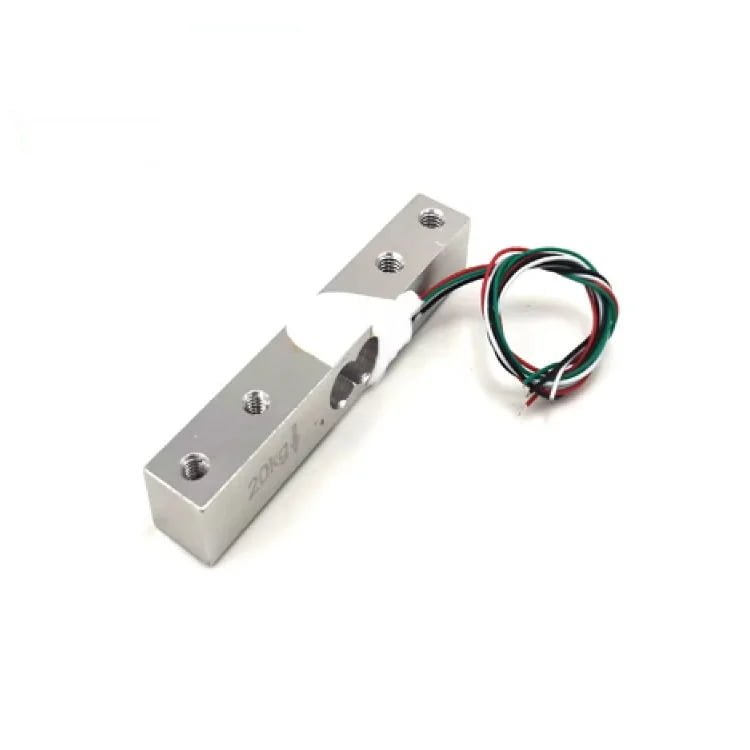
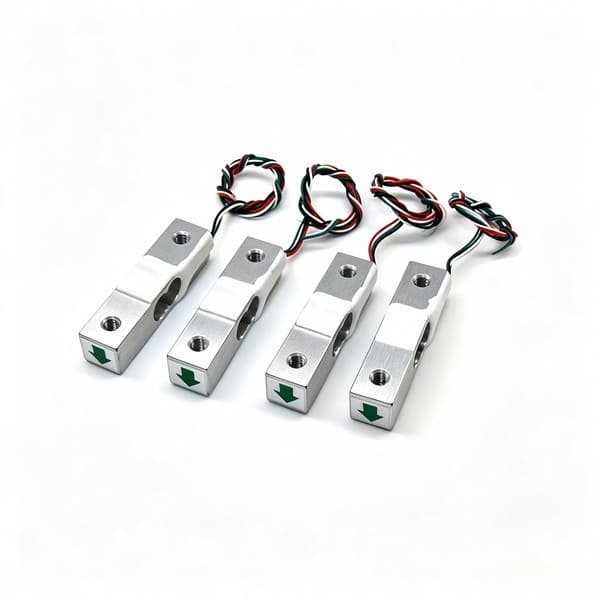
WST103 — 1 kg to 50 kg Cell for Small Compartments
The cell I quote for a phone, wallet or badge compartment. It goes down to 1 kg, which is the whole point: on a 1 kg cell a 200 g phone sits at 20 % of full scale instead of 4 %, so the creep and zero terms that are quoted as a percentage of full scale shrink by a factor of five in grams.
- Range: 1–50 kg
- Accuracy: 0.05 %FS comprehensive error, ±0.05 %FS linearity, hysteresis and repeatability, ±0.05 %FS/3 min creep
- Output: 1.0 ±0.15 mV/V, 3–10 VDC excitation
- Body: aluminium alloy, Φ0.8 × 220 mm 4-wire PVC cable, −10 to +40 °C
- Overload: 150 %FS safe
Best for: phone lockers, valuables compartments, staff lockers, exam-hall lock boxes, 300 × 250 mm shelves carrying under 1 kg.
WST107 — Low-Current Cell for Battery Cabinets
The one I reach for when the cabinet has no mains. Its bridge is 1090 Ω in and 1000 Ω out, which means the same excitation voltage draws roughly a third of the current of a 350 Ω bridge — about 5 mA instead of 14.3 mA at 5 V. In a cabinet that has to keep watching all day to catch a removal, that is the cheapest power saving available. IP65 and potted for compartments that get wiped down.
- Range: 3–50 kg
- Accuracy: ±0.05 %FS comprehensive error, ±0.05 %FS/3 min creep
- Output: 1.0 ±0.15 mV/V; input 1090 ±10 Ω, output 1000 ±10 Ω
- Sealing: IP65, Φ0.8 × 220 mm 4-wire PVC, −10 to +40 °C
- Overload: 120 %FS safe, 150 %FS ultimate
Best for: solar or battery parcel columns, mobile locker banks, launderette and gym lockers, and any compartment that sees cleaning fluid.
WST201 — C3 Single-Point Cell for Parcels and Tool Drawers
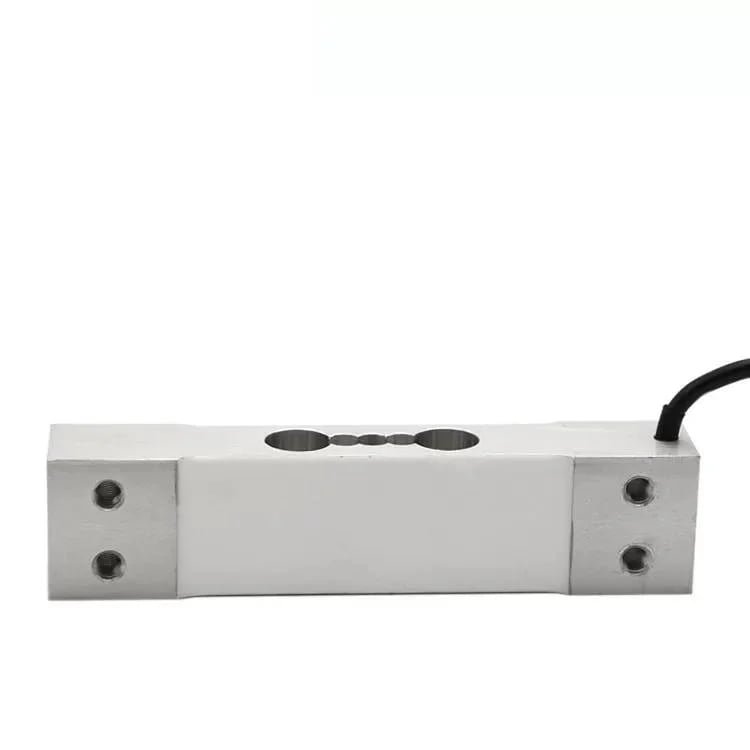
The workhorse for the big compartments. A C3-rated single-point cell with a 30-minute creep specification rather than the 3-minute figure on most miniature cells — and a 30-minute number is what you actually want for a drawer that stays loaded for a whole shift or a parcel that sits there overnight. Its 2.0 mV/V output also doubles your signal compared with a 1 mV/V cell, and the operating range reaches −20 °C for outdoor banks.
- Range: 3–100 kg, accuracy class C3
- Accuracy: ±0.02 %FS comprehensive error, linearity, hysteresis and repeatability; ±0.02 %FS/30 min creep
- Output: 2.0 ±0.2 mV/V, 5–12 VDC recommended; 406 ±20 Ω input, 350 ±5 Ω output, 4-wire shielded
- Environment: IP65, Φ4 × 400 mm cable; operating −20 to +60 °C, compensated −10 to +40 °C
- Overload: 120 %FS safe, 150 %FS ultimate
Best for: parcel and click-and-collect lockers, laundry and dry-cleaning lockers, tool drawers, staff lockers holding bags or PPE.
WST101 — Flat Micro Cell for Columns and Heavy Drawers
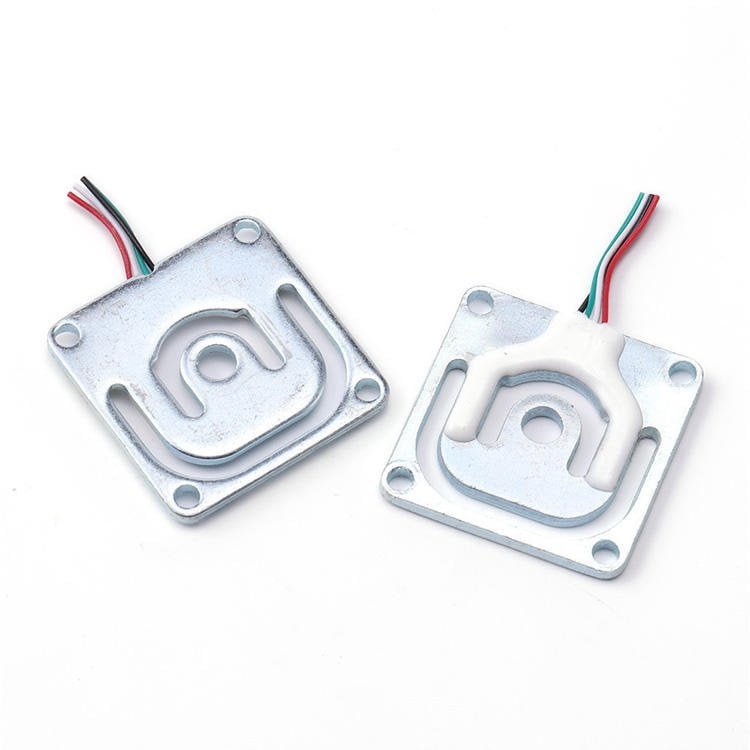
A low-profile alloy-steel plate with a cut-out pattern and mounting holes at each corner, so it slides under a thin shelf plate without raising the compartment floor — which matters when your compartment height budget is already spent. It also goes up to 200 kg, and that is what I quote where the shock load rules: a drawer holding a 4 kg torque wrench needs a range that survives 220 N, not just the static weight.
- Range: 5–200 kg
- Accuracy: 0.05 %FS comprehensive error, linearity, hysteresis and repeatability; ±0.05 %FS/3 min creep
- Output: 1.0 ±0.2 mV/V, 5–10 VDC excitation, zero balance ±0.3 mV/V
- Body: alloy steel flat plate, Φ8 × 200 mm cable, −10 to +40 °C, ≥2000 MΩ insulation
- Overload: 150 %FS ultimate
Best for: whole-column or whole-cabinet weighing (arrangement B and C), heavy tool cribs, and any shelf where a thin profile or a large capacity matters more than the last gram.
Looking at a different compartment shape or a different object? The wider ranges are in the single point load cell, micro load cell and flat type load cell ranges, and the retail-cabinet and shelf-layer versions of this problem are covered in load cells for smart vending machines, load cells for smart shelves and smart warehouse management systems. If your problem is counting rather than storing, the arithmetic in load cells for banknote counters is the same arithmetic; if it is an outdoor cabinet on a battery, smart LPG cylinder weighing is the closest thing I have written to it.
12. FAQ: load cells for smart lockers
How many load cells does a smart locker need?
It depends on which question you are answering. One cell per compartment gives you a per-door answer and is what most phone lockers use; one to four cells per column or per cabinet gives you a bank-level answer for a fraction of the cost and channels. A 60-door bank is commonly quoted as either 60 channels (full localisation) or 4–24 channels plus door sensors (column-level, arbitrated).
What accuracy does a locker weighing channel actually need?
Not an accuracy class. A locker is not a trade instrument, so the numbers that matter are repeatability, the temperature effect on zero, and creep converted into grams at your real load. My rule is to convert every error term to grams and keep the total under a quarter of the smallest object you will ever place in the compartment. On a 200 g phone that usually means a 1 kg cell, not a 5 kg one.
Can a load cell tell me which phone was taken?
No. Two identical phones in identical cases weigh the same, and no strain-gauge channel on the market can separate them. The architecture that works uses the credential to bind a named device to a named compartment, then uses the weight to confirm that the mass in that compartment changed by roughly the amount that went in — a delta window of around ±10–12 % of the object’s mass.
Do I need an OIML-certified load cell for a locker?
No, and you should be careful what you claim because of it. OIML R76 and EN 45501 govern trade and legally controlled weighing; a compartment confirming its own contents is neither. We supply cells, matching test data, junction boxes, indicators and a calibration protocol, but the certification and compliance story of the finished cabinet is the cabinet builder’s, and it should not lean on a component certificate.
Will a load cell survive the compartment doors being slammed?
Not without help. A slammed door produces a short transient on the whole cabinet frame, and a dropped tool produces a genuine peak force 10 to 30 times its own weight. The fixes are mechanical — a stop that limits shelf travel, an elastomer decoupling pad, and mounting the cell on the fixed frame rather than the door — plus a firmware rule that only accepts a reading when the door reports closed and the value has been stable for a second or two.
Can a smart locker weighing channel run on battery or solar?
Yes, if you choose the bridge and the policy together. A 1000 Ω bridge draws roughly a third of the current of a 350 Ω bridge at the same excitation — about 5 mA against 14.3 mA at 5 V — and you should not run the bridge continuously in a mains-free cabinet. Wake it on a door event and on a slow schedule such as every ten minutes instead.
What happens to the zero in an outdoor locker at −20 °C?
A cell with a compensated range of −10 to +40 °C and an operating range of −20 to +60 °C is, at −20 °C, at the edge of operating and outside compensated. Be explicit about that rather than pretending otherwise: measure the temperature at the cell, apply a per-channel correction using the cell’s own coefficient, allow a longer stabilisation window at cold start, and lower the ambition — you are confirming a parcel is present, not resolving 20 g.
How do you calibrate a bank of 60 compartments?
In four steps: record the per-channel slope at the factory on the assembled shelf; zero every door on site with the doors closed and empty and record the empty-shelf weight; spot-check six channels on site with a single 200 g and 500 g class-M check weight, choosing the highest and lowest slope numbers and the most-used door; then repeat that spot check annually. Because each channel’s slope is stored individually, a damaged cell is a re-scale rather than a re-certification.
Does adding a weighing channel create a data protection problem?
It can, because a record of what was in a person’s compartment at a given time is personal data under the GDPR. The fix is architectural and free: log the mass delta and the timestamp against a compartment rather than a person, keep the retention window short, and let the credential layer hold the identity. That is the same division of labour that solves the two-identical-phones problem.
Tell me the compartment, the object and the environment
That is all I need to tell you the range, the load path, the creep budget and the part number — including when the answer is a smaller cell than the one you asked for.
Send me the compartment drawing, the heaviest and lightest object, the door count and whether the cabinet has mains power. You get a sizing note and a quotation, not a brochure.
Request a sizing note →
Email Robin directly
VektorForce — load cells, force sensors, junction boxes and weighing indicators since 2004. We supply the sensing layer; the locker is yours.