
Load Cells for Packaging Machinery: Field Notes From the Three Scales Every Line Needs
Every packaging line is secretly a weighing machine. Here is how the load cell choice differs between a dosadora, a multihead weigher and a checkweigher — with the tolerance math, three real projects, and the honest limits of what a component supplier can do.
8 October 2026
14 min read
By Robin, export sales engineer at VektorForce. I sell load cells, junction boxes and weighing indicators to packaging machine builders and end users — not the machines themselves. Everything below comes from projects I have personally quoted, shipped or troubleshot. Numbers are rounded where it doesn’t change the conclusion.
Why every packaging line is secretly a weighing machine
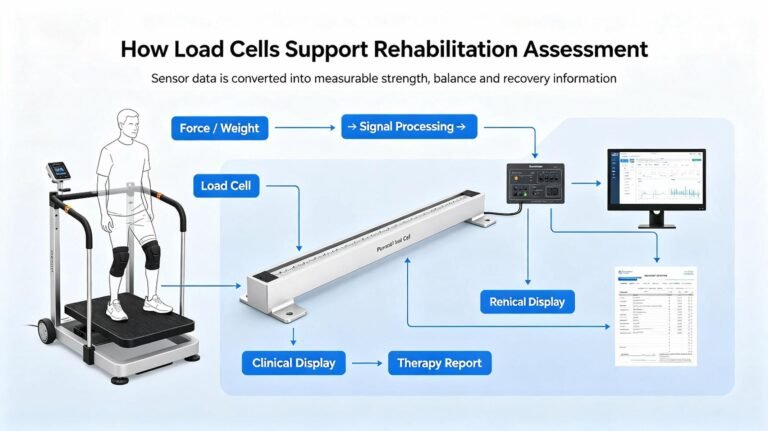
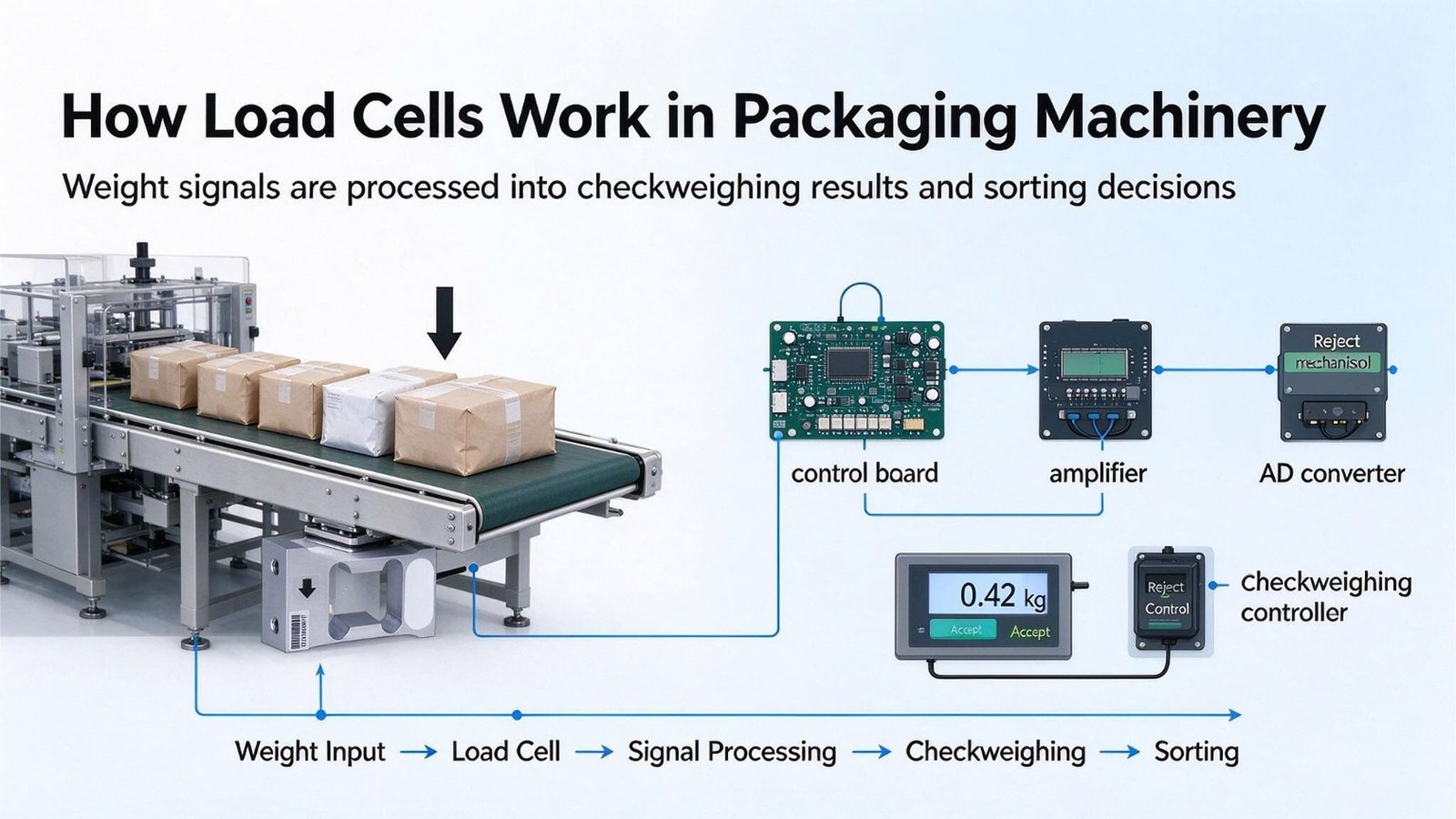
Stand in front of any modern packaging line and count the scales. Not the people with clipboards — the actual weighing points inside the machines. A typical dry-food line has at least three: the gravimetric filler (a dosadora, in Brazilian Portuguese) that doses product into the bag, the multihead weigher or linear weigher that portions free-flowing product above it, and the checkweigher at the end that weighs every finished pack in motion and kicks out the ones that break the rules. Each of those stations is built around one or more load cells. The machines are different brands, the sensors inside them are the same physics.
The market behind those sensors is enormous and still growing. Brazil — the largest packaging machinery market in Latin America — was valued at roughly US$1.36 billion in 2025 with a projected 6.5% CAGR through 2033, according to Grand View Research. Globally, Persistence Market Research sizes the checkweigher segment alone at US$708.5 million in 2026, heading to US$1,037.5 million by 2033 (5.6% CAGR). Machine builders like Maqesfera in Santa Catarina build the dosadoras and ensacadoras that fill this region’s rice, pet food and fertilizer bags. I sit exactly one layer below companies like that: they build the machine, I supply the sensors, junction boxes and indicators inside it — and the sizing phone calls that happen before a single bracket is machined.
Who this article is for
If you build packaging machinery and buy sensors as components, this is a sizing guide written from the supplier side. If you run a packaging plant and your checkweigher “sometimes lies”, this will help you understand why — and what to ask your machine builder to change.
The three weighing stations — and why they need different cells
The most common quoting mistake I see is treating “packaging load cell” as one product category. It isn’t. The three stations impose three different measurement regimes, and the same model number can be perfect at one and wrong at the other two.
Station 1 — the gravimetric filler (dosadora / weigh filler). A weigh hopper hangs on one or more cells. The feeder runs at full speed to about 90% of target, slows to a dribble, and the controller cuts off at the set weight — correcting for the product still in flight. Then the hopper dumps and the cycle repeats. The cell here sees a static load that holds still for a second or two. The accuracy killers are creep (signal drift while the load sits), repeatability, and temperature drift across a shift. Capacity must include the tare of the hopper itself, which is often 3–4× the product weight — a trap I cover in the arithmetic section.
Station 2 — the multihead weigher. Ten to twenty weigh hoppers in a ring, each with its own small single-point load cell. The controller reads all hoppers and computes which combination sums closest to the target — combinatorial math, done in milliseconds. Industry-standard machines run 60 to 120+ weighings per minute with ±0.1–1.5 g accuracy. Each hopper’s cell works in short static bursts: fill, settle, read, dump, all inside 500–900 ms. The cells are small (typically 1–5 kg per hopper), cheap to replace, and get abused by vibrating feed pans bolted nearby. Replacement cells for imported multihead weighers are one of my most common enquiries — the original part is unobtainable, but the mounting hole pattern and capacity tell me everything I need.
Station 3 — the checkweigher. The pack crosses a short weigh belt at line speed — anywhere from 100 ms to 600 ms of dwell — and the system must produce a static-quality weight from a moving object. This is the hardest of the three, and here is an industry truth worth knowing upfront: checkweigher weighing elements come in two families. Electromagnetic force compensation (EMFC) cells give laboratory-grade performance but cost accordingly and dominate pharmaceutical and milligram-class lines. Strain gauge single-point cells are the workhorse of the food and consumer goods segment — the reference parts this segment has copied for years are the Tedea 240, the HBM FIT/7A and the UTILCELL 200. If a machine maker quotes you a strain-gauge checkweigher, that sensor slot is our territory. Where EMFC starts (milligram resolution, 250+ packs per minute), I will tell you honestly that catalog strain gauge cells are not the answer.
One sentence per station
Filler cell: chosen for creep and thermal stability. Multihead cell: chosen for size, speed of settling and cost per head. Checkweigher cell: chosen for repeatability and how well the mechanics isolate it — the cell is rarely the limiting factor there; the belt is.
The law you are really filling to: the three packer’s rules
Packaging weight is not a preference — in most export markets it is legislation. And the legislation is why the filler and the checkweigher exist at all. If you sell packaged goods into the European Union, the governing text is Directive 76/211/EEC (carried forward by Directive 2007/45/EC), with the tolerance ladder from OIML R87. The system is the “average quantity system”, and it is what the ℮ mark on a European pack certifies.
Three rules, the famous “three packer’s rules”, decide whether a batch is legal:
- The average rule: the actual contents of the batch, averaged, must not be below the nominal quantity (Qn).
- The 2.5% rule: no more than 2.5% of packs (1 in 40) may have a negative error greater than the tolerable negative error (TNE) — i.e. below Qn − TNE.
- The T2 rule: no pack whatsoever may fall below Qn − 2×TNE. This is a hard floor.
The TNE ladder shrinks as packs get smaller, which is exactly why small packs are the hard ones:
| Nominal quantity Qn | Tolerable negative error (TNE) |
|---|---|
| 5 – 50 g | 9% of Qn |
| 50 – 100 g | 4.5 g |
| 100 – 200 g | 4.5% of Qn |
| 200 – 300 g | 9 g |
| 300 – 500 g | 3% of Qn |
| 500 – 1,000 g | 15 g |
| 1,000 – 10,000 g | 1.5% of Qn |
| 10,000 – 15,000 g | 150 g |
| over 15,000 g | 1% of Qn |
Worked example, 1 kg pet food bag: TNE = 1.5% × 1,000 g = 15 g. So T1 (the soft line) is 985 g and T2 (the hard floor) is 970 g. A batch averaging exactly 1,000 g with a few bags at 980 g is perfectly legal under the ℮ system — that is the whole point of the average system, and it is worth real money, because it lets you trim the safety overfill that a minimum-weight system would force on you.
Not every market works this way, and the difference changes what your weighing system must do:
| Market | System | What it means for the machine |
|---|---|---|
| EU / UK / Australia / Brazil (average-type rules) | Average quantity (76/211/EEC family) | Checkweigher feeds statistics back to the filler; target mean sits at or a hair above Qn. |
| USA | Individual limits — NIST Handbook 133, MAV per pack | Every pack must clear its own limit; forces higher overfill and tighter per-pack control. |
| Japan | Minimum system (Measurement Act) | No averaging allowed at all; every pack is a minimum-weight pack. |
| China | Average system — JJF 1070-2023 | Same structure as the EU ladder; sampling rules differ. |
A practical rule of thumb from metrology practice: the checkweigher should resolve to about 0.2 × TNE to be trusted as a compliance instrument. For the 1 kg bag that means 3 g resolution at line speed. Hold that number — it comes back in the case studies.
OIML R61 vs R60: what is approved, and by whom
Because packaging weight is legal metrology territory, approvals come up in almost every packaging enquiry. The boundary confuses people constantly, so here it is flat:
- OIML R61 is the recommendation for automatic gravimetric filling instruments — the complete filling machine, evaluated as a whole. R76/EN 45501 covers the non-automatic weighing side (the checkweigher’s static verification, platform scales). These are machine-level approvals, and in a legal-for-trade application they belong to the machine builder and the notified body — never to the component supplier.
- OIML R60 is the metrological regulation for the load cell itself — the element. A class C3 R60 evaluation means the cell met accuracy, creep, temperature and error-envelope tests at a certified lab. It is a component credential. An R60 certificate on a load cell does not approve a filling machine, a checkweigher, or any control loop.
The line I will not cross
If a customer asks me “is your load cell OIML approved so my machine is legal?”, the honest answer is: an R60 element certificate (where the specific model holds one — I provide the certificate, not a general claim) supports the machine builder’s R61/R76 evaluation; it does not replace it. I supply sensors and test data. Machine approval, ℮-mark system certification and legal-for-trade verification belong to the machine maker and the packer. Any supplier who tells you otherwise is selling you something they don’t have.
The sizing arithmetic: %FS is not grams
Here is the single most useful conversion in packaging sensor selection. Load cell datasheets speak in %FS — percent of full scale. Your tolerances, your TNE, your product giveaway — those are in grams. The gap between the two is where bad sizing hides.
Step 1 — capacity is tare + net, not net. On a dosadora, the cell carries the weigh bucket full time. A 1 kg fill with a 3.8 kg bucket is a 4.8 kg working load. On a checkweigher, the weigh belt, frame and idlers sitting on the cell are all tare. If you size to the product weight alone, you will spend your life at 5% of full scale where the signal is tiny — or worse, you’ll pick a cell whose creep and zero drift, calculated in grams, quietly eat your TNE.
Step 2 — keep the working point at 40–80% of capacity. Below 40%, resolution waste; above 80%, no headroom for product clumps, belt tension surges or the day someone dumps a whole sack in by hand. Safe overload on our single-point cells is 150% FS, ultimate 200% — those margins are for events, not for sizing policy.
Step 3 — translate every error into grams on your actual working load. Example with a class C3, 10 kg cell (3,000 verification intervals → static division d = 10,000 g ÷ 3,000 ≈ 3.3 g) working at 4.8 kg:
| Error source (datasheet) | In grams at full scale (10 kg) | Relevance to a 1 kg fill (TNE 15 g) |
|---|---|---|
| Comprehensive error ±0.02% FS | ±2.0 g | 0.2% of fill — negligible |
| Repeatability ±0.01% FS | ±1.0 g | Matters for bag-to-bag σ |
| Creep ±0.02% FS / 30 min | ±2.0 g | Only if the load sits — short cycles OK |
| Temp effect on zero ±0.02% FS / 10 °C | ±2.0 g per 10 °C | A 10 °C shift on a non-vented line ≈ 13% of TNE — re-zero between shifts |
Step 4 — check the signal, not just the datasheet. A 10 kg cell at 2.0 mV/V on 5 V excitation gives 10 mV at full scale — that’s 1 µV per gram. Feeding a 24-bit sigma-delta input like our WST1502 indicator (±10 mV range, 5,000,000 counts → 4 nV per count), one gram is roughly 250 counts. Resolution is never the bottleneck in packaging; the mechanical repeatability of the filler is. Anyone selling you a “higher resolution sensor” to fix an inconsistent filler is selling you a better view of the same problem.
Giveaway economics: what 1 gram per bag actually costs
Product giveaway — the amount you overfill to stay safe — is the quietest profit leak in packaging, and the load cell is upstream of it. Run the numbers on a modest line:
The 1-gram line
120 packs/min × 60 min × 16 h/day = 115,200 packs/day.
At just 1.0 g average overfill: 115.2 kg of product given away per day.
Over 250 production days: 28.8 tonnes of product per year.
At US$3/kg, that is ≈ US$86,000 a year — spent one invisible gram at a time.
This is why the average quantity system (and a checkweigher that feeds the filler) is not bureaucratic overhead — it is the mechanism that lets you run the batch mean at 1,002 g instead of 1,015 g and keep the difference. The sensor chain that makes that trustworthy — stable cells, a junction box that doesn’t inject its own drift, an indicator whose zero you can believe — costs a tiny fraction of one month of giveaway. I have done this math with customers on a whiteboard and watched the procurement conversation change tone mid-sentence.
Case 1: a dosadora in Santa Catarina and a 20-gram creep problem
Machine builder, Santa Catarina, Brazil · 2025 · gravimetric filler for 1 kg dry pet food · WST217
A machine builder I’d been quoting for about a year makes dosadoras — gravimetric fillers — for rice and pet food packers. In March 2025 their service phone started ringing: bags off a certain filler were running light late in the shift. Not at start-up — at hour six. Their first instinct was the auger feeder; mine, when they sent me the photos, was the load cells.
The filler’s weigh bucket hung on a generic 40 kg shear beam cell. The creep spec on that cell — a generic import, not ours — was around 0.05% FS per 30 minutes. Do the math in grams: 0.05% of 40 kg is 20 grams of drift while the bucket sits loaded. The bucket holds product for a couple of seconds per cycle, but the cell also spends entire shift segments loaded at tare plus product between batches — and creep accumulates with time under load, not with cycles. Twenty grams against a 15 gram TNE. The cell was eating the entire legal tolerance by itself, and it did it progressively, which is why the fault looked like “late shift light bags” instead of “broken machine”.
We re-sized from scratch. Bucket tare 3.8 kg, product 1 kg → working load 4.8 kg. I put them on the WST217 at 10 kg capacity — a single-point cell with a 250×250 mm platform rating that their bucket mount adapted to with a new top plate:
- Working point 48% FS — inside the 40–80% band, with headroom for the day an operator drops a full sack in the bucket.
- Creep ±0.02% FS / 30 min = 2.0 g at capacity, about 1 g at their working load — an order of magnitude better than what they had.
- Repeatability ±0.01% FS = 1 g at capacity, which is what actually determines bag-to-bag σ on a gravimetric filler.
- IP66 and −20 to +60 °C operating, because their customer plants wash the floor and the filler lives next to the extruder line.
We also re-tuned the fill sequence: coarse fill to 940 g with the auger at full speed, dribble to a cut-off of 1,000 g with an 8 g in-flight allowance, re-zero at bucket-dump. Their measured result over one week of production: batch mean 1,003 g, bag σ 2.1 g — versus σ around 8 g before. That σ is what let them pull the target mean from 1,015 g down to 1,003 g. At their volume — roughly 24,000 bags a day — that is on the order of 12 g × 6 million bags ≈ 70 tonnes of product a year they stopped giving away. I flag these as their measured numbers on their line; your product and filler will differ, but the structure of the calculation won’t.
What this case is really about
Nobody in that project asked for a “better” load cell. They asked why bags were light. The diagnosis lived in a datasheet line — creep — translated into grams against a legal tolerance. That translation is the actual service a component supplier should be providing. If your supplier quotes a part number without doing that math in front of you, they’re a catalog, not a supplier.
Case 2: a 5 kg bag checkweigher where the class C3 division landed exactly on the law
Co-packer, São Paulo state · 2024 · in-motion checkweigher for 5 kg pet food bags, 40 bags/min · WST219
A co-packer running bagged pet food on an ensacadora line wanted to add a checkweigher after the bagging machine — partly for compliance, mostly because their customer (a supermarket chain) was auditing underweight claims. The line runs 5 kg bags at 40 bags/min. They had budgeted for a famous-brand imported machine, then saw the quote, and asked whether their own workshop could build one around sensors we supply. I said yes for this class of line, with one honest boundary I’ll come back to.
The sizing was almost a textbook exercise. Belt section tare (frame, belt, idlers sharing onto the cell): about 12 kg. Bag: 5 kg. Working load: 17 kg. The 50 lb (22.7 kg) version of the WST219 puts that at 75% FS — tight; the 100 lb (45.4 kg) version puts it at 38% FS, comfortable, with the belt-tension surges of a 40 bags/min line absorbed in the headroom. The WST219 is stainless steel, IP66, rated for a 400×400 mm platform — which matched their weigh belt section almost exactly.
Then the pleasing coincidence, which is really not a coincidence at all: TNE for a 5 kg nominal quantity is 1.5% = 75 g, so a compliance-grade checkweigher should resolve to about 0.2 × 75 g = 15 g. Class C3 on the 45.4 kg cell gives a static division of 45,360 ÷ 3,000 ≈ 15.1 g. The sensor class and the legal tolerance line up almost perfectly — that is how this segment of the industry was designed, and why the Tedea-240-class single point became the default part in bag checkweighers worldwide.
What actually took three visits was the mechanics. Their first build bolted the weigh frame directly to the main conveyor girder, and every bag landing on the infeed belt sent a shock wave through the load cell. Readings wandered ±60 g bag to bag — worse than useless, because useless numbers at least look useless; these looked plausible. The fixes, in order of impact:
- Three-section layout: infeed belt, weigh belt, outfeed belt as separate frames with a visible air gap. The weigh section carries only the pack — nothing else touches it.
- Belt tension discipline: the weigh belt tensioned to the minimum that prevents slip. Belt tension loads the cell sideways-down and changes with temperature; a loose-but-not-slipping belt beat their beautifully-tight one.
- Hard mounts, electronic filtering: they wanted rubber pads under the weigh frame. I talked them out of it — a soft mount drops the natural frequency into the same band as line vibration and amplifies exactly the motion you’re trying to filter. Rigid mounts, then an analog low-pass before the A/D, then averaging in software.
- A sampling window with room to breathe: at 40 bags/min the dwell is 1.5 s — luxurious. We used ~1 s of filtered reading per bag after settle.
Final in-motion performance: ±10 g on a 5 kg bag (0.2% of fill), stable across a shift after a scheduled re-zero. Their QA manager’s comment, translated: “now the checkweigher agrees with the static scale.”
The honest boundary
This works for the 1–10 kg bag class at up to roughly 100–120 packs/min — which is where most bagging lines in Latin America actually run. For 100–250 g snack packs at 150+ packs per minute, or milligram-class pharma, the industry moves to electromagnetic force restoration cells or dedicated dynamic cells with natural frequencies above 500 Hz. I don’t pretend catalog strain gauge parts serve that segment, and I’d rather lose the order than sell a cell into a line it can’t hold.
Case 3: the additive hopper that went digital
Feed mill equipment retrofitter, Minas Gerais · 2026 · 0.8 kg premix additive dosing · WST1201
Not every packaging weighing problem needs an analog signal chain. A retrofitter I work with upgrades feed mill bagging lines; one line dosed a vitamin premix into each 25 kg feed bag — 0.8 kg of additive per bag, dosed from a small hopper above the filler. The old chain was an analog single-point cell, a 15-meter cable run to the control cabinet, an amplifier, and an analog input card on the PLC. Their complaint was not accuracy — it was the analog loop drifting differently every season, and an electrician’s day lost every time someone “recalibrated” it.
We replaced the whole chain with one WST1201 digital single-point load cell, 6 kg capacity: hopper tare 2.4 kg + 0.8 kg dose = 3.2 kg working load, 53% FS. The WST1201 does its own conversion internally — 1,200 samples per second A/D, 300,000-count resolution, 0.005% FS comprehensive error — and speaks MODBUS RTU over RS485 with weight data out every 3 ms. One cable, four wires, straight to the PLC as another MODBUS slave. Division at ≤5 kg capacity is 0.1 g — overkill for an 800 g dose, but overkill here cost nothing and made the dosing trend readable.
The result they cared about: dosing repeatability went to ±0.5 g and stayed there across season changes, because the zero and span live inside the cell’s compensated range instead of at the end of a long analog cable. And recipe changeovers — they run four premix formulations — became a number change, not a recalibration.
When I push digital cells — and when I don’t
Digital single-point cells like the WST1201 shine on static dosing and level monitoring: hoppers, additive tanks, check-weighing stations that stop the pack. I do not recommend them as the primary sensing on a high-speed dynamic checkweigher — the conversion pipeline inside the cell is optimized for stability, not for the raw unfiltered waveform a fast dynamic system wants. There, an analog cell into your own fast A/D with proper analog filtering is still the right architecture. Knowing which of the two problems you have is half the selection.
Why the cell is the easy part: belts, ringing and filtering
On fillers and hoppers, the load cell is most of the measurement story. On anything dynamic — checkweighers especially — the cell is maybe a third of it. The other two thirds are mechanics and signal processing, and this is where self-built systems fail. The short list of what bites people:
Belt tension is a load, and it moves. The weigh belt pulls on its frame; the frame loads the cell. Tension changes with temperature, with belt wear, with how enthusiastically the last technician tightened the trackers. Every newton of belt tension is a false gram on the display. Separate frames and minimum-slip tension are not refinements — they are the instrument.
Every fill and dump event rings the structure. A hopper discharging excites the natural frequency of the mount; the cell keeps “singing” for tens to hundreds of milliseconds after the event. If you sample during the ring, you measure the vibration, not the weight. The fix is timing (wait for settle), not a faster sensor — a faster sensor just shows you the ringing in more detail.
Soft mounts amplify; they don’t protect. The instinct is to put something rubbery under a weighing frame to “absorb vibration”. Run the natural frequency formula: a mount with 5 mm of static deflection has a natural frequency near 7 Hz — which sits right in the band where line sway and pack-handling forces live. You’ve built a resonant amplifier. Rigid mounting plus electronic filtering is the reliable order.
Sample too slowly and vibration becomes a constant offset. This is the sneaky one. If belt or structure vibration lives at a frequency above your sampling rate, it doesn’t show up as noise — it aliases, folding down to near zero hertz, where it looks like a steady false weight. Lines have run for weeks with a phantom residual product weight caused by nothing but an undersampled vibration. The fix is an analog low-pass filter before the A/D, set for the frequency content you actually want; software filtering after sampling cannot unfold what sampling already folded.
Zero is a schedule, not a setting. Between batches, at shift start, after washdown — re-zero with the weigh section empty. The best cells drift grams per day across temperature; the best systems never let the drift accumulate into the batch average.
Washdown, hygiene and the cable you forget about
Packaging environments are wetter and more chemical than machine builders budget for. The failure mode is rarely the sensing element; it is the entry points — cable gland, cable end, the weld seam someone ground down. Practical rules I apply to every packaging quote:
- Dry packaging hall, no washdown: anodized aluminium, IP65 is honest and sufficient — that’s the WST216 and WST217 territory.
- Wet product, floor washing, or CIP-adjacent: stainless steel, IP66 minimum, IP67 if hoses point at the mount — the WST219 and WST218 territory. Alloy choice is not about cost snobbery; aluminium + caustic foam ends its life fast.
- The cable is part of the IP rating. A cell with an IP66 body and a cut-and-rejoined cable is an IP00 system. Keep the factory cable length, gland it properly, and route it away from the wash spray.
- Food contact is the machine builder’s design problem — hygienic mount geometry (EHEDG-style), cleanable surfaces, no crevices. The load cell hides under brackets in most hygienic designs; I supply the cell’s ingress rating and cable spec, the OEM owns the hygienic integration. I say this in every food packaging enquiry because it’s the most common assumption to get wrong.
What I ask for before quoting a packaging project
A packaging sensor quote that doesn’t ask questions is a guess with a price. My intake list, refined over twenty-odd packaging projects:
- Product and nominal quantity — and the target market, because TNE and the averaging rules change by country.
- Which station — filler, multihead hopper, checkweigher, or a dosing/monitoring hopper. Different physics, different shortlist.
- Rate — packs per minute, and dwell time if it’s a checkweigher. This is where I tell people honestly if they’ve crossed into EMFR territory.
- Tare weight of the bucket, belt section or platform — the number everyone forgets and every sizing error hides in.
- Platform or mount dimensions — single-point cells have a maximum platform size for their corner-error spec; a 250 mm-rated cell on a 400 mm platform will surprise you at the corners.
- Environment — washdown? caustic foam? ambient range? outdoor, unventilated?
- Electrical — mV/V into your A/D, 4–20 mA into a PLC, or digital RS485? And what sampling rate does your controller actually run — this decides whether I warn you about aliasing before it happens.
- Approvals — do you need an element-level OIML R60 test report for your machine evaluation, and for which model? I provide what the specific model genuinely holds, never a blanket claim.
- Replace or new build? — for replacements, photos of the existing cell’s nameplate and mounting holes; nine times out of ten the capacity and footprint decide the shortlist before specs do.
What we supply — and what we don’t
Because the packaging industry is full of “solutions providers”, here is our position in plain text. I sell weighing components and the engineering that goes with them. I do not build machines.
| What we supply | What we don’t supply |
|---|---|
| ✓ Single-point load cells for fillers, weigh hoppers and checkweighers (aluminium and stainless, C3) ✓ Digital cells with RS485/RS232 and MODBUS RTU for dosing and monitoring ✓ Junction boxes and matched-output cell sets for multi-cell hoppers ✓ Weighing indicators (HI/OK/LO outputs, RS485) and transmitters (4–20 mA / 0–10 V to PLC) ✓ Element-level OIML R60 test reports where the specific model holds one, plus calibration certificates ✓ Sizing help: capacity with tare, creep/thermal budgets in grams, mounting and filtering advice |
✗ Complete fillers, multihead weighers, checkweighers or bagging machines ✗ Filling/dosing algorithms, PLC code or checkweigher software ✗ Machine-level approvals: OIML R61/R76 type evaluation, MID, NTEP — the machine builder’s job with a notified body ✗ ℮-mark / average-quantity system certification — the packer’s responsibility under 76/211/EEC ✗ Hygienic machine design (EHEDG/3-A integration) ✗ EMFR-class dynamic sensing for milligram / 250+ packs-per-minute lines — we’ll tell you when you’ve left strain gauge territory |
Frequently asked questions
- 1. What’s the difference between the load cell a filler needs and one a checkweigher needs?
- The filler cell works statically — its killers are creep, repeatability and temperature drift, and its capacity must include the hopper tare. The checkweigher cell works dynamically — repeatability matters, but the belt mechanics, vibration isolation and filtering decide most of the accuracy. The same model can be right at one station and wrong at another; that’s why “packaging load cell” isn’t a product category.
- 2. Is accuracy class C3 good enough for packaging machinery?
- For the bag and hopper class — roughly 100 g to 25 kg packs at up to ~120 packs/min — C3 (3,000 divisions) sized correctly is the industry standard, and it is no accident that a C3 division on a correctly sized checkweigher cell lands near 0.2× the legal TNE. For milligram-class pharmaceutical lines or very high speeds, the industry uses C6 and above or electromagnetic force restoration cells — a different budget class entirely.
- 3. How do I size the capacity of a filler or checkweigher cell?
- Capacity = tare + net + headroom. Weigh the bucket, belt section or platform exactly as it sits on the cell, add the maximum product, then keep the working point at 40–80% of the cell’s rated capacity. The most common sizing failure is using the product weight alone and discovering the signal is buried — or the creep, translated into grams, is bigger than your TNE.
- 4. Do I need OIML-approved load cells to put the ℮ mark on my packs?
- The ℮ mark certifies that you run a verified average-quantity system under Directive 76/211/EEC. The machine (filler or checkweigher) may need type evaluation under OIML R61 or R76 — that is the machine builder’s approval, done with a notified body. The load cell carries an element-level OIML R60 evaluation, where the specific model holds one, and that certificate supports — but does not replace — the machine approval. No load cell certificate makes a machine legal by itself.
- 5. Why does my checkweigher show a different weight at line speed than the static scale?
- Usually one of four things: belt tension transferring load to the cell, structural vibration being sampled (or aliased into a constant offset), a settling window that’s too short, or a soft mount amplifying line vibration. The cell is rarely the culprit — which is why swapping the sensor almost never fixes it, and separating the weigh frame usually does.
- 6. Aluminium or stainless steel for packaging machinery?
- Dry halls and no washdown: anodized aluminium (IP65) is honest and economical. Any wet product, floor washing, or caustic foam nearby: stainless steel with IP66/IP67. Aluminium bodies plus alkaline cleaning chemicals have a short, unhappy life — the body corrodes at the entry points long before the element degrades.
- 7. Can a digital load cell talk straight to my PLC?
- Yes — models like the WST1201 output weight data over RS485 with MODBUS RTU every 3 ms, so the PLC sees the cell as just another slave. That eliminates the amplifier, the long analog cable and the analog input drift. It’s the right architecture for static dosing and monitoring; for high-speed dynamic weighing I still recommend an analog cell into your own fast, properly filtered A/D.
- 8. Can I sum several load cells in a junction box on a filling machine?
- For a static weigh hopper on multiple cells, yes — with a matched set (same capacity, same output, ideally same sensitivity batch) into a quality junction box, and corner adjustments done at commissioning. Never sum a dynamic checkweigher signal with anything else; it needs its own clean channel.
- 9. What happens if I oversize the load cell “just to be safe”?
- Every %-of-full-scale error — zero drift, creep, temp effect — scales up with capacity while your tolerance stays in grams. A cell sized at four times the working load turns a 2 g error budget into 8 g against a 15 g TNE. Oversizing is how “safe” selections quietly become non-compliant ones.
- 10. Do you build complete checkweighers or filling machines?
- No. VektorForce supplies load cells, junction boxes, weighing indicators and transmitters, plus the sizing and signal-chain engineering around them. Machines, machine approvals and filling software belong to machine builders — we are the sensor layer inside their equipment, and we’re deliberately good at exactly that layer.
Load cells I recommend for packaging machinery
The four models below cover the three stations described above. All are single-point cells, which is the right topology for packaging: one cell, one mount, corner-error compensated for platform use. Click through for full datasheets; every dimension and spec cited in this article comes from the product pages.


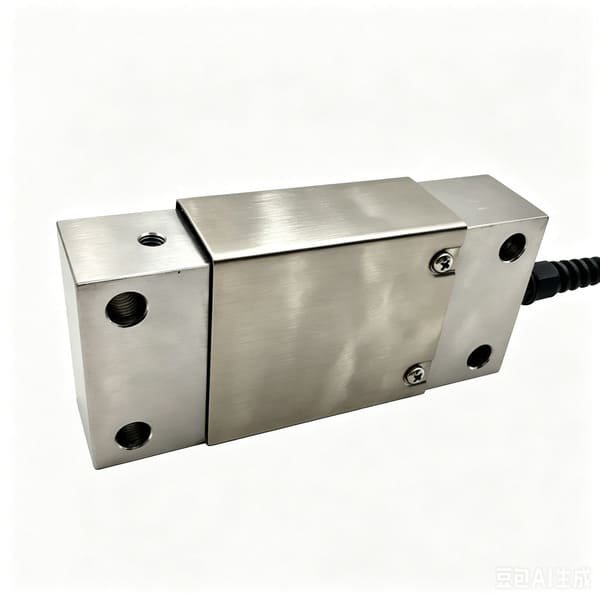
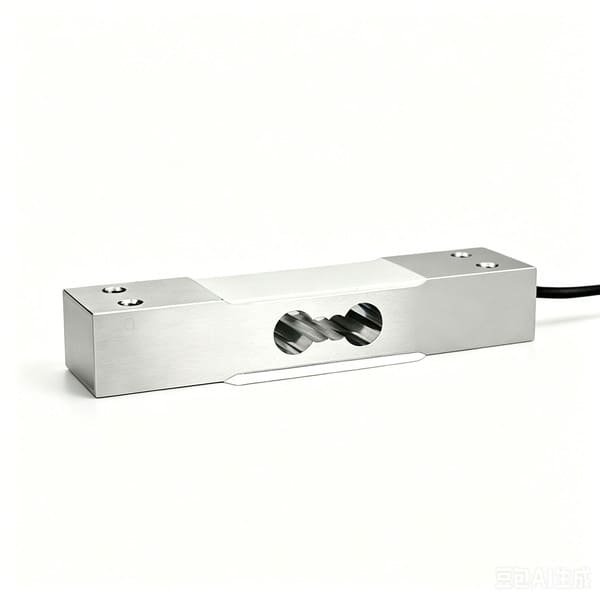
Around those four, the rest of the signal chain also comes from one place: the WST218 stainless single point for checkweighers and multihead weighers, WST402 S-type cells for suspended weigh hoppers, shear beam weighing modules for larger hoppers, the WST1502 indicator with HI/OK/LO setpoints and RS485 MODBUS for filler control, and the WST1508 transmitter when your PLC wants 4–20 mA. If your application needs deeper reading, our guides on choosing the right load cell and diagnosing a damaged load cell cover the general method — and our notes on banknote counters and vending machines cover other dynamic-adjacent single-point applications.
Sizing a filler, multihead or checkweigher?
Send me the nominal quantity, the target market, the rate in packs per minute and the tare weight — I’ll come back with a capacity calculation, a creep-and-temperature budget in grams, and a shortlist. Quotes within 12 hours on business days.