

Kitchen Scales · Micro Load Cells · Cups, Grams and Tare
A 0.05 percent load cell cannot fix a recipe that is 60 percent uncertain.
Every enquiry for a load cell for kitchen scale work arrives with the same number in it: one gram. The customer wants a 5 kg scale that reads 1 g, and they want the cell that delivers it. I have that conversation about twenty times a year, and about eighteen of those times the gram is not what is costing them money. A cup of flour weighs anywhere from 113 g to 181 g depending on how it was filled. Your competitor is a measuring cup, and a measuring cup is wrong by twenty percent. Once you understand that, the specification you should be writing changes completely — and it stops being about accuracy at all.
What this guide covers
- Why accuracy is the wrong thing to buy for a kitchen scale
- The quarter teaspoon that actually decides the cell
- Eight presses of a button nobody puts in a specification
- Four words that get used as if they were one word
- The bowl, the platform, and the bowl you drop
- Who regulates a kitchen scale, and who does not
- The four cells I was asked for, and eleven questions
- Questions buyers actually send me
Why load cells for kitchen scales are the wrong place to buy accuracy
Start with the appliance almost everyone is actually building. The SF-400 is the cheapest and most-copied kitchen scale on the planet: five kilograms, one gram, a 146 mm round platform on a 166 × 240 mm body, 36 mm thick, two AAA cells, 245 g without the batteries, forty to a carton. It wholesales for somewhere between ¥9 and ¥16 and retails for the price of two loaves of bread. There are variants of the same shell at 1, 3, 5, 7 and 10 kg, and the 1 kg one is marked 0.1 g. That product line is a complete answer to the question “what does a kitchen scale actually need”, and it was written by the market, not by an engineer.
The market itself is not small. Analysts put digital kitchen scales at about USD 1.28 bn in 2025 heading for USD 2.2 bn by 2033, roughly ten percent a year, with the home segment alone around USD 400 m and more than 150 million units a year. Basic models sell for USD 15 to 30 and multifunction ones for USD 45 to 120. And when those same analysts list what limits growth, one entry keeps appearing next to battery life and breakage: competition from measuring cups and spoons. That is the whole article in five words. The thing your product has to beat is not another scale.
What one cup of flour actually weighs
All-purpose flour is the single most-converted ingredient in baking and the least stable one, because flour is compressible. A cup is a fixed 236.6 ml of space. How much flour ends up in that space depends entirely on how you filled it.
| How the cup was filled | Grams of all-purpose flour | Against the spooned 125 g |
|---|---|---|
| Sifted, then spooned in | 100 to 110 g | 20 % light |
| Spooned in and levelled with a knife | 120 to 125 g | the reference |
| Scooped straight out of the bag | 145 to 155 g | 20 % heavy |
| Tapped down, or packed | 165 to 181 g | up to 45 % heavy |
Published conversions disagree with each other as well. King Arthur Baking prints 120 g per cup, most American test kitchens assume 125 g, the USDA lists 125 g, and one recent survey of live conversion sites found published figures spanning 113 g to 181 g for the same cup — a 60 % spread on the one ingredient every baker converts. In a four-cup recipe, spooning gives you 500 g and scooping gives you 600 g. Same recipe, same cup, one hundred grams of flour apart.
Put the two numbers side by side. A mistake in technique costs you 100 g on a 500 g batch, which is 20 %. A load cell with a comprehensive error of 0.05 % of full scale, sitting under five kilograms of platform, has a floor of 2.5 g — which on that same 500 g batch is 0.5 %. The cup is forty times worse than the cell. You are not selling a measuring instrument. You are selling a repeatable habit.
Curitiba, November 2025: the complaint was never about the cell
A bakery-equipment distributor in Curitiba, Brazil, sent me a specification in November 2025 that I have now received in eight languages. It said: 5 kg capacity, 1 g division, accuracy ±1 g, and please quote your most accurate cell because our customers say the scale is not accurate.
So I asked the distributor to do one thing before spending any money. Weigh a cup of flour three ways on the appliance they were complaining about: scoop, spoon, sift. Their numbers came back 152 g, 124 g and 107 g. The scale was reading correctly the entire time. The appliance had never been the error, and no cell in my catalogue — or anyone else’s — would have changed a single cake.
What they did next is the reason I still tell this story. They printed the gram weights on the shelf liner that sits over the platform — a small table, three lines, no engineering. Complaint volume about “accuracy” fell by about two thirds in a quarter. They bought the WST103 for their next model anyway, because a scale that is honest about grams still needs a cell inside it. But they bought it for the right reason, and they knew what it could not do.
So what should the specification say?
Here is what I now put at the top of every quotation I send for a kitchen-scale cell. It is a two-line brief, and it is the whole design:
- The largest mass that ever touches the platform decides the capacity — and that number is almost never an ingredient. It is a bowl with batter in it.
- The smallest mass the user has to get right decides what the resolution has to be — and that number is almost never what the product page advertises.
The smallest line in the recipe decides the cell
| One level teaspoon of | Weighs | Against the 2.5 g floor of a 5 kg cell |
|---|---|---|
| Honey | 7.0 g | 36 % |
| Fine table salt | 6.0 g | 42 % |
| Vanilla extract | 4.3 g | 58 % |
| Baking powder | 4.0 g | 63 % |
| Instant yeast | 3.1 g | 81 % |
| Ground cinnamon | 2.6 g | 96 % |
| Unsweetened cocoa powder | 1.8 g | 139 % |
| A quarter teaspoon of fine salt | 1.5 g | 167 % |
Read the last column slowly. On a five-kilogram appliance whose cell carries a 0.05 % of full scale error, the error band is 2.5 g. That is bigger than every line in the table except honey, and it is one and a half times the size of the smallest one. And the cell’s error does not shrink when the ingredient does: the floor is a percentage of capacity, so a two gram line of agar on a five kilogram cell is an error band the size of the ingredient.
The smallest line in the recipe is smaller than the cell’s own error. This is not a defect you can buy your way out of with a finer display, and it is the single most useful thing you can tell a customer who is shopping for “a more accurate cell”. It reframes the purchase: what they need is not a better sensor, it is a smaller platform, or a spoon.
The same floor, quoted honestly on six capacities
| Platform capacity | Error floor at 0.05 % F.S. | What it can honestly resolve | What it cannot |
|---|---|---|---|
| 200 g | 0.10 g | a quarter teaspoon of salt, to 7 % | a bowl with batter in it |
| 500 g | 0.25 g | yeast, salt and spice at 8 to 17 % | a one kilo dough, plus its bowl |
| 1 kg | 0.50 g | a small bowl of ingredients | a quarter teaspoon of anything |
| 2 kg | 1.00 g | a 1 g display is honest here | spoon lines under three grams |
| 3 kg | 1.50 g | table salt to 25 % | yeast, baking powder, cinnamon |
| 5 kg | 2.50 g | honey and table salt, just | every other spoon in the drawer |
| 10 kg | 5.00 g | large batches, coarse targets | anything measured with a spoon |
Where I tell people not to buy from me
Two or three times a year somebody asks for a cell that will make a five kilogram scale weigh a pinch of saffron. The arithmetic above says that product does not exist, so I say so, and then I say the thing that usually surprises them: for lines under about five grams, the spoon was already the better instrument, and the baking literature agrees. Every serious conversion guide I have read ends with the same advice — below a quarter teaspoon, use the spoon and do not fight it, because the mass is so small that the volume measure is as reliable as anything a home kitchen will produce.
So the honest answer for the sub-five-gram problem is a change of workflow, not a change of sensor. Weigh the flour, the water, the sugar and the fats — the ingredients where a cup is twenty percent wrong. Keep the spoons for salt, yeast, spice and extract, where a scale at any sensible capacity is worse than the spoon and always will be. That single sentence, printed on the box, is worth more than any cell upgrade I can sell, and it costs nothing.
The tare button is not a feature. It is the error budget
Here is how a kitchen scale is actually used, and every baking guide on the internet teaches it. Put the mixing bowl on the platform. Press TARE. Add 500 g of flour. Press TARE. Add 350 g of water. Press TARE. Add 12 g of salt. Press TARE. Add the yeast. Press TARE. That is a six-ingredient bread and it is six presses of a button that appears in no specification, no datasheet and no purchase order.
Everything the cell does slowly, the user erases
The WST103 is the cell in my catalogue with “kitchen scale” in its own product page title. Take its real numbers and put them on a five kilogram platform, which is the appliance this article is about.
| What the cell does | Size on a 5 kg platform | Does TARE erase it? |
|---|---|---|
| Zero drift, 0.2 % F.S. per 10 K | 10 g per 10 K | Yes, completely |
| Creep, 0.05 % F.S. per 3 min | 2.5 g per 3 min, 8.3 g over a ten minute proof | Yes, at the next tare |
| Span drift, 0.05 % F.S. per 10 K | 0.25 g per 10 K at a 500 g working point | Mostly, by re-referencing |
| The systematic part of nonlinearity | under 1 g inside a 400 g window | Yes, if it is a smooth curve |
| Repeatability, 0.05 % F.S. | 2.5 g | No. This is the floor |
| Hysteresis, 0.05 % F.S. | 2.5 g | Only if every load comes from below |
The top four rows are, every one of them, larger than a gram. The 10 g per 10 K figure is ten displayed divisions — a scale that is a full centimetre of flour out of position after a hot afternoon in the kitchen. And none of it matters, because the user tares. That is not a loophole; it is the correct engineering answer, and it is why a five dollar kitchen scale can hold a recipe together for a decade.
The bottom two rows are the ones that survive, and here is the number I want every buyer to take away: 2.5 g. On a 5 kg platform carrying a 0.05 % of full scale cell, 2.5 g is the portion of the error that no amount of taring will remove, because it is the part that changes from one reading to the next instead of staying put. On a 2 kg platform the same data sheet gives 1.0 g. On a 500 g platform, 0.25 g. Nothing in the datasheet has changed; only the capacity has. This is the mechanic behind the whole “buy the smallest platform you can live with” rule, and the tare button is the reason it is true.
The trap on the other side of the same behaviour. Automatic zero tracking is what makes a scale feel calm, and it is also the only error in the product that is installed by your own firmware. Set the tracking rate too high and a slow, deliberate pour — a hand shaking salt over a bowl for twenty seconds — becomes indistinguishable from the zero drifting, and the scale quietly subtracts the ingredient while you are adding it. The rule I give OEMs is to require the platform to be undisturbed for a few seconds before any automatic re-zero, and to make the threshold larger than the cell’s repeatability. If the tracking window is shorter than the time it takes to pour a spoonful, the feature is a defect.
Five numbers on one datasheet that cannot all be independent
One more thing about my own catalogue, because I would rather you heard it from me. Open the WST103 page and you will find non-linearity, hysteresis, repeatability, creep and temperature effect on sensitivity listed at plus or minus 0.05 % of full scale each. Then, a few lines above them, comprehensive error is also 0.05 % of full scale. If those five terms were independent and all present at their limits, they would combine to 0.10 % — twice the headline figure. So one of two things is true: either “comprehensive error” here means the largest single term rather than the sum, or the headline is a factory result from a sample rather than a worst case bound.
Either answer is fine. Not knowing which one you are holding is not. When you are comparing two suppliers, ask the question in exactly that form — is your comprehensive error the sum of the components or the largest of them, and what is the test procedure? — and you will separate the suppliers who have measured their product from the ones who have copied a table. The same question applies to the WST101, whose page carries the identical shape of five 0.05 % rows and a 0.05 % headline.
Four words, four numbers: division, resolution, error, repeatability
A kitchen scale specification uses four words as if they were one. They are not, and the gap between them is where every misunderstanding in this category lives. Division is the last digit’s step size. Resolution is the smallest change the electronics can see. Error is how far a reading may sit from the true mass — on a load cell that is a percentage of full scale. Repeatability is how far the same mass may read, twice in a row, under the same conditions. Only the last two are promises about the kitchen; the first two are promises about the screen.
The clean way to see it is to divide one by the display. If a scale shows 5 000 g in 1 g steps, it is presenting 5 000 divisions, and 1 part in 5 000 is 0.020 % of full scale. Compare that to what the cell inside can actually do.
| What the box says | Divisions | Accuracy it implies | Against a 0.05 % cell |
|---|---|---|---|
| 3 kg, 1 g | 3 000 | 0.033 % | 1.5 times fine |
| 2 kg, 1 g | 2 000 | 0.050 % | exactly matched |
| 5 kg, 1 g | 5 000 | 0.020 % | 2.5 times fine |
| 1 kg, 0.1 g | 10 000 | 0.010 % | 5 times fine |
| 10 kg, 1 g | 10 000 | 0.010 % | 5 times fine |
| 2 kg, 0.1 g | 20 000 | 0.005 % | 10 times fine |
| 5 kg, 0.1 g | 50 000 | 0.002 % | 25 times fine |
Two rows in that table are green and five are red, and the pattern is the point: the display gets further ahead of the cell every time you add a decimal place or a kilogram. A 5 kg scale in 1 g steps is only two and a half times optimistic. A 5 kg scale in 0.1 g steps is twenty-five times optimistic, which is not a harder specification, it is a different product.
The claim I keep finding in market literature
A division is a promise the display makes and the cell does not co-sign. That is not a scandal. Every digital instrument works this way, and 0.1 g resolution on a 2 kg platform is genuinely useful for the job it is used for — we will come back to espresso in a moment. What is not useful is letting the last digit set the purchase order. When a customer tells me they need 0.1 g, my next question is always the same: 0.1 g at what capacity? The answer changes the part number. The digit on its own changes nothing.
So what capacity does 0.1 g need?
Reverse the arithmetic. For a cell whose error is 0.05 % of full scale to have a floor of 0.1 g, the full scale has to be 0.1 g divided by 0.0005, which is 200 g. Not 500 g, not a kilogram, not five. Two hundred grams is the capacity at which a 0.05 % cell and a 0.1 g display are telling the truth about the same thing. A 500 g cell gets you 0.25 g. A one kilogram cell gets you 0.5 g. A two kilogram platform, which is what most espresso scales use, gets you 1.0 g — ten times the digit on the screen.
The good news is that the market already knows this, even when its marketing does not say it. The same SF-400 shell that sells as 5 kg / 1 g is also sold as 1 kg / 0.1 g, and at 1 kg a 0.1 g step is 10 000 divisions, which is five times optimistic rather than twenty-five. Small-capacity four-digit scales are a real product category with real cells behind them, and if 0.1 g is what you need, the honest move is to shrink the platform rather than to chase the digit. 0.1 g is not a feature you add. It is a capacity you subtract.
The bowl sets the capacity, and the bowl is also the overload event
Ask a buyer what the maximum load is and you will get the largest ingredient. Ask the appliance and you will get the bowl. Almost nothing that touches a kitchen-scale platform is an ingredient; it is a container full of them, and the container is the part nobody writes down.
| What is standing on the platform | Mass | Share of a 5 kg range |
|---|---|---|
| A 250 g steel mixing bowl, empty | 250 g | 5 % |
| A 500 g flour dough at 70 % hydration, in that bowl | 1 109 g | 22 % |
| A one kilo flour dough, same bowl | 1 968 g | 39 % |
| The same dough in a 1 050 g glass bowl | 2 768 g | 55 % |
| The eighty percent working point people should design to | 3 500 g | 70 % |
| A 4 kg stockpot with three litres of water | 7 000 g | 140 % |
| A six kilogram turkey | 6 000 g | 120 % |
The platform is smaller than the bowl
One geometry note that gets lost between the datasheet and the moulding. A 146 mm platform under a 200 mm mixing bowl leaves 27 mm of bowl overhanging each side. The bowl is supported on a circle smaller than itself, which means the load is not centred, the platform sees a moment rather than a force, and if the user rests a thumb on the rim while stirring, part of the bowl’s mass is being carried by the thumb and part by the cell. Nothing breaks. The reading just stops being a measurement of the bowl.
Now drop the bowl
The overload event in a kitchen is not the turkey. It is a five hundred gram steel bowl being set down on a hard platform by someone who is not looking. A micro load cell deflects about 0.5 mm at its rated load, so under 500 g on a 5 kg cell it deflects 0.05 mm. That small a compliance is a stiff spring, and a stiff spring is very good at turning a fall into a force. The standard result for a mass dropped onto a linear spring is that the peak force is multiplied by
1 + √(1 + 2h / δ)
where h is the drop height and δ is the static deflection under that same mass — 0.05 mm here. Put real heights into it.
| Bowl set down from | Peak force | As a share of the 5 kg cell |
|---|---|---|
| 0.5 mm — placed, not dropped | 2.79 kg | 56 % |
| 1 mm | 3.70 kg | 74 % |
| 2 mm | 5.00 kg | 100 % |
| 5 mm | 7.59 kg | 152 % |
| 10 mm | 10.51 kg | 210 % |
| 20 mm — set down over a bowl you did not see | 14.65 kg | 293 % |
Read the green rows as reassurance and the red ones as the warranty line. A bowl set down from two millimetres already reaches exactly full scale. From five millimetres it is 152 % — past the 150 % safe overload that the WST103 publishes, and the WST103 page does not publish an ultimate overload at all, so 152 % is a number I cannot price against a rating. From twenty millimetres, which is a normal height for a distracted hand, the peak is 293 %, or 1.95 times the safe overload. That is the event that produces the returns nobody can reproduce on a bench, because the unit arrives dead or drifting and no one dropped anything on the bench.
Worth noting too that among the four cells I was asked to recommend, the one with the highest overload headroom is the WST1101, at 150 % safe and 200 % ultimate, and the tightest is the WST201 at 120 % safe. On a 5 kg scale, 120 % is six kilograms — and the stockpot row above is seven. If you are building a scale for people who cook rather than bake, the overload figure should be the first line you read, not the last.
A mechanical stop is not a limit on force. It is a second load path. Set the platform so it bottoms out on the housing a fraction of a millimetre past full-load deflection — 0.6 mm against the cell’s 0.5 mm, for instance — and everything the platform cannot carry goes into the moulding instead of into the strain gauge. Two rules make it work and both of them belong to the OEM, not to the cell supplier: the stop must not touch before full load, or the calibration curve bends at the top of the range; and the housing must be stiff enough to take the whole overload without flexing into the cell. A tenth of a millimetre of clearance is the cheapest insurance in the product, and it is the difference between a dropped bowl being a bad afternoon and being a warranty claim.
Wisconsin, October 2025: the seasonal product with a seasonal failure
The clearest version of this I have worked on came from a housewares brand in Wisconsin in October 2025. They build a kitchen scale that sells hardest in the eight weeks before Thanksgiving, and they came to me because that year the return rate in those eight weeks ran around thirteen percent. Not drift, not accuracy — dead units and units reading tens of grams wrong. Their incoming inspection found nothing, and their bench test, once again, found nothing.
The first useful thing I asked for was not a drawing. It was the packaging. Their retail box showed the scale with a large stainless bowl on the platform, because that photograph sells. So I asked them to weigh the bowl in the photograph. It was 480 g, it was steel, and in the box art it was being set down from about twenty millimetres onto the platform, which is exactly how the photograph had been lit.
We put the 480 g bowl on a test platform with an accelerometer and a load cell in series, and the peak came out just under fourteen kilograms. The arithmetic in the table above says 293 % of five kilograms, which is 14.65 kg, inside the noise of the measurement. The load cell in that appliance was rated 150 % safe overload with no ultimate published. So every one of those returns had the same physical cause, and the cause was on the front of the box.
The fix cost almost nothing and did not involve me selling anything. They added a 0.6 mm stop under the platform boss, which catches the impact before the cell sees more than its rating, and they re-shot the packaging with the bowl being placed rather than dropped. Returns came back under two percent in the next season. The cell was never the problem, and a tighter cell would have made it worse — a more accurate element is usually a more delicate one, and the whole failure mode here is mechanical.
Their second question is the one that turned into a refusal. They wanted to add a ten kilogram variant for the holiday market, because turkeys run six to nine kilograms and their five kilogram model could not weigh one. They asked for a more accurate cell to keep the one gram division on the bigger platform. I said no, and showed them the table from the previous section: ten kilograms in one gram steps is 10 000 divisions, five times finer than a 0.05 % element, and the honest floor on that platform is five grams. Their options were to print two gram divisions and tell the truth, or move to a higher-grade single-point cell and a mechanically different platform. They printed two grams. The product shipped on time.
0.1 g: what it is, and what it is not
There is exactly one honest reason to ask me for a 0.1 g scale, and it is almost never the reason written at the top of the enquiry. An espresso dose is 18 g and the yield is 36 g, a 1:2 ratio. On a display that counts in whole grams, an 18 g dose is quantised into steps that are 5.56 % of itself, and no amount of care at the grinder can beat that; at 0.1 g the same quantisation is 0.56 %. That is a real gain in a real workflow. Wanting 0.1 g because it sounds better than 1 g is not a reason at all, and it is the reason I get nine times out of ten.
| A 0.1 g display on this capacity | Printed counts | Share of full scale | Distance beyond a 0.05 % element |
|---|---|---|---|
| 200 g | 2 000 | 0.050 % | 1.0 — the cell signed for it |
| 500 g | 5 000 | 0.020 % | 2.5 times beyond |
| 1 kg | 10 000 | 0.010 % | 5 times beyond |
| 2 kg | 20 000 | 0.005 % | 10 times beyond |
| 3 kg | 30 000 | 0.003 % | 15 times beyond |
| 5 kg | 50 000 | 0.002 % | 25 times beyond |
| 10 kg | 100 000 | 0.001 % | 50 times beyond |
The first line is the answer, and it is the uncomfortable one. If you want the element to have signed for 0.1 g, the largest capacity you may put under it is 200 g. That is not a negotiating position; it is 0.1 g divided by 0.0005. Every line below it is a promise the display makes and the element has not countersigned, and the further down the table you read, the more of that promise is the firmware’s opinion rather than the sensor’s.
The same sentence, said to a buyer
A 0.1 g claim on a 5 kg platform is not a 5 kg scale. It is a 200 g scale and a 5 kg scale sharing one housing and one coin cell, whether or not the box admits it.
That is exactly what one espresso equipment maker and I worked out in Milan in February 2026. The specification they sent said 0.1 g on 2 kg, because one platform had to weigh an 18 g dose of grounds and a 2 kg bag of roasted beans. Two kilogrammes in tenths of a gram is 20 000 divisions, 0.005 % of full scale and ten times finer than the element I could sell them at that price, and no single cell I can buy does both jobs well. What they actually had was two jobs, so we built two.
The dose cup sits on a WST110, a micro cell in the 100 g to 750 g family whose honest floor at 200 g is 0.10 g. The hopper sits on a WST109 at 2 kg, floor 1.0 g, and nobody needs a hopper readout to a tenth of a gram because beans are bought in 250 g steps. It cost them a second element and a second analogue front end, roughly the price of one set of grinder burrs. It bought them a dose readout they can defend in front of a customer and a hopper readout that is not flattering itself. Two cells, one honest scale, is a better trade than one cell and a paragraph of marketing.
The last constraint has nothing to do with accuracy at all. There are 26 mm between the drip tray and the group head, and the element has to live inside that 26 mm, which is why the answer in this application is a thin micro cell with a 0.6 mm cable rather than a platform cell with a machined boss. And what makes an espresso scale useful is not the last digit. It is the settling rate: at ten samples a second you can watch the flow curve and cut the shot on weight; at two samples a second you are watching a slideshow of a shot that already finished. I once sold a slower cell to a customer who would not give up the 0.1 g claim, and spent the following month explaining why the number arrived after the pump stopped. The digit was fine. The timing was the product. When the same argument is made inside the grinder instead of under the cup, it becomes a machinery question rather than a scale question, and I wrote about that separately in load cells for smart coffee machines.
The second request I turned down this year came from a brand that wanted 0.01 g on 500 g, because a competitor advertised it. Five hundred grammes in hundredths is 50 000 counts, 0.002 % of full scale and 25 times finer than an honest 0.05 % element; it is a number a pocket balance can print and a kitchen element cannot, and the rival was almost certainly printing a filtered average of a load that a 0.05 % element could not resolve. I told them I could not supply it and that nobody who could was being straight with them. If they genuinely needed 0.01 g, they needed a 20 g range, which is a different instrument sold to a different customer.
Where 0.1 g is a real specification
Espresso dosing and pour-over, at 200 g of capacity and above ten samples a second. Everywhere else, 0.1 g on the box is a statement about the capacity you gave up, not about the quality you bought.
Who regulates a kitchen scale, and who does not
The question that decides whether a weighing product is regulated metrologically is not how accurate it is. It is whether a price is computed from the reading. In a domestic kitchen the answer is no, which is why this entire category ships without a type approval, and why the load cells for kitchen scales in a catalogue are sold as components with published characteristics rather than as approved instruments.
But no is not the same as unregulated, and this is where almost every compliance sheet I am sent has something wrong in it. The first error is the Low Voltage Directive. A kitchen scale runs on two AAA cells, which is 3 V, far below the 50 V AC and 75 V DC thresholds where 2014/35/EU begins to apply. Citing it in a declaration of conformity is a reliable sign that the document was assembled by somebody who has not read the directive. I have seen the same sentence in a document that also claimed EN 280 for a kitchen appliance, which is a standard for mobile elevating work platforms.
The second error is the safety standard. Kitchen scales get filed under EN 60335-1 because that is the household appliance standard, but a scale is measuring equipment, and the standard written for it is EN 61010-1. The electromagnetic side is 2014/30/EU, where the product-specific route for an instrument is IEC 61326-1, and it is also where you find the reason the cell’s cable shield has to be bonded at one end rather than both. If the appliance has Bluetooth, the Radio Equipment Directive 2014/53/EU joins in, and the two AAA cells bring the Batteries Regulation (EU) 2023/1542 along behind them.
The third point is the one that actually governs the product, and it is not a metrology document at all. Since December 2024, a consumer kitchen scale placed on the European market falls under the General Product Safety Regulation, (EU) 2023/988. That carries a risk assessment, traceability and incident reporting, and it applies whether or not anybody in the company has ever thought about measurement accuracy. Here is the whole map, in one place, because I have never received it in one place from a customer.
| Provision | Applies to a home kitchen scale? | Why |
|---|---|---|
| Low Voltage Directive 2014/35/EU | No | 3 V from two AAA cells sits below the 50 V AC and 75 V DC thresholds |
| EMC Directive 2014/30/EU | Yes | It is electrical equipment, and a multiplexed display is an emitter in the regulatory sense |
| IEC 61326-1 | Yes, as the route to presumption | The measurement front end is where both emissions and immunity failures come from |
| EN 61010-1 | Yes | Safety of electrical measuring equipment — this is the right standard for a scale |
| EN 60335-1 | Usually the wrong citation | It covers household appliances; a kitchen scale is a measuring instrument |
| Radio Equipment Directive 2014/53/EU | Only with a radio | Bluetooth or Wi-Fi inside the appliance, including a phone app that pairs with it |
| Batteries Regulation (EU) 2023/1542 | Yes | Two AAA cells are in scope, including removability and labelling duties |
| RoHS 2011/65/EU | Yes | Solder, display and cable insulation; the cell itself is a component in scope |
| WEEE 2012/19/EU | Yes, if placed on the EU market | Take-back registration and the crossed-out bin marking |
| GPSR (EU) 2023/988 | Yes — this is the governing one | General consumer product safety since December 2024, with a named responsible person in the Union |
| NAWI 2014/31/EU | No, unless a price is computed | Home use does not trade on the reading, so the instrument is not in scope |
| OIML R76 | Only as a technical reference | It is not law by itself; EN 45501 is what carries the presumption of conformity |
Read the last two lines again, because that is where the whole category gets confused. Put the same appliance on a market stall and sell flour by weight with it, or put it behind a counter and sell beans by weight, and the reading now computes a price. Everything changes. NAWI 2014/31/EU applies, EN 45501 becomes the technical route, and the accuracy class stops being a word on a gift box and becomes a legal statement about the instrument. That side of the problem has its own article here: load cells for AI smart checkout scales is what happens when the same element has to produce a price.
In Class III the minimum load is 20 e and the maximum is 10 000 e. With e at one gramme that is a 20 g minimum and a 10 kg ceiling, so the ordinary 5 kg kitchen scale at 1 g sits comfortably inside the class. Move the division to 0.1 g on a 2 kg platform and you are at 20 000 e, outside Class III altogether; that instrument would need Class II, whose ceiling is 100 000 e but whose minimum load is 50 e, which at 0.1 g is 5 g. The same arithmetic that shapes a consumer product also shapes a legal one, and it moves the design rather than the label.
Then there is the permitted error, and this is the paragraph I would most like a buyer to read. Class III allows plus or minus 0.5 e up to 500 e, plus or minus 1.0 e from 500 e to 2 000 e, and plus or minus 1.5 e above that. At 3 000 g on a one gramme scale the permitted error is plus or minus 1.5 g. The 0.05 % element I would happily sell into that product is worth 2.5 g at the top of its range, which is 1.67 times the entire tolerance, before the indicator, the thermal drift and the corner loading have contributed anything at all. A verified instrument is measured as a whole chain and never as an element. That assessment belongs to the OEM which builds the appliance, and I put that in writing rather than let a component datasheet imply otherwise.
What a component certificate is, and is not
None of the products I supply carries a legal-for-trade approval for any appliance. Component-level OIML R60 published characteristics are test data about an element. They are not a certificate for the product that contains it, and any supplier who blurs those two sentences is selling you a document rather than a part.
One more number worth carrying in your head. A 500 g pack with a tolerable negative error of 15 g has to be checked on equipment whose division does not exceed one fifth of that error, which is under 3 g. The moment a customer moves from a kitchen to a packing line, the scale stops being a gift and becomes a check instrument, and the same 0.05 % element that was overkill on a countertop becomes the least interesting part of the question.
What I supply, and what I do not
I export load cells, force sensors, junction boxes and weighing indicators. I do not build appliances, and the list below is the part of every project where that distinction actually matters.
| What I supply | What I do not supply |
|---|---|
| Load cells: WST103, WST101, WST201, WST1101 and the micro elements for a 0.1 g platform | The assembled kitchen scale, its housing, its firmware or its tooling |
| Matching data across the family, so four corners behave alike | A conformity assessment, a declaration of conformity or a technical file |
| Junction boxes and summing hardware with the corners compensated | Type approval, verification or a notified body certificate for the appliance |
| Weighing indicators with the sample rate quoted honestly rather than hidden | Hygiene, chemical or ingress approvals for the whole product |
| Mechanical drawings, load introduction points and overload limits | A mains adapter, a battery compartment design or charger certification |
| Custom capacities, cable lengths and connector options in production quantities | Safety-rated or explosion-protected elements for a certified appliance |
| The cell’s own error budget at your working point, in writing | The instrument error budget, which belongs to your indicator and your software |
| Advice on where the platform should be fixed and where it should float | An engineered platform assembly or a finished weighing module |
| The arithmetic behind every limit in this article, on request | A guarantee that a design will pass a legal metrology verification |
| An honest refusal when a cell cannot do what the enquiry asks | A whole-appliance solution, or another maker’s platform rebadged as mine |
A kitchen scale becomes a legal measuring instrument on the day somebody computes a price with it. Until that day, the law around it is the law around a product in a person’s kitchen, and that law cares far more about the bowl you drop than the digit you print. Which brings the question back to where it started: you asked me for accuracy, and what decides whether your product survives its first Christmas is a 480 g steel bowl and twenty millimetres of drop.
Load cells for kitchen scales: eleven questions before a quote
Almost every enquiry for load cells for kitchen scales arrives as two numbers: a capacity and an accuracy. Those are the answers. The questions are what decide whether the product works, and there are eleven of them. I ask all eleven before I quote, and roughly a third of the time the answer changes which element I would have sent. If you can answer them, the cell chooses itself; if you cannot, no datasheet will choose it for you.
| The question | Why it decides the element | What I need from you |
|---|---|---|
| 1. What is the heaviest thing that will ever stand on the platform, full and including the container? | Capacity is set by the load, and the load is almost never the ingredient | The mass, the bowl’s own weight, and the largest batch anybody makes |
| 2. What is the smallest mass that must be resolved, and what decision depends on it? | It sets the largest capacity that can honestly carry the division you printed | The smallest ingredient, and what goes wrong when it is wrong |
| 3. One element, or four? | Four cells divide the load but multiply the error floor by four | Platform size, and how the user stands on it or sets things down on it |
| 4. Where is the platform fixed, and where does it float? | Load introduction decides hysteresis and corner repeatability | Your platform drawing, or permission for me to comment on one |
| 5. How much vertical room is there above and below the platform? | 26 mm under a group head is a different part from 60 mm inside a housing | The clearance in millimetres, measured, not estimated |
| 6. Is the bowl placed down or dropped, and from how high? | The overload number comes from the drop, not from the capacity | Your packaging photography, and how your user actually behaves |
| 7. What is the ambient range where it is used, and how fast does it change? | Zero drift is quoted per 10 K, and a kitchen swings about 14 K in a day | The hottest and coldest conditions, and the warmest working surface |
| 8. Does anything press TARE, and when? | TARE is the error budget, and auto-zero tracking adds an error of its own | Your zero-tracking window and the threshold at which it re-zeros |
| 9. What division is printed, and which element signed for it? | A division is a claim; the element either supports it or it does not | The display division and the full capacity, written together in one line |
| 10. Does the reading ever compute a price? | This is the switch that turns a component into a legally regulated instrument | Whether it is sold to homes, to shops, or to both from one design |
| 11. What has to survive on the outside of the element? | Steam, splash, dishwasher heat and cable strain kill more cells than accuracy does | The cleaning regime, and where the cable can be routed and anchored |
The four cells I was asked for
The enquiry behind this article named four parts, and it is worth saying plainly that they are not a product line. They are four different answers to four different platforms, and in two of the four cases the honest answer was that a smaller element elsewhere in the range would do the job better. Here they are with the numbers I would put in a quotation, and with the cost of each one stated as clearly as the benefit.
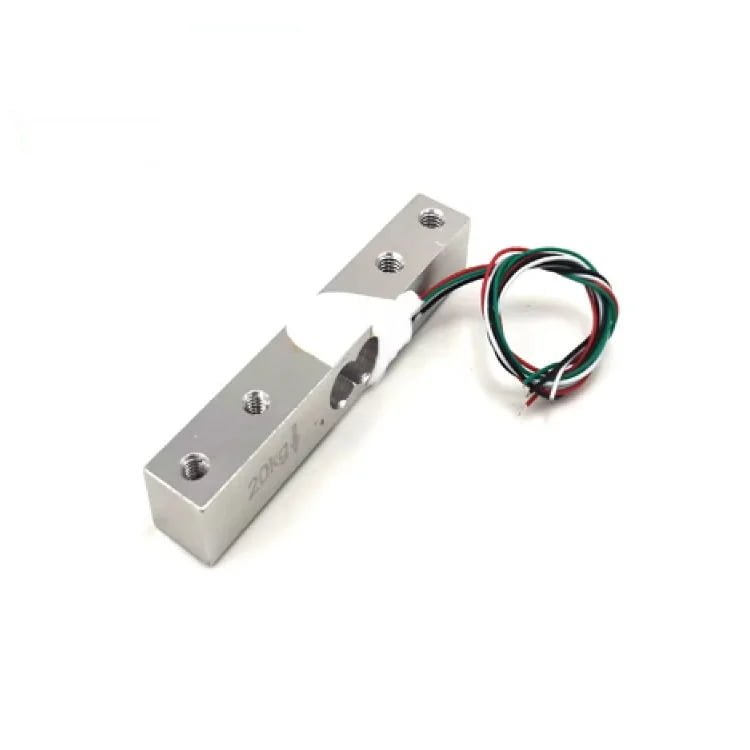
Single point · 1–50 kg
WST103 — the element this category is built around
- 1–50 kg · output 1.0 ±0.15 mV/V · aluminium
- Comprehensive error 0.05 %F.S · 2.5 g at 5 kg, 0.25 g at 500 g
- Linearity, hysteresis and repeatability each ±0.05 %F.S · creep ±0.05 %F.S/3 min
- Zero drift 0.2 %F.S/10 °C, which is 10 g per 10 K on a 5 kg platform
- Safe overload 150 %F.S · 3–10 VDC · −10 to +40 °C
The cost is disclosure and drift. The page publishes no bridge resistance, no IP rating and no ultimate overload, and it lists five independent 0.05 % rows beside a 0.05 % comprehensive figure, which is one number doing two jobs. It also has the loosest zero drift of the four here, so on a 5 kg platform it is the element that most needs a stable surface and a calm user. Buy it as the volume element and ask me for the missing lines in writing.
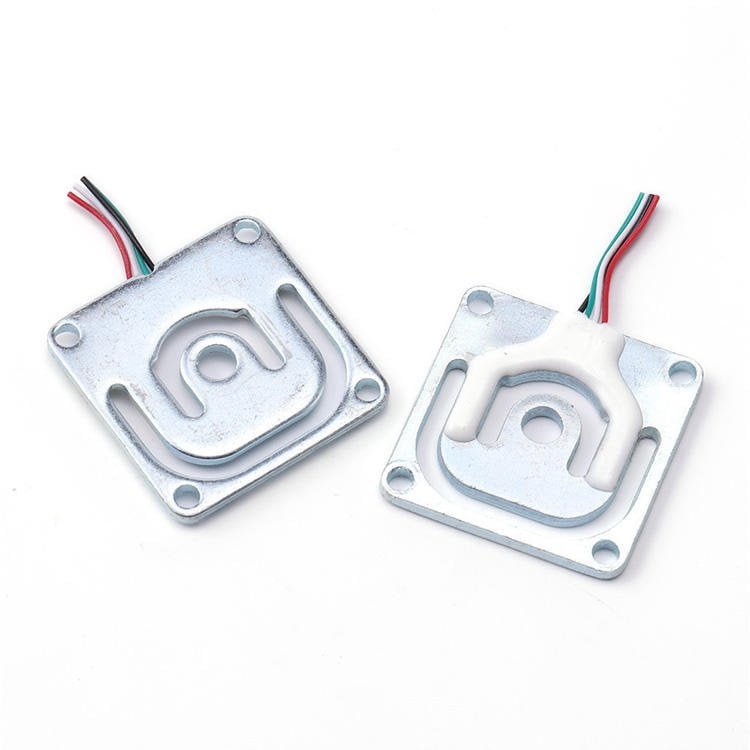
Flat micro · low profile
WST101 — the flat one, with the best zero on paper
- 5–200 kg · output 1.0 ±0.2 mV/V · alloy steel
- Comprehensive error 0.05 %F.S
- Zero and span drift ±0.1 %F.S/10 °C — half the WST103’s drift
- Lin., rep. and hysteresis each 0.05 %F.S · insulation ≥2 000 MΩ
- Ultimate overload 150 %F.S · 5–10 VDC · −10 to +40 °C
The cost is that the page publishes an ultimate overload and no safe overload, so I will not design a product that sits above full rated load on it and I tell customers that rather than quote a margin that is not written down. It is also a large element at the bottom of its range: 5 kg is its smallest capacity, which makes it the wrong answer for a 0.1 g platform and a good one for a thin plate where the platform has no bowl.
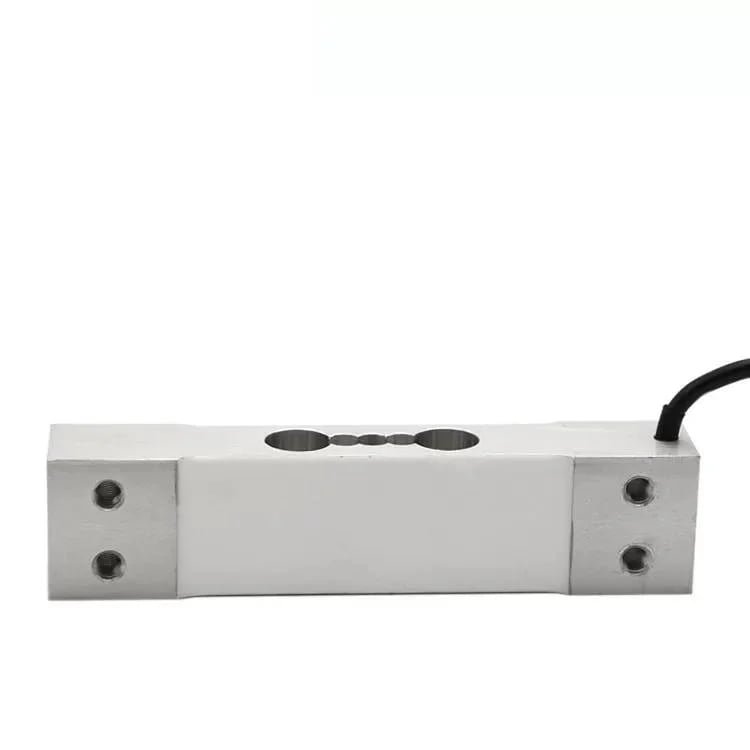
C3 declared · IP65
WST201 — the only element here with a declared class
- 3–100 kg · accuracy class C3 · output 2.0 ±0.2 mV/V
- Comprehensive error ±0.02 %F.S · 1.0 g at 5 kg, 0.6 g at 3 kg
- Lin., rep. and hysteresis each ±0.02 %F.S · creep ±0.02 %F.S/30 min
- Zero drift 0.1 %F.S/10 °C — ten times tighter than the WST103
- IP65 · 406 ±20 Ω in / 350 ±5 Ω out · ≥5 000 MΩ
Two costs, both worth knowing before you quote it. Safe overload is 120 %F.S, the tightest of the four, which makes it the wrong element under a bowl that gets dropped from packaging photographs. And the page states its zero drift two ways, 0.1 % and 0.02 %, a factor of five apart; when a number that decides your drift budget is written twice, ask for it in writing on the order rather than trusting the page.
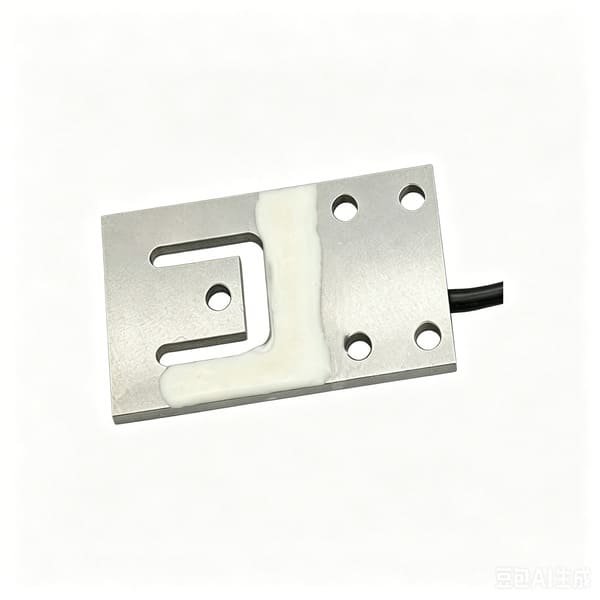
Wide platform · 7.5–600 kg
WST1101 — when the kitchen platform becomes a counter
- 7.5–600 kg · comprehensive error 0.05 %F.S · 3.75 g at 7.5 kg
- Repeatability and hysteresis each ±0.02 %F.S · creep ±0.02 %F.S/5 min
- Safe 150 %F.S · ultimate 200 %F.S — the widest margin of the four
- IP65 · 1090 ±30 Ω in / 1000 ±10 Ω out · cable 1.0 × 600 mm
- Zero drift ±0.05 %F.S/10 °C
The cost is a sensitivity that steps rather than runs: 1.0 mV/V up to 75 kg and 1.5 mV/V from 150 kg upwards, so one indicator configuration will not cover the family, and the product page’s own address says 30 to 75 kg while the table lists 7.5 to 600 kg. It is the element I quote when a customer’s kitchen-scale project turns out to be a counter scale, because that is the moment the reading starts computing a price.
What I actually sell alongside those four is the part no catalogue shows, and it is the part that decides whether a four-corner platform repeats: matching data. When four elements share one plate, the corners agree only if the cells agree with each other, and a table of matched outputs and matched zero balance is worth more to your yield than the last hundredth of a percent on any single element. I make the same argument about a smaller platform in load cells for baby scales, where the capacity is even smaller and the identical arithmetic decides the product.
The number I quote more than any other
At a 5 kg platform and a 1 g division, the element’s honest floor is 2.5 g, and the first thing to improve is almost never the element. It is the bowl, the drop height and the tare routine — and three of those four are free.
Questions buyers actually send me
Can a 5 kg kitchen scale really show 1 g accurately?
It can print 1 g, and it will hold that digit steady, but the digit is finer than the element behind it. One gramme on 5 kg is 5 000 divisions, 0.020 % of full scale, and an honest 0.05 % element is worth 2.5 g at the top of that range — two and a half times the step size. Near full load the last digit is decoration. Near zero it becomes genuinely useful, which is exactly why cooks tare their bowl and why the same scale feels accurate when it is weighing 20 g of yeast and vague when it is weighing a full mixing bowl.
What accuracy is realistic for a kitchen scale?
0.05 % of full scale is what this class of element does well and economically, which is 0.25 g on a 500 g platform and 2.5 g on a 5 kg platform. Higher-grade elements exist and cost more, but they rarely help a kitchen product, because the bowl, the drop and the kitchen’s own temperature swing are larger contributions than the element. If you need better than 2.5 g of real accuracy, the answer is almost always a smaller capacity rather than a better cell. That is what load cells for kitchen scales honestly offer at this price point, and it is enough for every recipe I have ever weighed myself.
Should a kitchen scale use one load cell or four?
Four cells spread the load across a larger panel and let the housing be thin, because the plate spans between supports instead of carrying a point load in its middle. The price is arithmetic: the readings are summed, so the error floor is summed too, and a four-cell platform at 0.05 % per element behaves like 0.2 % if the elements disagree. For a small kitchen platform one element is usually the better part count; for anything wider than about 200 mm, four matched elements are easier to make repeatable.
Why does my reading change between morning and evening?
Zero drift is published per 10 K, not per day. The WST103 moves 0.2 %F.S per 10 K, which on a 5 kg platform is 10 g — ten printed divisions — and a household kitchen swings about 14 K between a cool morning and a hot afternoon with the oven on. So the reading is not drifting because the scale is cheap; it is drifting because it is being used in a room that changes temperature. Tare at the working temperature and keep auto-zero tracking calm, and most of it disappears.
Does a kitchen scale need OIML or legal-for-trade approval?
For a domestic kitchen, no. The deciding question is whether a price is computed from the reading. If it is — a market stall, a deli counter, a shop selling beans by weight — then NAWI 2014/31/EU applies, EN 45501 is the route to presumption of conformity, and Class III sets a 20 e minimum load and a 10 000 e ceiling. Even then, the approval belongs to the complete instrument, not to the element, and I do not sell an element with an approval attached to it.
How accurate does a coffee scale need to be?
0.1 g is meaningful up to about 200 g of capacity and it is a claim beyond that, because the element’s floor grows with the range while the display keeps shrinking. In practice the scale that baristas keep is a 200 g range at 0.1 g for the dose and a separate, larger readout for the hopper. The other number that decides whether a coffee scale is usable is the sample rate: ten readings a second lets you watch the flow and cut the shot on weight, and two readings a second does not, no matter how fine the last digit is.
How much overload protection does a kitchen scale need?
The number comes from the drop, not the capacity. A 480 g steel bowl set down from 20 mm onto a 5 kg platform produces a peak around 14.65 kg, which is 293 % of rating and 1.95 times a 150 % safe overload, and a two grammes-per-division scale makes that event just as violent as a one gramme scale does. The fix is mechanical: a stop that closes just outside the full-load deflection so the impact has a second path that is not the element. A tighter element would make the failure worse rather than better.
Can you supply the complete kitchen scale?
No, and I would rather say so early than bid on it. I export load cells, force sensors, junction boxes and weighing indicators, together with the matching data, the mechanical drawings and the arithmetic in this article. The appliance, its firmware, its conformity assessment and any legal metrology verification belong to the OEM that builds it. What I can do is tell you what the element can and cannot support, in writing, before you commit to a platform — which is the part of the project that is expensive to change later.
If your platform does not look like anything here, the selection logic is set out in the load cell selection guide, and the underlying mechanics in the complete guide to load cells. Both are worth reading before you write a specification, mine or anybody else’s.
Tell me the heaviest thing that stands on the platform, the smallest thing that has to be right, the clearance under the tray, the hottest and coldest the product will ever see, and whether the reading ever computes a price. I will send back the element, the matched set if you need four, and the two numbers your specification is still missing — and if your requirement belongs to a different instrument, I will tell you that instead.
or write directly to Robin@vektorforce.com
VektorForce · load cells, force sensors, junction boxes and weighing indicators · www.vektorforce.com · Robin@vektorforce.com