

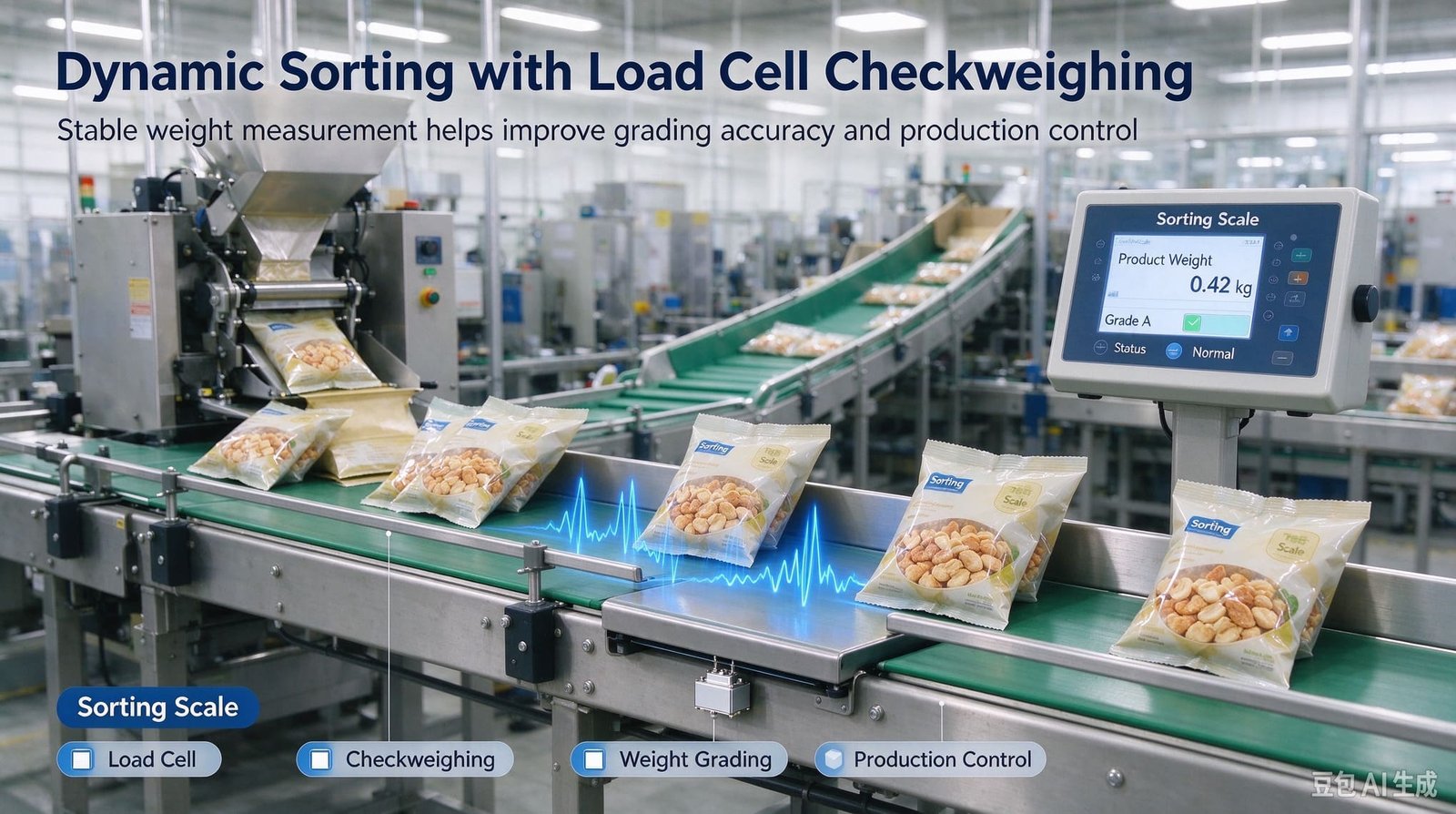
A checkweigher weighs to make a decision, and the law caps how widely the reading may spread.
A checkweigher does not issue an invoice. It issues a decision — pass, reject, or which bin. That difference rewrites the rule book: the law stops asking what your scale reads and starts capping how widely the reading spreads. This is the whole design problem of load cells for sorting scales, and it is where most bad purchases begin.
- What a sorting scale actually does
- The three Packer’s Rules behind every checkweigher
- OIML R51: the rule book that names the sensor’s error
- A decision is not a price
- Speed is the third variable
- Case one: the stick-pack line that rejected a tenth of its good packs
- What I supply, and what the machine builder owns
- Capacity: the belt is tare, the surge is real
- Case two: the grader where I did not sell the digital cell
- What a digital cell really buys on a sorting line
- Case three: the missing leaflet weighs 0.7 grams
- Giveaway: the money the checkweigher earns back
- Approvals by market
- Load cells for sorting scales: the four I recommend
- Seven questions to answer before you ask for a quote
- Questions I get from checkweigher builders
1. What a sorting scale actually does
A sorting scale — most of the world calls it a checkweigher — is not a scale with a conveyor bolted to it. It is a decision machine that happens to weigh. Every pack on the line crosses a short weigh belt, the instrument compares the reading against limits it was given, and something physical happens at the other end: a pusher fires, a flap drops, an air jet pops, or the pack simply continues into one of several bins. Nobody looks at the number. The number looks at the pack.
That makes it the third kind of weighing I have written about on this blog. On a trade-approved self-service weighing station the reading issues an invoice — the mass becomes money while the guest is still holding the spoon, which is why that application drags the entire legal chain of non-automatic weighing behind it. At an AI checkout the reading only confirms what a camera already recognized, and the weighing is a supporting actor. Here, the reading fires an actuator. Three different legal worlds, three different sensor conversations — and because the sorting scale usually stands two metres from the first of those three, I drew the boundary between them in my article on load cells for packaging machinery.
Before we get anywhere near a datasheet, it is worth separating the jobs people lump under “sorting scale”, because they are legally different instruments — and because load cells for sorting scales are chosen differently for each one:
| The job on the line | What the machine decides | Typical products |
|---|---|---|
| Checkweighing (pass / fail) | Is this pack inside its weight limits? Underweight goes to the reject bin. | Pouches, cartons, bottles, stick packs, tins |
| Weight grading (sort into classes) | Which weight class does this item belong to? Two to six gates. | Fish, poultry, fruit, eggs, crabs |
| Completeness checking | Is a component missing — leaflet, scoop, sachet, blister? | Pharma cartons, kit boxes, detergent packs |
| Fill-control feedback | Is the filler drifting? Trim the target before packs go out of limits. | Any filling line with a checkweigher downstream |
One of the oldest arguments for the machine — and my favorite slide in any customer meeting — is the sampling math. A line running 100 packs a minute produces 6,000 packs an hour. A diligent QA team pulling 15 manual samples an hour checks 0.25 percent of production. The other 99.75 percent leave the plant on trust. A checkweigher is the machine that replaces a statistic with a census: every pack is weighed, every deviation is logged, every reject has a timestamp. When a retailer or a weights-and-measures inspector later asks how you know your net content is legal, the answer is either “I sampled” or “I measured all of it.”
The core idea of this article: for a static platform scale, the interesting spec is the reading. For a sorting scale, the interesting spec is the spread of the reading — how much a single pack’s weight reading scatters when the same pack crossed the belt ten times. The law does not cap your scale’s reading. It caps your spread. Everything about load cell choice follows from that.
2. The three Packer’s Rules behind every checkweigher
If you sell prepacked goods into the EU — and most of my customers do — the document that shapes your packaging line is not a checkweigher brochure. It is Council Directive 76/211/EEC, the average-quantity system that governs prepackages from 5 g to 10 kg, plus its sampling update 2009/23/EC. Pack to its rules and you may mark the package with the “e” sign, which acts as a metrological passport across the EU and EEA: your packs are checked at origin and circulate freely afterward.
The directive compresses into three rules that everyone on a packaging line should be able to recite. Inspectors call them the Packer’s Rules:
| Rule | Requirement | What it means on the line |
|---|---|---|
| Rule 1 — the average | Actual contents of the batch must not average less than the nominal quantity Qn. | Underfills are legal if the batch average holds — the law regulates the mean, not each pack. |
| Rule 2 — the tail | At most 2.5 percent of packs (1 in 40) may fall below T1 = Qn minus one TNE. | A few light packs survive an audit — but only a few, and only slightly light. |
| Rule 3 — the cliff | No pack may fall below T2 = Qn minus two TNE. Zero tolerance. | One grossly underweight pack with the e-mark is a violation by itself. |
The tolerable negative error (TNE) scales with pack size:
| Nominal quantity Qn | Tolerable negative error (TNE) | Worked example |
|---|---|---|
| 5 to 50 g | 9 % of Qn | 20 g stick pack: TNE = 1.8 g |
| 50 to 100 g | 4.5 g | 75 g pouch: TNE = 4.5 g |
| 100 to 200 g | 4.5 % of Qn | 150 g tin: TNE = 6.75 g |
| 200 to 300 g | 9 g | 250 g carton: TNE = 9 g |
| 300 to 500 g | 3 % of Qn | 500 g pack: TNE = 15 g |
| 500 to 1,000 g | 15 g | 800 g bag: TNE = 15 g |
| 1,000 to 10,000 g | 1.5 % of Qn | 5 kg bag: TNE = 75 g |
Run the 500 g example through the three rules and the structure appears. TNE is 15 g, so T1 = 485 g and T2 = 470 g. Your batch mean must sit at or above 500 g. At most one pack in forty may land below 485 g. Not a single pack may land below 470 g — ever. For a 20 g stick pack the numbers get uncomfortable fast, because the TNE there is 1.8 g: T1 is 18.2 g and T2 is 16.4 g. You are managing a legal boundary that is two grams wide at eighteen hundred packs an hour.
The three rules are statistics. They talk about means, percentages of a batch, and sampling tests. But a reject is not a statistic — it is a per-pack decision made in milliseconds by your checkweigher. The rest of this article is about the gap between those two things, and which part of that gap the load cell owns.
One more number from the same legal family, because it silently sizes the sensor: the checking equipment used to demonstrate compliance — which on most e-marked lines is the checkweigher itself — must have a total uncertainty of no more than one fifth of the TNE. For a 500 g pack that is 3 g. For the 20 g stick pack it is 0.36 g. The machine you put at the end of the line is not just a filter; it is your measuring standard for the whole average-quantity system.
3. OIML R51: the rule book that names the sensor’s error
Here is where most buyers pick the wrong standard, and it costs them a redesign six months later. A checkweigher is not a non-automatic weighing instrument. Nobody places the pack on the platform and waits for a stable reading; the machine weighs and decides without an operator in the loop. The instrument family for that behaviour is OIML R51, automatic catchweighing instruments — and R51 is the document that, uniquely among weighing standards, writes the load cell’s error into the law as a statistical quantity.
R51 splits catchweighers into two accuracy classes:
| Class | What it is for | How the error is judged |
|---|---|---|
| X (with an evaluation scale number, e.g. X(1)) | Instruments that divide a batch into items of different mass and then totalise — the classic net-content checkweigher feeding the average-quantity system. | Two tests: the mean error of a batch, plus a hard cap on the standard deviation of the weigh errors. |
| Y with classes Y(I) to Y(b) | Instruments that sort into uniform classes — weight graders, price-labelling checkweighers, most fish and poultry graders. | Basically the familiar R76-style MPE bands, expressed in scale intervals e. |
If you only remember one thing about R51, remember that class X is judged on dispersion. The table below is the maximum permissible standard deviation for class X(1) — the tightest common checkweigher class — and the right-hand column is the number I put in front of buyers of load cells for sorting scales before I quote anything:
| Nominal quantity | TNE (76/211/EEC) | Max std dev, X(1), first verification | In service |
|---|---|---|---|
| 30 g | 2.7 g | 0.144 g | 0.180 g |
| 100 g | 4.5 g | 0.24 g | 0.30 g |
| 200 g | 9 g | 0.48 g | 0.60 g |
| 500 g | 15 g | 0.80 g | 1.00 g |
| 1 kg | 15 g | 0.80 g | 1.00 g |
| 5 kg | 75 g | 4.0 g | 5.0 g |
| 10 kg | 150 g | 8.0 g | 10.0 g |
Run the division and something tidy appears: across the whole band from 100 g to 5 kg, that standard deviation is the TNE divided by 18.75 — 15 ÷ 0.8, 9 ÷ 0.48, 4.5 ÷ 0.24, 75 ÷ 4.0. In service the divisor loosens to roughly 15. So R51 does not say “your readings must be accurate”. It says your readings must cluster inside a window that is about one eighteenth of the legal tolerance you are trying to defend. That is a completely different engineering target, and it is the reason a load cell that looks superb on a datasheet can still fail a checkweigher type test.
Why this catches people out: a static scale is judged on its indication — one number, at one moment, against one tolerance. An automatic catchweigher is judged on a distribution. Nobody can see a distribution on a shop floor, and no single datasheet line describes it. It is produced jointly by the cell, the mechanics, the belt, the filter and the line speed — and I only sell one of those five.
Two practical consequences follow. First, a buyer who asks me for “a 0.01 percent cell so the checkweigher passes” has mis-identified which term dominates the sum; I will come back to that in the first case below. Second, class Y graders are judged in MPE bands (typically 1.5 e to 2.5 e depending on class and load), which is the easier regime — if your machine only sorts fish into three sizes and never feeds a net-content declaration, you are not fighting the 18.75 divisor at all.
4. A decision is not a price
I have spent several articles on this blog drawing one line through the weighing world: is a price computed from this reading? If yes, the whole legal machine of trade measurement wakes up. If no, you are solving a mechanical and process problem instead. A sorting scale sits on the “no” side — but on its own terms, which is why it is worth a chapter.
| Machine | What the reading produces | Who owns the legal chain |
|---|---|---|
| Self-service weighing station | A price, printed and charged | Trade-approved instrument: EN 45501 / R76, MID MI-006 does not apply |
| AI checkout | A confirmation of what a camera already recognised | The weighing is subordinate to identification |
| Sorting scale / checkweigher | A verdict: pass, reject, or bin number. An actuator fires. | R51 if the verdict feeds a net-content declaration; otherwise pure internal QC |
The verdict is a strange object. It has no invoice attached, so on some lines the instrument needs no approval at all: a plant that uses a checkweigher purely to catch its own filler drift can run an unapproved machine, and many do, because the machine never makes a claim to a customer or an inspector. But the moment the same machine is the evidence you present for average-quantity compliance, it becomes the measuring standard for your legal net content — and R51 plus 76/211/EEC apply whether or not anybody stamped a plate on it.
One asymmetry is worth stating plainly, because it is the mirror image of what I wrote about enforcement on the road. On a highway, the inspector’s tolerance is generous and your legal limit is brutal. On a packaging line it is the opposite: the legal tolerance for a single pack is generous (a 500 g pack may legally weigh 470 g), while the process capability you must demonstrate is harsh (a standard deviation of 0.8 g). The law has already forgiven your worst pack. Your retailer has not.
The sentence I use with machine builders: a static scale promises a number; a sorting scale promises a decision rate. So tell me your reject-rate target and your pack spread, and I will tell you whether a load cell is even the limiting part. Often it is not — and saying so early is cheaper for both of us.
5. Speed is the third variable
Capacity and accuracy are the two numbers a customer brings to me. Speed is the one they forget, and it is the one that changes the answer — which is why load cells for sorting scales cannot be specified from a static-scale checklist. A checkweigher gives the cell a fixed amount of time to produce a trustworthy reading, and that time is not negotiable: it is the length of the weigh zone divided by the belt speed.
| Weigh zone | Belt speed | Dwell time | What this dwell buys |
|---|---|---|---|
| 400 mm | 36 m/min | 0.667 s | A comfortable weighing window; filters settle, vibration averages out |
| 350 mm | 30 m/min | 0.700 s | The slow lane of a grader: enough for a digital cell on RS485 |
| 250 mm | 60 m/min | 0.250 s | A fast lane at 300 packs/min: filters are starved, bandwidth is the limit |
| 200 mm | 60 m/min | 0.200 s | Packs are 200 mm apart at this rate — the geometry barely fits |
The industry publishes accuracy as a function of rate, and the shape of that curve is the single most useful commercial fact in this article. Machine builders who publish it honestly give figures in this neighbourhood: about 0.15 g at a leisurely 60 packs per minute, 0.45 g at 180 per minute, 0.85 g at 300, and 1.3 g at 450. Notice what that is: the tolerance widens by roughly a factor of nine while the rate widens by seven and a half. You are not paying for speed with money alone — you are paying with accuracy, and the exchange rate is bad.
Two adjustments have to be made to every brochure number before it reaches a real line. First, the quoted rate is a nominal ceiling; on real lines with real product, builders and integrators quietly derate it by 15 to 25 percent depending on how the product behaves — loose powder and light bags cost more than rigid cartons. Second, the quoted accuracy is a two-sigma laboratory figure measured with a well-behaved test pack on a warm machine; in production, expect the real spread to be 1.5 to 2 times worse. Both of those adjustments apply to my own case studies below, which is why I show the arithmetic rather than the brochure.
Practical rule: if a customer tells me they want “300 packs per minute at plus or minus 0.2 grams” on a single lane, I stop talking about load cells and start talking about line layout. No cell on my shelf, and to my knowledge none on anyone else’s, converts a 250 millisecond pass into a 0.2 g verdict on a vibrating belt. The honest answer is a slower lane, a longer weigh zone, or a different measurement principle.
6. Case one: the stick-pack line that rejected a tenth of its good packs
The arithmetic below is the first thing I run on any enquiry for load cells for sorting scales, and it is the reason the enquiry usually changes shape before I quote. A stick-pack machine builder in Southeast Asia came to me with a sentence I hear in some form almost every month: “Our checkweigher is rejecting too many good packs. We think the load cell is not accurate enough. Please quote your best 0.02 percent cell.” They build the filler and the checkweigher together; the product is instant coffee, 20 g per stick, running three shifts.
I asked for two things before quoting anything: the reject band width they had set in the instrument, and one shift of reject logs with timestamps. Asking for the log before the quotation is the habit that has saved me the most wasted samples over the years, and on a sorting line it is the only place where the difference between a bias problem and a spread problem is visible. My article on load cells for packaging machinery covers the sibling weighing stations on the same machine; here I stay on the verifier itself.
The log answered the question in about ten minutes of arithmetic. Start from the law. A 20 g pack falls in the 5 to 50 g band of 76/211/EEC, where the tolerable negative error is 9 percent of the nominal quantity:
| Quantity | Value | Meaning |
|---|---|---|
| Nominal quantity | 20.0 g | What is printed on the stick |
| TNE | 1.8 g | 9 percent, the legal slack between printed and actual |
| T1 (max 2.5 percent of batch below) | 18.2 g | One pack in forty allowed under this line |
| T2 (no pack below, ever) | 16.4 g | The cliff: one stick here voids the batch |
| Checking-equipment limit | 0.36 g | TNE divided by five — the uncertainty the checkweigher itself may have when used as evidence |
Now the production side. Their line was rated 180 sticks per minute, which in practice with a light, slightly sticky stick and a hot machine was running at roughly 140 per minute on a sixteen-hour day — about 134,400 sticks a day. The cell they had was quoted at plus or minus 0.3 g, which is a two-sigma figure, so the ideal standard deviation was 0.15 g; allowing the usual production penalty of about 1.7 times, their real spread was nearer 0.25 g.
They had set the reject band at plus or minus 0.5 g. Divide the band by the spread: 0.5 ÷ 0.25 = 2.0. Two sigma, two-sided, is a false-reject rate of about 4.55 percent. Applied to 134,400 sticks, that is roughly 6,100 rejected sticks a day — and from the log, most of them were perfectly legal product. The cell was not the culprit. The band was.
The arithmetic of the fix: keeping the same 0.25 g spread but widening the band to plus or minus 0.9 g puts z at 3.6, and the two-sided tail beyond 3.6 sigma is 0.032 percent — about 43 rejects a day instead of 6,100. Nothing changed in the sensor. One parameter changed in the instrument, and it stayed entirely inside the legal window: 0.9 g is half of the TNE, so the machine is still rejecting at twice the strictness the law asks for.
There is a second lesson in the same log, and it is the one I actually spend my time explaining. The reject band should not be symmetric. The law has a hard floor (T2) and a soft warning line (T1) beneath nominal, and no ceiling at all above it. Your filler, meanwhile, has a cost that rises monotonically with overfill. So the rational band is tight below and loose above: reject aggressively on the low side, where a legal violation lives, and let the high side be governed by filler trim rather than by the rejector. A symmetric band rejects your most profitable packs.
Then came the part where I had to disappoint them. They asked for a 0.02 percent cell, so I did the sum on our own parts. Our WST201 in a 3 kg capacity is specified at plus or minus 0.02 %F.S comprehensive error, which is 0.6 g — and the class X(1) standard deviation budget at 20 g is 0.144 g, with the checking-equipment limit at 0.36 g. The cell’s own comprehensive error is already larger than the whole legal budget. Buying a tighter cell would not fix that, because comprehensive error is a static number while the budget is a statistical one, and neither of them is where their false rejects came from.
What I did recommend: keep the analog cell class they had, take the capacity down rather than the price up (a smaller spring element raises the millivolt-per-gram output, which is what actually buys resolution at 20 g), tighten the mechanics and the sticker knife so the stick does not jitter on the belt, and fix the environment first. Their plant had a loading door open at the end of the line and a measured swing of 8 to 10 degrees Celsius across the day. At 3 kg, a zero-temperature effect of 0.02 %F.S per 10 degrees moves the zero by 0.6 g; the pessimistic figure our own product page also lists — 0.1 %F.S per 10 degrees, and yes, both values appear on the same page, which I have flagged for years — would move it by 3 g. Either way it is several times the entire X(1) spread budget. I asked them to close the door and add a draught shield before I sold them anything at all.
Six weeks later the false-reject rate was down to a figure they were happy with, achieved with the original cell class. The purchase they had planned — a premium cell to solve a control problem — never happened. I count that as a good outcome, because they still call me for the second line and for the smaller-capacity cells, and because the alternative would have been a returned shipment and a broken relationship.
What I would tell any checkweigher builder: false rejects are a ratio problem — spread against band. Bias, zero drift and comprehensive error move the mean, and moving the mean is what creates legal trouble, not what creates rejects. Two different illnesses wearing one symptom. Diagnose before you buy.
7. What I supply, and what the machine builder owns
I run an export business for weighing components: load cells, force sensors, junction boxes and weighing indicators. I am not a checkweigher manufacturer, and I have never sold a reject mechanism. Since the whole value of this article depends on that line being clear, here it is drawn explicitly.
| I do supply | I do not supply, and will not claim |
|---|---|
| Load cells and force sensors in the capacity, class and IP rating the line needs | The checkweigher itself: frame, weigh belt, infeed, rejecter, binning |
| Junction boxes, summing and trimming, cable and connector selection | The instrument firmware, filtering strategy, HMI or line software |
| Matching test data and the calibration certificate for the cells I ship | Type approval of the assembled instrument: MID, NTEP or JJG approval belongs to the machine’s manufacturer |
| Weighing application advice: capacity, class, mounting, wiring, temperature compensation data | Safety-rated or functional-safety components, and safety risk assessments of any kind |
| Custom capacities, cable lengths, connectors and output formats | Compliance sign-off for your pack sizes, your labels or your net-content system |
Why insist on this? Because on a sorting line the failure modes are mostly between the components. A cell with a superb datasheet bolted to a frame with a resonance at the belt frequency produces a worse verdict than a mediocre cell on a stiff frame. If I let a customer believe I sold the machine, I would be quietly accepting blame for the belt, the filter and the rejecter — three things I do not make and cannot see. What I can do is give you the weighing solution: the part of the problem that is genuinely mine, specified with numbers, and tested before it leaves.
How to use a supplier like me: tell me the pack, the rate, the dwell time, the tare mass of your weigh belt, and what your verdict does downstream. I will answer with a capacity, a class, a mounting arrangement and the two or three numbers you should measure yourself before you commit to a frame design. That is a weighing solution. It is not a machine, and I will say so in writing.
8. Capacity: the belt is tare, the surge is real
On a static platform scale, capacity is chosen for the object. On a checkweigher it is chosen for the conveyor, and this single reversal decides load cells for sorting scales more often than accuracy class does. The pack is a rounding error in the mechanical load; the weigh belt, the rollers, the side guides and the drive all sit on the cell, and every one of them moves.
Take the arithmetic from case one, but with a modest weigh conveyor. Suppose the moving assembly on the cell weighs 3.1 kg and the stick pack weighs 20 g. A digital single-point cell in an 11 kg capacity sits at 28 percent of Emax while the line runs — a comfortable static position. Now look at what dynamic service means for the same cell: our WST1206 and WST1209 digital cells are specified with a safe dynamic load of 70 percent of Emax, which is 7.7 kg in the 11 kg size. Against the 3.1 kg of live load, that is a headroom factor of about 2.5. In practice, the pack is irrelevant to that calculation: the same cell would carry a 500 g pack with an 18-fold margin on the pack alone, and would still be limited by the belt.
| What the cell carries | Mass | Share of an 11 kg cell |
|---|---|---|
| Weigh conveyor, rollers, guides | 3.10 kg | 28 percent — the real customer |
| Live dynamic load allowed (70 percent) | 7.70 kg | The vibration margin you are actually buying |
| Product, 20 g stick | 0.02 kg | 0.18 percent — invisible, which is exactly the point |
| Product, heavy pack | 0.50 kg | 4.5 percent — still far below the belt |
The second capacity number is the one almost nobody quotes, and it is the reason I put it in writing: Vmin, the minimum load cell verification interval, given by Emax divided by the Y value from the OIML R60 certificate. It is the smallest span in which the cell is allowed to make a legally meaningful statement. This is the same arithmetic that governs any weighing station fed by a vessel — the hopper scales I wrote about in load cells for hopper scales live with exactly the same floor — except that here the tare is a moving belt instead of a static vessel.
| Model | Smallest capacity | Y value | Vmin |
|---|---|---|---|
| WST1206, C6 grade | 11 kg | 15 000 | 0.73 g |
| WST1206, C3 grade | 11 kg | 10 000 | 1.10 g |
| WST1209, C10 grade | 10 kg | 22 000 | 0.45 g |
| WST201, C3 | 6 kg | 10 000 | 0.60 g |
Read that table against the class X(1) spread limits from section three and the design conversation changes shape. At a 500 g pack the legal spread budget is 0.8 g; the X(1) cell in that row delivers a 0.73 g verification interval, which is just barely adequate — and adequacy is not comfort. At a 20 g stick the budget is 0.36 g for the checking equipment, which no 11 kg cell can reach, at any price. This is why I keep saying that the answer to a small pack is a smaller spring element, not a more expensive certificate.
Two number traps. First: the internal resolution of a digital cell is not its accuracy. A 200,000-division cell at 11 kg counts in 55 milligram steps, and a 500,000-division cell at 10 kg counts in 20 milligram steps — impressive on a page, and completely swamped by a belt that vibrates by grams. Second: Vmin is a floor set by the certification, not a capability target. Quoting a resolution figure as if it were an accuracy figure is the single most common mis-selling trick in this trade, and I would rather you heard it from me than from a competitor.
9. Case two: the grader where I did not sell the digital cell
A seafood equipment builder in Europe was designing a three-lane weight grader for fish fillets: 300 to 800 g pieces, sorted into three size classes, with a recheck lane at the end. They had already decided they wanted digital cells on every lane. The reasoning was the one I hear constantly: “Digital is more accurate, and we get rid of the junction box and the trimming.” This is the class Y branch of the family — the same machine type as the egg grading lines I wrote about earlier, where the verdict is a size class rather than a pass or fail.
Both halves of that sentence are worth examining. The junction box half is true and valuable — a digital cell network genuinely removes the summing box, the trimming pots and the long analog cable run. The accuracy half is where the trouble starts. A digital cell does not measure better than a good analog cell; it transmits better. And transmission has a rate, which becomes a hard limit when the weighing window shrinks.
So I asked for the line drawing and did the dwell arithmetic for each lane. Everything depends on two numbers: the length of the weigh zone, and the belt speed.
| Lane | Weigh zone and speed | Dwell | Updates available | Verdict |
|---|---|---|---|---|
| Grading, slow | 350 mm at 30 m/min | 0.70 s | 14 (RS485 at 20 Hz) | Digital is comfortable |
| Grading, fast | 250 mm at 60 m/min (300 pieces/min) | 0.25 s | 5 (RS485) or 12.5 (CAN at 50 Hz) | Digital is the bottleneck |
| Recheck | 350 mm at 25 m/min | 0.84 s | 16.8 (RS485 at 20 Hz) | Digital is comfortable |
A digital cell on an RS485 bus with one device and a 9,600 baud link reports at about 20 hertz — one fresh reading every 50 milliseconds. In the slow lane’s 0.7 second window that is fourteen readings, plenty for a filter to work with. In the fast lane’s 0.25 second window it is five. Five samples is not a measurement; it is a guess with a confidence interval. Switching to CANopen at 125 kilobaud raises the rate to about 50 hertz, which gives 12.5 samples in the same window — workable, but with no margin for the addressing overhead that appears the moment you put four cells on the same bus.
There is a quieter problem too. Bus latency adds directly to the decision time: a Modbus RTU round trip in a real installation can take 17 to 23 milliseconds, and if the reject decision is issued after the reading arrives, that latency pushes the reject window past the point where the piece is still under the pusher. Above roughly 200 pieces per minute, latency stops being a detail and starts producing misfires.
The recommendation I sent, in three lines. Lanes one and three: digital, as they wanted — no junction box, no trimming, and 14 to 17 updates is a real margin. Lane two: keep it analog, put a fast machine-side converter with kilohertz sampling on the frame next to the cell, and let the grader’s own processor do the filtering. They pushed back for a week; two lines of the same machine ending up with different cell types felt untidy. Then they built the prototype, and the fast lane with the digital cell produced visibly worse repeatability than the slow lanes. The untidy answer was the correct one.
This is the moment where a supplier earns or loses trust. I had a clean, higher-priced, easier-to-install product to sell for all three lanes, and I told them not to buy it on one of them. That is not charity: a customer who discovers in commissioning that a cell cannot keep up will not distinguish between the cell and the supplier who chose it. I also showed them the alternative honestly — if they could slow the fast lane to 40 metres per minute or lengthen the weigh zone by 100 mm, digital would work there too. Line geometry and cell type are one decision, not two.
10. What a digital cell really buys on a sorting line
Since I argued against digital cells on one lane, it is only fair to say precisely what they do buy, because for load cells for sorting scales the list is longer than it is on most machines.
| What you gain | Why it matters on a checkweigher |
|---|---|
| Cable length leaves the error budget | A digital cell’s own specification states the effect of cable length on system accuracy as zero. On a long machine, with the electronics cabinet far from the weigh frame, that removes a term that otherwise has to be measured and compensated. |
| No junction box, no trimming pots | Cell-to-cell networks are addressed in software. Fewer connectors on a wet or dusty line means fewer long-term faults. |
| Continuous self-compensation and status reporting | The cell reports its own temperature and health. On a sorting line this is the difference between a fault you find and a fault that finds you. |
| Eccentricity compensation set at the factory | One cell is enough to build a single-point platform, and the corner-load behaviour is already published: our WST1206 quotes an eccentric error of less than 0.0028 %AL per centimetre. |
| A filter you can trust, in the digital domain | Averaging inside the cell avoids carrying belt noise down a long analog path to an instrument that has to clean it later. |
The costs are equally specific. Refresh rate is shared: our own WST1209, a four-cell network on a 125 kilobaud CAN bus, delivers 40 hertz, not 50 — the rate falls as you add devices. Latency sits between the physical weight and the verdict, which is harmless on a slow lane and dangerous on a fast one. And the cell no longer hands you a raw analog signal: if your machine’s filtering, autozero or diagnostics logic was written around an analog input, moving to digital means rewriting that logic, not just rewiring.
One further point deserves its own paragraph, because it is the most useful thing I learned from a checkweigher customer in five years. On a sorting scale, a failed channel does not always announce itself as a fault. A cell that has drifted low will reject perfectly good packs, and somebody will notice within the hour. A cell that has drifted high, or that has frozen at its last value, will pass everything — and the line will ship underweight packs to a retailer with a completely clean reject log. The failure that hurts you is the one whose symptom is “no faults today”. This is why I now recommend, on any multi-cell sorting machine, that the self-diagnostic path be treated as a functional requirement rather than a feature: an analog cell’s worst failure mode is a plausible number, a digital cell’s worst failure mode is no number — and the second is easy to alarm on, which is exactly what you want. If you want the general test procedure for deciding whether a cell has actually failed, I wrote it up in how to determine whether the load cell is damaged.
11. Case three: the missing leaflet weighs 0.7 grams
The third project is a pharmaceutical cartoner in Asia who wanted a completeness check: a folded patient leaflet weighing about 0.7 g must be inside every carton, and a missing leaflet has to be detected before shrink-wrapping. The carton itself weighs 45 g, and the packed carton plus the weight of the checkweigher’s own carrier fixture comes to about 1.45 kg on the cell.
The naive version of this problem looks easy. A 0.7 g step against a spread of 0.15 g is nearly five standard deviations, and the chance of missing such a step purely by noise is around one in a million. On paper, statistically, you cannot miss it. In the plant, they were missing about one carton a day, and the customer complaint that brought them to me was a recall.
| Quantity | Value | Comment |
|---|---|---|
| Leaflet mass | 0.7 g | 1.56 percent of the carton — a very small step to see |
| Carton, TNE (5 to 50 g band) | 4.05 g | The leaflet is under one sixth of the legal tolerance on the pack |
| Carton plus carrier on a 3 kg cell | 1.445 kg = 48 percent of Emax | A healthy static position — capacity is not the problem here |
| Cell comprehensive error at 3 kg | 0.6 g | Nearly the entire leaflet, if you ask the wrong question |
| Carton-to-carton tare variation | 0.4 to 1.0 g | The real enemy, and it is not a load cell problem at all |
Here is the diagnosis, and it took about a day of their reject log to confirm. A cardboard carton’s mass is not a constant. Paper takes up and gives off moisture with the ambient humidity, and in a tropical plant a 45 g carton can swing by close to a gram across a shift — on some days more. Their detection logic compared each carton’s gross weight against a fixed target. But the carton’s own tare drift was larger than the leaflet they were trying to detect. Some cartons dry out by 0.7 g and look exactly like a carton with a missing leaflet; others absorb 0.7 g and hide a genuinely missing leaflet completely. No load cell, at any resolution or any price, can separate those two cartons, because nothing in the gross weight distinguishes them.
The sentence I had to say three times before it landed: you are not measuring weight, you are detecting a change. Those need different machines. A completeness check on a variable tare is a differential measurement, and the reference has to be the same carton, not a fixed number in the instrument.
The architecture I proposed was differential and sequential: weigh the empty carton immediately before filling, store that value against the carton’s position or a printed code, then weigh after the leaflet is inserted and compare the difference. Now the tare, including its humidity drift, cancels out of the subtraction, and the only thing left to detect is the 0.7 g step. Two further measures made it robust: a settling gate, so the carton must be motionless for a defined period before both readings are taken, and a dedicated leaflet-verification station upstream rather than asking one machine to do both the net-content check and the completeness check with one number.
On the sensor side, that architecture is undemanding, and this is the point I want readers to take away. Once the comparison is a difference between two readings taken on the same cell minutes apart, what matters is not comprehensive error but repeatability and zero stability — a specification that a well-made analog single-point cell satisfies easily in a 3 kg capacity, and which does not improve further when you spend four times as much on a certificate class. I recommended the analog part, and I have been shipping it to them since.
12. Giveaway: the money the checkweigher earns back
Machine builders sell a checkweigher on compliance. Plants buy it for something more mercenary, and it is worth doing the arithmetic openly, because a customer who understands the economics makes a better sensor decision — and buys the right load cells for sorting scales rather than the most expensive ones.
The mechanism is simple. A filler cannot hit a target exactly, so it is set to overfill slightly; the overfill is giveaway that goes out of the factory door as free product. A checkweigher measures every pack, so the filler’s mean can be brought down toward the nominal quantity with a known, statistically defended margin — not with a guess. Published case studies show what that is worth. Take a line running 200 packs per minute, eight hours a day, 250 days a year: that is 24 million packs. Removing 2 g of average overfill saves 48 tonnes of product a year. On a slower 60 per minute line, 7.2 million packs a year, the same 2 g saves 14.4 tonnes. On a high-rate line — 3,000 packs an hour, sixteen hours, 300 days, 14.4 million packs — a 1.8 g reduction at two US cents per gram is over half a million dollars a year.
The most quoted numbers come from snack production, and they are consistent with the arithmetic above: a nuts line cutting average overfill from 4.1 percent to 1.0 percent — three percentage points of the pack — saved about 98,000 euros in eight months, roughly 12,250 euros a month. A smaller example: one million packs a month where the mean is pulled down by 0.5 g saves 500 kg of product, about 5,000 dollars a month at ten dollars a kilogram. None of these figures depend on the load cell; they depend on the machine being trusted enough to tighten the filler. That trust is the product.
Now the other side of the ledger, which almost nobody puts in a proposal. Every reject costs money. Take a 120 pack per minute line: 14.4 million packs a year. Run the reject band at three sigma with a spread of 1 g — plus or minus 3 g — and the false-reject rate from random variation alone is about 0.27 percent, or 38,880 good packs a year thrown away. At 3.00 dollars of product plus 8 cents of packaging each, that is about 119,750 dollars a year burned on product that was perfectly legal. Tighten the band to two and a half sigma, which is a tempting thing to do when a retailer complains, and the false-reject rate rises to 1.24 percent: 178,560 packs, nearly 550,000 dollars.
Two conclusions from one table. The reject band must stay comfortably wider than three sigma, or the machine destroys more value than it creates. And the reason the legal T1 line sits at roughly two standard deviations below nominal is no accident: at 1.96 sigma the one-sided tail is exactly 2.5 percent, which is the Packer’s Rule 2 limit. The law and the statistics were cut from the same cloth — which is why the correct engineering answer and the correct legal answer keep landing in the same place.
If you take one thing from this section, take the asymmetry. Giveaway is a mean problem and is solved by trusting the machine enough to move the filler’s target down. False rejects are a spread problem and are solved by widening the band or reducing noise. Buy a better load cell to attack the second, and you may gain a little; attack the first with a log and a filler trim, and you gain tonnes. The cell matters most in the third case — where a step must be detected against a variable tare — and there the spec you want is repeatability, not class.
13. Approvals by market
A sorting scale crosses more rule books than any other machine I write about, and the confusion is always the same: people assume the certificate on the instrument and the certificate on the cell are the same document. They are not, and the difference is where a project can stall for months.
| Market | What governs the machine | What governs the load cell |
|---|---|---|
| European Union | MID 2014/32/EU, Annex VIII (MI-006), which implements OIML R51 for automatic catchweighing instruments; non-automatic weighing instruments sit under the separate 2014/31/EU, which implements R76. A sorting scale is the MI-006 side of that line. | OIML R60 module certificate: class, Y value, Vmin |
| United States | NTEP Certificate of Conformance under NIST Handbook 44, with net-content verification under Handbook 133. Do not confuse the checkweigher code with section 2.21, which governs belt-conveyor scale systems for bulk material — a different animal weighing tonnes, not packs. | NTEP approval of the cell, class and temperature range |
| China | JJG 648, the verification regulation for automatic checkweighing and sorting instruments. The one people forget, because JJG 539 (electronic non-automatic instruments) is the familiar document. | CMC pattern approval for the cell |
| Prepackaging, all e-marked markets | 76/211/EEC as amended by 2009/23/EC for pack sizes from 5 g to 10 kg, with batch testing under OIML R87 and WELMEC guidance; the MID itself was amended again in 2026, which is a reminder that this framework is maintained rather than frozen. | Indirectly: the Y value determines the smallest interval the law will accept |
Read the third column and the practical consequence is obvious: what I ship is evidence, not permission. I can give you a cell from a certified production line, with the class and the Y value documented, and a calibration certificate for the serial numbers on the pallet. I cannot approve your machine, and neither can any component supplier. If a builder tells you that fitting a certified cell makes the machine legal, that builder has the paperwork backwards.
Where the Y value earns its keep. On a class X(1) net-content machine, the smallest legally meaningful interval is Vmin = Emax divided by Y. On an 11 kg cell at Y = 15 000 that is 0.73 g, and at Y = 10 000 it is 1.10 g. If your pack’s spread budget is 0.8 g, a cell whose Vmin is 1.1 g cannot get you there — not because it is a bad cell, but because the certificate says the statement you need is smaller than the smallest statement it is allowed to make.
14. Load cells for sorting scales: the four I recommend
The four models below cover the whole sorting-line conversation: an analog workhorse for slow lanes and heavier packs, a six-wire packing-machine cell for compact stations, a digital single-point cell for wet or washdown lines, and a digital bending beam for heavier packs and for the hoppers feeding the sorter. The capacity, class and IP rating differ, and so does what each one costs you in exchange — so I have written the trade-off into every card rather than leaving it out.
One thing I want on the record before the cards: our own WST219 and WST218 are the two models our catalogue names specifically for checkweigher systems, and neither appears in my four. That is not an oversight. Both are imperial-capacity cells (20 to 100 lb, and 50 to 500 lb) designed for the incumbent machine platforms, and on a metric-line project the four below are the cheaper, better-documented route. If you are building a replacement platform for an existing American-designed machine, ask me for the two imperial ones instead — that is a real difference in tooling, not a marketing preference.
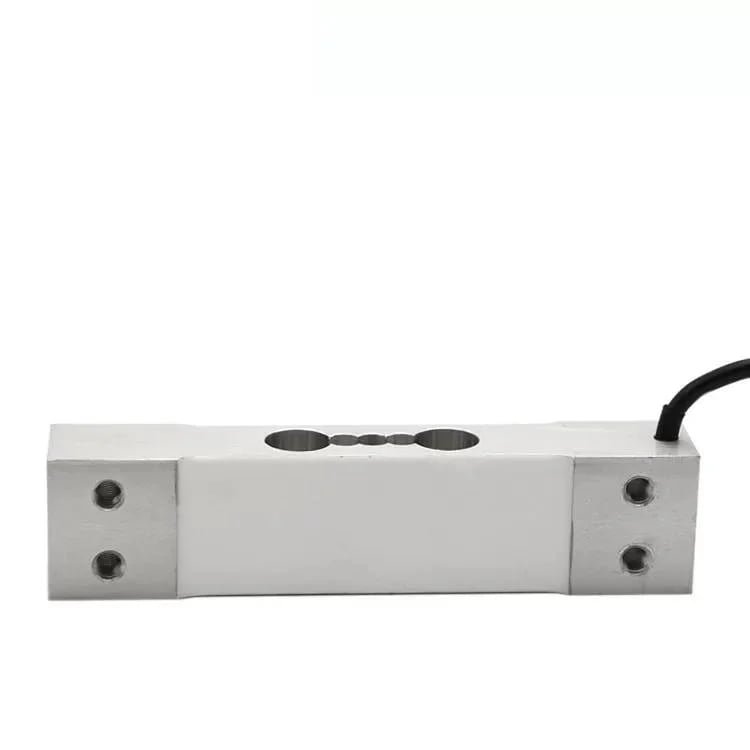
WST201
- Rated capacities 3 to 100 kg, eleven steps
- Accuracy class C3, comprehensive error ±0.02 %F.S
- Output 2.0 ± 0.2 mV/V, 406 ± 20 Ω in, 350 ± 5 Ω out
- Compensated −10 to +40 °C, operating −20 to +60 °C
- Safe overload 120 %F.S, ultimate 150 %F.S
- IP65, 4-wire shielded cable, 400 mm
The cheapest way onto a checkweigher frame for slow lanes and heavier packs. IP65 means dust and drips, not washdown. Note that this product page still opens with the words “WST204 is hot sale” — a copy-paste error on our own site that I have been reporting for years.

WST217
- Rated capacities 5, 10, 20, 50, 100 kg
- Accuracy class C3, linearity ±0.015 %R.O., repeatability ±0.01 %R.O.
- Creep ±0.02 %R.O. in 30 minutes
- Six-wire shielded cable — sense leads allow long runs without loss
- Maximum platform 250 × 250 mm
- Aluminium, IP66, safe overload 150 %R.C., ultimate 200 %R.C.
The six-wire connection and the compact platform make it the natural cell for a small packing-machine station where the electronics cabinet is far away. Being aluminium and IP66, it belongs in a dry area, not a washdown zone. The page also prints its input resistance as 405±102; read that as 405 ± 10 Ω and confirm with us before you fix your input circuit.
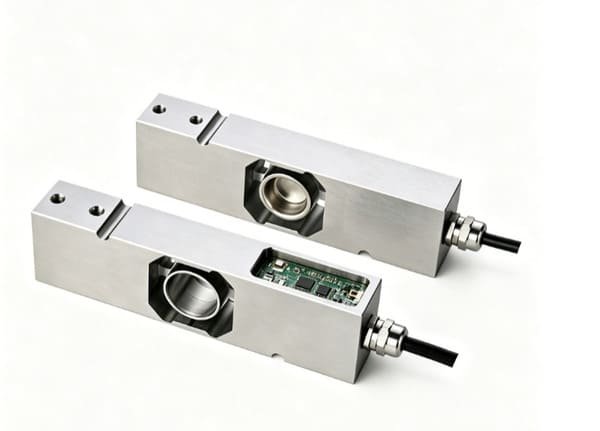
WST1206
- Rated capacities 11, 22, 60, 100 kg — the smallest digital single point we build
- C3 to C6 class, Y value 10 000 to 15 000, sensitivity 200 000 d
- Repeatability better than ±0.005 %AL at C6, creep ±0.0083 %AL in 30 minutes
- Hermetically sealed, IP68 / IP69K, surge protection built in
- CANopen at 50 Hz single cell, Modbus RTU at 20 Hz; cable length effect is zero
- Safe dynamic load 70 % of Emax, safe 150 %, ultimate 300 %, fatigue over 1 000 000 cycles
My first choice when the area gets hosed down or when you want the junction box gone, and strong where a grader runs many cells. Two limits: the network clock (20 Hz on RS485 is too slow for a 250 millisecond window), and the capacity floor at 11 kg, which rules out small packs. The features list a 300 × 400 mm platform while the specification table says 400 × 400 mm — another inconsistency on our own page; use the smaller figure for your stress check and ask us which applies.

WST1209
- Rated capacities 10 to 500 kg (see the note on the unit below)
- C3, C6 and C10 classes, Y value up to 22 000
- Sensitivity 400 000 to 500 000 internal divisions
- C10 repeatability better than ±0.003 %AL, creep ±0.005 %AL in 30 minutes
- 316 stainless steel, hermetically sealed, IP68 / IP69K, CPA C8
- Safe dynamic load 70 % of Emax, four-cell network at 40 Hz on CAN
The tightest repeatability in this group, and the right cell when packs are heavier or when the weighing station sits under a hopper that feeds the sorter. It is a bending beam, so it mounts into a frame rather than dropping into a platform. On the unit question: the specification table prints the capacities as 10, 20, 50, 100 and 200 t, while the feature list says 10 kg to 500 kg. For a sorting line the kilogram reading is the correct one; our page is wrong and I would rather tell you than have you design the wrong frame.
And the honest gap in this list. If your packs are stick packs at 20 g, none of the four is small enough — on our own shelf the family that starts at 0.3 kg and runs to 6 kg, the WST205, is the answer, and a smaller spring element buys more millivolts per gram than any certificate can. Tell me the pack weight first and I will tell you whether the four above are even relevant, or whether you should be looking at a different capacity range entirely, as described in my selection guide.
15. Seven questions to answer before you ask for a quote
Every enquiry for load cells for sorting scales that later went wrong went wrong at one of these seven questions, and none of them is about the sensor. Answer them in writing, even roughly, and my reply stops being a price list and starts being a design.
| Question | What it decides | Number I need |
|---|---|---|
| 1. What is the pack, packed? | The tolerable negative error, the T1 and T2 lines, and the class X standard deviation budget | Nominal quantity Qn in grams or kilograms |
| 2. How fast, over what weigh zone? | The dwell time, and therefore whether a digital cell is even possible on that lane | Packs per minute, belt speed, zone length |
| 3. What sits on the cell when no pack is present? | Capacity. The belt is the customer; the pack is a rounding error. | Weigh conveyor tare mass in kilograms |
| 4. What does the verdict do? | Whether the machine needs approval at all, and whether it becomes your net-content evidence | Reject, grade, log, or declare |
| 5. How wet or dusty is the zone? | IP rating, and whether aluminium is acceptable at all | Washdown, hosed, damp or dry |
| 6. What is the air doing? | Zero stability. Draughts and ambient swings move the zero more than a good cell drifts. | Ambient range across a shift, and where the draughts are |
| 7. Where is the electronics cabinet? | Analog or digital; if analog, whether you need six wires with sense leads | Cable run in metres, and the bus your instrument speaks |
16. Questions I get from checkweigher builders
Which load cell should I use for a checkweigher or sorting scale?
It depends on three things, and none of them is the accuracy class. The tare mass of the weigh conveyor sets the capacity, because the belt is what the cell actually carries. The dwell time — weigh zone length divided by belt speed — decides whether a digital cell can report often enough. And what the verdict drives decides whether you need an approved instrument at all. In practice: analogue single point for slow lanes and dry areas, six-wire analogue for compact packing stations, digital single point when the zone is washed down, and digital bending beam for heavier packs or a hopper upstream of the sorter.
Do I need a trade-approved load cell for a sorting scale?
You need a certified cell if the machine itself has to be approved, because the approval depends on the cell’s module certificate — its class, its Y value and its temperature range. What no component supplier can give you is the instrument approval. Under the EU Measuring Instruments Directive an automatic catchweigher is covered by MI-006 implementing OIML R51, and that certificate belongs to the machine builder. The same split applies in the United States with NTEP and in China with JJG 648. I ship certified cells with matching test data; the machine certificate is yours.
Why does my checkweigher reject too many good packs?
Almost always because the reject band is too close to the machine’s real spread. A band of plus or minus 0.5 g with a production spread of 0.25 g is two sigma, which rejects about 4.55 percent of good packs two-sided. On a 134,000 pack day that is roughly 6,100 packs. Widen the band to 0.9 g — still only half the legal TNE on a 20 g pack — and z becomes 3.6, and the same calculation gives about 43 rejects a day. Before buying a tighter cell, measure the spread, then widen the band. And make the band asymmetric: the law only punishes the low side.
Can a load cell detect a missing leaflet or sachet inside a carton?
Only if the carton’s own mass is stable, which for cardboard it usually is not. A 45 g carton can gain or lose close to a gram with humidity across a shift, while the leaflet you want to detect weighs about 0.7 g. When the tare drift exceeds the item you are looking for, no resolution helps. The working architecture is differential: weigh the empty carton, weigh it again after insertion, and compare the difference so the tare cancels. Add a settling gate, and put leaflet verification in its own upstream station rather than asking one machine for both net content and completeness.
Analog or digital load cell for a checkweigher?
Digital buys integration, not accuracy: cable length drops out of the error budget, the junction box disappears, and the cell reports its own temperature and health. It also buys a clock. Our digital single point cell reports at about 20 Hz on RS485 or 50 Hz on CANopen, so in a 0.7 second dwell you get 14 readings, while in a 0.25 second dwell you get 5 — which is not a measurement. Fast lanes over about 200 packs per minute are where I tell customers to keep an analogue cell and put a fast converter next to it. Speeds are shared: four cells on one CAN bus drop the rate to 40 Hz.
What capacity do I need for a sorting scale load cell?
Size it for the weigh conveyor, not the pack — the same rule that governs load cells for sorting scales on every lane I have specified. A 3.1 kg conveyor on an 11 kg cell sits at 28 percent of capacity, and since the digital cell family in this article is rated for a safe dynamic load of 70 percent of Emax, that leaves about 2.5 times headroom for vibration. The pack is irrelevant at that scale: even a 500 g pack has an 18-fold margin on its own. Smaller capacity is better for resolution — Vmin is Emax divided by the Y value — so the wish for a small pack and the wish for a big belt pull in opposite directions.
OIML R51 or R76 — which one applies to my sorting scale?
R51, because the machine decides without an operator. R76 governs non-automatic instruments where an operator places the load and reads a stable result. The practical difference is what the law measures: R76 caps the error of an indication, while R51 class X caps the standard deviation of a batch of weigh errors — for a 500 g prepackage, about 0.8 g, which works out to the tolerable negative error divided by 18.75. Class Y graders, which sort into uniform classes rather than feeding a net-content declaration, are judged on ordinary MPE bands instead.
Can you supply the complete checkweigher, or just the load cell?
Just the weighing layer, and I would rather be precise about it. I supply load cells, force sensors, junction boxes, weighing indicators, matching test data and the application advice that goes with them. I do not supply the machine frame, the weigh belt, the reject mechanism, the instrument firmware, or any kind of safety-rated component, and I cannot approve your instrument. What you get from me is a weighing solution — capacity, class, mounting, wiring and the error budget expressed on the product you sell — with the boundary written down.
Nominal quantity, packs per minute, belt speed, weigh zone length, the tare mass of your weigh conveyor, and what the verdict does downstream. I will come back with a capacity, a class, an analog or digital recommendation with the reason, the dwell-time arithmetic, and a written note on which parts of the problem are not mine. If the sensor is not your limiting factor, that will be the first line of my reply.
VektorForce · load cells, force sensors, junction boxes and weighing indicators · www.vektorforce.com · Robin@vektorforce.com


