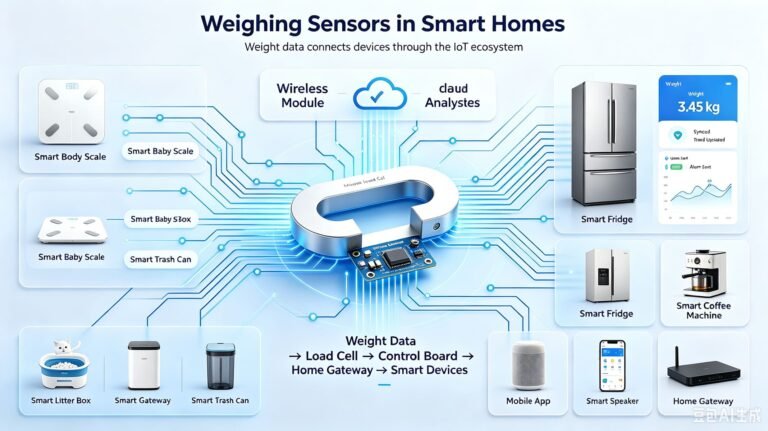


The drip tube is allowed ten percent. The load cell is allowed one tenth of one percent.
I quote load cells for IV bag weighing into monitors, pumps and pharmacy benches, and the first thing I have to say on the phone is almost always unwelcome. The drip tube your nurse is counting is allowed plus or minus ten percent by the international standard that governs it. The pump standing next to it is allowed five. The hanging height alone costs thirteen before anyone has made a mistake. A load cell for IV bag weighing is allowed one tenth of one percent. Here is the arithmetic, three projects, and the two offers I refused.
- The one bag that moves its own fluid
- What I supply, and what I will not sign
- Boundaries against the other bags we already weigh
- Everyone else’s budget, and why the cell is not your problem
- What the falling head costs before anyone errs
- Five mounting positions and the trap in each
- Empty is a weight plus a residue
- Density here is a table, not an unknown
- Two temperature effects, only one of them ours
- Case one: the drift that was hydraulic
- Case two: the hook I would not quote
- Case three: the resolution that was two hundred times too fine
- Metrology says no; the medical chain says more
- Sealing, chemistry, and the connector nobody budgets for
- Five parts, five different jobs
- The ten questions, and the habit that matters more
- Questions I get asked
1. The one bag that moves its own fluid
I have weighed a lot of containers. Tanks on legs, hoppers on modules, drums on platforms, bags on hooks. In almost every one of them the container is a passive object: something else decides how fast the contents move, and the scale simply watches. A urine bag watches. A filler nozzle controls. A tank pump delivers.
An IV bag is the exception. It hangs from a pole above a patient, it drains by gravity, and the pressure that pushes the fluid out of it is created by the height of the fluid still in it. The reading and the mechanism are the same variable. As the bag empties, the head falls, the flow slows, and the weight you are measuring is the reason. That single coupling rejects most of the standard advice about weight monitoring, and it is why three of the projects in this article turned out to be hydraulics rather than electronics.
The mechanics first, because they set everything else. A one litre bag of normal saline holds 1004.6 grams of fluid at room temperature, and an empty one-litre PVC bag with its spike weighs roughly 32 grams, so the hook carries about 1036.6 grams when the bag is full. The same bag is labelled as containing one litre. Those two numbers, 1004.6 and 1000, are the first hint that this application is a volumetric problem being solved with a mass sensor, and they are 0.46 percent apart because saline is not water.
The second hint is the direction. A urine bag counts up over three days and its total is a clinical endpoint. An IV bag counts down over one to eight hours, and its endpoint is that it stops. Nobody charts the bag’s weight; they chart the volume that went in, and the volume that went in is the volume that left the bag minus what is still sitting in the tubing. I will come back to that subtraction in section seven, because it is where a one litre bag and a fifty millilitre neonatal bag stop being the same problem.
Is a price computed from this reading? On a supermarket scale, a belt weigher or a filling machine the answer is yes, and the entire legal apparatus of trade metrology follows. On an IV bag monitor the answer is no, and the honest conclusion is that MID 2014/32/EU, OIML R76 and EN 45501 do not apply here at all. What follows instead is heavier: the reading contributes to a dose, and a dose has its own standards, its own pharmacopoeia and its own regulator. Section thirteen lays the whole chain out.
If you are an engineer sizing load cells for IV bag weighing, or a pharmacy automation team putting a gravimetric check on a compounding bench, the useful news is that there is almost no measurement problem in this application. The signal is enormous, the required resolution is about ten bits, and the cell I would quote is fifty times more accurate than the tightest requirement anywhere in the chain. The difficult part is that everyone else in the chain is working to five or ten percent, and one of them is a nurse counting drops with a stopwatch.
2. Where my supply stops, and where yours starts
I export weighing components. I do not make infusion devices, I do not hold a medical device registration, and I cannot issue an IEC 60601 test report or a USP 797 qualification. Saying so is not a disclaimer bolted on at the end; it is the boundary that makes the rest of this article usable, because everything on the right-hand side of the table below changes the sensor requirement, and a supplier who quietly implies he covers those items will size your cell for the wrong job.
| What I supply | What I do not supply, and whose signature it needs |
|---|---|
| Load cells and force sensors, with the data sheet you will actually be judged on | The ADC, the controller, the display and the alarm logic — yours |
| Matched sets, with the matching data in writing | The risk management file to ISO 14971 and the usability file — yours |
| Summing junction boxes, transmitters and weighing indicators | IEC 60601-1, 60601-1-2 and 60601-1-8 evidence — yours, with your test house |
| The arithmetic, the mounting advice, and my own bench data on request | IEC 60601-2-24 flow accuracy if your product is labelled a pump — yours |
| A written answer when a number is missing from the product page | MDR 2017/745 classification, technical documentation and registration — yours |
| The load path arithmetic for a hook, a bracket or a tray | The bag, the set, the pole, the bracket, the breakaway — yours |
| A refusal, in writing, when the thing you asked for is not mine to sell | The clinical claim, the alarm threshold, and anything safety rated — yours |
The second column is longer than a supplier usually admits, and there is a precedent for it inside our own catalogue. The published weighing solution for a hospital bed that we have carried for years stops at the junction box on purpose: the converter, the controller and the screen are drawn as customer supplied. Nobody has ever objected, because the customer was building the bed. The same is true here, with one addition. On a medical device the right-hand column is not only your work, it is your liability, and it is the part a notified body will read line by line.
So I quote a component. When I decline something, it is because I have been asked to make a decision that belongs to the device manufacturer, and pricing it would only hide where it belongs.
3. Where this sits beside the other medical weighing jobs
We have published several articles in this space already, and the fastest way to waste your time is to read the wrong one. All of them are a bag or a patient on a sensor, and none of them is the same problem. The table separates them by what the reading is for, which is the only division that changes the hardware.
| Application | What the reading decides | The problem that dominates it |
|---|---|---|
| IV bag weighing (this article) | How much fluid entered the patient, and when the bag runs out | The weight sets the flow rate it is measuring |
| Urine bag weighing | Whether a patient is making enough urine; a rising total | A three minute creep spec asked to hold for seventy-two hours |
| Syringe pumps | Whether a very small dose was delivered by a driven plunger | Micrograms, in a volume of a few millilitres |
| Medical bed weighing | A patient’s body mass trend across days of fluid therapy | A living load that moves, and a large fixed tare |
| Infant incubators | Neonatal weight gain at a few grams a day, inside a warm chamber | Thermal gradients and a chamber you must not disturb |
| Baby scales | A static weight, read once, in a clinic | Cost, repeatability and a restless patient |
| Medical devices, generally | The full walkthrough of a regulated OEM weighing component | Change control after approval |
Two boundaries are worth stating explicitly. The first is against the urine article. A urine bag and an IV bag look identical on a pole, and they are opposites underneath: one counts up and one counts down. The urine bag accumulates a total that a clinician reads as evidence about a kidney; the IV bag surrenders a volume that the clinician already prescribed, and the question is only whether it arrived. One is a measurement of the patient. The other is a measurement of a delivery.
The second boundary is against the syringe pump article, which is about the same room. A syringe pump pushes. A gravity bag is pushed by nothing at all — it is drained by the height of its own contents, and that is why the two applications share a data sheet but not a single design decision. If your line is pump driven, the physics in section five does not apply to you and your budget is tighter. If your line is gravity fed, almost nothing else in this article matters more than section five.
A liquid filling machine also weighs a container of fluid, and there the reading opens an invoice, so the whole of OIML R61 and MID Annex MI-006 Chapter III applies to the machine. An IV bag monitor weighs a container of fluid and computes nothing at all. Same sensor family, same range, same physics, and not one line of shared regulation. If a supplier quotes you a filling machine’s compliance package for a bedside monitor, that is a signal to read the rest of their quotation carefully.
4. The error stack, and why the sensor is not your problem
Every infusion project I have been asked to quote arrives with a sensor question attached, and the sensor question is almost never the question that matters. So before we discuss any cell, here is the error budget of an infusion, written by the people who own each line of it rather than by me.
| What is being judged | What it is allowed | Where the number comes from |
|---|---|---|
| The drip tube the nurse is counting | ±10 % | ISO 8536-4:2019, clause 7.8: 20 or 60 drops of distilled water must deliver 1 ± 0.1 mL, or 1 ± 0.1 g. At 20 drops per millilitre, 125 mL per hour is 41.67 drops per minute, so a nurse who is off by one drop a minute is off by 2.4 percent of the rate |
| A volumetric infusion pump | ±5 % | IEC/EN 60601-2-24. High-precision sets are claimed at ±3 %, non-PVC sets at ±10 % above 500 mL/h, and one manufacturer documents about −10 % below 10 °C |
| The pharmacy’s gravimetric check on a compounded bag | ±5 % | USP <797> section 9.1, with the ASHP guidance figure of 5 % of the programmed amount, checked per ingredient |
| The hanging height, over the life of one bag | −13.1 % on the average rate | Geometry, worked through in section five |
| A 2 kg load cell at 0.05 %F.S, on a full one litre bag | 0.096 % | The data sheet, divided by 1036.6 grams |
| The one millilitre display you asked me about | 0.096 % | Arithmetic. One millilitre is one gram, and one gram is the cell’s own error |
Percentages hide the ordering, so convert every row to grams on a one litre bag and sort them. The bag holds 1004.6 grams of saline, so one percent of it is about ten grams.
| Term | Grams on a one litre bag | Compared with the cell |
|---|---|---|
| The falling head, average rate over the bag | 131.6 g | 132 times |
| The drip tube’s own tolerance, ±10 % | 100.5 g | 100 times |
| A pump’s flow accuracy, ±5 % | 50.2 g | 50 times |
| The pharmacy’s per-ingredient check, ±5 % | 50.2 g | 50 times |
| A 2 kg cell at 0.05 %F.S | 1.0 g | 1 |
The two largest errors in an IV infusion are the dripping tube and the hanging height. Neither of them is inside a box you can buy, and neither of them is affected by which load cell you install. Meanwhile the cell you were worried about is one hundred times tighter than the standard that governs the nurse’s drop count, and it has been that way since before you called me. You are not buying accuracy. You already have it. You need a record of what physically left the bag, which nothing in the chain currently produces.
That last sentence is the commercial case for the whole product, so it is worth saying plainly. A volumetric pump knows what it pushed, which is not the same as what arrived. A nurse knows what she counted, which is not the same as what fell. The chart records what somebody wrote down. At no point in that sequence does anything measure the fluid that left the container. Your pharmacy already solved this problem on its own bench: USP <797> requires a documented gravimetric accuracy assessment of every automated compounding device on each day of use, and the published result of that practice in hospital IV workflow systems is a 90 to 99 percent reduction in compounding errors. The weighing method is not exotic in this building. It is the last place without one that is the ward.
The measurement side, to close it out
A common adult maintenance infusion is one litre over eight hours, which is 125 millilitres an hour. Convert it and the numbers get large very quickly: 2.09 grams a minute, or 34.9 milligrams a second. A fifteen minute window — the sort of window a rate display would use — contains 31.4 grams of signal.
Now ask what resolution the job needs. Resolving one millilitre on a full one litre bag means resolving one part in 1037, which is 10.02 bits. A twenty-four bit converter delivers 16185 times that resolution. If you fit a sixteen bit converter because it is cheap, you are still 63 times finer than the question. I have quoted load cells for IV bag weighing into hardware where the signal conditioning was the most expensive line on the bill of materials, and in every one of those projects the money belonged somewhere else.
Resolution is also not the constraint you think it is at the slow end. The quietest line anybody monitors is a keep-vein-open drip, and the smallest rate a fifteen minute window can resolve is set by the cell’s own error floor, not by the converter. Here is what each range can actually see.
| Rated capacity at 0.05 %F.S | Error floor | Slowest rate resolvable in a 15 minute window |
|---|---|---|
| 2 kg | 1.0 g | 4.0 mL/h |
| 3 kg | 1.5 g | 6.0 mL/h |
| 5 kg | 2.5 g | 9.9 mL/h |
| 10 kg | 5.0 g | 19.9 mL/h |
Even the ten kilogram option resolves a paediatric line. The consequence is that there is nothing technical to argue about, and the choice of cell is decided by mechanics: what the bag weighs, where it can hang, and what happens on the day somebody lets it drop onto the hook.
5. The hanging height sets the flow, and the bag lowers it
A gravity infusion is driven by the column of fluid between the surface of the liquid in the bag and the point where the fluid enters the patient. Every millimetre of water is worth 0.0736 millimetres of mercury, and the arithmetic is stable enough to quote. The UK regulator’s own guidance on infusion systems states that a bag may be hung up to 1.5 metres above the infusion site, and that this height provides about 110 millimetres of mercury of driving pressure; it also notes, in exactly these words, that simple gravity drips slow down when the patient sits up, because the head has fallen. One and a half metres at 0.0736 gives 110.3. The published figure and the arithmetic agree.
The international infusion set standard uses a one metre reference head for its own flow test, which is 73.6 millimetres of mercury. So one metre is not my invention; it is the industry’s reference condition.
Now the part that surprises people. A full one litre bag hangs about twenty-five centimetres tall, and that twenty-five centimetres is inside the head. As the bag drains, the fluid surface falls by the full height of the column, so the driving pressure at the end of the bag is lower than at the start by twenty-five centimetres divided by whatever the head was. Hang the bag high and the bag’s own column is a small fraction of the total. Hang it low and the same column is a large fraction.
| Height of the fluid surface above the site | Driving pressure at the start | Flow at the end of the bag, relative to the start |
|---|---|---|
| 1500 mm | 110.3 mmHg | 83.3 % |
| 1000 mm, the standard reference head | 73.6 mmHg | 75.0 % |
| 914 mm, the usual minimum quoted for an adult | 67.2 mmHg | 72.7 % |
| 770 mm, a bag hung on a low ward pole | 56.6 mmHg | 67.5 % |
Read the last column carefully, because it contains the sentence I have to say most often. Hanging the bag lower does not merely slow the infusion; it makes the infusion slow down more. A bag on a 1.5 metre pole loses 16.7 percent of its rate over its own life. The same bag on a 0.77 metre pole loses 32.5 percent. The nurse who lowers a bag to make a patient more comfortable has also changed the shape of the whole hour.
What the fall costs in minutes
If the flow is proportional to the head, and the head falls linearly as the bag empties, the volume against time curve is not a straight line. It is an exponential decay, and it has one consequence that matters commercially: a rate computed from the start of the bag is not the rate the bag will run at. Working the model through for a one metre head, a one litre bag and 250 millimetres of fluid column:
| Quantity | Value |
|---|---|
| Instantaneous rate at the moment the bag is hung | 100 % of itself, by definition |
| Average rate over the whole bag | 86.9 % of the starting rate |
| Instantaneous rate as the bag finishes | 75.0 % of the starting rate |
| True emptying time, against a linear extrapolation of the starting rate | 15.1 % longer |
| An eight hour, one litre prescription, delivered by gravity on a one metre pole | 9 hours 12 minutes |
| The average rate the patient actually receives, against 125 mL/h prescribed | 108.6 mL/h, an error of −13.1 % |
Thirteen point one percent is 2.6 times the tolerance IEC 60601-2-24 demands of a volumetric pump, and it is produced by the geometry of a pole inside a room where nothing has gone wrong. Published clinical engineering material puts the field figure higher still — a gravity infusion can lose as much as 40 percent of its rate over two hours while the bag empties — and 40 percent back-calculates to a pole so low that the bag sits only about 625 millimetres above the site. The difference between my 25 percent and their 40 percent is not a contradiction. It is the set: PVC tubing creeping under a roller clamp, and a fluid that got colder than it was in the pharmacy.
First, I have modelled the bag as a prism with a constant fluid cross-section of four millilitres per millimetre. A real PVC bag is a soft pillow that bulges in the middle and necks at the ports, so four millilitres per millimetre is a nominal figure and the true decay is a little irregular near the end. Treat the 25 percent as an order of magnitude you can design around, not as a calibration constant.
Second, flow is only proportional to head if the resistance in the set is dominated by the narrowest restriction. Change the roller clamp setting, change the cannula gauge, or put a filter in line, and the constant of proportionality moves. The fractional fall is governed by the geometry, so it survives those changes; the absolute rate does not.
The reason I lead with this is not to attack gravity infusion, which is cheap, safe and appropriate for most maintenance fluids. It is that a customer who has just bought a weighing module will report the falling curve to me as a sensor fault, and I will have to ask for their log and their pole height before I answer. The test takes an afternoon and it is worth doing before you write a purchase order:
Hang the same bag on the same cell twice, once with the fluid surface at about one metre above the site and once at about one and a half metres, and log the weight. Compute the rate decay from the start of the bag to the end of the bag in each case. The prediction is that the decay shrinks from about 25 percent to about 17 percent, a ratio of 1.5, because that is the ratio of the two heads. If the ratio comes out near 1.5, your load cell is fine and you have been arguing with a pole. If both runs decay by the same percentage regardless of height, stop reading this section and send me the log, because then it is something else and I want to see it.
6. Where to hang the cell, and where not to
If the sensor is fifty times better than it needs to be, then the selection is mechanical, and the mechanical question is one sentence long: what must the cell see, and what must it not see? Five positions get used in practice, and four of them have a failure mode that is worth knowing before you draw the bracket.
| Where the cell goes | What it sees | The trap |
|---|---|---|
| On the pole hook, above everything | Every bag on the pole, plus the hanger, plus anything clipped to the pole | The sum of two fluids is not a dose. See the piggyback case in section eleven |
| On the bag’s own hanger or spigot, in tension | One bag, and only that bag | The hanger tab is a weld on a soft bag, and the tube below the cell is no longer weighed |
| In line, in tension, below the bag but above the patient | The bag and the fluid still in the tubing, which is what actually reaches the patient | Any tension on the line is now a load reading. Nothing may pull on the tube |
| On a rigid bracket, with a single-point cell cantilevered and the bag on the loading hole | One bag, with the cell’s own compliance in the load path | The bracket’s stiffness becomes part of the head measurement, and off-centre loading becomes a sensitivity error |
| On a bench, with the bag laid flat in a tray or cradle | A bag being filled or checked, not a bag being drained | None from hydraulics, because nothing hangs. This is the pharmacy bench, not the ward |
The third row is the one worth arguing for. Putting the cell in line below the bag means the reading includes the fifteen millilitres or so that live in the administration set, and that fluid has already left the container. The difference between what the bag lost and what the patient received is exactly that hold-up, and it is a systematic bias rather than a random error, which means it can be designed out. On a one litre bag it is 1.5 percent and it disappears into the budget. Section seven shows what it does to a fifty millilitre neonatal bag, where it is thirty percent, and that single comparison is the most useful thing in this article for anyone building a small-volume product.
Two mechanical details are worth dispatching with arithmetic rather than opinion. The first is the cell’s own deflection. If the mount moves half a millimetre under the full bag, that is half a millimetre out of a one metre head, which is 0.05 percent of the driving pressure. The compliance of a load cell is not a hydraulic problem. The second is the effect of the cell’s position on the head: moving the sensor five centimetres down the hanger changes the head by five centimetres, which is 5 percent of a one metre column, and that is why a monitor should be calibrated with the sensor fitted, not on the bench.
The two seconds nobody designs for
A bag is not placed on a hook; it is spiked, lifted and let down onto one. That gesture produces a transient that is far larger than any of the error terms we have been discussing, and it is the only event in this application that can physically destroy the sensor. A one litre bag weighs 1.0366 kilograms, and if it is released five millimetres above the hook and stopped in ten milliseconds, it arrives at the hook as 4.35 kilograms.
| Event | Force at the hook | As a fraction of rating |
|---|---|---|
| Static, bag hanging | 1.04 kg | 52 % of a 2 kg cell, 21 % of a 5 kg cell |
| Set down gently, 5 mm drop, 10 ms stop | 4.35 kg | 217 % of a 2 kg cell, 145 % of 3 kg, 87 % of 5 kg |
| Dropped 10 mm onto a hard stop, 5 ms | 10.40 kg | 520 % of 2 kg, 347 % of 3 kg, 208 % of 5 kg |
The 2 kilogram cell is the electrically right answer for a one litre bag, and it can resolve 4 millilitres an hour. It is also the cell that a five millimetre set-down exceeds twice over: 4.35 kilograms against a 2.4 kilogram safe overload. The 5 kilogram cell survives the same gesture at 87 percent of rating and resolves only 9.9 millilitres an hour, which is still three times finer than anything a ward prescribes. So the honest recommendation is usually the 5 kilogram part with a mechanical end-stop and a soft link in the hanger, and the resolution you gave away is resolution you were never going to use. Also note that safe overload is a static figure in every data sheet I have ever written; a dynamic transient is not the same claim, and if your ward drops bags I would rather you put the energy into a rubber coupler than into a bigger cell.
7. Empty is not a weight, it is a weight plus a residue
Every monitor in this category needs to answer the same question: when is the bag empty? The intuition is that empty means the cell reads the dry tare of the bag. The intuition is wrong, and it is wrong in a way that scales badly in exactly the direction where the patients are smallest.
Three masses have to be separated. The first is the dry tare: the bag and its spike, around thirty-two grams for a common one litre PVC bag, with a spread of a few grams between cartons. The second is the residue: the fluid the bag physically cannot deliver, because its outlet is not at the lowest point of a collapsed pillow. The third is the set prime, the fifteen millilitres or so that fill the administration tubing and stay in it after the bag has finished. The cell reads the sum of all three when the bag is done, and only the first of them is a number you can look up.
The consequence is a commissioning instruction rather than a specification. An alarm set at the dry tare will never fire, because the cell never reaches it. An alarm set at a round number will fire early, and the difference between those two behaviours — the hold-up — is a property of the disposable, not of my sensor. So the number has to be measured per set model, and it has to be re-measured when the customer changes set supplier, which is a sentence I have had to write into three quotations.
| Bag | Fluid at 1.0046 g/mL | With a 32 g bag | Smallest capacity at the 70 % rule | 15 mL of line, as a share of the dose |
|---|---|---|---|---|
| 50 mL | 50.2 g | 82.2 g | 300 g | 30.0 % |
| 100 mL | 100.5 g | 132.5 g | 300 g | 15.0 % |
| 250 mL | 251.2 g | 283.2 g | 500 g | 6.0 % |
| 500 mL | 502.3 g | 534.3 g | 1 kg | 3.0 % |
| 1000 mL | 1004.6 g | 1036.6 g | 2 kg | 1.5 % |
| 2000 mL | 2009.2 g | 2041.2 g | 3 kg | 0.75 % |
| 3000 mL irrigation | 3013.8 g | 3045.8 g | 5 kg | 0.50 % |
Look at the last column as a column and it becomes obvious. The same fifteen millilitres of tubing is a rounding error on an adult maintenance bag and a third of the dose on a neonatal one. It is twenty times the relative burden, from the same disposable, changed only by the size of the container on the hook. That is why the line-prime measurement is not an optional refinement in small-volume work; it is the dominant term, and no choice of load cell changes it.
A urine bag is replaced when it is full, which may be every eight hours or every three days, and until then the sensor has no way to refresh its zero. An IV bag is replaced on a schedule, typically three or four times a day, whether anyone asks it to be or not. That is a free re-zero at a known load, several times a day, and it deletes the zero drift term from the budget without costing a single component. Your fluid schedule is your zero schedule. Use it. It is also why the creep windows in this family — three minutes for most of the cells, thirty minutes for the platform part — do not decide anything here: neither window covers a one to eight hour bag, so the design answer is the re-zero, not a better creep figure.
The alarm rule follows from the same reasoning. If the residue is set by the disposable and the tare spread is a few grams, then the only thing you can alarm on reliably is the slope. When the rate goes to zero the bag is finished, and that condition is independent of which bag you hung and what its dry weight was. A monitor that alarms on a weight threshold will need a new threshold every time procurement changes set supplier. A monitor that alarms on the rate going flat will not.
8. Volume against weight, and why it is easier here than it looks
An IV bag is labelled in millilitres and a load cell reports grams, so at some point somebody has to multiply. This is the exact point where a urine bag project becomes hard, and it is the exact point where an IV bag project becomes easy, and the difference is worth spelling out because people carry the same anxiety from one to the other.
Normal saline is 9 grams of sodium chloride per litre, and one millilitre of it weighs 1.0046 grams at 22 degrees. Water at the same temperature is 1.0000. Whole blood sits around 1.055. So the entire spread of fluids you will ever see on this hook is about five percent, and the correction for the common case is half of one percent.
| Fluid | Density | Mass of one litre | Volume error if the firmware assumes saline |
|---|---|---|---|
| Sterile water | 1.000 | 1000.0 g | 0.46 % high |
| 0.9 % sodium chloride | 1.0046 | 1004.6 g | reference |
| Whole blood, packed cells | about 1.055 | about 1055 g | 5.0 % low |
Five percent is exactly the tolerance IEC 60601-2-24 gives a volumetric pump, which means a firmware that hard-codes saline and is then handed a unit of blood has spent the entire accuracy budget of the device on the conversion, before the load cell or the hydraulics get a turn. Fifty grams on a litre is not a small number; it is a tenth of the bag.
The reason this is nonetheless the easy chapter is that the fluid is on the label. Nobody has to infer it, and nobody has to average over a population. The bag says 0.9 percent sodium chloride or 5 percent dextrose or red cells, and each of those has a published specific gravity. When I look at the IV bag application next to the urine bag application I worked on last month, the contrast is stark: on a urine bag the specific gravity ranges from 1.003 to 1.030 and only the lab knows today’s value, so a whole percentage point of uncertainty is baked into the sensor’s job; here the same correction is a lookup with four rows in it.
It is a configuration field, and this industry already knows it. ISO 8536-4 defines the drop by mass as well as by volume — one millilitre or one gram, to within ten percent — and the gravimetric verification that USP <797> requires on a compounding bench is described in the pharmacopoeia itself as weighing the delivered fluid and converting that weight to volume using the ingredient’s known specific gravity. The standard assumes you have the number. Build the fluid table, put a specific gravity against each product code, and make it editable, because the day somebody hangs blood on your device is the day an un-editable constant costs you five percent of the dose.
9. The room and the pharmacy both move the number
Two entirely different things are called temperature error in this application, and buyers routinely conflate them. One is inside my data sheet. The other is inside a refrigerator. The useful move is to put both in the same unit — grams per degree, and then as a share of the fifteen minute rate signal, which is 31.4 grams.
| Term | Grams per °C | Share of a 15 minute rate signal | Can you remove it? |
|---|---|---|---|
| The connector, if its pins are at different temperatures (a few microvolts per °C at 2.5 microvolts per gram) | up to 2.0 | 6.4 % per °C | Yes, by keeping the pins isothermal |
| WST107 zero coefficient at 3 kg, the loosest in this family | 1.5 | 4.8 % per °C | Yes, with a re-zero |
| WST111 zero coefficient at 5 kg | 1.5 | 4.8 % per °C | Yes, with a re-zero |
| WST109 zero coefficient at 2 kg | 0.4 | 1.3 % per °C | Yes, with a re-zero |
| WST103 zero coefficient at 1 kg | 0.2 | 0.6 % per °C | Yes, with a re-zero |
| WST201 at 3 kg, whose page carries two values five times apart | 0.06 to 0.3 | 0.2 to 1.0 % per °C | Yes, with a re-zero |
| The fluid, if a bag is hung straight out of a 4 to 8 °C refrigerator | not a per-degree figure | 10 % of the flow, a documented manufacturer figure below 10 °C | No. This is viscosity, not electronics |
Two conclusions fall out of that table, and the second one took me a project to learn. The first is that the largest per-degree term in the whole assembly is not the bridge inside the load cell; it is the point where the cable meets it. A pair of dissimilar-metal junctions at slightly different temperatures generates an offset directly in series with the bridge output, and at two and a half microvolts per gram, a few microvolts per degree becomes two grams per degree. If the two ends of your connector differ by 1.6 degrees, you have reproduced the cold-bag effect with a piece of wire.
The second conclusion is the useful one. Everything in that table except the fluid is a zero offset, and a zero offset is deleted by the next re-zero. The fluid’s viscosity change is a change in the actual flow, and no re-zero will touch it. So the design priority is not to buy a better temperature coefficient; it is to put a little thermal mass and insulation around the connector so its pins stay together, and then to accept the fluid as a clinical fact. On a ward running three or four bags a day, the schedule does the zeroing for you.
10. Case one: the cell that drifted, and the test I gave instead
A monitor manufacturer in northern Europe wrote to me in February with a complaint rather than an enquiry. They had built a bedside fluid module around one of our 2 kilogram cells, and their bench results were unacceptable: the weight trace fell away smoothly over the first hour of a bag and finished around twenty-five percent below where a straight line from the start would have put it. Their words were that the sensor was drifting under load, and they wanted a quotation for a higher grade cell, or a different technology.
I did not quote anything in that reply. What I asked for instead was their raw logger file, in full, plus a photograph of the pole with the bag on it and a tape measure held against the wall. I have learned to ask for those two files before I ask a single technical question, because the log tells me what is happening and the photograph tells me where the sensor is.
The log is worth describing, because the shape is diagnostic. The trace was flat at the start of every bag and decayed smoothly towards the end. It reset on every bag change. The level was correct: when they took the bag off, the cell returned to the empty hanger weight within half a gram. And the decay was monotonic — it never went back up.
That combination rules out almost every sensor failure mode I know. A cell with a creep problem drifts under a constant load and stops drifting when the load comes off; it does not start again from a different baseline every six hours. A cell with a thermal problem follows the room, not the bag. A cell with a bad connection produces steps, not curves. What follows the bag exactly, resets when the bag is replaced, and leaves the level intact is the load path itself changing as the bag empties, and there is only one mechanism that does that.
The photograph confirmed it. Their pole was a low one; the fluid surface sat about a metre above the insertion site, which gives 73.6 millimetres of mercury at the start. A full one litre bag hangs about 250 millimetres of fluid column, so by the end of the bag the driving pressure had fallen by a quarter. Section five sets out the whole calculation, and the arithmetic predicts that a one metre head should show a 25 percent decay and an average rate 13 percent below the starting rate. Their trace showed 24.8 percent.
I sent them the head-height calculation, one page of arithmetic, and a two-condition test: run the same bag on the same cell with the fluid surface at one metre and again at one and a half metres, and compare the decay in each case. The prediction was that the decay should shrink from about 25 percent to about 17 percent, a ratio of 1.5. I did not quote a 0.02 percent cell, because a better cell would have reproduced the same curve with more decimal places.
Three weeks later they sent 24.8 percent at the low height and 16.9 percent at the high one, a ratio of 1.47 against a predicted 1.50. The sensor was exonerated by a two percent fit to a hydraulic model, and the enquiry turned into an order for the same 2 kilogram part in production quantity. What they changed was their firmware: the display stopped claiming a rate in millilitres per hour and started showing a two-point rate index that says which part of the bag it refers to. The most useful thing I sold them was a calculation, and the patient-facing consequence is that their monitor stopped reporting a drift that no monitor can prevent.
I tell this story first because it is the most common shape of the problem in this application. A gravity set produces a curve that looks exactly like a slow sensor failure. If you are buying load cells for IV bag weighing and your acceptance test is a straight line, you will reject the correct part.
11. Case two: the piggyback hook I would not quote
A hospital equipment distributor in the Gulf asked for a pole scale. The requirement, as they wrote it, was elegant: one load cell under the pole hook, one number on a screen, tracking two bags at once. They wanted a hundred units and they wanted them in a month, and it was the sort of email that is easy to answer quickly and wrongly.
I asked for the administration layout drawing first. Not the mechanical drawing of the pole; the drawing of the line. What came back showed a one litre maintenance bag on the primary line and a hundred millilitre antibiotic piggyback on a secondary line above it, joined at a Y-site. That one drawing turned a simple quotation into a refusal.
Here is why the hook cannot work. While the secondary is running, the hook carries both bags: about 1036 grams of maintenance fluid plus about 132 grams of antibiotic, so 1168 grams together. When the secondary finishes and the primary resumes alone, the hook carries about 1036 grams. A single sensor cannot tell those two states apart from a primary bag that simply got 132 grams lighter through normal delivery, and the rate your firmware computes during the transition belongs to neither drug. Worse, the two bags are deliberately hung at different heights, because a secondary has to sit above the primary for it to drain first, which means the two fluids are being delivered at different driving pressures as well as different concentrations. A hook is not a fluid. The sum of two doses is not a dose.
There is a second problem in the same drawing, and it is the one that changed the project. Their alarm for the end of the bag was going to be a weight threshold, and to set it they needed the hold-up of the administration set. They had three set SKUs from two suppliers across their hospitals, and one of the suppliers had changed the tubing specification eighteen months earlier without changing the part number. The hold-up, which is roughly fifteen millilitres for a standard adult set, is not my number to supply; it belongs to their disposable, and it changes when their procurement changes.
No pole hook. One cell per bag, on each bag’s own hanger, or the secondary moved to a separate hook on the same pole so the two readings stay separable. And for the alarm: forget the weight threshold and drive it from the rate going flat, which is a property of the line rather than of the disposable.
Then, rather than quote a hundred units on a guess, I sent three WST109 cells in the 2 kilogram range and a bench protocol for measuring the hold-up of each of their three set SKUs with a real one litre bag. It cost me three samples and it produced the number the whole project depended on. The senior engineer’s reply was that nobody had ever sent them cells in order to measure their own tubing. One hundred units followed, and the number in their alarm table has an owner now.
12. Case three: the resolution that was two hundred times too fine
The third project came from a neonatal accessories company building a monitor for total parenteral nutrition in a fifty millilitre bag. Their specification asked for a display resolution of 0.1 millilitres, an empty-bag alarm, and a sensor that would fit inside a hanger they had already tooled. It was the last requirement they cared about and the first one I had to argue with.
A fifty millilitre bag of saline holds 50.2 grams, and with a small bag and spike the whole thing weighs about 82 grams. One tenth of a millilitre is 0.1 grams, which is 0.12 percent of the total load. That is not an unreasonable thing to ask of a 300 gram cell. It is simply not what they needed, because three other errors in their own system are far larger than the resolution they had specified.
| Error in the neonatal product | Size | Against the 0.1 mL they asked to resolve |
|---|---|---|
| The administration set’s hold-up, on a 50 mL dose | 15 mL, or 30 % of the bag | 150 times larger |
| The dry-tare spread between cartons, a few grams | 4 g, or 8 % of the bag’s fluid | 40 times larger |
| A pump’s permitted flow accuracy | ±5 % of 50 mL = 2.5 mL | 25 times larger |
| The resolution they had specified | 0.1 mL | 1 |
I declined to quote a 0.1 millilitre resolution, and I said why in one sentence: you are asking for a resolution two hundred times finer than the largest error already in your own system, and if I sell it to you it will hide your real problem for a year. A specification like that is worse than a loose one, because it is verifiable, it will pass, and it will be believed.
What I proposed instead had three parts, and the second is the one that mattered. First, claim resolution to 0.5 millilitres — one percent of the bag, which is five times finer than the pump standard and twenty times finer than the hold-up you cannot remove anyway. Second, move the cell so that it sees the bag and the fluid in the line down to the patient, which makes what left the container and what entered the patient the same measurement instead of two that differ by a third of the dose. And third, alarm on the slope rather than the level, so the threshold survives a change of set supplier.
Every fixed mass in the system — the bag’s dry tare, the hold-up in the tubing, the cell’s zero offset, the connector’s thermal EMF — is a rounding error on an adult bag and a first-order term on a fifty millilitre one. The scaling factor is twenty, and it comes from the ratio of 1000 millilitres to 50. On a small-volume product, budget the first hour separately from the rest of the bag, because the first hour is where the tare and the hold-up are at their worst, and design the mount so that the fluid in the line is inside the measurement rather than outside it. It is also the reason I will not put a resolution claim on a small bag without seeing the tubing drawing.
13. Which law applies, and which one does not
This is the section I would ask a customer to read before they write a purchase specification, because the reflex in this industry is to reach for trade metrology and the reflex is wrong.
| What the product is | Governing instrument | Applies here? | Whose signature |
|---|---|---|---|
| Anything at all in this article | MID 2014/32/EU, OIML R76, EN 45501 | No. Nothing computes a price, so no trade instrument exists to approve | nobody |
| The load cell as a component | OIML R60 | Optional, and it is a component certificate that transfers no system approval | supplier, if claimed |
| An infusion pump or controller | IEC/EN 60601-2-24 | Yes, if that is the label. Your weighing subsystem then sits inside the pump’s ±5 % budget | device maker and test house |
| A monitor of a physiological process | MDR (EU) 2017/745 | Yes, if the intended purpose is monitoring. The class is decided by the notified body, not by the supplier | device maker and notified body |
| The electrical assembly around a patient | IEC 60601-1, 60601-1-2, 60601-1-8, IEC 62304, ISO 14971 | Yes. The cell is a conductive body in the patient environment and follows the same isolation reasoning as the rest | device maker |
| The disposable administration set | ISO 8536-4, ISO 8536-10 for burette sets, ISO 1135-4 for transfusion, ISO 80369-7 for the Luer connector | Yes, and it belongs to the set, not to your device or to me | set manufacturer |
| Pharmacy compounding, including TPN | USP <797> section 9.1, ASHP guidance, USP <800> for hazardous drugs | Yes, and the requirement is a documented gravimetric accuracy assessment on every day of use | pharmacy |
| The same product sold in China | GB 9706.27, YY 0451, YY/T 0906 for burette pumps, JJF 1259-2018 as the calibration specification | Yes, mirroring the above | device maker |
Two things in that table are worth more than the rest. The first is that the reference method inside IEC 60601-2-24 for measuring flow accuracy is gravimetric: you collect the delivery on a balance and convert mass to volume. China’s JJF 1259-2018 does the same thing with a balance. The same is true of the pharmacopoeia’s requirement for compounded sterile preparations. So a weighing device in this application is not introducing an unfamiliar measurement into a regulated space. It is the method the regulators themselves already accept as the referee, moved from the calibration bench to the bedside or the compounding bench.
The second is new to me and it is a design constraint rather than a legal one. If your product is labelled a pump or a controller, then the weighing subsystem’s error becomes part of the pump’s ±5 percent. In every other application I write about, the load cell sits outside the regulation and only has to be good enough for the customer’s own purposes. Here, quoting a resolution instead of an error is not a marketing liberty; it is a defect. When we quote this family I will give you a maximum error in grams at your capacity, with the temperature range it holds over, because that is the number that survives an audit.
The machine-level conformity declaration. The risk assessment. The alarm threshold and its clinical justification. Anything described as safety rated, and any claim of a safety integrity or performance level. The clinical accuracy claim for the device. And the statement that my component meets IEC 60601-2-24, because that standard governs a device and I supply a part. I will supply the cell, the matching data, the insulation figures and the arithmetic. I will not supply a signature that belongs to your notified body.
One practical consequence follows for any customer already in the field with an approved device, and it is the same rule that applies to every medical component I quote. A change of critical component supplier can itself be a substantial change, which means that once your device is approved, the material, the heat treatment, the capacity, the rated output, the cable and connector, the potting and the ingress construction, the matching tolerance, and the marking and part number are all frozen. If you need a different capacity for a second product, it gets its own part number and its own approval; it never ships under the approved one. And what I ask in return is three things in writing: a change-notification window, a last-time-buy arrangement, and a named engineer on your side who owns the interface.
14. Sealing, chemistry, and the connector nobody budgets for
Four of the five cells I quote for load cells for IV bag weighing declare IP65. The fifth, the WST103, declares no ingress figure at all, which is not the same as being unsealed — it means the number has to come from me in writing rather than from the page. On an infusion pole that matters less than it does on a urine bag, because the fluid is inside a closed system and the cell is above the wet zone. What matters more is the chemistry, and no ingress standard covers it. Every test behind an IP65 rating uses fresh water. Your ward uses alcohol, chlorhexidine and quaternary ammonium wipes several times a shift, and a swollen silicone seal is a leaking seal. Ask me which elastomer is in the cell before you commit to a disinfectant that your cleaning protocol insists on.
A damp connector is a shunt resistor, and here is how many grams
A leakage path across one arm of the bridge behaves exactly like a shunt calibration resistor, and the only unusual thing about it in this application is that the signal is continuous. On a 1 000 ohm bridge with a one millivolt-per-volt cell, the arithmetic is short and worth memorising.
| Leakage across a 1 000 Ω bridge | Offset produced | On a 2 kg cell | Against a 15 min window at 125 mL per hour, 31.39 g |
|---|---|---|---|
| 2 000 MΩ — the published minimum | 0.0125 %F.S | 0.25 g | 0.80 % |
| 500 MΩ | 0.05 %F.S | 1.0 g | 3.19 % |
| 25 MΩ | 1.0 %F.S | 20 g | 63.7 % |
| 2.5 MΩ | 10 %F.S | 200 g | 637 % |
Twenty-five megohms is not a short circuit. It is a slightly damp connector, or a cable gland that has been wiped four hundred times, or a drop of cleaning fluid that has crept down a strain relief. At that point the cell reports twenty grams too high on a two kilogram range, which is sixty-four percent of a fifteen minute window, and the failure has no signature: it looks like the infusion is running fast. The WST201 is the only cell on this page with any margin here — it declares 5 000 MΩ at 50 V instead of 2 000.
The battery is decided by the bridge, not by the cell count
Most IV monitors I am asked about are pole-mounted with a mains lead, and the ones that are not are the interesting ones. Excitation is the whole battery argument, and the four miniature cells have a quiet advantage: a 1 000 ohm bridge at five volts draws 5.00 milliamps, which is 25.0 milliwatts of self-heating. The WST201’s 406 ohm bridge draws 12.32 milliamps at the same five volts, 61.58 milliwatts, or 2.46 times the heat. If somebody has specified twelve volts for headroom, that same bridge becomes 354.7 milliwatts — fourteen times the miniature cell’s dissipation, sitting inside the housing you are trying to keep isothermal. On a 3 000 milliamp-hour pack, five milliamps buys 600 hours of continuous excitation and the 406 ohm bridge buys 243.6. Duty-cycle the excitation to two seconds in sixty and you are at eighteen thousand hours, which is roughly seven hundred and fifty days, and the battery stops being a design constraint at all.
What I cannot do from my side is the enclosure. I seal the cell; the housing that survives a ward is yours, and the ingress rating of your product is the weakest of every joint in it — the lid gasket, the gland, the display window, the battery door and the cell’s own seal. A monitor rated IP65 on the strength of its load cell alone is not rated at all. Two things I can supply for the parts that are not the sensor: the WST1513 stainless multi-channel junction box if you are summing a cradle and a hook, and the WST1508 or WST1510 transmitter to carry the millivolts up the pole to the display. There is a junction box wiring guide on the site for teams new to four-wire cells. None of that is a medical device. All of it is what makes the medical device’s weighing channel work.
15. Five load cells for IV bag weighing, five different jobs
These are the five cells I would put in front of an infusion monitor builder, and each one carries the limitation that matters as well as the specification. I have kept the comments as blunt as the numbers, because a cell chosen for the wrong reason costs more than a cell chosen badly. Note what is missing from this list: nothing here is a medical device, and nothing here carries a medical certification. What they carry is a millivolt output, a zero coefficient and an overload figure, and those are the three numbers your risk file will actually argue about.
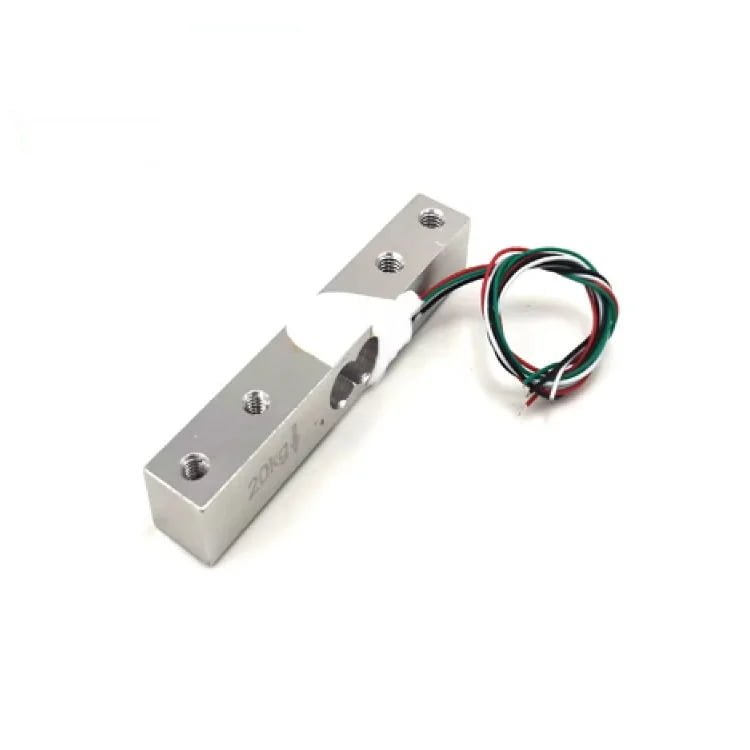
WST103
- Rated loads 1 to 50 kg, aluminium alloy, cable 220 mm
- Combined error ±0.05 %F.S, creep ±0.05 %F.S/3 min, zero tempco ±0.2 %F.S/10 °C
- Rated output 1.0 ± 0.15 mV/V, excitation 3 to 10 V, safe overload 150 %F.S, insulation ≥ 2 000 MΩ
The tightest electricals of the five and the largest overload margin of the miniature group, at the lowest price. Its cost is silence: the page states no ingress figure and no bridge resistance at all, so the sealing decision and the excitation design have to come as a written answer. Its capacity list says 1 to 50 kg while its page title says 5 kg and 10 kg. And its smallest range is a trap in this application: a one litre bag is 1 036.6 grams, which is 103.7 percent of a 1 kg cell, so that range cannot carry a litre bag before anybody hangs a second one. Ask me and I will send the missing numbers in writing.
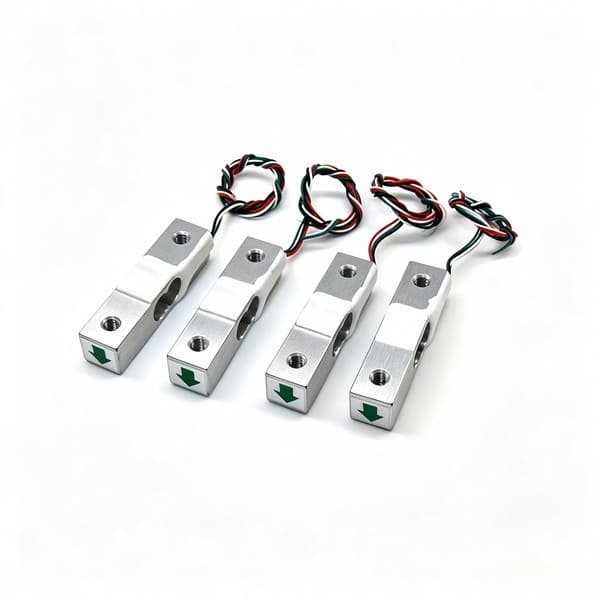
WST107
- Rated loads 3 to 50 kg, anodised aluminium, cable 220 mm
- Combined error ±0.05 %F.S, IP65, insulation ≥ 2 000 MΩ, safe overload 120 %F.S, ultimate 150 %F.S
- Input 1090 ± 10 Ω, output 1000 ± 10 Ω, excitation 5 VDC, zero balance ±0.1 mV/V
The only one of the five with a full specification line by line, and we already sell it into syringe pump builders, so its medical history exists. Its cost is temperature: a zero coefficient of ±0.5 %F.S per 10 °C, two and a half times the other miniature cells, which is 15.0 grams for every ten degrees the ward moves and 47.8 percent of a fifteen minute window at 125 mL per hour. Its page also carries the syringe-pump name in the title and a luggage-scale photograph while the body text says pocket scale. Default to it for the history and compensate the temperature.
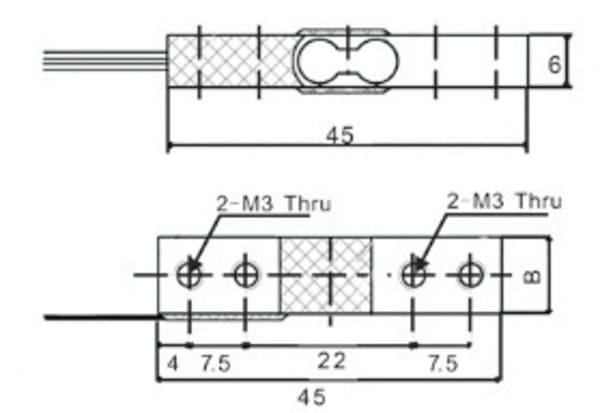
WST109
- Rated loads 300, 500, 750, 1 000, 2 000, 3 000, 5 000 g, aluminium with a silicone seal, cable 110 mm
- Combined error ±0.05 %F.S, creep ±0.1 %F.S/3 min, zero tempco ±0.2 %F.S/10 °C, IP65
- Input and output 1000 ± 10 Ω, rated output 0.7 to 1.0 ± 0.15 mV/V, safe overload 120 %F.S
My default for a litre bag in a cradle, and the only one of the five whose own image library already contains an infusion pump photograph — while its heading sells it for 3D printers and coffee scales. Its cost is the tare. A zero balance of ±0.1 mV/V against a rated output of 1.0 mV/V is ten percent of full scale, which is 200 grams on the 2 kg cell, and the four gram batch spread on dry bags is nothing beside it. Its creep limit is also twice the WST103’s. Re-zero on the empty bag at every change and neither number matters.
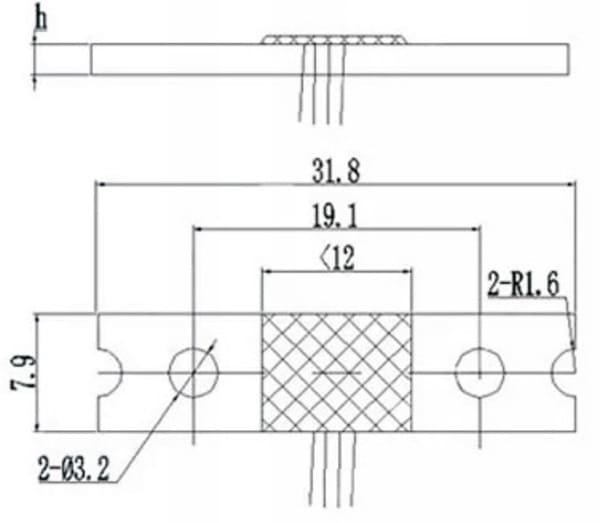
WST111
- Rated loads 5 to 50 kg, manganese steel (65Mn), silicone sealed and zinc plated, cable 110 mm
- Combined error ±0.2 %F.S, creep ±0.1 %F.S/3 min, IP65, safe overload 120 %F.S
- Input and output 1000 ± 10 % Ω, rated output stated as 0.6 to 1.5 ± 0.15 mV/V, zero balance ±0.3 mV/V
The one I quote when the housing is flat and there is no room for a bar. Its cost is the number the rest of the family does not have: a zero balance of ±0.3 mV/V against the 0.95 mV/V it prints for the 5 kg range is 31.6 percent of full scale, or 1 579 grams, which is more than the tare of a litre bag. Its size table also lists 0.95, 1.9, 1.9, 1.7, 1.5 and 1.9 mV/V, three of which sit outside the 0.6 to 1.5 band the same page specifies. Re-zero at every bag change and it is usable; skip it once and the number means nothing.

WST201
- Rated loads 3 to 100 kg, accuracy class C3, compensated −10 to +40 °C, cable 400 mm
- Combined error ±0.02 %F.S, creep ±0.02 %F.S/30 min, IP65, insulation ≥ 5 000 MΩ
- Input 406 ± 20 Ω, output 350 ± 5 Ω, rated output 2.0 ± 0.2 mV/V, zero balance ±2.0 %F.S
The only one here that states its zero balance as a percentage instead of making you divide two millivolt figures: ±2.0 %F.S is 60 grams on the 3 kg cell, the smallest of the five, and its zero coefficient is the tightest at 0.02 to 0.1 %F.S per 10 °C, which is 0.6 to 3.0 grams. Its costs are three. It is a platform cell, so the bag sits on a plate and never hangs. Its 406 Ω bridge draws 12.32 milliamps at 5 volts, 61.58 milliwatts, or 2.46 times the heat of a miniature cell. And its page still opens with the words “WST204 is hot sale”, something I have reported to our own web team more times than I want to count.
The five, side by side, with the limitation attached to each
| Cell | What I use it for | Range for a 1 L bag | Combined error | Zero tempco per 10 °C | Ingress |
|---|---|---|---|---|---|
| WST103 | Flat bar in a cradle, 50 to 500 mL doses | 2 kg or above | ±0.05 %F.S | 2.0 g | not stated |
| WST107 | Hanging hook, when the medical history matters | 3 kg | ±0.05 %F.S | 15.0 g | IP65 |
| WST109 | Cradle for litre bags, my default | 2 kg | ±0.05 %F.S | 4.0 g | IP65 |
| WST111 | Flat housing, 5 kg and up | 5 kg | ±0.2 %F.S | 15.0 g | IP65 |
| WST201 | Platform or tray, thinnest zero | 3 kg | ±0.02 %F.S | 0.6 to 3.0 g | IP65 |
There is one column that deserves its own table, because it is the number nobody reads and the number that decides whether your firmware’s zero is stable. The data sheets state it in millivolts per volt, which is not a unit anybody can argue about, so here it is in grams.
| Cell and range | Zero balance as published | What it is in grams | Against a 4 g batch spread on dry bags |
|---|---|---|---|
| WST103 @1 kg | ±0.1 mV/V of 1.0 mV/V | ±100 g | 25× |
| WST109 @2 kg | ±0.1 mV/V of 1.0 mV/V | ±200 g | 50× |
| WST107 @3 kg | ±0.1 mV/V of 1.0 mV/V | ±300 g | 75× |
| WST201 @3 kg | ±2.0 %F.S, stated directly | ±60 g | 15× |
| WST111 @5 kg | ±0.3 mV/V of 0.95 mV/V | ±1 579 g | 395× |
Zero balance is not an error, and I do not want it read as one. It is a permitted offset, and every cell here is specified as a ratio to its own output, which means the offset is proportional to the capacity you bought. That is the trap: choosing a 5 kg cell to be safe costs you a 1 579 gram permitted offset, which is one and a half litre bags’ worth of tare. In this application that is tolerable for exactly one reason, and it is the structural advantage I described in section seven — the bag is replaced, and the empty bag is the natural zero. Re-zero on every empty bag and the offset column stops mattering. Skip it once and the offset column is your whole reading.
If you are also building the readout side, the WST1502 indicator and the WST1505 process indicator both give you a stable gross and a rate, which is what your monitor needs from me. If your existing numbers have already gone strange, the damage diagnosis checklist is the fastest path, and the selection guide covers the mechanical part in more depth than I can here. Everything in those three pages applies to a weighing channel on a pole exactly as it applies to a hopper.
16. The ten questions, and the habit that matters more
These are the ten things I ask for on load cells for IV bag weighing, in the order I ask them. They take a customer fifteen minutes, and they have changed my recommended capacity in four of the last six projects — twice upward because of an accident case, twice downward because a tape measure settled the hanging head before I had quoted anything.
| What I ask for | Why it decides the answer |
|---|---|
| Bag size, dry tare, and the spread between deliveries | Sets the error in the first minutes, and forces the re-zero rule at every change |
| Whether the bag hangs, sits in a cradle or lies on a tray, and whether a full bag can touch the pole | Decides hook or platform, and whether a bypass fault is waiting to happen |
| Where the tubing runs, and how much slack there is when the patient turns over | The dominant mechanical error, and the only item with a patient attached to it |
| The prescribed rate, the bag volume, and how long the bag is meant to last | Tells me which error term is the size of your job rather than mine |
| The hanging height from bag to patient, and the lowest it will ever be in service | The largest term in the chain, and it is settled with a tape measure, not a catalogue |
| The room’s temperature swing between the night and the day shift | Drives the zero term, worth 0.6 to 15 grams per ten degrees across these five cells |
| Whether the display is a rate, a remaining volume or a total, and which of the two alarms | Ranks the five cells differently, and decides how long the averaging window can be |
| The smallest volume the software must resolve, and over what window | Sets the window length, not the division — and the window is far the cheaper lever |
| What the fluid is, and whether the firmware divides by 1.0046 or by 1.000 | A 5.0 percent volume error if the fluid changes and the constant does not |
| What happens when the cell drifts, and who owns the alarm threshold | The risk file question. This one I cannot answer for you, and I will say so on the call |
The routine that keeps the number honest afterwards is short and cheap. A certified weight hung in the loaded geometry at the start and end of every shift, not in the empty one, because the loaded geometry is where the load path actually changes. The two-condition head test run monthly — the same bag, hung high and then hung low, compared against the ratio in section five — because that is the only cheap early warning that a bypass path has appeared. The dry bag weighed at every delivery, because the tare is a purchased item and it drifts with the supplier. And the one I would insist on: keep the raw, unfiltered log for every alarm, with the nursing notes alongside it.
A flat infusion trend has two causes that matter: the bag has stopped delivering, or the bag is no longer carrying its own weight because something is holding it up. From the filtered output they are the same curve, and no amount of software effort separates them in real time. From a raw log with a timestamp, next to a photograph of the pole and the nurse’s note that she had hung the bag on the lower hook after the patient sat up, they are trivially distinguishable — after the fact, which is exactly when it matters. Build the raw log before you build the alarm.
17. Questions I get asked about load cells for IV bag weighing
What load cell capacity do I need for a one litre IV bag?
A full litre of 0.9 percent saline is 1 004.6 grams, and a bag with its spike is about 32 grams in the example I use here, so the hanging load is about 1 036.6 grams. Two kilograms is the sensible rating, which puts a full bag at 51.8 percent of rated load, and the 70 percent rule needs 1 481 grams, which only the 2 kg range meets. A 1 kg cell cannot carry a litre bag at all: 1 036.6 grams is 103.7 percent of it, before anybody hangs a second bag on the same pole. That is the arithmetic I run for load cells for IV bag weighing, and it starts with the bag, not with the cell.
Can I hang the bag directly on the load cell?
Sometimes, but none of the data sheets I quote here declare a tension rating, so that has to be confirmed in writing before you freeze a housing. The bigger issue is what a hanging bag does to the cell. The whole fluid column arrives as a step at every bag change, and a litre bag lowered five millimetres onto a hook and stopped in ten milliseconds arrives as 4.35 kilograms of equivalent load — 217 percent of the rated range on a 2 kg cell, and 181 percent of its 120 percent safe overload. Hanging is fine; dropping is not. The fix is a housing that guides the bag on, not a bigger cell.
Does an IV monitor need OIML or MID approval for its weighing function?
No. MID 2014/32/EU, OIML R76 and EN 45501 govern instruments used for trade, and no price is calculated from this reading. An OIML R60 component certificate is available if you want one, but it transfers no compliance and is not required. What applies instead is MDR 2017/745, because a device intended to monitor a physiological process is a medical device, plus IEC 60601-1 with its collateral standards, IEC 60601-2-24 and IEC 62304 for the software. And the ±5 percent volumetric accuracy in IEC 60601-2-24 is a requirement on the volume your pump delivers, tested by that standard’s own reference method — which is gravimetric. Your cell is a component inside the chain being weighed, and at 1.0 gram on a litre it is one fiftieth of the allowance.
How accurately can an IV bag monitor report millilitres?
More accurately than the tubing it is watching. The conversion needs a density, and saline is 1.0046 grams per millilitre at 22 degrees, which is a published number and not an unknown. Water would be 0.46 percent light, and whole blood is about 1.055, which is 5.0 percent heavy — 50.4 grams on a litre, the same size as the pump’s entire ±5 percent budget. The sensor’s own share is 1.0 gram on a litre bag, or 0.0965 percent, so the density constant in your firmware is fifty times coarser than the cell. Fix that constant before you shop for a better sensor.
Does the falling head really matter, or is it a rounding error?
It is the largest term in the chain, and it is a tape measure rather than a component. A litre of fluid sits in a bag column about 250 millimetres tall, so hanging at 1.5 metres loses 16.7 percent of the driving pressure over the life of the bag, one metre loses 25.0 percent, and 0.77 metres loses 32.5 percent. Taken through the physics instead of guessed, a bag prescribed as one litre over eight hours actually takes 9 hours 12 minutes, an average of 108.6 millilitres per hour against a prescribed 125 — minus 13.1 percent, which is 2.6 times the ±5 percent the pump is allowed, and no part of it came from the sensor. It is the first thing I test on any load cells for IV bag weighing project I am asked to look at.
Do you have long-duration creep data for these cells?
Not from a data sheet, and I will not extrapolate one. Four of the five state creep over a three minute window and the WST201 over thirty minutes; both figures are limits rather than rates, and three minutes is well under one percent of an eight hour infusion, so the published number cannot tell you what happens over the rest of it. What I would do instead is a loaded hold at your worst-case hanging weight for the length of your longest infusion, and look at where the zero comes back to, because the zero return is the number your firmware depends on. I will write the method; you run it on your own units, because three samples from me are not evidence for a risk file.
Is IP65 enough for a hospital environment?
For the cell, usually yes; for the device, the rating is the weakest joint in it and not the cell’s. IP65 means dust tight and protected from water jets, and every test behind it uses fresh water, so it says nothing about alcohol or quaternary ammonium wipes several times a day. There is a real electrical consequence. On a 1 000 ohm bridge a leakage of 25 megohms produces a one percent of full scale offset, which is 20 grams on a 2 kg cell and 63.7 percent of a fifteen minute window at 125 millilitres per hour, and it looks exactly like an infusion running fast. Four of these five cells declare IP65 and the WST103 declares nothing, so ask me. WST201 declares 5 000 megohms instead of 2 000, the only real margin here.
Can you supply the monitor, the indicator and the alarm as well?
The indicator and the transmitter, yes. The alarm, no. I supply load cells and force sensors, matched sets with matching data in writing, summing junction boxes, weighing indicators and transmitters, plus the mounting advice and the arithmetic that goes with them. I do not supply the pump, the controller, the display logic, the alarm threshold, the risk management file, the usability file, the IEC 60601 evidence or the MDR registration, and I supply nothing that performs a safety-rated function. I will sell you the sensor. I will not sell you the threshold.
Bag size and dry tare with the spread between deliveries, whether the load hangs or sits in a cradle, where the tubing goes and what happens when the patient turns over, the prescribed rate and the bag duration, the hanging height from bag to patient at its lowest, the room’s temperature swing between shifts, whether the display is a rate or a total, and what happens when the cell drifts. I will come back with a capacity and its utilisation, the cell’s share of a litre bag in grams against the ±5 percent the pump is allowed, which of the four error terms in section four is your limiter, the cell I would choose out of the five and why, and a written note on the parts of your design that are not mine to sign. If the load cell is not your limiting factor, that will be the first line of my reply.
VektorForce · load cells, force sensors, junction boxes and weighing indicators · www.vektorforce.com · Robin@vektorforce.com