
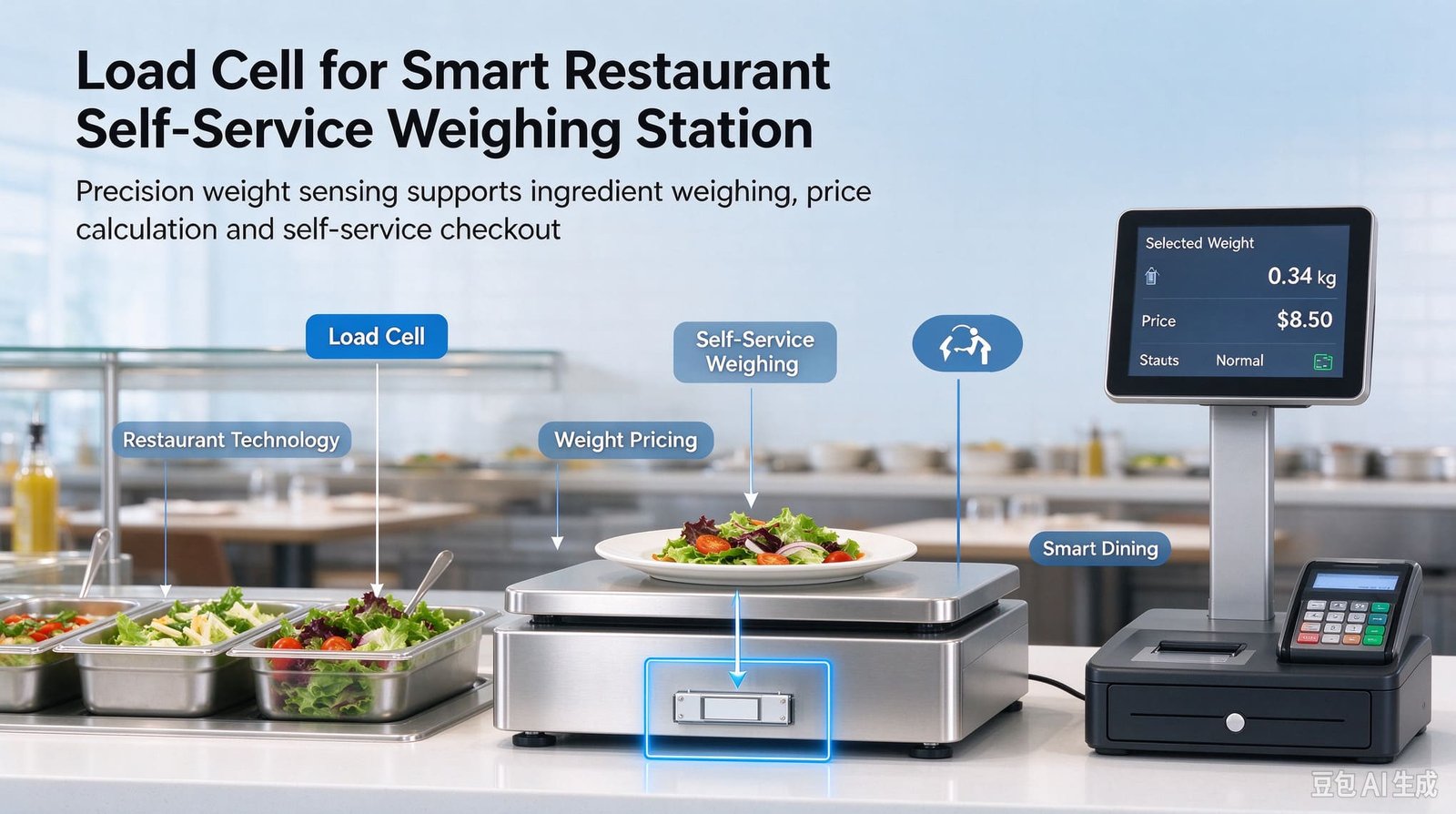
A self-service station weighs a plate to set a price, and the law decides the divisions, not you.
Every other article I have written in this series is about a scale that has to see something. This one is about a scale that has to testify. A load cell for a self-service weighing station is not judged on whether it sees the plate — it is judged on whether the number it produces can be invoiced. The moment a weight becomes a price, the accuracy stops being your choice: you get to choose two integers, and a table written in Paris decides the rest.
Class III: Min = 20 e
4 % of Max is the zero budget
700 g plate = 11.7 % of a 6 kg station
NAWI 2014/31/EU · OIML R76
RS485 digital cell, 300,000 counts
- Four questions a serving line has to answer
- The reading issues an invoice
- e is a legal integer, not an accuracy knob
- Two tolerances, and 70 % of one of them is mine
- A tare is a material property
- The zero device is not a tare device
- Three ways to mount a cell in a serving line
- Plate-level: what the smallest legal bill is
- Counter-level: why the steel sets the division
- What a digital cell really buys you here
- The test that fails is eccentric loading
- Heat, steam, and one division per five degrees
- Twelve stations is twelve verifications
- Standards: what applies, and what does not
- What I supply, and what I do not
- Questions I get from canteen integrators
- Six load cells for self-service weighing stations
1. Four questions a serving line has to answer
A self-service weighing station in a restaurant is not a scale with a display bolted on. It is a pricing instrument that happens to use a load cell. The guest takes a plate, serves himself, and walks away; there is no cashier to check anything; and the number that appeared on the screen while he was still reaching for the ladle has already been written into his account. That single change — the price is computed from the mass — moves the whole design into a different legal world.
Before we get to load cells, it is worth being explicit about what the machine is actually being asked to do, because only one of these four jobs belongs to the sensor.
| The question at the counter | What answers it | What it costs when the answer is wrong |
|---|---|---|
| How much food is on the plate? | A verification scale interval the law recognises, on a platform small enough to carry it | An invoice a weights and measures inspector can reject, after the money has been taken |
| How much of that is the plate? | A tare value that matches the plate in the guest’s hand, not the plate in the catalogue | A systematic over-charge. It never cancels out, because every plate moves the money the same way |
| Is the plate empty and still? | A legal zero policy and a stability rule, both of which the law already writes for you | Food charged twice, or a plate charged as food, in a pattern nobody can reconstruct afterwards |
| Is the number still true? | A load-cell error budget, a temperature allowance and an eccentric-loading plan | The whole fleet fails verification, and the fix is in the stainless steel, not in the sensor |
The sentence that saves the most money
A self-service weighing station is a trade-approved scale with the operator deleted. The law still assumes somebody is standing there. Every requirement in OIML R76 is written around an operator who zeroes the instrument before each transaction, keeps an eye on the platform, and can see the net, the gross and the tare. Take that person away and you have not simplified the machine — you have taken on his job in firmware. Some of it can be done in firmware. Some of it cannot, and has to be done mechanically. Knowing which is which is most of this article.
I make load cells, junction boxes and indicators. I do not make the station, and I do not certify it. But roughly every second enquiry I get about a canteen or buffet weighing line arrives with a specification that cannot be approved, and the sender does not know it. So this article is written from the position I actually occupy: the person who has to explain, before the purchase order, that the accuracy you asked for and the platform you asked for cannot exist in the same instrument.
2. The reading issues an invoice
I have written before about scales that measure things nobody charges for: the coffee shot scale, the 3D-printer filament spool, the bath mat, the pet bowl. All of those live in a comfortable place, legally speaking. In the European Union a weighing instrument used for a purpose outside the six regulated categories carries only the manufacturer’s name, Max and Min — and it must not carry a conformity marking. Nobody inspects it. The worst that happens when it drifts is that you get a bad cup of coffee.
A restaurant self-service weighing station is on the other side of that line, and it is worth naming the exact clause, because it is the whole reason this article has a standards section at all. Directive 2014/31/EU — the Non-Automatic Weighing Instruments Directive — lists six regulated uses in Article 1(2). The relevant one is (f):
Article 1(2)(f), quoted because it decides everything else
“determination of price on the basis of mass for direct sales to the public”
That is your buffet station, and there is no interpretation needed. Conformity is mandatory, the instrument is subject to verification, and in the United Kingdom the same requirement arrives through the Non-automatic Weighing Instruments Regulations 2016. There is no small-operator exemption and no minimum turnover.
The reason this matters so much commercially is that the demand side is no longer voluntary. On 31 December 2030 every EU member state has to reduce food waste at retail and consumption — and that bracket includes restaurants and food services — by 30 % per capita against a 2021–2023 baseline, with a separate 10 % target for processing and manufacturing. That is written into the revised Waste Framework Directive (Directive (EU) 2025/1892), and the member states had to nominate a competent authority for it by 17 January 2026. The Union throws away roughly 59 million tonnes of food a year, about 131 kg per person, with an estimated market value near €132 billion, and 11 % of that arises in food service and restaurants.
You cannot cut waste you cannot measure. That is the mechanical link between a sustainability target agreed in Brussels and a strain gauge bonded to an aluminium beam. The category was born in China, where the smart-canteen market passed ¥41 billion in 2026 and is still growing above 28 % a year, where canteen penetration went from 3–5 % in 2021 to 12–15 % in 2026, and where more than 42 % of state-enterprise, university and campus canteens have already moved to pay-by-weight self-service. The reported results there are consistent: labour cost down 15–25 %, waste down 30–50 %, payback in 1.5 to 2.5 years, and about ¥120,000 a year saved in a 1,000 m² canteen. The instrument behind every one of those numbers is a scale with a legal obligation attached.
Where this article stops being about the same thing as retail checkout
Most of what is written about weighing in food service is about the checkout: a barcode, a known product, an operator, a price-computing scale. Smart shelves and vending machines know the identity of the article and only need to know how many are left; the price is in the database. A self-service station has the opposite problem. The identity is unknown and the quantity is continuous. Nobody scanned anything. The guest decided, bowl by bowl, how much of each dish to take, and the only fact the machine ever gets is a mass. That is why the accuracy question here is not “how fine is the display” but “how fine may the division legally be, on a platform that fits a serving bowl”.
One last boundary, because it trips up almost every project I see. A weighing instrument is non-automatic when a person intervenes in the weighing — places the load, decides the reading is acceptable, completes the transaction. That is what a guest serving himself does. It is also what a member of staff does at a manual checkweighing bench. Automatic catchweighers, checkweighers, belt weighers and gravimetric fillers are covered by the MID instead, in Annex MI-006. So a self-service station, however much software is inside it, is a NAWI. If a supplier tells you their canteen scale is “MID MI-006 approved”, they are describing a different machine.
3. e is a legal integer, not an accuracy knob
Here is the trap. Every project brief I receive says something like “we need 1 gram accuracy”, and the sender is thinking of it the way you think about a ruler: a finer mark is a better ruler. In legal metrology that is backwards. Under OIML R76 an instrument is classified by e, the verification scale interval, and the classification table does not let you pick e on its own. It pairs e with two other numbers and then hands back the largest capacity you are allowed to have.
For Class III — medium accuracy, which is where every bench scale, platform scale and retail scale lives — the relevant lines of the table are these:
| Class III rule | Value | What it means at the counter |
|---|---|---|
| Verification scale interval, e | 0.1 g ≤ e ≤ 2 g (or e ≥ 5 g) | 1 g and 2 g are inside the fine band; 5 g and 10 g sit in the coarse band |
| Number of intervals, n = Max / e | 100 to 10 000 | This is the hard ceiling. Your capacity is 10 000 × e, full stop |
| Minimum capacity, Min | 20 e | You may not legally sell the guest less than this. It is a floor on the transaction |
Read those three lines together and something uncomfortable falls out. The capacity is not a free variable. If you want a 1 g division, the largest instrument you may build is 10 kg — and the smallest portion you may charge for is 20 g. If you want a 2 g division, the ceiling is 20 kg and the floor is 40 g. If you want to put a whole serving bay on the platform and you need 30 kg of capacity, then e must be at least 5 g, and the smallest bowl you may price is 100 g.
But the class table is only half of it, and this is the half almost nobody quotes. The load cell underneath has its own classification, in OIML R60, and its own ceiling on the number of intervals it may carry. A Class C load cell — which is essentially the entire commercial strain-gauge family, and every part in this article — is certified between 500 and 10 000 intervals, and the “C3” that appears on nearly every datasheet means exactly 3 000. Class B exists on paper, from 5 000 to 100 000 intervals. I have never quoted one, because it is not a thing the aluminium parallel-beam family is made in.
The line that decides your platform size
Combining the two recommendations gives a very short rule for a station built on one C3 cell:
Max = 3 000 × e and Min = 20 × e therefore Min = Max ÷ 150
On a 6 kg plate station the smallest legal portion is 40 g. On a 15 kg bay it is 100 g. On a 30 kg bay, 200 g — and on a 60 kg counter, 400 g. Nothing about your menu, your dish sizes or your price list changes those numbers. Only the size of the platform does.
| You want a division of | Largest station on one C3 cell | Absolute Class III ceiling (n = 10 000) | Smallest portion (Min) | Smallest bill at €20/kg |
|---|---|---|---|---|
| 1 g | 3 kg | 10 kg | 20 g | €0.40 |
| 2 g | 6 kg | 20 kg | 40 g | €0.80 |
| 5 g | 15 kg | 50 kg | 100 g | €2.00 |
| 10 g | 30 kg | 100 kg | 200 g | €4.00 |
| 20 g | 60 kg | 200 kg | 400 g | €8.00 |
I want to point out something about that table rather than let you find it. It has no row where the minute column and the capacity column are both generous. The division is bought with the platform. This is the same truth as the one I keep repeating about capacity and absolute error, expressed in the currency of legal metrology instead of the currency of physics — and it is the reason I now ask every canteen enquiry the same first question, which is not about accuracy at all. It is: what is the smallest bowl you sell, and how much does that bowl cost?
Because if the smallest legal bill is €0.40, nobody at the counter will ever notice a 1 g division. And if the smallest bill is a bowl of soup priced at €0.80, then a 2 g division is already five times finer than the smallest price change the guest can see. Which raises a question that takes this article somewhere I did not expect when I started writing it.
Half the “1 g” specifications in this industry are d, not e
There are two symbols in legal metrology that look the same on a datasheet and mean completely different things. d is the scale interval the display shows — the smallest step you can read. e is the verification scale interval, the unit the inspector uses to calculate the tolerance and the class. They are frequently different, and when they are different, both have to be marked on the instrument. Tolerances always follow e, never d.
Now consider the two documents that land on my desk most often. The first is a competitor’s solution sheet for a canteen weighing line — a parallel-beam digital cell, 50 to 100 kg capacity, dividing value 1 to 2 g, platform from 250 × 350 mm up to 400 × 500 mm, RS485 or RS232. The second is my own datasheet for the digital planar cell in the card list at the end of this article, which offers 1 g up to 50 kg and 2 g at 60 to 100 kg, with a 300,000-count converter.
Both numbers are real. Neither one is e. Watch what happens if you treat them as e. A 100 kg platform with a 1 g division has n = 100 000. That is not Class III — Class III stops at 10 000. It is not even in the same family; it is Class II, whose interval count runs from 5 000 to 100 000 and whose minimum capacity is 50 e, so 50 g. And it needs a load cell certified to 100 000 intervals, which is the very top of Class B, a class that does not exist in the parallel-beam family at all. On a 50 kg cell with a 2 g division you get n = 25 000, which is the same story one size down. And if you put a 100 kg cell and a 2 g division together, n = 50 000. All of these are Class II numbers stamped on Class C parts.
1 g on a 100 kg platform is not a division. It is a count.
The arithmetic that separates the two is trivial and nobody does it. A 300,000-count converter on a 100 kg cell resolves 0.333 g per count, and on a 60 kg cell, 0.2 g. So a “1 g division” is comfortably inside the electronics — it is a perfectly honest statement about resolution. What it is not is a statement about the class the instrument can be verified in. The same page that says “division 1 g” also says “A/D resolution 300,000”, and those two lines together are the tell: if 1 g were a verification interval, the converter would not need to be thirty times finer than the division it is supposed to be resolving.
I am deliberately writing this section against my own product page, not just the competitor’s. When you buy load cells for self-service weighing stations from me and the datasheet says 1 g, you are buying a cell that can resolve 1 g. Whether the station may legally price in 1 g is decided by the table two screens up, and by what platform you bolted on top. A supplier who will not draw that distinction for you is either new to the segment or hoping you are.
4. Two tolerances, and 70 % of one of them is mine
You now have e. The next thing you need is the tolerance that goes with it, and there are two of them, and they are not the same number. On initial verification, Class III instruments must hold ±0.5 e from zero up to 500 e, ±1.0 e from 500 e to 2 000 e, and ±1.5 e above that. In service, all three are exactly doubled: ±1.0 e, ±2.0 e and ±3.0 e.
The certificate and the inspector are not measuring the same thing
Your calibration certificate is written against the initial verification limits. The inspector who visits three years later works to the in-service limits, which are twice as wide. That sounds like good news, and in one sense it is. What it actually means is that a station which was comfortable on the day it was installed can drift a long way and still be legal — and that the margin you thought you had was never one number. On a 2 g division, your true tolerance band at the bottom of the range is not ±1 g. It is ±2 g, and nobody is going to tell you that at the handover.
So a 2 g station has to hold ±1.0 g / ±2.0 g / ±3.0 g when it is new, and double that in service. That is the budget for the whole machine: the load cell, the junction box, the cable, the indicator, the A/D, and the platform. How is it divided?
This is where a document most integrators have never seen comes in. When a NAWI is certified from separately approved modules — which is how nearly every scale in the world is actually built — each module is assigned a fraction of the maximum permissible error, and the fractions are combined in quadrature. On real declarations of conformity for retail platforms the indicator gets 0.5, the load receptor — platform, frame, structure — gets 0.5, and the load cell gets 0.7. Add the squares and you get 0.25 + 0.25 + 0.49 = 0.99. The fractions are designed to fill the budget exactly once, with nothing left over and no component generously funded.
| Module | Apportionment factor p | On a 2 g division, at loads up to 500 e (1 kg) | At the top of the range |
|---|---|---|---|
| Indicator / A/D | 0.50 | ±0.5 g | ±1.5 g |
| Load receptor (platform and frame) | 0.50 | ±0.5 g | ±1.5 g |
| Load cell | 0.7 | ±0.7 g | ±2.1 g |
| Whole instrument (initial verification) | 1.00 in quadrature | ±1.0 g | ±3.0 g |
And now the elegant part, which took me two years to appreciate. Under OIML R60 a Class C load cell’s own error limits are pLC × 0.5 v, pLC × 1.0 v and pLC × 1.5 v, where v is the cell’s own minimum verification interval, equal to Emax divided by its interval count. A 6 kg C3 cell therefore has v = 6 000 g ÷ 3 000 = 2 g, and its own limits come out at ±0.7 g, ±1.4 g and ±2.1 g. Those are not similar to the numbers in the table above. They are the same numbers. Two recommendations written decades apart, by different committees, add up to the same place — and the reason is that v = e is the design intent, not a coincidence. One cell, three thousand divisions, one station.
Why a %F.S number cannot tell you whether a cell will pass
The cells in this article quote a combined error of ±0.02 % F.S. On a 6 kg cell that is ±1.2 g — against the cell’s entire allowance of ±0.7 g at the bottom of the range. On paper, my own cell is 1.7 times outside its own budget.
It passes anyway, and the reason is worth understanding. A %F.S figure is anchored at full scale. The legal tolerance is a staircase anchored at e. If the error of a well-designed cell grows roughly in proportion to the load, then at 500 e — one sixth of Emax on a 6 kg cell — the actual error is nearer ±0.2 g, comfortably inside ±0.7 g. But if that error happens to be flat, a fixed offset that does not shrink with load, you are over budget at exactly the load where the tolerance is tightest, which is where a buffet spends its whole day.
Which gives us the first genuinely useful rule of this article, and it is a rule about paperwork rather than electronics. A %F.S combined-error figure does not tell you whether a load cell is legal for trade. It tells you one number at one load. The document that answers the question is the R60 certificate, because it carries the staircase: the interval count, the minimum verification interval, and the error limits at each step. When an integrator sends me a competitor’s datasheet and asks whether they can price food with it, the correct answer is almost always “show me the certificate” — and about half the time there is no certificate to show.
Case 1 — the specification for a 30 kg station that did not exist
A contract caterer in the Netherlands, running staff restaurants for three office campuses, sent me a tender document in early 2026. Under “weighing specification” it said: Max = 30 kg, e = 1 g, four-corner platform, 400 × 400 mm, OIML approved. They wanted a quotation for the weighing element.
I did not quote it. The combination they had asked for has n = 30 000, which is three times over the Class III ceiling, and it would need a load cell certified to 30 000 intervals — Class B again, in a 400 × 400 mm parallel beam. What I asked for instead was not a drawing. I asked for their menu with portion sizes, and the price of the cheapest item they sell by weight. It came back in two days: the smallest thing anyone buys at that counter is a single small bowl of soup, roughly 90 g, at about €1.80.
So the 1 g was not protecting a €1.80 sale. It was protecting the fourth decimal place of it. And the 30 kg came from one thing only — a full serving bowl the chef carries out from the kitchen. We solved it by moving the bowl, not by shrinking the division: the full bowl went onto a 30 kg preparation counter in the kitchen at e = 10 g, where Min is 200 g and a 90 g bowl would be below the legal floor anyway; the guest-facing station became 6 kg at e = 2 g, where the smallest legal bill is €0.80 and the soup bowl is comfortably above the 40 g floor. Two stations, one of them changed from a tender requirement to a kitchen fixture, and the total bill for the weighing elements went down rather than up.
The part they found hardest to hear was the last sentence of my reply: I cannot approve this station, and neither can any sensor supplier. Type approval belongs to the finished instrument and its manufacturer, in front of a notified body. What I can hand you is a certified component, the certificate number for it, and the arithmetic above. That is the whole of my legal contribution, and pretending otherwise is how integrators end up with an unusable certificate.
5. A tare is a material property
Everything so far has been about the food. Now consider the thing the food is sitting on, because in a self-service station the plate is not a container. It is a deduction, and the deduction is stored in a database as a number. That number was written by somebody, in an office, from a supplier’s catalogue, and it describes a dry plate.
Meanwhile the plate on the platform has just come out of a commercial dishwasher at 65 to 85 °C wash and 82 to 90 °C rinse. It is warm, and in the case of anything porous, it is not the same object it was in the catalogue.
| Tableware, 27–28 cm dinner plate | Typical dry mass | Water absorption | Mass gain after washing |
|---|---|---|---|
| Vitrified porcelain | 350–850 g | ≤ 0.5 % | ≤ 3.5 g |
| Stoneware | 600–900 g | 1–3 % | 7–21 g |
| Earthenware | varies widely | 5–15 % | 35–105 g on a 700 g piece |
| Melamine (A5) | 380–450 g | effectively non-porous | negligible |
Read the third row again. Earthenware at 5 to 15 % uptake is a 35 to 105 g tare error on a single plate, and it is not exotic — it is the cheap buffets and the outdoor terrace sets. But even the middle row is enough to cause a legal problem, so let us do that one properly. Stoneware, 700 g plate, 1.6 % uptake in the middle of the range: the plate that leaves the dishwasher weighs 711 g, and the database says 700.
Eleven grams. At €20 per kilogram that is €0.22 per tray. Small enough that nobody will ever complain about it at the till, which is exactly what makes it dangerous. Run the year: a hotel or campus restaurant doing 900 trays a day, 360 days, is 324,000 transactions, and 11.2 g each is €72,576. Switch the same site to vitrified porcelain at 0.5 % uptake, where the plate gains 3.5 g, and the same 324,000 trays come to €22,680. The difference between two plate materials is €49,896 a year — and that is not a tableware budget, it is a tare convention.
A tare error is the one error that never averages out
Random noise is symmetrical: some trays are over, some are under, and the day’s total is close to right. A tare error is not symmetrical, because every plate gains weight in the same dishwasher and loses it in the same way. So the sign never changes. In the inspector’s language that is not noise, it is a systematic error of the instrument, and it shows up as a positive deviation at low loads — the one part of the range where the tolerance is tightest and the portion is smallest. One plate, one direction, 324,000 times a year.
Why “just press zero with the plate on” makes it worse
The obvious field fix — have the guest put the empty plate on and press zero, so the wet weight disappears — works perfectly, once, for one plate type. It also moves the plate out of the tare path and into the zero path, and those two devices have completely different legal limits, which is the subject of the next section. And it quietly breaks every other plate in the building, because there is no longer a tare value at all: the plate has become part of the zero. A soup bowl, a side plate and a dessert dish now all weigh zero, and every guest who picks a different dish is mis-priced by the difference in the tableware.
The legal metrology community has a name for the pattern that does work, and it is worth quoting. Tare values must correspond to the scale interval of the instrument, so your 700 g tare on a 2 g station has to be rounded to a multiple of 2 g — mine was 700, which is fine, but a 703 g average plate is not. A tare value may be increased by repeated operations of the tare device, but cannot be reduced by the same method — before a lower tare can be established, the instrument must be returned to zero. A pre-set tare cannot be modified or cancelled while any subsequent tare operation is still in use. And the pattern the guidance actually recommends for direct sales to the public is the one-shot tare: an empty container is tared; the full container replaces it without the instrument ever seeing zero; and when the transaction is complete and the pan is clear, the tare drops out and the instrument returns to zero.
Then the sentence that explains why this whole article exists. In the same guidance: “It is the responsibility of the operator of a weighing instrument to ensure that it is at zero before each transaction.” A self-service station has no operator. So who holds that responsibility, and what have you installed in the machine to discharge it? That is not a rhetorical question — it is the design review, and if your answer is “the firmware does it,” you need to know what the firmware is legally allowed to do.
Case 2 — the complaint that turned out to be about crockery
An Irish catering contractor running hotel breakfast and a hospital staff restaurant wrote to me in the spring of 2026 with a table of numbers. Six stations, quiet and clean, no hardware faults, and a complaint that would not go away: guest receipts were consistently a few cent above what the portions looked like. Their working theory was the load cells, and they had already asked two suppliers for a tighter-accuracy replacement.
The first thing I asked for was not a drawing or a datasheet. I asked for twenty plates weighed twice — once bone dry from the shelf, once within a minute of coming out of the pass-through dishwasher — and for the pre-set tare table from the POS. The tare table said 700 g for the main plate. The dry weighing averaged 698 g, which is a perfectly good catalogue value. The wet weighing averaged 709 g, and the spread across the twenty was 8 g. Not a sensor problem. A crockery problem, priced by the kilogram.
What made it worse was their own mitigation. Somebody had trained the front-of-house team to put the empty plate on and press zero before serving, which removed the plate mass entirely and made the first twelve trays of the day look perfect — and then mis-priced every tray after that on which a guest picked the soup bowl or the dessert dish instead. Two faults in opposite directions, twelve plates of evidence, and no way to reconcile the till without the plate weights in front of you.
The repair was three lines of work. A wet-calibrated tare table, averaged over twenty pieces per plate type and refreshed weekly; the zero key taken off the guest-facing path so the plate can only ever be handled by a tare device; and one-shot tare per transaction instead of a persistent pre-set value, which is the pattern the guidance recommends anyway. I sold them six junction boxes and no load cells at all. Eleven grams a tray is €72,576 a year, and it was being read as a sensor tolerance because a tare that drifts in one direction looks exactly like a scale that reads heavy.
6. The zero device is not a tare device
Every integrator I have met treats “zero” as a convenience function. In legal metrology it is a device with a name, a range and a rate, and all three are fixed by the recommendation rather than by your firmware team. Three numbers matter.
| Legal limit | Rule | 6 kg station | 15 kg station | 30 kg station |
|---|---|---|---|---|
| Zero-setting and zero-tracking, total range | 4 % of Max | 240 g | 600 g | 1 200 g |
| Initial (power-on) zero-setting range | 20 % of Max | 1 200 g | 3 000 g | 6 000 g |
| Zero-tracking correction rate | ≤ 0.5 e per second | 1 g/s = 60 g/min | 150 g/min | 300 g/min |
Also fixed by the recommendation, and more important than any of the ranges: zero-tracking may only run when the indication is at zero — or the negative net is equivalent to gross zero — and only when the equilibrium is stable. And when the equilibrium is disturbed, the instrument must not print, store, zero or tare at all. That last sentence is the one I would put on the wall of every canteen station. The law already tells you that you may not take a zero while the guest’s arm is still on the counter. You do not need to invent that rule; you need to make sure your firmware obeys it.
Case 3 — “can we auto-zero every 30 seconds so nobody has to check it?”
A German system integrator asked me this in a review call, and it is the best question I have been asked all year, because the answer is not yes or no. It is: the device you are describing exists, and here is its size.
On their 6 kg guest station, the zero-setting and zero-tracking devices together may absorb 240 g — four per cent of Max. Not per day and not per month: that is the total range of the devices. At €20 per kilogram, that is €4.80 that the instrument is permitted to forget about and never report. On the 15 kg stations elsewhere in the same building, the same allowance is 600 g, or €12.00. And the power-on range is five times larger again: on a 6 kg station the initial zero-setting device may take out up to 1 200 g, which is €24.00.
Here is why that should worry you rather than reassure you. A 700 g plate is 11.7 % of a 6 kg station. It sits comfortably inside the 20 % power-on window, so if a plate is ever left on the platform when the station is switched on or reset, the zero device will silently absorb it and the station will believe it is empty. It is outside the 4 % tracking window — 700 g is 292 % of 240 g — so tracking cannot eat a plate, which is the one piece of good news in this section. And the correction rate is generous: at a 2 g division the permitted rate is 60 g a minute, which sounds enormous until you remember that it may only run at zero and the total is capped at 240 g. The rate is not the number that matters. The cap is.
The answer I gave them was: yes, you may run an automatic zero-setting device, and it will do useful work absorbing slow thermal drift on the platform structure. No, it must not be your tare strategy, because the device that hides a plate at power-on is the same device that hides a plate at every subsequent reset — and once the plate is inside the zero, the station can no longer tell you how much food it just sold. What they built instead was a power-on interlock: the station refuses to complete its zero sequence and shows a fault until the platform reads within a few grams of the calibrated dry-platform mass, which takes about two seconds and costs nothing. Zero is for the platform. Tare is for the plate. Mixing them is how a canteen ends up with a scale that is perfectly accurate and completely wrong.
7. Three ways to mount a cell in a serving line
Everything I have ever been asked to quote for a self-service station turns out to be a variation of one of three arrangements, and the choice is almost always made by whoever drew the steelwork, months before anyone asked a metrologist. The three arrangements are not variations in quality. They are variations in how much of the tray a single cell is asked to be responsible for, and that single decision sets the capacity, which sets v, which sets e. The division is decided at the drawing stage and merely discovered later.
| Arrangement | Cells per station | What each cell actually carries | Where it costs you, later |
|---|---|---|---|
| A. One platform, one cell, centre mounted | 1 | The whole tray: plate, food, cutlery, and anything the guest puts down | The plate sits on the cell, so tare becomes the entire design. Off-centre error is mechanical and cannot be trimmed out afterwards. |
| B. One platform, four cells, corner mounted and summed | 4 + junction box | One quarter of the platform load each — and one quarter of the steel | Four corners have to agree, and the summing box becomes a legal object that must be sealed against a screwdriver. |
| C. One pad per position, one cell per pad | 3 to 8 | Only the bowl standing on that pad — never the plate, never the tray | Every pad is its own weighing boundary, every pad gets its own cable, and the wet zone moves under every cell. |
Arrangement C is the one in the reference designs, and for a simple reason: it is the only one where the cell never sees the plate. If the guest fills a bowl on a pad, the pad weighs the food and the bowl, and the plate stays on the tray where it belongs. Arrangement B is what you need when a whole loaded tray has to be priced in one go, which is what most canteens actually ask for. Arrangement A looks like the cheap version of B and is almost always the expensive one, because the plate has moved onto the platform and you have bought yourself the tare problem from section 5 with no way to solve it mechanically.
There is one more number in arrangement A and B that almost nobody reads properly, and it is on every single-point datasheet I sell: the recommended platform size. WST1201 says 250 × 350 mm. WST202 and WST1204 say 400 × 400 mm. WST1205 says up to 800 × 800 mm. That number is not a suggestion about counter space. It is the size of lever the cell has been characterised for, and it is the reason a single-point cell can hold its specification when a guest drops a plate on the far corner. Fit a 600 × 500 mm top to a 400 × 400 mm cell and the cell has not become inaccurate — it has become unpredictable at the corners, which the eccentric loading test will find and which you cannot fix in firmware.
And if you do go to four corners, the summing device stops being a convenience. On a NAWI, the junction box and every component that sums the load cells has to be protected against unauthorised access, because a trim potentiometer that anyone can turn is a way to change what the instrument measures without leaving a trace. This is where the choice of cell starts to change the paperwork. WST1101 is a planar beam cell designed to be used three or four to a platform, and it is not corner-adjusted — the corner matching has to happen in your summing box, which means your summing box has trim pots, which means your summing box has to be sealable. WST1201 and WST1204 arrive with the off-centre compensation already installed at the factory to OIML R60, so the summing box only has to add numbers. The digital cell did not make the scale more accurate. It removed a screwdriver from the counter.
Case 4 — the feature that would have cost 80 % of the resolution
A Belgian integrator building for a Nordic workplace caterer sent me a layout in February 2026: a four-position bowl counter, one 3 kg single-point cell under each position, priced by weight. That part was clean. Four pads at 3 kg with e = 1 g gives 3 000 intervals each, a minimum capacity of 20 g, and a smallest legal bill of €0.40. I quoted it in a week.
Three weeks later the customer asked for a fifth platform: put the whole loaded tray on a 400 × 300 mm top and price the entire lunch in one transaction. I did the arithmetic on the back of their own drawing. The steel top alone is 1.41 kg at 1.5 mm thickness, the tray and food need 6 kg of range, and the structural allowance is 20 % — 8.6 kg, so a 10 kg cell. A 10 kg C3 cell has v = 3.33 g, so the finest honest division on that platform is 5 g, not 1 g: n = 2 000, Min = 100 g, smallest legal bill €2.00.
Now they had a counter carrying a 1 g pad at one end and a 5 g platform at the other, both printed on one guest-facing display. Their question to me was whether that is allowed. My answer was that I can do the arithmetic and I cannot do the interpretation, and the interpretation belongs to their notified body — but that the rules require the indicating, printing and tare devices to use the same scale interval for a given load, and that any printed label has to show the same value, the same decimal places and the same unit as the main display. Read conservatively, that means one division for everything the guest can see and pay from, and if you must pick one, you pick the coarsest. The fifth platform would have dropped all four bowl pads from 1 g to 5 g, a loss of 80 % of their resolution, to serve a mode the average guest uses once or twice a visit.
They deleted the tray mode from the guest-facing station and kept the four pads at e = 1 g. The wide platform stayed, in the kitchen, as a separate instrument at e = 5 g for the chef’s own portioning. They lost nothing that anyone pays for, and they kept the receipt. When a customer asks me to add a platform, I now ask one question before I answer: what division is it going to be, and does that division have to be the same as everything else on the counter?
So the rule I now use, after nine of these projects: count the places a guest can put something down. One small pad means arrangement C with an analogue cell, which is the cheapest and the best. A tray crossing the counter means arrangement B, and prefer cells that already carry their corner compensation. Arrangement A survives only if the platform is at or under the cell’s rated size, which usually means a platform too small to be useful. The arrangement you draw decides the division, and the division is the thing the law cares about.
8. Plate-level: what the smallest legal bill is
Here is the consequence of section 3 that catches people out, and it is about the bottom of the range rather than the top. You can always print a big number. You cannot print a bill smaller than 20 e. The minimum capacity is not a suggestion or a warm-up zone; below Min the instrument is not required to be accurate at all, and a legal-for-trade instrument that prices below its own Min is selling something it does not stand behind.
| e | Max on the C3 line (3 000 e) | Min = 20 e | Smallest legal bill at €20/kg | One division, in money |
|---|---|---|---|---|
| 1 g | 3 kg | 20 g | €0.40 | €0.02 |
| 2 g | 6 kg | 40 g | €0.80 | €0.04 |
| 5 g | 15 kg | 100 g | €2.00 | €0.10 |
| 10 g | 30 kg | 200 g | €4.00 | €0.20 |
| 20 g | 60 kg | 400 g | €8.00 | €0.40 |
Read the third and fourth columns together and a strange inversion appears. A station with a finer division cannot sell a smaller portion — it can sell the same portion at a better resolution, but its floor is high. The €0.40 station and the €8.00 station are not better and worse versions of each other; they are two different products. If your menu includes a 30 g garnish, a shaving of parmesan, a spoon of sauce sold by weight, then a 6 kg station at e = 2 g cannot legally sell it, because 30 g is below the 40 g floor. No amount of engineering fixes that. Either the item is sold by piece, or the station’s Max has to come down, or the law changes, and only one of those three is in your hands.
And the division itself is nearly free once you are above the floor. At €20/kg, one 2 g division is four cents. The entire argument between a 1 g station and a 2 g station, the argument that drives tender documents and doubles the price of a load cell, is a two-cent argument per division — and because a legal instrument only has to be accurate to half a division at rest, the amount of money that actually hinges on the choice is one cent. I have never once been asked to justify the accuracy of a station at that level, but I have been asked to justify the price. When a customer tells me they need 1 g, I now ask one question: what is the lightest thing on your menu that anyone buys by weight? If the answer is above 40 g, the 1 g is decoration, and I say so, which occasionally costs me the cell.
There is a mechanical half to this section as well, and it is the reason I now ask for the plate before I ask for the platform. (The same arithmetic runs the other way on a baby scale, where the cradle is the tare and the patient is the live load — the cradle is lighter, so the division survives, which is exactly the trade this section describes.) The reference product in this market — the machine nearly every European canteen integrator benchmarks against — uses a platform of 390 × 286 mm with two divisions, 2 g and 5 g, and minimum capacities of 40 g and 100 g. Those are not arbitrary numbers. They are exactly the C3 line from section 3: 6 kg at e = 2 g is 3 000 intervals; 15 kg at e = 5 g is 3 000 intervals. Somebody at that company sat down with the same table I have been quoting and picked the two points on the line that fit a dinner plate. A 270 mm plate on a 286 mm platform leaves 8 mm a side. That is the whole design envelope of a plate-level station: not “how much can it weigh”, but “does the plate go on, and does it go on nearly centred every time”.
The plate decides the platform, the platform decides the cell
A 400 × 400 mm platform will hold any dinner plate with room for a side bowl, and two of my six cells are rated for exactly that size. A 250 × 350 mm platform holds one 270 mm plate and very little else, and one cell is rated for exactly that. An 800 × 800 mm platform holds a whole counter bay. Write the plate diameter on the drawing first, then the platform, then the cell, and the capacity question usually answers itself — because on a plate-level station the live load is under a kilogram and it is the steel, not the food, that fills the range.
9. Counter-level: why the steel sets the division
Now put the same exercise on a counter instead of a plate, and watch the division collapse. This is the part of the conversation where a customer who has asked for 2 g finds out that he is going to get 50 g, and that nothing about my cell is at fault. It is worth doing in full, because the chain is short and every link is checkable.
The station in question is a full service counter: a stainless top 1 200 × 700 mm, 3 mm thick, with two basin openings and a sub-frame carrying the load cells. The live load — the food — is at most 8 kg, and the customer asked for a 15 kg platform on that basis, which is a sensible way to size a scale and a completely wrong way to size a counter. Here is what the cells actually see.
| Step | Number |
|---|---|
| Stainless top, 1 200 × 700 × 3 mm, at 7 850 kg/m³ | 19.782 kg |
| Plus basins, sub-frame, fixings and the cells’ own mounting hardware | 41.80 kg total receptor dead load |
| Dead load as a share of the 60 kg instrument the customer assumed | 69.67 % |
| Structural factor Q = 1 + 0.70 (dead load uplift) + 0.20 (bending, cable pull, side load) | 1.90 |
| Required cell capacity = 60 × 1.90 | 114 kg |
| Next standard capacity above that | 150 kg |
| That cell’s own minimum verification interval: v = 150 000 g ÷ 3 000 | 50 g |
| Instrument at Max = 60 kg and e = 50 g gives n | 1 200 |
| Min = 20 e | 1 000 g = €20.00 |
| Dead load as a share of the cell’s own capacity (150 kg) | 27.87 % |
I have written about the same mechanism before, in leg-loaded silos and feed towers, where a tank holding tonnes is weighed by the steel underneath it and the live load is almost a rounding error. A canteen counter is the same problem at a twentieth of the scale, and it fails for the same reason: somebody sized the sensor for what goes in rather than for what it is bolted to. The last row of the table above is the one that should be on the wall of every canteen kitchen. Twenty-eight per cent of the load cell’s capacity is permanently occupied by the counter it is bolted to. The food the station exists to weigh is a thin layer on top of 41.8 kg of steel, and every gram of it moves inside the top sixth of the cell’s range, exactly where a %F.S specification is least informative. What a customer means when he says “medium accuracy” is that the food is medium-sized. What a load cell hears is that it is going to spend its life at 28 % of full scale, at a division of 50 g, no matter how good it is.
Compare that with what the same station would have done on a 60 kg cell. Sixty kilograms on the C3 line is exactly e = 20 g, n = 3 000, Min = 400 g, and a smallest legal bill of €8.00 instead of €20.00. The 41.8 kg of steel turned a 20 g instrument into a 50 g instrument and a €8.00 floor into a €20.00 floor. Nobody chose that. It happened between the drawing and the quotation, and it is invisible because the number that caused it — the bare mass of the counter — usually does not appear anywhere on the specification.
It also matters at the load the station is actually used at. An empty receptor already reads 41.8 kg. Add a 340 g portion and the instrument is at 42.1 kg. On the 20 g instrument that is 2 107 e, in the 2 000—10 000 e band, where the permissible error is 1.5 e — 30 g, which is 8.8 % of the portion. On the 50 g instrument the same gross is 843 e, in the 500—2 000 e band, where the error is 1.0 e — 50 g, or 14.7 % of the portion. There is no configuration of the C3 line in which a portion measured on top of a 41.8 kg counter is better than one part in ten. That is not a load cell problem and it is not a tare problem. It is a “why are you weighing the counter” problem.
Why nobody builds a by-weight station on a full service counter
The counter is a preparation fixture. It is where a chef puts a full serving bowl down, and where a canteen throws two kilos of stew, and the reason it is made of 3 mm stainless is that it gets loaded by hand and cleaned with a hose. Asking that structure to also be a legal instrument means buying a 150 kg certified cell for a job that a 3 kg cell would do perfectly if it were bolted under a 270 mm plate. Whenever a customer sends me a counter drawing and asks for the division, my reply now is a request: send me the picture of what the guest stands in front of, not the picture of the whole line. The guest never touches the counter. The guest touches a plate, and the plate is where the instrument belongs.
10. What a digital cell really buys you here
Half of a bowl-station conversion in Asia is specified with digital cells and half with analogue, and the argument for digital is usually stated as resolution. I want to separate the claims, because two of the three common reasons are wrong and the third is the one that matters.
| Analogue (WST201 / WST202 / WST1101) | Digital (WST1201 / WST1204 / WST1205) | |
|---|---|---|
| Signal at the far end of the cable | 2.0 mV/V — about 12 mA of bridge current at 5 V | A number, over RS485 |
| Where the A/D converter lives | In your indicator, metres away | Inside the cell, millimetres from the bridge |
| Internal resolution | Set by the indicator you buy | 300 000 counts, 1 200 samples a second |
| Corner matching on a four-cell platform | Trim pots in the summing box — which then have to be sealed | Already compensated at the factory to OIML R60; the box only adds numbers |
| Combined error | ±0.02 % F.S (WST201/202); ±0.05 % F.S (WST1101) | ±0.005 % F.S |
| Temperature effect on output | ±0.02 % F.S per 10 °C | 0.002 % F.S per °C |
| Creep over 30 minutes | ±0.02 % F.S | 0.018 % F.S |
| Rated platform | 400 × 400 mm (WST202); three or four cells per platform (WST1101) | 250 × 350 / 400 × 400 / 800 × 800 mm |
| What it asks of you | A good indicator and a disciplined cable route | Protocol work and a firmware story |
| What it does not change | Max, e, Min, or the size of platform the cell is rated for. Not one of them. | |
Take the resolution claim first, because it is the one that gets repeated and it is the least useful. A 300 000-count digital cell at 60 kg resolves 0.2 g per count, so a 2 g legal division is ten raw counts wide. At 100 kg it is 0.333 g per count and the division is six counts wide. Six counts is thin but it is not marginal; the reason good indicators want five to ten counts under a division is to keep the last digit from flickering, and six to ten does that job. The counts were never the bottleneck. A 300 000-count converter does not make a station Class II, and it does not let you use a smaller division than the cell’s certificate allows. If you want the proof, look at my own datasheet: WST1201 lists a division of 0.1 g on its 5 kg capacity. Read that as a legal scale interval and it is n = 50 000 — an accuracy class well above anything a parallel-beam cell is certified for, and twice below the Class II ceiling only in the sense that it is half of it. It is not a division. It is a resolution, and it is honest to call it one.
The latency claim is also weaker than it looks. RS485 gives you the reading in 3 ms and RS232 in 20 ms. The busiest single-channel canteen line I have seen quoted does 1 200 people an hour, which is one transaction every three seconds. Seventeen milliseconds of difference is not a factor in whether a queue moves. It becomes a factor in a completely different design — a checkweigher rejecting a package on a moving belt — and if that is your application you should not be reading this article.
What the digital cell actually buys you is the cable and the corner trim pots, and both of those are legal problems rather than engineering ones. On a four-cell counter the analogue signal travels down four cables into a summing box, gets trimmed across four potentiometers that must be sealed, and then travels down a fifth cable to an indicator that has to resolve a 2 mV/V signal in a room with a dishwasher on the other side of the wall. That is a long way for two millivolts to travel while staying inside a ±0.5 e budget. The digital cell does the conversion where the physical quantity is, sends a number, and arrives with its corners already matched. It is not more accurate in the laboratory sense. It is more accurate at the end of the cable, which is where your station actually lives.
The price of the digital cell is a piece of software you do not control
A digital load cell contains a processor and firmware, and firmware that affects the measurement result is inside the scope of every software requirement that applies to the instrument. If your cell’s firmware can be reflashed in the field, you have created a way to change what the instrument measures without opening the case, and someone in the approval chain is eventually going to ask you how you control that. WELMEC’s software guidance exists precisely for this, and it asks for an identifiable, non-updatable software version — a checksum or a version string that cannot be edited — plus the usual tamper-evident precautions.
So when you choose a digital cell, ask the supplier two things that have nothing to do with accuracy: is the firmware version readable and unchangeable, and can the configuration be locked? My digital cells are factory-calibrated and pre-compensated, which removes the need for you to write calibration code at all — the interface is essentially one zero command and one read command. That is not a marketing feature. It is the smallest possible measurement-affecting software surface, and on a legal instrument small is the point.
So: a four-cell service counter where the guest places a full tray should use digital cells, because the summing and the sealing are the real cost and the cells pay for themselves in the junction box and in the approval meeting. A single small pad where a bowl is placed should use an analogue cell with a short cable, because there is nothing to sum, nothing to trim, and nothing to protect except the cable itself. If you are choosing a cell for the first time rather than replacing one, the nine questions I use are set out in how to choose the right load cell for a project. In neither case does the choice change the two numbers the law cares about. Pick the digital cell because of what it does at the end of the cable. Do not pick it because of the counts, and never pick it because of the milliseconds.
11. The test that fails is eccentric loading
If you take one thing from this article into a design review, take this: of all the tests an approval laboratory runs on a self-service station, the one that finds the mistakes is the shifted-load test. The instrument has to hold the permissible error with the test load placed anywhere on the load receptor — at each corner, at each edge, off to one side. It is not a hard test to pass. It is a very hard test to pass by accident, because the errors it exposes are drawn into the steelwork months earlier and are invisible in every simulation.
The mechanism is a lever, and it is worth stating plainly because it explains why accuracy class does not help. A platform on a centre-mounted cell is a lever pivoting about the cell. A plate placed on the far corner produces the same vertical force as a plate placed in the centre, plus a moment the cell has to resist. A parallel-beam single-point cell exists precisely to absorb that moment without changing its output — that is the entire reason it looks different from a bending beam — but the absorption is only characterised within a certain platform envelope, and that envelope is the recommended platform size on the datasheet. Inside it, the corners agree. Outside it, they stop agreeing, gradually at first and then not gradually at all.
And the guest works against you in a way a laboratory never does. Laboratory weights land vertically, in a marked position, on a settled platform. A guest slides a plate across the top, drops a bowl onto a corner, leans a forearm on the edge while reaching for the tongs, and puts an empty plate back on the platform it just left. The shifted-load test is not an exotic scenario. It is a description of lunch.
Case 5 — the corner error that no load cell could have fixed
A French integrator building for a hospital canteen sent me a corner test in March 2026, taken on their own prototype. A 30 kg platform at e = 10 g, centre-mounted cell, 500 × 400 mm stainless top. A 1 kg test load put in the centre read 1 000 g. The same 1 kg put in each of the four corners read between 1 003 and 1 006 g. A six-gram spread.
Six grams sounds trivial until you put it through the standard. At 1 kg on a 10 g instrument you are at 100 e, and the permissible error below 500 e is half a division — 5 g. Their spread was 1.2 times the whole allowance, on the lightest load the station will ever sell, before temperature, before creep and before the A/D had been given anything to do. Their hypothesis was that the cell was not good enough, and their request was for a quotation on a higher-accuracy part.
I declined to quote it and asked for one dimension off the drawing instead. The cell they had chosen was a 400 × 400 mm part and they had put a 500 × 400 mm top on it. That extra 100 mm is 100 mm of lever, and no cell in my catalogue, or in anyone else’s, is characterised for it. They cut the top to 400 × 400 mm — same cell, same indicator, same summing, no electronics touched — and the corner spread came down to 3 g, which is 0.3 e and comfortable. One dimension of a piece of sheet metal, and the tender passed.
The sentence I gave them, and the one I now give everyone who sends me a corner failure, is this: a corner error is a mechanical multiplication, so a better load cell multiplies it more accurately. Buying accuracy moves the noise floor. It does not move the lever.
The four-corner arrangement changes the problem from one you cannot fix to one you can. With four cells, each one carries a quarter of the platform and a quarter of the lever, and the corner behaviour becomes a matching question between four channels rather than a property of a single envelope. That matching is trimmable, which is why wide platforms are built that way — but it also introduces a slow error that has nothing to do with corner geometry and everything to do with electricity. Both families of my cells are quoted at 2 mV/V, but the input impedance is very different: WST201 and WST202 have a 406 Ω bridge and WST1101 has 1 090 Ω. At the recommended 5 V excitation that is 12.3 mA and 4.6 mA per cell, and about 62 mW against 23 mW of heat dissipated inside the cell. Four of the low-impedance cells on one supply draw 49 mA; four of the high-impedance ones draw 18 mA.
Why that matters on a counter and not on a bench: the strain gauge grid heats itself, and it reaches its working temperature over minutes, not seconds. (If you already have a station in service and are trying to work out whether what you are seeing is a corner problem, a drift problem or a damaged cell, the checks in how to tell whether a load cell is damaged separate the three in about ten minutes with a multimeter.) On a four-cell platform, the four corners do not carry the same load — that is the definition of a leaning guest — so they do not heat identically, and the difference settles slowly and shows up as a corner drift that no trim pot can chase because the trim was set on a cold instrument thirty minutes earlier. It is the classic “it was perfect in the morning and eleven grams out after lunch” report, and it is one of the few places where a higher bridge impedance or a lower excitation is a metrological decision rather than a power-supply one.
12. Heat, steam, and one division per five degrees
There is a number in the temperature requirements that is easy to miss and expensive to ignore. Near zero, the indication on a Class III instrument must not change by more than 1 e for a 5 °C change. On a 2 g division that is 0.4 g per degree. Nothing about that sounds alarming until you watch a canteen through a service: the doors open at eleven, the hot line comes on, four hundred people arrive, and the room climbs 12 °C by half past one. Twelve degrees at 1 e per five is 4.8 g, or 2.4 divisions, or €0.10 a tray at €20/kg — €86.40 a day at 900 trays, which is €31 104 a year.
That number is a budget, not a verdict, and how it is spent depends entirely on the division you chose. The zero-tracking device from section 6 is exactly the mechanism designed to absorb slow thermal drift — but it can only absorb up to 4 % of Max in total, and it may only run while the indication is at zero or at the gross-zero equivalent, and stable. A busy station is loaded for most of the service and only sees an empty platform in the gaps between guests, which is precisely when the room is changing fastest. So on a real counter, a meaningful fraction of that 4.8 g survives to the till, and the question becomes how much of it my cell is responsible for.
| Cell | Published temperature effect | Drift over a 12 °C service | Share of the 1 e per 5 °C allowance |
|---|---|---|---|
| WST201 / WST202 (6 kg, e = 2 g) | ±0.02 % F.S per 10 °C | 1.44 g | 30 % of 4.8 g |
| WST1101 (15 kg, e = 5 g) | ±0.05 % F.S per 10 °C | 9.0 g | 75 % of 12.0 g |
| WST1204 (60 kg) | 0.002 % F.S per °C | 12 g = six 2 g divisions | scales with capacity, not with division |
| WST1204 (100 kg) | 0.002 % F.S per °C | 20 g = ten 2 g divisions | same coefficient, bigger number |
0.002 % per degree is not better than 0.02 % per ten degrees. It is the same number.
Look at those two cells side by side on a datasheet and the digital one appears to be ten times better: one thousandth of a per cent against two hundredths. Multiply 0.002 % by ten and you get 0.02 %. They are the same coefficient, quoted over different intervals, which is a thing my industry does constantly and which has cost me more arguments than any genuine specification error.
What actually differs is the capacity underneath the coefficient. The same drift, expressed as a fraction of full scale, is 1.44 g on a 6 kg cell and 12 g on a 60 kg cell — a factor of eight in absolute grams, from the same percentage. So when you compare temperature figures across capacities, convert to grams at your own Max first. A percentage of full scale is only meaningful once you have said out loud what full scale is. I now put the absolute figure in the quotation, because a customer cannot compare a per-cent with a per-cent and rank them, but he can compare two numbers in grams.
The other half of the environment is not a number at all. A commercial dishwasher washes at 65 to 85 °C and rinses at 82 to 90 °C, and the trolley comes back through the dining room hot and wet. My cells are compensated over −10 to +40 °C and specified to operate from −20 to +60 °C. The compensated range is where the published temperature coefficients actually hold. Above +40 °C, the cell has not become unreliable, but it has left the range in which anything on its certificate is a promise. If the cell sits under a platform 400 mm from the dish-return lane, that is not a corner case; it is the standard layout, and it is the reason I ask for a photograph of the room rather than a plan drawing.
IP65 is about water. It says nothing about temperature.
Every cell in this article is IP65: dust-tight, protected against water jets from any direction, and not protected against immersion. That is the right rating for a hose-down counter. But IP65 does not extend the compensated range by one degree, and it does not protect the cable entry from a jet of 70 °C water directed at it for four seconds. When I specify a cell for a station with a wash-down cycle, I ask three questions that have nothing to do with the cell: where does the water go when it leaves the platform, where does the cable enter, and does anything pool under the frame. The answers change the mounting and the cable route far more often than they change the sensor. Incidentally, they also decide the plate — the same material choice that solved the tare problem in section 5 solves this one, because ceramics come out of an 85 °C wash unchanged and a melamine tray is only recommended to about 60 °C, twenty-five degrees below the wash. Buying the ceramic plate fixes two problems, and neither of them is on the scale.
Case 6 — the four grams that were not mine
A Polish integrator running a hospital canteen wrote to me in April 2026 with a log rather than a question, which is my favourite kind of message. His 6 kg / e = 2 g station read about 4 g light by 13:00, every day, and recovered overnight. He had already decided the cell was drifting and wanted a quotation for something better.
The log had a room temperature channel on the same chart. Twenty degrees at seven in the morning, thirty-two at the lunch peak — a 12 °C service. So the allowance is 4.8 g, and my cell’s contribution to it, at ±0.02 % F.S per 10 °C on a 6 kg capacity, is 1.44 g. My cell was 36 % of his complaint, and the other 2.56 g — 64 % — was coming from the platform, the frame, the room and the discounting window, none of which is in the load cell. A perfect load cell would have removed a third of the problem. He would have paid for a new sensor and still been 2.5 g out at half past one.
What actually fixed it cost nothing. He had disabled zero tracking eleven months earlier, because a technician had complained that the display “crept while nobody was touching it” — which is precisely what a zero-tracking device is supposed to do, within its 4 % ceiling, and switching it off to stop the creep also switched off the only thing standing between a 12 °C room and the till. We re-enabled it with the cap left where the rule puts it, added a zero confirmation at the start of each service, and moved the station 400 mm away from the dish-return draft. The drift fell under a gram. He ordered the next batch of cells from me anyway, which is the outcome I would rather have than the sensor sale.
13. Twelve stations is twelve verifications
A canteen refurbishment is rarely one station. It is four counters, or a line of eight pads, or twelve identical units across three buildings, and this is where the arithmetic of everything above turns into a project schedule. Every station is a separate instrument. Twelve stations means twelve verifications, twelve sets of paperwork, twelve opportunities to fail, and one acceptance decision that depends on the worst of them. If the fleet is a series of small identical enclosures rather than weighing counters, I have argued elsewhere that the same fleet arithmetic applies to smart lockers, where one summing box and one seal settle the whole bank. Here the difference is that each station is priced separately by a member of the public, so each one has to be right on its own. The cost of the load cells is a line in the bill of materials. The cost of the verification is a day rate multiplied by twelve, and at that point the sensor is the cheap part of the programme.
There is a clause in the verification procedure that rewards good engineering with something rare — less work. The standard test load is normally half of Max. If the instrument demonstrates a repeatability of 0.3 e or better, the verifier may drop to a third of Max; if it achieves 0.2 e, to a fifth. On a 6 kg station at e = 2 g those thresholds are 0.6 g and 0.4 g, and half Max is 3 kg against 1.2 kg at a fifth — a factor of 2.5 in the weight somebody has to carry up and down a service corridor. Now look at my own specification: a combined error of ±0.02 % F.S on a 6 kg cell is 1.2 g, which is three times the 0.2 e threshold. You are carrying 3 kg weights, and across twelve stations that is 36 kg of certified stainless steel being wheeled around a hospital.
That is not a criticism of the cell; it is the concession being designed for instruments that are far better than they need to be, and the honest reading is that the concession is a reward for repeatability, not for accuracy — two properties that are related but not the same, and only one of which is quoted on the datasheet. When a customer asks me whether he can claim the reduced test load, my answer is that he should ask his verifier, and that the way to earn it is to build the station so that it repeats, not so that it scores well: a stiff platform, a flat floor, no cable pulling on the cell, and a fixed mounting torque. Those are the four things I ask about when a client reports a repeatability problem, and about three times out of four the cause is the fourth one.
Case 7 — twelve units, five failures, no load cells
Last year a customer ran the first twelve units of a series through a laboratory before shipping them. Seven passed. Five came back, which is a first-time pass rate of 58 % and, in the customer’s first email, five reasons to blame the sensor.
Two were corner failures, and neither was a cell: on one unit a mounting plate had been fitted without seating it, and on another the platform overhung the frame by 30 mm on one side, which is Case 5 all over again in a different factory. One failed a zero test in the morning because a chiller door had been left open on the bench and the frame was two degrees colder than the room at the time of the test. One had an unsealed summing box with four trim pots visible to anyone with a screwdriver, and the laboratory refused to treat it as a sealed measurement path — a paperwork failure that took a new box to fix and no metrology at all. The fifth had a technician switch on zero tracking after the calibration, so the sealed configuration in the file no longer matched the unit in the crate.
Five failures, zero load cells. Every one was fixed with a screwdriver, a shim, a door or a switch. This is why I now ship a one-page commissioning note with a multi-station order — not because the note is clever, but because the same five things fail in the same order on every programme, and it is cheaper to read them than to rediscover them.
Two of those five were legal rather than technical, and they are worth naming. On a legal-for-trade instrument the calibration and adjustment must be sealable, mechanically or in software, and the junction box and every component that sums the cells must be protected against unauthorised access. A trim pot anyone can turn is a way of changing what the instrument measures without leaving a trace. So before a fleet goes into service: the summing box is sealed, the calibration switch or service mode is sealed or password-protected, the software version is identifiable and cannot be edited, the secondary display and any printed label agree with the main display to the same value, decimal place and unit, and the descriptive label is present with maker, model, serial number, certificate number, accuracy class, Max, Min, e and the temperature range. None of that is engineering. All of it is the difference between a station that is accurate and a station that is legal.
| Adverse influence | What it is tested to | What the instrument has to do |
|---|---|---|
| Electrostatic discharge | ±8 kV, contact | stay within 1 e |
| Radiated electromagnetic field | 3 V/m, 80 MHz to 1 GHz | stay within 1 e |
| Fast transient burst | ±2 kV | stay within 1 e |
| Surge | ±2 kV | stay within 1 e |
| Temperature at zero | 1 e per 5 °C, no load | re-zero, or the drift is yours to carry |
| Temperature on span | the cell’s own coefficient, on its certificate | nothing — it is a specification, not a fault |
| Off-centre loading | shifted load, every quadrant | stay within mpe at every position |
| Steam, condensate, hose-down | not a laboratory test — an installation condition | IP65 cell, sealed cable entry, no pooling tray |
The thing that fails on a fleet is never the thing you specified
Four of the rows above are electromagnetic tests on the instrument, two are temperature, one is mechanical and one is housekeeping. Not one of them is a load cell specification, and yet on the twelve-unit programme the failures came from the mechanical row and the housekeeping row. If you are commissioning more than one station, spend the engineering budget on the mounting, the cable route and the seal, and treat the sensor as the one component that is already solved. That is genuinely what I believe, and it is a slightly awkward position for a man who sells sensors to hold — which is why I would rather state it here than have you discover it in the laboratory.
14. Standards: what applies, and what does not
I am a sensor supplier, not a notified body, so treat this table as a map of the conversation rather than as legal advice. It is the map I use, and the most useful thing about it is the number of rows where the answer is “no”. Most of the compliance noise around a self-service station comes from suppliers quoting documents that do not apply to it.
| Document | Applies? | What it means at this station |
|---|---|---|
| NAWI 2014/31/EU, Article 1(2)(f) | Yes | “Determination of price on the basis of mass for direct sales to the public” is one of the regulated uses. A by-weight self-service counter is squarely inside it, and the directive replaced 2009/23/EC with effect from 20 April 2016. The other regulated uses — medical, pharmaceutical, postal, customs and legal — are the only other ways a scale becomes compulsory. |
| EN 45501:2015 | Yes | The harmonised metrological standard for non-automatic instruments: accuracy classes, the mpe staircase, the disturbance tests in the table in section 13, and the requirement that software affecting the measurement be identifiable and protected. |
| OIML R76-1:2006 | Yes, in practice | The international recommendation behind EN 45501. Table 3 is where Class III gets its e range, its interval count and its minimum capacity; the same document sets the zero-setting, tare and direct-sales rules that sections 5 and 6 are built on. |
| OIML R60:2021 | Component level only | This is the document my cells are certified against, and it governs the cell, not the station. That distinction is the whole of section 15, and the reason I will not describe a C3 cell as “approved”. |
| MID 2014/32/EU, Annex MI-006 | No | MI-006 covers automatic weighing instruments — checkweighers, sorting scales, gravimetric fillers, belt weighers. A counter that a person or a guest loads by hand is non-automatic, so this is the wrong instrument directive and any quotation that leads with it is a warning sign. |
| UK SI 2016 No. 1152 | Yes, in Great Britain | The UK non-automatic weighing instrument regulations. An instrument approved for the EU is not automatically approved for Great Britain; the approved body and the marking are separate items and should be costed separately. |
| NIST Handbook 44 §2.20, plus an NTEP certificate | Yes, in the US | Weights and measures is a state matter and every state adopts Handbook 44. The instrument needs a certificate of conformity, the descriptive marking has to carry maker, model, serial number, certificate number, accuracy class and capacities, and scale divisions must satisfy e ≥ d — the single most misread line in the whole document. |
| Low Voltage Directive 2014/35/EU | Yours, not mine | The station gets its power from your supply and your terminal. The directive belongs to whoever puts mains voltage on the machine. A load cell is a passive component with a millivolt output and no opinion about it. |
| EMC Directive 2014/30/EU, via EN 61326-1 | Yours | The electrostatic, field, burst and surge tests are performed on the finished instrument. My contribution is a shielded cable, a documented wiring practice and a cell that does not make the job harder. The declaration is yours. |
| Radio Equipment Directive 2014/53/EU, FCC Part 15 | Yours | If the station reports over Wi-Fi, Bluetooth or cellular, both apply. Also not a load cell question, and also worth costing before the tender is priced rather than after. |
| EC 1935/2004, EN 1672-2, hygiene rules | Yours | Food contact materials and the cleanability of machinery in the food area. The platform, the basins, the seals and the fixings are food-area surfaces; a strain gauge inside a sealed stainless body is not. This is why the mounting design deserves more of your attention than it usually gets. |
| WELMEC Guide 2.5 and Guide 7.2 | Reference | 2.5 is the modular approach and the treatment of digital peripheral devices; 7.2 is the software guide and the document that governs how you demonstrate that a digital cell’s firmware cannot be changed unnoticed. If you are using digital cells on a legal instrument, read 7.2 before you write the specification. |
| Directive (EU) 2025/1892 | Context, not compliance | The revised waste framework directive requires member states to cut per-capita food waste at retail and consumption level by 30 % by 31 December 2030, against a 2021–2023 baseline, with the first competent authorities named by 17 January 2026. It is not a scale requirement, and it is very often the reason the project exists at all. |
Where my responsibility stops
I supply a certified component and its certificate. That certificate carries an interval count, a minimum verification interval and an error limit at each step of the staircase, in grams, at a stated capacity. It says nothing about your station, and I will not pretend otherwise. Type approval belongs to the finished instrument and its manufacturer, in front of a notified body. I do not approve stations, I do not sign risk assessments, I do not supply safety-rated devices, and I do not hold the machine certification for anything anyone builds with my cells.
What I will do is the part that is actually mine: read your drawing, do the capacity and division arithmetic in front of you, tell you which combination can be legal and which cannot, and say so when the answer costs me the order. In nine projects that has meant declining to quote four times, and three of those four customers came back with a design that worked.
15. What I supply, and what I do not
The right-hand column is not a list of things I am apologising for. It is the reason the left-hand column is worth anything: if I claimed the right-hand column too, I would be a solutions company selling you a promise instead of a component I can measure.
| What I supply | What I do not |
|---|---|
| Load cells and force sensors: analogue strain gauge and digital with RS485 / RS232 output, certified to OIML R60 at component level | The station, the counter, the platform, the basins, the tray and the steelwork |
| Multi-channel junction boxes and summing boxes for four-cell platforms — the WST1513 range, with sealing taken seriously | Type approval, CE marking, the notified body process and the declaration of conformity for the finished instrument |
| Weighing indicators and terminals, including RS485 output models such as the WST1502 | The POS integration, the pricing engine, the menu database, the payment terminal and the loyalty system |
| Capacity, division and tare arithmetic for your actual drawing, with the certificate limits quoted in grams | Food-contact approval, hygiene design, dishwasher compatibility and the choice of plate |
| Matched sets for four-corner platforms, with the cells selected and the corner compensation either in the cell or in a box you can seal | Safety-rated devices, emergency-stop functions, or anything with a category or a performance level |
| Mounting guidance: rated platform sizes, cable routes, sealing and the four commissioning checks from section 13 | Risk assessments, machinery certification, site acceptance testing, and any signature that belongs to your engineer |
Four defects I found on my own product pages while writing this article
I would rather publish this than have you find it. One: the WST201 product page opens its body text with the model number WST204, which is not a part we make. This is the sixth article in which I have had to write that sentence, and it is still there. Two: the WST1205 division table lists only two of its capacities — 200–300 kg at 5 g and 300–600 kg at 10 g — and leaves the division blank for its other ranges, including 60 kg and 1 000 kg. Ask me for the number rather than reading a gap as a specification.
Three: the WST201 page gives its zero temperature effect twice in two different notations, as ±0.1 % and as (0.02 %) of full scale per 10 °C, in the same row. The second figure is the one that matches the certificate. Four: WST202’s safe overload is 120 % of rated capacity, which is the narrowest on this shortlist and the opposite of what its 500 kg top capacity suggests. On a station where a guest may lean on the platform, that is a real design constraint, and you should size the cell for the overload case rather than for the food.
All four are in the correction queue. Until they are fixed, trust the certificate and the current datasheet, not the web page — and if you find a fifth, I would genuinely like to hear about it.
16. Questions I get from canteen integrators
Is a self-service weighing station a legal-for-trade instrument, or is that only for shop scales?
It is a legal-for-trade instrument. Under NAWI 2014/31/EU, “determination of price on the basis of mass for direct sales to the public” is a regulated use, and a canteen counter that prices food by weight sits inside it. That the customer is a guest rather than a cashier changes nothing about the metrology. What it changes is who carries the responsibility, because the rules assume an operator who checks that the instrument is at zero before each transaction — and a self-service station has deleted that person. The responsibility does not disappear. It moves into your firmware, and that is the largest single piece of work in the design.
Which accuracy class do I need — Class III, or something better?
Class III is the practical class for direct sales to the public: e between 0.1 g and 2 g, n between 100 and 10 000, and a minimum capacity of 20 e. Class II begins at 100 000 intervals, which is out of reach for a parallel-beam cell in a platform of this size. What people usually mean by “better than Class III” is a finer division, and above Min a finer division is nearly free — it changes how the price rounds by two cents. Below Min it is not available at any price, because the cell family that could resolve it does not exist in these capacities.
Can I use one 30 kg cell for a whole station and still get 1 g?
No, and the arithmetic is short. Thirty kilograms at 1 g is n = 30 000 — three times the Class III ceiling and three times the interval count a C3 cell is certified for. On the C3 line the honest combinations are 3 kg at 1 g, 6 kg at 2 g, 15 kg at 5 g, 30 kg at 10 g and 60 kg at 20 g. If you want a finer division, reduce Max — and note where Max comes from: the platform, the basin and the steel, not the certificate.
Does the load cell need to be approved, or does the station?
The station. Type approval belongs to the finished instrument and its manufacturer, in front of a notified body. What I supply is a certified component with an R60 certificate stating its interval count, its minimum verification interval and its error limits at each step. That certificate is what makes a module-based approval possible at all, because it is the evidence your notified body asks for. I cannot approve your station, and neither can any other sensor supplier.
My guest display and my printed label both show the weight. Can they use different divisions?
The rules require the same scale interval for a given load across the indicating, printing and tare devices, and any secondary display or printed label must show the same value, the same decimal places and the same unit as the main display. Read conservatively — which is how I read it — that means one division for everything the guest can see and pay from. On one counter with two receptors of different resolution, the safe answer is the coarser division, or two instruments.
Does the junction box really have to be sealed?
If it sums the cells of a legal-for-trade instrument, yes. The requirement is that the calibration and adjustment be protected, and that every component that sums the load cells be guarded against unauthorised access. A trim potentiometer anyone can turn is a way of changing what the instrument measures without leaving a trace. It is the cheapest item on the whole drawing — a sealed enclosure and a tamper-evident label — and one of the five most common reasons a unit comes back from a laboratory.
Can I mix by-weight items and fixed-price items on the same station?
Yes, and you probably should, because the weighing boundary only covers what is priced by weight. A fixed-price bottle of water is a transaction in your POS, not a weighing event, and keeping it out of the instrument does not move Min, Max or e. What you must not do is add a second weighing position with a coarser division to the same guest-facing display and call it one instrument.
Where does my responsibility stop and yours begin?
You own everything above the sensing chain: the structure, the electronics, the food-contact surfaces, the EMC testing of the finished instrument, the CE marking and the type approval. I own the cell, its certificate, the mounting guidance and the arithmetic that says whether a combination can be legal. I do not supply safety-rated devices and I do not sign risk assessments. That is the boundary that makes my numbers worth trusting, and a supplier who sells you the cell and the certification and the risk assessment is selling the same confidence in three wrappers.
17. Six load cells for self-service weighing stations I would shortlist
These are the parts I would put in front of a canteen integrator, with the limitation of each stated next to it rather than hidden in a footnote. They are not six answers to the same question: two belong to a plate-level station, two to a wide counter, one is the four-corner option and one is for a whole counter bay. If you want a single load cell for a self-service weighing station rather than a set, the plate-level digital cell is what I would send first.
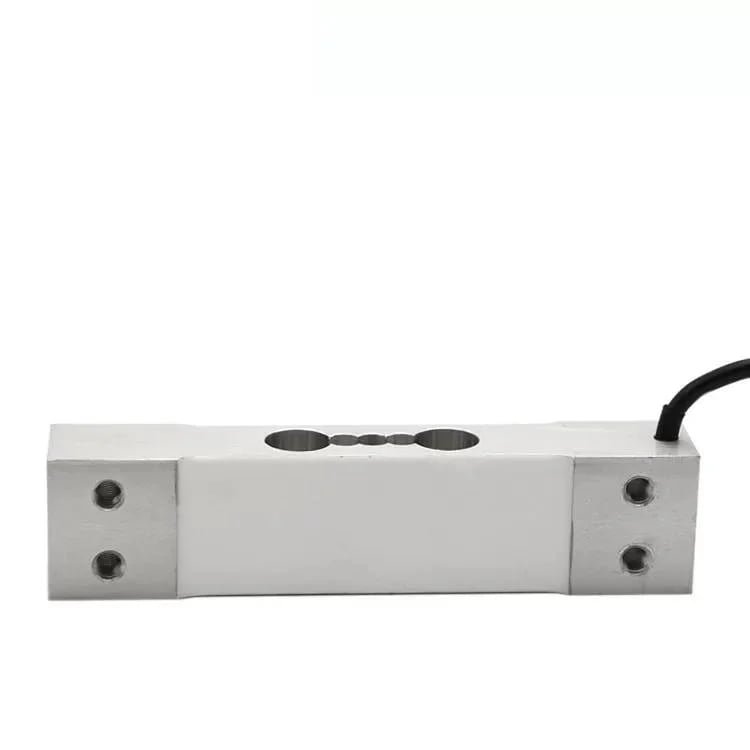

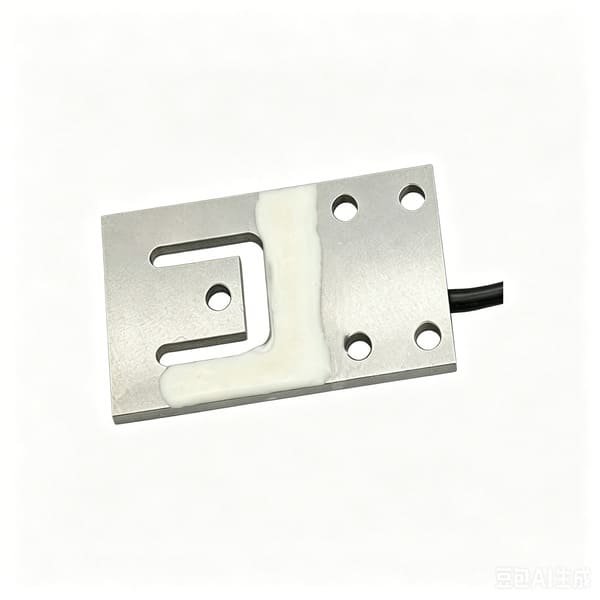
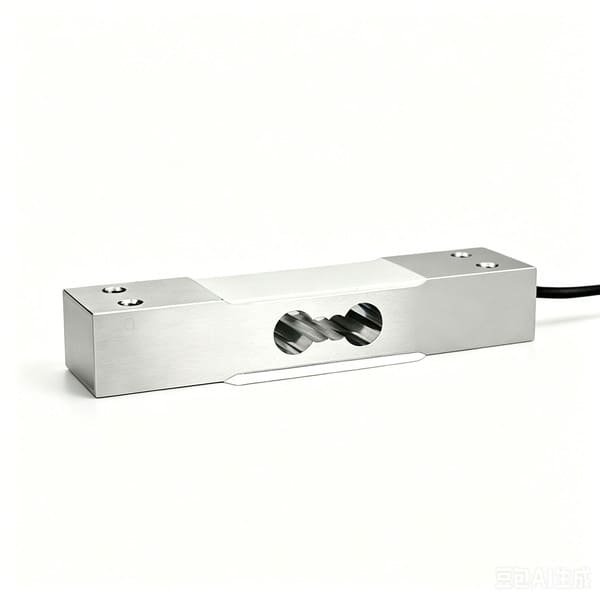
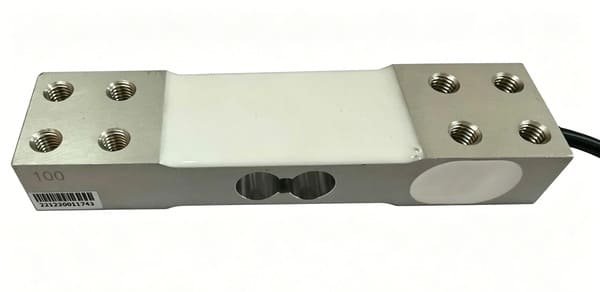
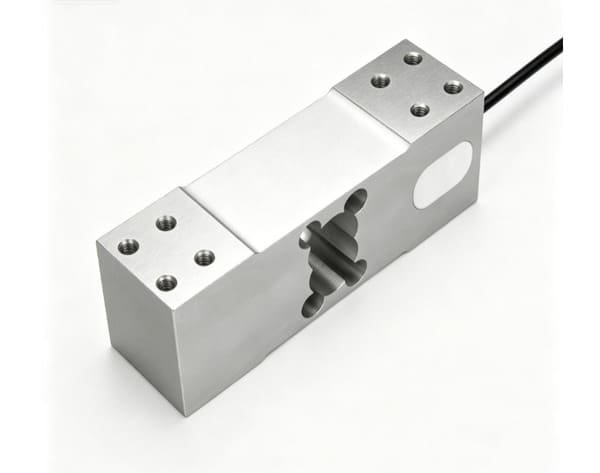
If you take one thing away from this article, take the constraint rather than the model. A self-service weighing station is a trade-approved scale with the operator deleted, which means every judgement that operator used to make — is this at zero, is this plate the same plate, is this weight worth arguing about — has to be answered by two integers, Max and e, and by the certificate of one load cell. Get those two right and the rest of the station is sheet metal and firmware. Get them wrong and no sensor on the market will rescue the design. Send me the drawing and the menu and I will do that arithmetic with you, including when the answer is that you do not need to buy anything from me.
Where I have quoted a standard rather than our own data, the source is the standard itself: the accuracy classes and the mpe staircase are from OIML R76-1 and the load cell classes and Y values from OIML R60; the direct-sales and zero-setting rules are from the same two documents; the food waste target is from the European Commission’s food waste pages; and the US marking and division rules are from NIST Handbook 44. The Dutch, Irish, German, Belgian, French and Polish cases are my own projects, and the names are omitted because the projects are theirs.
With those four I will come back with Max, e, Min, the money at the smallest legal bill and the capacity your platform actually needs — usually inside twelve hours. I make the sensing chain: load cells, force sensors, junction boxes and indicators. The counter, the display, the payment and the approval are yours, and I will tell you plainly where that line is.
Load cells, force sensors, junction boxes and weighing indicators