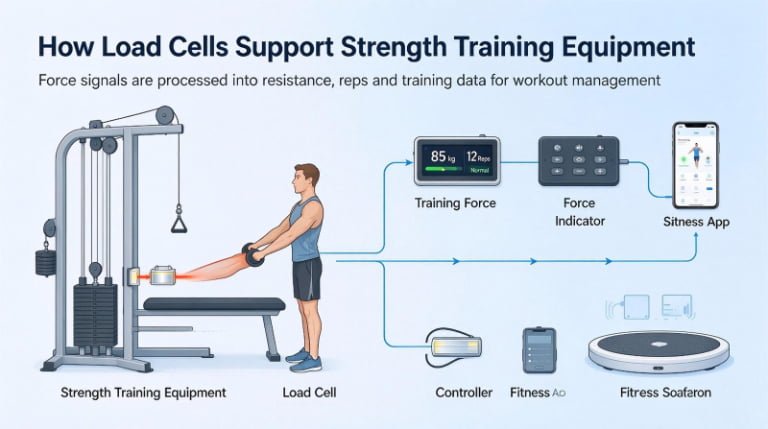


Four cells share a load unevenly, so one must be rated above its quarter share.
Every month I quote load cells for wheelchair scales, and every one of those enquiries opens the same way: a three hundred kilogram platform, four cells, one hundred gram divisions, please send your best price. That arithmetic is the first thing I have to argue with, because the number it produces is 75 kilograms per cell and the number the scale actually needs is 125. The second thing is harder. A load cell for wheelchair scale platforms is part of a legal measuring instrument, and the law governing it does not mention money anywhere. Here is the arithmetic, three projects, and the two offers I refused to write.
- A legal instrument before it is a scale
- Seven regulated purposes, and only one of them is a price
- What I supply, and whose signature is on the rest
- Where this sits beside the other patient-weighing jobs
- Four cells does not mean divide by four
- Three formulas that decide whether your cell can be legal
- The chair is the load
- Why four cells, and why one is impossible
- The low-profile cell you need is the one that drifts most
- What voids a reading, and what breaks a cell
- Two and a half microvolts, and where the twelve bits go
- The chair that sits on the platform for eight hours
- What the clinic actually does with the number
- Three projects, and the two quotes I did not send
- Five cells, five different jobs
- The twelve questions, and the habit that matters more
- Questions I get asked
1. A legal instrument before it is a scale
I have quoted cells into cash registers, belt weighers, filling nozzles, labellers and truck axles. Almost all of those conversations begin with the same question, which is what the load will be, and almost all of them end with an argument about price. A wheelchair scale is the only platform I quote where the useful argument happens before the mechanics, and it is not about price at all. It is about what the number is legally allowed to say.
The first time this landed on me I was standing in a physiotherapy room in the Netherlands with an integrator who had already built the platform and was shopping for four cells to go underneath it. His requirement list was two lines long: 300 kilograms, 0.1 kilogram divisions, four cells, aluminium, IP65, send the matching data with the delivery. He had the platform welded, the ramp cut, the handrails bent and the junction box bracket made. What he did not have was a reason to believe any of it was legal, because nobody had told him that a scale which weighs a patient is a regulated measuring instrument, and that the regulation is not the one he was expecting.
A load cell for wheelchair scale platform sits inside a machine that is doing three things at once. It is measuring a human being, so a medical device regime reaches it. It is measuring mass with a declared scale interval, so a legal metrology regime reaches it. And it is carrying a piece of equipment that weighs between seven and one hundred and eighty-one kilograms depending on whether it is manual, powered or a heavy-duty bariatric chair, so a mechanical regime reaches it as well. Only one of those three is mine to engineer. The other two are the reason I have to say no to things.
Is a price computed from this reading? On a supermarket scale, a belt weigher or a filling nozzle the answer is yes, and the whole apparatus of trade metrology follows. On most of the medical weighing projects I write about, the answer is no, and I conclude that the trade directives and OIML R76 do not apply. Here that shortcut fails. A wheelchair scale computes no price, and it is a regulated instrument anyway, under a directive whose wording names the weighing of patients directly. Section two quotes the sentence.
So the shape of this article is: the law first, then the mechanics, then the arithmetic. If you only want the number to give your platform designer, it is 125 kilograms per cell for a 300 kilogram machine with 100 gram divisions, not 75, and section five shows where the extra fifty comes from. If you want to know whether the cell will survive being rolled onto, section ten. If you want to know what a clinic does with the result once it has it, section thirteen, and it is not what most integrators assume.
One warning before the mechanics, because it is the most expensive mistake I see. Wheelchair scales get sold in two flavours that look identical on a quotation. One is a piece of fitness equipment with a display. The other is a verified class III instrument with a marking on it, and its platform, its indicator, its temperature compensation, its test procedure and its paperwork are all different. The cells underneath the two machines can be the same part number. The difference is not in the cell. It is in everything you have to prove once the cell is inside.
2. Seven regulated purposes, and only one of them is a price
In the European Union the instrument that governs non-automatic weighing is Directive 2014/31/EU, usually called NAWI. Its first article limits the directive to instruments used for a list of purposes, and the list is longer than most integrators expect. There are seven entries, and money is only one of them. The fourth reads: the determination of mass in the practice of medicine for weighing patients for the purposes of monitoring, diagnosis and medical treatment.
Read that sentence twice. It does not say trade. It does not say price. It says monitoring, diagnosis and medical treatment, and it puts the weighing of patients in the same article as the weighing of goods, eating side by side with commerce. Price is one of seven heads of regulated use, which makes it about fourteen percent of the reason a scale can become a legal instrument. Every medical weighing article I have written before this one concluded that the trade regime did not apply. This is the first one where it does, and it applies because of four words in a sentence about medicine.
| Question | Urine bag, syringe pump, incubator | Wheelchair scale, chair scale |
|---|---|---|
| Is a price computed from this reading? | No | No |
| Is the mass of a patient being determined? | Indirectly — fluid, not the patient | Directly |
| Does NAWI 2014/31/EU apply? | No | Yes, Article 1(2)(d) |
| Does MDR 2017/745 apply? | Yes | Yes, and with a measuring function |
| Who signs the conformity | The device manufacturer | Manufacturer plus a notified body |
What the marking on the machine actually says
A verified patient scale carries four things next to each other: the CE mark, the letter M, the year it was first put into service, and the four-digit number of the notified body that did the work. The M is the metrology suffix, and it is a different claim from the CE mark on the same label. If you are designing a scale for the European market and you have never seen an M on a nameplate, look at a hospital bed scale or an infant scale the next time you are in a clinic, because the M is the part your cell has to be capable of supporting, and the cell cannot supply it by itself.
There is a second detail that surprises people who come from the trade side of weighing. NAWI gives a presumption of conformity through harmonised standards, and the harmonised standard for non-automatic weighing in Europe is EN 45501. The OIML recommendations, including R76, are the international technical documents that sit behind it, and the OIML’s own published position is that its recommendations do not by themselves confer a presumption of conformity with the directive. The two documents are nearly identical on paper and are not interchangeable in a file. I mention this because a great many quotations I receive have an R76 test certificate in the attachments and a claim of European compliance in the cover letter, and the second does not follow from the first.
The German version, because it is the strictest one I sell into
Germany puts the directive into national law through its verification ordinance, and adds obligations that do not exist everywhere else. Medical scales used in hospitals fall into the group that must be verified again on a fixed cycle rather than once, and the cycle for patient scales in a hospital setting is four years. A newly acquired scale has to be declared for verification within six weeks of being put to use, not at the end of the financial year. The penalties for using an unverified instrument in a regulated setting reach fifty thousand euros, and the penalty for failing to declare a new one reaches twenty thousand.
The reason I care about the German numbers is not the money. It is that they explain a purchase pattern I could not otherwise account for. Twice now I have had a German integrator ask for a cell that is more accurate than his own stated specification, with the words, we would rather pay for margin than for a second verification. A four-year cycle means that every drift mechanism in the machine has four years to accumulate before anyone inspects it, and the cell’s zero temperature coefficient accumulates continuously from the day it is installed.
Medical device regulation 2017/745 also applies, because a scale intended to support monitoring or treatment is a medical device. A scale with a measuring function is class I, and class I devices with a measuring function are exactly the ones that cannot self-certify: the measuring function itself has to be assessed by a notified body. National metrology institutes describe the situation plainly, which is that a manufacturer of a medical scale has to satisfy both the weighing instrument directive and the medical device regulation, and the two are not alternatives to each other. Your technical documentation and your metrology file are separate documents, and a change to the cell touches both.
What follows from all of this for a cell supplier is narrow. Your cell has to have the metrological characteristics for the class you are claiming, a temperature behaviour that survives a four-year cycle, unit-to-unit consistency or your corner adjustment will not hold, and replaceability by an identical part after approval. That last one is why I keep the matching data on file and why I tell buyers to ask for it before they freeze a design, not after.
3. What I supply, and whose signature is on the rest
I export weighing components: load cells, force sensors, matched sets with the matching data in writing, summing junction boxes, transmitters and weighing indicators. I do not build scales, I do not hold a medical device registration, I cannot issue an EC type-examination certificate, and I cannot put an M on your nameplate. On a trade scale that boundary is a commercial fact. On a patient scale it is also a legal one, because the person who signs is the person who is responsible for the whole machine, and no component supplier can move that signature onto himself.
| What I supply | What I do not supply, and whose signature it needs |
|---|---|
| Load cells with the data sheet you will actually be judged on | The platform, frame, ramp and handrails — yours |
| Matched sets, with the matching data written down | The indicator, display and firmware — yours, from any supplier |
| Summing junction boxes, transmitters and weighing indicators | Corner adjustment, linearity and the verification test — yours |
| Mounting advice and the load path arithmetic underneath it | EC type-examination and the M marking — your notified body |
| The bridge resistance, the temperature coefficients and the insulation figure | The MDR technical file and the clinical claim — yours |
| A written answer when a number is missing from our product page | Every safety-rated function, including overload protection devices — not mine to sell |
| A refusal, in writing, when the thing you asked for is not mine to sell | Re-verification after four years and the six-week declaration — yours |
Two of the rows in that right-hand column deserve a sentence each, because they are where suppliers quietly overstep. The overload protection row is there because a wheelchair scale can find itself described as having a patient-safe limit, and the moment that limit is used to protect a person rather than a sensor it stops being a weighing component and becomes something I am not permitted to design. The declaration row is there because I have been asked, more than once, whether I could include a note in the shipment that would help a customer’s declaration. The answer is no. A document from a parts supplier describing a machine he has never seen is not evidence, and presenting it as evidence would be worse than sending nothing.
What I can do is narrower and more useful. If you send me the platform drawing, the capacity and the interval you intend to declare, I will tell you in writing which of the three metrology conditions in section six your chosen cell meets, which one it fails, and what capacity or class would satisfy all three. That is arithmetic on your numbers, not approval of your machine, and I will label it that way.
4. Where this sits beside the other patient-weighing jobs
We have published seven articles about weighing people and the fluids attached to them, and none of them is about load cells for wheelchair scales, so the fastest way to waste an afternoon is to read the wrong one. All of them are a human being on a sensor. None of them is the same problem, and the division that matters is whether the reading is a legal quantity, a clinical trend, or a control signal. The table sorts them.
| Application | What the reading decides | The problem that dominates it |
|---|---|---|
| Wheelchair and chair scales (this article) | A patient’s body mass as a declarable, verifiable quantity | A legal instrument with a movable 18 to 181 kilogram tare on it |
| Medical bed weighing | A body mass trend across days of fluid therapy | A living load that moves, on a fixed tare |
| Urine bag weighing | Whether a kidney is producing; a rising total | A three minute creep spec asked to hold for seventy-two hours |
| Syringe pumps | Whether a very small dose was delivered | Milligrams to micrograms, in a few millilitres |
| Infant incubators | Neonatal gain at a few grams a day, inside a warm chamber | Thermal gradients and a chamber you must not disturb |
| Baby scales | A static weight, read once, in a clinic | Cost, repeatability and a restless patient |
| Rehabilitation test rigs | Force, not mass, and a fatigue life rather than an accuracy class | Thousands of cycles, and a load that is never static |
| Medical devices, generally | The full walkthrough of a regulated OEM weighing component | Change control after approval |
The nearest neighbour is the medical bed, and the difference between them is the whole article. A bed scale is bolted under a bed that stays in one place. Its tare is large and constant, the patient arrives and leaves without the furniture moving, and the interesting error is the load’s own activity. A wheelchair scale has a tare that arrives with the patient and leaves with the patient, is between eighteen and one hundred and eighty-one kilograms, changes whenever someone hangs an oxygen cylinder on the back, and is standing on four feet whose exact positions you do not control because the chair is pushed on by hand. The bed’s tare is a number. The wheelchair’s tare is a piece of equipment.
The second boundary is against the urine article, and it is about direction rather than furniture. A urine bag accumulates. A clinician reads its total as evidence about an organ, no legal instrument is involved, and the sensor’s job is to not drift for three days. A wheelchair scale reads once, in a second, and the number is a legal quantity with an interval and a maximum permissible error attached. Same hospital, same corridor, and one reading is a measurement while the other is a certificate.
There is a home bathroom scale in our own catalogue whose cell is a half-bridge strip costing a fraction of anything in section fifteen. It is a good product and it sells. It cannot go in a wheelchair scale, and not because of its accuracy: it is a two-wire half bridge that expects a matched partner, its housing is not built to be walked on by castors, and nothing about the family is documented for a metrological file. If a quotation for your project contains a cell that looks like a bathroom scale part, ask what class it is offered under. The honest answer is usually none.
5. Four cells does not mean divide by four
Here is the sentence that starts almost every enquiry I answer, and the sentence I have started replying to with a question. A three hundred kilogram platform with four cells needs four seventy-five kilogram cells, because three hundred divided by four is seventy-five. It is arithmetic, it is correct, and it produces the wrong part number every time. The four cells do not carry three hundred kilograms. They carry everything that is standing on the frame as well, and they carry it unevenly.
The correct expression has five terms, and OIML R76 writes it in a form you can use directly. The sum is the maximum capacity you must declare, plus the dead load of the platform itself, plus the initial zero-setting range, plus the allowance for non-uniform loading, plus the tare you intend to place on it. Then you divide by the number of cells, and then you correct for the fact that the load does not sit in the middle.
| Term | What it is on a wheelchair scale | My working figure |
|---|---|---|
| Max | The declared capacity, printed on the nameplate | 300 kg |
| DL | Dead load: platform, channel frame, ramp, both handrails | 70 kg |
| IZSR | Initial zero-setting range: how far from zero the machine may be when the chair first rolls on | 20 % of Max = 60 kg |
| NUD | Non-uniform load: the corner allowance for a person sitting off centre | 20 % of Max = 60 kg |
| T | Tare plus distribution: a foot hanging off the edge, a load path that is not symmetric | 10 kg |
| Sum | What the four cells must support before the corner correction | 500 kg |
Five hundred divided by four is one hundred and twenty-five kilograms per cell. The seventy-five in the enquiry is too small by a factor of 1.667, and the failure mode of believing it is not a scale that reads wrongly on day one. It is a scale that passes its factory test, ships, and then starts going non-linear whenever a heavy patient sits on one side, because the cell that was supposed to be at 50 percent of its range is at 83 percent and the overload margin that the data sheet promised has quietly gone.
A four-cell platform is not four independent scales. It is a bridge circuit with four resistors in it, and the load shares between them according to geometry. If a patient sits on one corner, the two cells nearest that corner each take about thirty percent of the total and the far two each take twenty. The difference is five percent of Max per cell, and because two cells are on the heavy side, the pair carries an extra twenty percent of Max between them. That is where a quarter of the extra hundred kilograms in the table above comes from, and it is not something you can fix with a better indicator.
The same expression at three platform sizes
| Declared capacity | Sum of the five terms | Per cell, four cells | Cell I would quote |
|---|---|---|---|
| 150 kg (chair scale, 0.05 kg) | 255 kg | 63.75 kg | 75 kg |
| 300 kg (standard wheelchair scale) | 500 kg | 125.0 kg | 150 kg |
| 500 kg (bariatric, powered chairs) | 800 kg | 200.0 kg | 200 kg, or 250 kg if the frame is heavy |
The last column does not pick the cell just above the calculated number, because those numbers are not catalogue sizes. It picks the next size up, for the reason that applies to every weighing job: the calculated figure is the load the machine sees on its worst day, and the cell has to be comfortable there. Four 150 kilogram cells give 600 kilograms of cell capacity against a declared 300, a factor of 2.0, and 1.20 against the 500 kilogram sum. That is the margin you are buying, and it is the number I put in front of anyone who tells me a 300 kilogram scale only needs 300 kilograms of cells.
There is one more check that people forget, and it is the reason I ask for the ramp drawing. If the ramp is carried by the same frame as the platform, the ramp is part of the dead load and you have counted it. If the ramp is a separate structure that a wheelchair rolls across on its way in, it is not, and the transition at the joint is where the worst instantaneous load arrives. Section ten runs that number.
6. Three formulas that decide whether your cell can be legal
Everything in section five tells you what the cell has to carry. None of it tells you whether the cell is allowed to be there, and that is a separate set of conditions with a separate vocabulary. OIML R76 and EN 45501 express the relationship between a whole instrument and its individual load cells through three inequalities. I run all three on every wheelchair scale enquiry, and the third one is the one that changes people’s designs.
One. The minimum verification interval of the cell, divided by the number of cells and the reduction ratio, must not exceed the scale interval of the instrument. Written the other way round: vmin ≤ e × R / √N, where vmin is the cell’s minimum verification interval, e is your declared scale interval, R is the reduction ratio and N is the number of cells.
Two. The number of verification intervals the cell is rated for must be at least the number you are declaring on the machine: nLC ≥ n, and n is Max divided by e.
Three. The cell’s maximum capacity must cover its share of the five terms in section five: Emax ≥ (Max + DL + IZSR + NUD + T) × R / N.
Take the enquiry from section one: 300 kilograms, 100 gram divisions, four cells. The declaration gives n = 3000 intervals, which sits comfortably inside the range a class III instrument is allowed to occupy. The third condition gives 125 kilograms, which is 150 in catalogue sizes. So far everything is easy and the buyer is happy. The first condition is where the enquiry dies, and it is worth doing slowly.
For a set of several identical cells the reduction ratio is taken as one, which is the conservative choice, and with four cells the square root is two. So the limit on the cell’s minimum verification interval is one hundred grams divided by two, which is fifty grams. The 150 kilogram cell is rated class C3, which means three thousand intervals over its range, and its minimum verification interval is therefore 150 kilograms divided by 3000, which is exactly fifty grams. It satisfies the condition with nothing left over. Zero margin, and the reason is not a coincidence: a C3 cell of 150 kilograms and a class III instrument of 3000 intervals with 100 gram divisions are the same instrument seen from two sides.
| Cell capacity | vmin at class C3 | Limit for e = 100 g, N = 4 | Verdict |
|---|---|---|---|
| 150 kg | 50.00 g | 50 g | Exactly on the limit |
| 200 kg | 66.67 g | 50 g | Fails by 33 percent |
| 500 kg | 166.67 g | 50 g | Fails by 3.33 times |
| 1000 kg | 333.33 g | 50 g | Fails by 6.67 times |
| 2000 kg | 666.67 g | 50 g | Fails by 13.33 times |
The table has an unpleasant second reading: a bigger cell is not more capable, it is less. If the frame is heavy enough that the five-term sum pushes the per-cell figure to 200 kilograms, no class C3 cell of that size can support a 100 gram interval in a four-cell arrangement, however good it is. The way out is not a better cell of the same size. It is to buy a cell with a finer class, or to reduce the number of cells, or to accept a coarser interval. That is a sentence I have now written into three separate load cells for wheelchair scales quotations, and it has never once been the answer the buyer wanted.
The same inequality read backwards
Turn the first condition around and it tells you what the cell requires of you rather than the other way. For a 150 kilogram cell at 100 gram intervals and four cells, the cell’s own rating has to reach 3000 intervals, which is C3 and is what the data sheet says. Push the capacity up and the requirement climbs: 200 kilograms needs 4000 intervals, half a tonne needs 10000, a tonne needs 20000, two tonnes need 40000. Every one of those is a finer class than the one most people assume when they say, I will just use a bigger cell to be safe. On a verified scale, being generous with capacity is a way of failing the metrology.
| Cell Emax | nmax needed, e = 100 g, four cells | Finest e you can declare at C3 |
|---|---|---|
| 150 kg | 3000 (class C3) | 100 g |
| 200 kg | 4000 (class C4) | 133 g, so 200 g in practice |
| 1000 kg | 20000 | 667 g, so 1 kg in practice |
| 2000 kg | 40000 | 1333 g, so 2 kg in practice |
| Single cell, any size up to 300 kg | 3000 | 100 g |
That last row is the reason I am willing to discuss single-cell designs at all, and section eight explains why they do not survive the geometry. One cell has no square root and no reduction, so a 300 kilogram class C3 cell with 100 gram divisions is mathematically legal on paper. It is the platform that refuses.
What the accuracy class actually promises
Class III does not mean one accuracy. It means three, depending on where in the range you are, and the boundaries are expressed in intervals rather than kilograms. The first band runs from zero to five hundred intervals and carries a maximum permissible error of half an interval. The second runs to two thousand and carries one interval. The third carries one and a half. On our 300 kilogram machine with 100 gram intervals, those boundaries land at 50 kilograms and 200 kilograms, so the permitted error is fifty grams, then one hundred, then one hundred and fifty — not one hundred, which is what almost everyone assumes the last band is.
| Load on the platform | Intervals | Error at verification | Error in service |
|---|---|---|---|
| 0 to 50 kg | 0 to 500 | ±50 g | ±100 g |
| 50 to 200 kg | 500 to 2000 | ±100 g | ±200 g |
| 200 to 300 kg | 2000 to 3000 | ±150 g | ±300 g |
| Minimum load | 20 intervals | 2 kg, below which the instrument makes no accuracy claim | |
The in-service column is double the verification column, and it is worth understanding why rather than memorising it. The error a scale is allowed doubles once it leaves the workshop, because a verified instrument is permitted to drift through normal use and is expected to be brought back within the verification limits at its next inspection. On the German four-year cycle that means an instrument may legally sit two divisions and a half away from truth at the end of its cycle. Your cell has to have spent those four years not using up that allowance.
R76 does not tell you how much of the permissible error the cell is allowed to use. It gives you the condition instead: the sum of the squares of the fractions taken by each contributing module must not exceed one. With four identical cells the fair share is one divided by the square root of four, which is one half. So at the full-load band of ±150 grams, each cell may contribute 75 grams. That single number governs everything in section nine, and it is the number people skip.
7. The chair is the load
On a bathroom scale the person is the load and the tare is the plastic housing. On a wheelchair scale the tare is a steel and aluminium vehicle that arrives under its own power and leaves again, and on a powered chair it is heavier than the patient. Here are the ranges I work to, assembled from what chair manufacturers publish and from what I have seen on customers’ drawings.
| Class of chair | Mass | With an 80 kg patient | Share of the reading |
|---|---|---|---|
| Manual, standard | 16 to 20 kg | 98 kg | 18.4 percent |
| Manual, ultralight | 7 to 11 kg | 89 kg | 10.1 percent |
| Manual, heavy duty | 18 to 23 kg | 101 kg | 20.8 percent |
| Powered, portable | 23 to 45 kg | 125 kg | 36.0 percent |
| Powered, standard | 45 to 113 kg | 193 kg | 58.5 percent |
| Powered, bariatric | 113 to 181 kg and up | 281 kg | 64.4 percent |
Two things follow from that table and neither is about accuracy. The first is that a bariatric machine can be filled to two thirds of its capacity by a person who is not on it yet. In the 300 kilogram example the bariatric chair alone is 1810 divisions of a 3000 interval instrument, so the useful measuring range above it is only the last 1190 intervals, which is where the coarsest permissible error lives. That is an argument for a 500 kilogram platform even when the patients do not need one, and it is the argument I make when a customer wants to save money by declaring 300.
The second is that the tare is not stable. Oxygen cylinders, infusion poles, drainage bags, pressure cushions and footrests are added and removed by clinical staff all day, and they are added to the chair rather than to the patient. Five of them, one of each, come to 7.7 kilograms in the example I use with customers. Fifty of those are 77 intervals of a 100 gram instrument, and at a hundred kilogram load the permissible error is one hundred grams, so the accessories alone are seventy-seven percent of the permitted error at the working point. A single oxygen cylinder is thirty percent of it. The tare you entered when the machine was installed is stale before the first patient of the afternoon.
A scale that re-zeros itself on power-up is doing something reasonable on a parcel bench and something dangerous here. If the chair is standing on the platform when the instrument re-zeros, the chair becomes part of the zero and the patient’s mass is reported minus eighteen to one hundred and eighty-one kilograms. If the chair is wheeled off at the end of the round and the instrument re-zeros again, the two readings are on different zeros and are not comparable. The rule I give integrators is one sentence: zero must be established with the platform empty, and it must never be established automatically while a load is present. How your firmware knows the difference is your problem, and it is the single most valuable design decision in the whole machine.
8. Why four cells, and why one is impossible
Every few months someone asks why a wheelchair scale needs four cells when a single-point cell would need no corner adjustment, no summing box and no matching. It is the right question, and there is a single number that answers it. A single-point cell is specified for a maximum platform size, because the whole point of its construction is that it compensates for where the load sits. The big single-point cell in our own catalogue is rated for a platform of six hundred millimetres, and its smaller sibling for four hundred.
A wheelchair scale platform is not six hundred millimetres. Chairs are between six hundred and ten and six hundred and eighty-six millimetres wide, and a heavy-duty chair is seven hundred and sixty-two or more, and the platform has to be bigger than the chair with clearance on both sides because a patient is being pushed onto it by a person who cannot see the castors. The platforms I see in this market are eight hundred and fifty millimetres square, a metre square, or somewhere near a metre by a metre. Against a metre square, the largest single-point cell we make is two and a half times too small, and no amount of careful mounting changes that.
| Constraint | Number | Consequence |
|---|---|---|
| Platform size needed for a chair plus clearance | 1000 × 1000 mm | Four cells, corner adjusted |
| Largest single-point platform we offer | 600 × 600 mm | 1.67 times too small |
| Standard single-point platform | 400 × 400 mm | 2.5 times too small |
| Load per cell if one castor leaves the platform | 123.3 kg | 98.7 percent of the 125 kg the frame needs, 82 percent of a 150 kg rating |
| A 55 kg corner load, on one castor | 539.4 N | Sizes the mounting bolt, not the cell |
The castor is not a test weight
This is the part of the design that has caused me the most argument, and it is worth putting a number on because the number is startling. A castor touches the platform over a contact patch of roughly twenty by thirty millimetres. A fifty-five kilogram corner load over that patch is a contact pressure of about 899 kilopascals. The twenty kilogram test weight that will be placed on the platform during verification sits on a two hundred millimetre disc and produces 6.24 kilopascals. The castor presses about one hundred and forty-four times harder than the weight that certifies the scale.
The consequence is not that the cell fails. It is that the platform surface behaves differently under the two loads. A one metre wide plate in six millimetres of steel deflects about 3.1 millimetres under a mid-span corner load, and doubling the thickness to eight millimetres only brings that down to 1.3, which is still a visible dip and still a stiffer plate than most of the platforms I am shown. That is why every wheelchair scale I have seen that survives has a channel or box frame under the plate rather than a plate alone, and it is why the frame’s weight ends up in the dead load term in section five and costs you cell capacity. The plate and the cell are the same decision.
The ramps on this class of machine are around two hundred millimetres of rise at roughly twelve degrees, and the joint at the top of the ramp is where the transition happens. If the ramp is bolted to the platform frame, part of every chair’s weight is carried by the ramp and the load path through the frame changes at the instant the front castors reach the plate. If the ramp is a separate structure, the transition produces a step. Both cases are worth a drawing, and section ten turns the step into a number. What you must not do is model the machine as a static 300 kilogram mass on four points, because it never is one.
9. The low-profile cell you need is the one that drifts most
Section eight ended with a geometric requirement that decides which load cells for wheelchair scales you can actually use: the platform is a metre square, the underside clearance is a few centimetres, and the cell has to live in that gap without lifting the plate. In practice that means a planar beam cell, screwed flat to a channel frame, with a body a few millimetres taller than the plate. Our planar beam family has exactly the right form factor and exactly the wrong temperature coefficient, and the two facts are connected.
| Family | Model | Height | Temp effect on output |
|---|---|---|---|
| Planar beam, aluminium | WST1101 | Very low profile | ±0.05 %F.S / 10 °C |
| Planar beam, alloy steel | WST1103 | Very low profile | ±0.05 %F.S / 10 °C |
| Single point | WST203 | 40 mm | ±0.02 %F.S / 10 °C |
| Single point, large | WST204 | 60 mm | ±0.02 %F.S / 10 °C |
| Shear beam | WST301 | Taller again | ±0.02 %F.S / 10 °C |
The two low-profile cells drift two and a half times more than the cells that will not fit. That is not a defect in them; a planar beam bonded flat to a frame has a different thermal path from a free-standing single point with air around its body, and moving the strain gauge geometry closer to the mounting surface tends to move it closer to whatever temperature the platform frame happens to be. It is also not a reason to avoid them. It is a number to carry into the error budget, and the number is larger than most people expect.
Work it through on the 300 kilogram machine. The full-load band permits one hundred and fifty grams, and the R76 allocation from section six gives each of the four cells seventy-five grams. A 0.05 percent coefficient on a 150 kilogram cell is 75 grams for every ten degrees at rated load, which is the entire allowance in one step. At the actual working point of 125 kilograms per cell it is 62.5 grams, and four cells contributing in the same direction come to 250 grams for ten degrees, which is 1.667 times the permissible error of the instrument. A 0.02 percent cell gives 25 grams at the same point, or one hundred grams across four cells, which stays inside the one hundred and fifty.
| Condition | WST1101 / WST1103, 0.05 % | WST203 / WST204 / WST301, 0.02 % |
|---|---|---|
| Per cell at rated 150 kg, per 10 °C | 75 g | 30 g at rated |
| Per cell at the 125 kg working point | 62.5 g | 25 g |
| Four cells, worst case, per 10 °C | 250 g | 100 g |
| Against the 150 g full-load MPE | 1.67 times — fails | 0.67 of it — passes |
| Against the 75 g per-cell allocation | Used up in 12 °C of drift | Used up in 30 °C |
Twelve degrees is not a laboratory condition. It is the difference between a treatment room that has been at twenty-two all morning and a chair that has just come in through an ambulance entrance in February, or between a platform under a window and the same platform after the air conditioning has been running for an hour. Thirty degrees is the difference between a heated building and an unheated one. That is the whole distance between the two families, and it is why I ask about the building before I ask about the load.
The output coefficient moves the slope and is therefore proportional to the load. The zero coefficient moves the offset and is not. On the same 0.05 percent cell the zero term is 75 grams per ten degrees at rated load regardless of what is on the platform, so four of them worst-case come to 300 grams, which is two divisions. The saving grace is that a zero error can be removed by re-zeroing with the platform empty, which is a procedure rather than a part. It only stays harmless if your firmware never re-zeros with the chair on the platform, which is the rule from section seven. The slope error cannot be removed at all, and that is the one the coefficient column is about.
10. What voids a reading, and what breaks a cell
A load cell on a wheelchair scale does not see the weight of a chair and a patient. It sees whatever the castors deliver at the transition, and the transition is an impact. The size of that impact depends on one thing the platform designer controls, which is how far the load falls, and one thing he does not, which is how long it takes to stop. I model it the simple way, because the simple way gets the decision right: the castor falls a height, arrives with a velocity, and the platform and the castor’s own rubber bring it to rest in a short time. The load that appears is the static load multiplied by one plus the deceleration expressed in gravities.
| Event | Arrival speed | Dynamic factor | Peak, gross | Per cell |
|---|---|---|---|---|
| 10 mm lip, ramp joint, stopped in 15 ms | 0.443 m/s | 4.011 | 882 kg | 220.6 kg |
| 20 mm step, no ramp, stopped in 15 ms | 0.626 m/s | 5.257 | 1157 kg | 289.2 kg |
| Patient sitting down, 80 mm, stopped in 60 ms | 1.253 m/s | 3.129 | 313 kg | 78.2 kg |
The first row uses a 220 kilogram gross weight, which is a powered chair of 113 kilograms with a 107 kilogram patient in it. The peak is 882 kilograms and each of the four cells sees 220.6 kilograms, which is 1.47 times its 150 kilogram rating but only 98 percent of the 225 kilograms its 150 percent safe overload allows. The cell survives a ten millimetre lip with about two percent of margin. The second row is the same chair crossing a twenty millimetre step that nobody chamfered: 289 kilograms per cell, which is 28.5 percent past the safe overload and still inside the 200 percent ultimate overload of 300 kilograms, which means the cell will not break and will probably not come back to its calibration either.
The third row is the one that changes machine designs, and it is not a machine event at all. A patient lowering himself onto a chair that is standing on the platform, over a drop of eighty millimetres and arrested in sixty milliseconds, produces 313 kilograms of equivalent load from a hundred kilogram body. Add the eighteen kilogram chair standing there and the instrument displays a peak of about 331 kilograms, which is 10.3 percent above a 300 kilogram maximum, and the reading at that instant is out of range and therefore invalid. But look at the fourth column: each cell sees 82.7 kilograms, which is 55 percent of its rating. Nothing is stressed. Nothing is close to being stressed.
The overload that makes a wheelchair scale display nonsense is a patient sitting down. The overload that damages the hardware is a castor dropping off a step. On this machine the second is roughly five times the first in load terms, and the first is what happens ten times a day in a clinic while the second happens once, in the corridor, when nobody is looking. It also means that fitting a larger cell to stop the display going out of range is the wrong fix: the reading out of range is a firmware and platform geometry problem, and a heavier cell only moves the threshold. The cell is rated to survive a shock half of the instrument’s capacity again. It is your display logic that cannot.
I use these three rows as a design conversation, and it usually ends with the platform person revising the ramp rather than the buyer revising the cell. A chamfered transition of three or four millimetres instead of a step of twenty takes the worst realistic event from 289 kilograms per cell down below the 225 kilogram safe overload, and the fix costs a weld. Two other habits are worth writing into the drawing: a mechanical stop that prevents a castor from landing on a cell’s own mounting rib, and a handrail that is stiff enough that a patient does not use the platform edge as a grab handle on the way in. And keep a record of the first reading after any event of this kind, because the symptom of a cell that has been taken past its overload is rarely a dead channel; we publish a checklist for deciding whether a load cell is damaged and the first item on it is a change in zero return, not a loss of signal.
11. Two and a half microvolts, and where the twelve bits go
Everything so far has been about whether the cell is allowed to be there. This section is about whether your electronics can see it, and the answer contains one surprise that catches people who have only worked with single-point cells. Start with the signal. Four 150 kilogram planar beam cells, each rated at 1.5 millivolts per volt, excited at six volts, share a load of 500 kilograms. Each cell carries 125 kilograms, which is 83.3 percent of its range, so each produces 1.25 millivolts per volt, and the bridge output at full load of the machine is 7.5 millivolts.
| Converter | One code is | Divisions you can resolve | Verdict |
|---|---|---|---|
| 12 bit | 1.83 microvolts | 1.37 | Cannot see one division |
| 16 bit | 0.114 microvolts | 21.85 | Comfortable |
| 24 bit | 0.00045 microvolts | 5592 | Far past what the cell justifies |
One division of a 100 gram interval is 2.5 microvolts at the bridge, and separating 3000 divisions needs 11.55 bits of clean resolution, so the frequently quoted rule of thumb that a verified scale wants sixteen bits is right. What surprises people is the top row. A twelve-bit converter has one code per 1.83 microvolts, which is coarser than the 2.5 microvolt division it is supposed to be counting, so it resolves 1.37 divisions across the whole instrument. A 12-bit design is not marginal on this machine; it cannot display the interval it promises.
The single-point cell would have given you more signal
Here is the surprise. The single-point cell that the geometry in section eight forced us to abandon has a rated output of 2.0 millivolts per volt, and at six volts that is 12 millivolts across its own range. If a single cell could carry the platform, each 100 gram division would be 4.0 microvolts, which is sixty percent more signal per division than the four-cell set produces. The arrangement we are obliged to use is the one with the smaller output, and it is smaller because 1.5 millivolts per volt is what a planar beam is made at, not because anyone chose it. It is not a problem at sixteen bits. It is worth knowing before you specify a four-and-a-half digit display and wonder why the last digit moves.
Four bridges in parallel, and what that does to a battery
Planar beam cells also have higher bridge resistances than the single-point family, and on a mains-powered machine that is irrelevant. On a portable chair scale with a battery in the handrail it is the second largest decision in the design. Four 1090 ohm bridges in parallel present 272.5 ohms, and six volts across that is 22 milliamps and 132 milliwatts. Four 406 ohm bridges, which is what the single-point family has, present 101.5 ohms and draw 59 milliamps, which is 2.68 times as much. On the same 2000 milliamp-hour battery that is the difference between ninety hours and thirty-four.
| Bridge, four cells | Parallel resistance | Current at 6 V | Life on 2000 mAh |
|---|---|---|---|
| 1090 ohms, WST1101 and WST1103 | 272.5 ohms | 22.0 mA | 90.8 hours |
| 406 ohms, WST203 and WST204 | 101.5 ohms | 59.1 mA | 33.8 hours |
| 375 ohms, WST301 | 93.75 ohms | 64.0 mA | 31.3 hours |
The second consequence is less obvious and bites in the field. Four 1000 ohm output bridges in parallel present 250 ohms to the indicator, against 87.5 ohms for the 350 ohm family. That is three times the source impedance, so every ohm of cable, connector contact and junction box terminal contributes three times the offset error it would on the low-impedance set. On a machine where the summing box sits in the frame a metre from the cells, that is a real number and it is why I ask for the wiring drawing rather than assuming it. We publish a step-by-step guide to junction box wiring and adjustment that covers the terminals and the corner trim procedure, and the summation hardware I quote for this class of machine is the stainless multi-channel box in section fifteen.
12. The chair that sits on the platform for eight hours
A wheelchair scale takes thirty seconds to do its job, and the creep specification on the cell is quoted over five minutes or thirty. The temptation is to conclude that creep is irrelevant here, and for a single weighing it nearly is. Thirty seconds is one tenth of a five minute window, and the 0.02 percent of full scale that a cell is allowed to creep over five minutes is 30 grams on a 150 kilogram cell, which is 0.3 of a division and sits inside the 0.5 division allocation from section six.
The assumption that breaks is the one about how long the load stays on. In a day room or a physiotherapy suite the chair is not removed between patients; it is parked on the platform while the therapist does something else, and eight hours on the platform is ninety-six of the five minute windows the data sheet is describing. A specification expressed as a limit over five minutes does not tell you what the reading will be after eight hours, and I will not extrapolate it, because creep is not linear in time and the return-to-zero after the load comes off is the number the next patient’s reading depends on.
Load your worst-case weight on the platform, leave it there for the length of your longest working day, and record the reading and the return to zero afterwards. The return to zero is the number that matters, because that is what the next patient inherits. I will write the method and the sampling interval; you run it on your own units, because three samples from a supplier are not evidence in a technical file. It is the same procedure I recommend for the four-year cycle in section two, and it is the one page of this article I would most like you to take away.
Two practical points from real machines. First, the creep windows differ between the families in section nine: the planar beam cells quote five minutes, the shear beam quotes fifteen, and the single-point cells quote thirty. That is not a quality ranking, it is what each family’s manufacturer chose to publish, and it means a five minute figure and a thirty minute figure are not comparable numbers even when they look identical. Second, a chair left on a cold platform and then brought into a warm room makes the platform itself move, and on a frame that is bolted at four points that movement appears in the reading. Neither of these is a reason to change the cell. Both are reasons to define what settled means in your own procedure, and to write it into the operating instructions rather than leaving it to the operator’s judgement.
13. What the clinic actually does with the number
The reason a wheelchair scale is a legal instrument is not that a regulator enjoys paperwork. It is that the number ends up in a decision, and the decision has a threshold on it. The clearest example is dialysis. A haemodialysis session removes fluid, the amount removed is prescribed, and the rate at which it is removed is expressed per kilogram of the patient’s body mass per hour. The clinical term is ultrafiltration rate, and it is computed as the volume removed divided by the product of dry body mass and treatment time in hours.
Take a sixty kilogram patient and three litres over four hours. That is 12.5 millilitres per kilogram per hour, and the published quality threshold that dialysis units work to sits at thirteen. It is not a soft threshold: cohort studies associate rates above it with roughly seventy percent higher cardiovascular mortality, and the practical rule for a single session is to remove no more than three to five percent of body mass, or about five kilograms, whichever is lower. Dry weight is then adjusted in steps of 0.2 to 0.3 kilograms between sessions, which on our machine is two to three divisions.
The same clinical example, with three different assumptions about body mass. Three litres over four hours, patient nominally 60 kilograms.
If body mass is known to plus or minus 0.5 kilograms, the computed rate runs between 10.42 and 14.58 millilitres per kilogram per hour, which straddles the threshold and turns a clinical decision into a coin toss.
If body mass is a verified class III quantity with a 100 gram interval, the same arithmetic runs between 11.67 and 13.33, which still touches the threshold but narrows the band by sixty percent.
And if the patient is weighed in the chair rather than out of it, all three numbers are wrong by whatever the chair and its accessories weigh, which is the eighteen to one hundred and eighty-one kilograms of section seven.
Read that block again, because it is the reason I am willing to spend a whole article on a platform that looks trivial. A verified instrument contributes an uncertainty of 6.67 percent to a three litre fluid shift. The clinical convention that surrounds it, the plus or minus half a kilogram that a ward works to, is 16.67 percent. The legal instrument is more accurate than the decision it feeds, and the decision is what the patient experiences. Buying a better cell than section six requires will not move the outcome. Weighing without the chair, on the same platform, in the same session as the previous reading, will.
I am not a clinician and I do not give clinical advice. What I can say is what falls out of my own arithmetic. The value of a wheelchair scale to a dialysis unit is not its resolution; it is that the reading is taken the same way every time, by staff who did not have to decide where the patient was standing. That is a design property, and it is bought in section seven and section fourteen, not in the accuracy class.
14. Three projects, and the two quotes I did not send
Case one: the Netherlands, and a platform that was already welded
This is the physiotherapy room from section one. The integrator had built everything and needed four cells. His requirement was 300 kilograms, 100 gram divisions, four cells, low profile, IP65. He had asked three suppliers and received three quotations for 4 × 100 kilogram cells, which is what three hundred divided by four rounds up to in most catalogues. He sent me the same request and I sent back a question about the frame instead of a price.
The frame weighed sixty-eight kilograms including the ramp that was bolted to it, and the platform was 1050 by 972 millimetres. Adding the maximum, the dead load, the initial zero range, the corner allowance and a ten kilogram distribution term gave 498 kilograms, and 498 divided by four is 124.5, so the cell is a 150 kilogram part and not a 100 kilogram one. He had the drawings in front of him while we spoke and he re-did the sum himself, which is the version of this conversation I prefer.
The interesting part came next. Low profile pointed at the planar beam cells, which are the only ones that fit in the sixteen millimetres he had left under the plate, and those carry a temperature coefficient of 0.05 percent of full scale per ten degrees on both output and zero. At 124.5 kilograms per cell that is 62 grams for ten degrees on the slope, and four cells adding the same way is 250 grams against a permitted error of 150 grams at the heavy end. He asked me to send the 0.02 percent cells from the single-point family anyway. I explained that the largest single-point cell we make is rated for a 600 millimetre platform, and his platform is over a metre, so those cells would have been correct on temperature and wrong on geometry by a factor of more than 1.6.
What he did about it is worth copying. He kept the planar beam cells and attacked the thermal path, because the temperature problem was not the cell’s coefficient but the frame’s thermal time constant. The channel frame and the plate were lagging the room by more than an hour, so a machine that had been in a cold corridor read differently from one that had been in the treatment room all morning. He put a temperature sensor on the frame, characterised the lag with the platform loaded, and compensated in firmware with a first-order model. That is his work and his file, not mine, and I told him so in writing. The instrument verified at class III with 3000 divisions and shipped.
One consequence came back six months later and it is the best illustration of section six I have. He wanted to launch a 500 kilogram bariatric version of the same machine and declare 100 gram divisions on it, because the two models would then share an indicator setting. That is 5000 intervals on a machine whose five-term sum is 800 kilograms, which needs 200 kilogram cells, and a class C3 cell of 200 kilograms has a minimum verification interval of 66.67 grams against a limit of 50. The 500 kilogram model cannot declare 100 grams in a four-cell class III arrangement. No cell exists that would let it. He declared 200 gram divisions on the bariatric model, which gives 2500 intervals and lets a 250 kilogram C3 cell pass with room to spare, and the two models now have different indicator settings and a note in the manual explaining why.
Case two: Germany, and the twenty gram resolution I would not homologate
A hospital group in Germany asked for a chair scale that would read to twenty grams so that the 0.2 to 0.3 kilogram dry weight adjustments in section thirteen could be seen as ten or fifteen counts on the display. The engineering is not the problem; a 300 kilogram platform with a 20 gram interval is 15000 divisions, and the classes a non-automatic weighing instrument may occupy put a ceiling on that number. Fifteen thousand is above the ceiling for class III, and the machine cannot be a legal instrument at that resolution.
I quoted two things instead of one. The first was a 300 kilogram, 100 gram verified instrument that satisfies section six and can carry an M. The second was a separate trend channel on the same platform: an unverified internal resolution of ten grams, clearly labelled in the manual and on the screen as a trend and not a measurement, with no legal claim attached to it and no verification of it. The medical physics department accepted that split and it is the honest one. The number a clinician uses to see a trend and the number a regulator verifies do not have to be the same number, provided the machine never confuses the two. What I would not do is put 20 grams on the nameplate of a verified instrument, and no arithmetic in this article would have made that legal.
Case three: a machine that had already shipped, and failed at the heavy end
A manufacturer in Turkey had built a 300 kilogram, 100 gram wheelchair scale and sent it for verification. It passed at the light end and failed at the heavy end, and the failure appeared as a non-linearity that grew with load. His cells were 200 kilogram class C3 parts bought from another supplier, and his first message to me asked for a matched set of the same capacity with tighter matching data, because he had concluded that the cells were inconsistent.
The matching data would not have helped, and the reason is one line of section six. A 200 kilogram class C3 cell has a minimum verification interval of 66.67 grams, and a 3000 interval instrument with 100 gram divisions and four cells imposes a limit of 50 grams. His machine was outside the condition before any cell was mounted, and no amount of matching changes a class. He had two ways back inside: a finer cell class, or a per-cell figure below 150 kilograms.
He chose the second, which is the cheaper one, and he found it by weighing his own frame. It came to 94 kilograms with the ramp, against the 70 I had assumed for a platform of that size, and taking forty kilograms out of the frame brought the five-term sum from 524 to 484 and the per-cell figure from 131 to 121. He re-declared with 150 kilogram cells, re-tested, and passed. The lesson he wrote back to me is the one I would put on a wall: the frame you design decides which cells you are allowed to use, and it is much easier to move the frame than to move an accuracy class.
First: a matched set of 200 kilogram cells to retrofit case three. He asked for it twice and it would have been an easy sale, because the parts were available, the price was acceptable and his story about inconsistent cells was plausible. It would also have been wrong. The class of the cell was the problem and a supplier who sells around that problem is selling a second failure.
Second: a statement that a named set of our cells was suitable for use in a class I medical device with a measuring function. I was asked for it in exactly those words, on a customer’s letterhead, so that it could go into a technical file. I supply load cells. I do not assess medical devices, I do not hold a notified body designation, and a component supplier’s opinion about a machine he has not seen is not evidence. What I sent instead was the specification, the matching data, the test method I would use if he wanted to characterise the cell himself, and a note saying which of the three conditions in section six the set meets on the numbers he gave me. That note is arithmetic, it is useful, and it is not a certificate.
15. Five load cells for wheelchair scales, five different jobs
These are the five parts I would put in front of a wheelchair scale builder, and each one carries the limitation that matters as well as the specification. Read the small print under each card before the specification list, because on this application the limitation is usually the deciding factor and the specification list is not. Note what none of them is: none of these is a medical device, none carries a medical certification, and none of them can put an M on your nameplate. What they carry is a millivolt output, a temperature coefficient, an overload figure and a bridge resistance, and those are the four numbers your design will actually argue about.
| Model | Type | Ranges | Temp coeff | Safe / ultimate | For a 1 m platform |
|---|---|---|---|---|---|
| WST204 | Single point, large | 200 to 1000 kg | 0.02 % | 120 % / 150 % | Too small by 1.67 times |
| WST203 | Single point | 100 to 300 kg | 0.02 % | 120 % / 150 % | Too small by 2.5 times |
| WST1101 | Planar beam, aluminium | 7.5 to 600 kg | 0.05 % | 150 % / 200 % | Fits — my default here |
| WST1103 | Planar beam, alloy steel | 1 to 3 t | 0.05 % | 120 % / 150 % | Unverified platforms only |
| WST301 | Shear beam | 0.1 to 5 t | 0.02 % | 150 % / 200 % | Fits only at 100 kg per cell |
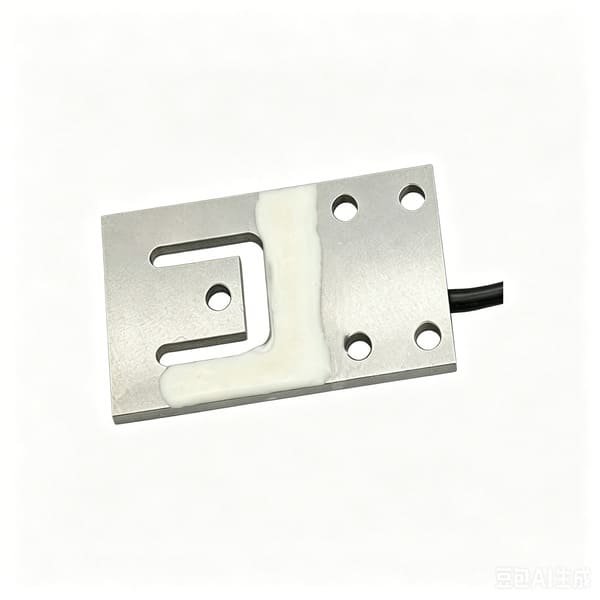
WST1101
- Rated loads 7.5, 15, 30, 75, 150, 300, 600 kg; aviation-grade aluminium, anodised
- Comprehensive error 0.05 %F.S, IP65, safe overload 150 %F.S, ultimate 200 %F.S
- Rated output 1.5 mV/V at 150 kg and above; input 1090 ± 30 Ω, output 1000 ± 10 Ω
- Zero balance ±0.05 mV/V, creep ±0.02 %F.S per 5 minutes, excitation 6 to 12 VDC
The 150 kg range satisfies the first condition in section six with exactly zero margin, which is the same thing as saying it is the correct part for a 300 kilogram class III machine and not a lucky one. The page text names low-profile infant and adult medical scales directly, so the application is not a stretch. Its costs are three. The temperature coefficient is 0.05 percent on output and on zero, which is two and a half times the single-point family, and it is the number that decides whether your platform needs a temperature model. The creep window is five minutes, shorter than the single-point cells at thirty. And the page body writes its accuracy as 0.05 percent of rated output while the specification table writes it as 0.05 percent of full scale, which for this part are the same number but should be confirmed in writing before you freeze a declaration.

WST204
- 174 × 65 × 60 mm, rated for a 600 × 600 mm platform, anodised aluminium
- Rated loads 200, 300, 500, 1000 kg; accuracy class C3; comprehensive error ±0.02 %F.S
- Rated output 2.0 ± 0.15 mV/V; input 406 ± 20 Ω, output 350 ± 5 Ω; IP65
- Compensated range −10 to +60 °C, the widest of the five; creep 0.02 %F.S per 30 minutes
The best temperature behaviour in this article at half the coefficient of the planar beam cells, and it cannot be used, which is why it is in the list. Its rated output of 2.0 mV/V also gives sixty percent more signal per division than the four-cell set, and section eleven is the section that explains what you give up by not being able to use it. Its costs are the platform limit of 600 millimetres, a zero balance of plus or minus 1.0 percent of full scale which is 10 kilograms on the 1000 kilogram range and must be absorbed by the initial zero-setting range, and the lowest safe overload of the five at 120 percent. If your platform is 600 millimetres or less, this is the cell I would argue for over the planar beam.
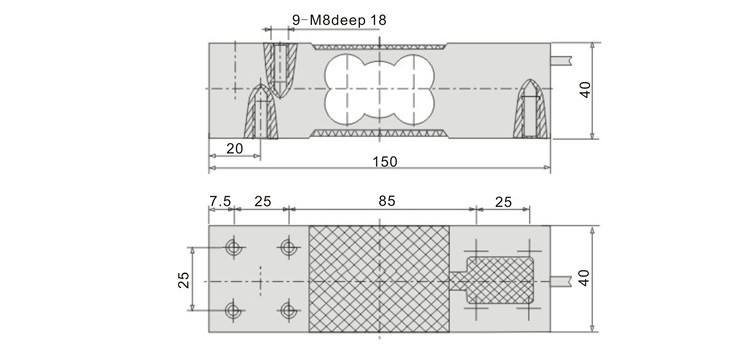
WST203
- 150 × 40 × 40 mm, rated for a 400 × 400 mm platform, anodised aluminium
- Rated loads 100, 200, 300 kg; accuracy class C3; comprehensive error ±0.02 %F.S
- Rated output 2.0 ± 0.15 mV/V; input 406 ± 20 Ω, output 350 ± 5 Ω; IP65
- Temp effect 0.02 %F.S per 10 °C on output and on zero; creep ±0.02 %F.S per 30 minutes
The one-cell answer, and the smallest part here that reaches 300 kilograms. Its page names the smart hospital bed, which is the closest thing in our catalogue to patient weighing, and its 0.02 percent coefficients are the ones you want. Its costs are geometry and electricity. A 300 millimetre platform is what it is rated for, so it is only a candidate for a single-cell chair scale or a step-on platform, and its 406 ohm bridge draws 2.68 times the current of the planar beam cells, which is the difference between 34 hours and 91 hours on the same battery. Its 300 kilogram range also carries a minimum verification interval of 100 grams, so the finest interval it can support in a single-cell class III machine is 200 grams.

WST301
- Rated loads 0.1, 0.2, 0.3, 0.5, 1, 2, 2.5, 3, 5 t; alloy steel or stainless steel
- Accuracy class C3; comprehensive error ±0.02 %F.S; rated output 2.0 or 3.0 ± 0.005 mV/V
- Safe overload 150 %F.S, ultimate 200 %F.S; operating range −35 to +80 °C, the widest here
- Input 375 ± 10 Ω, output 350 ± 5 Ω, cable 3 m, insulation ≥ 5000 MΩ
The part for a heavy bariatric platform, for a machine that lives somewhere unheated, and for anything that has to survive the shock in section ten with margin. Its 150 percent safe and 200 percent ultimate overload are the highest here and its operating range covers a cold loading bay. Its costs are height and interval. It is the tallest of the five, so it does not go under a platform that has to sit low to the floor. And the capacity you pick decides its class III interval: the 100 kilogram range has a minimum verification interval of 33.3 grams and four of them can declare 100 gram intervals, which caps a verified machine at about 250 kilograms of capacity, while the 200 kilogram range has a minimum verification interval of 66.67 grams and cannot support the 50 gram limit that a 300 kilogram machine at 100 gram intervals imposes. Its page title says 500 kilograms to 2 tonnes while the specification table starts at 100 kilograms, and the 375 ohm bridge is the lowest resistance here.

WST1103
- Rated loads 1, 2, 3 t; alloy steel, anodised; very low profile; matched output
- Comprehensive error 0.02 %F.S; rated output 1.8 ± 0.2 mV/V; IP65; excitation to 18 VDC
- Zero balance ±2 %F.S; input 1090 ± 30 Ω, output 1000 ± 5 Ω, cable 1 m
- Temp effect 0.05 %F.S per 10 °C on output and zero; creep ±0.02 %F.S per 5 minutes
The alloy steel flat pack, for a very heavy platform that still has to be thin, and it shares the 1090 ohm bridge of the WST1101 so its current draw is equally gentle. It is also the one part here I would not put on a verified wheelchair scale, and I am including it because it is the part most often proposed for bariatric machines and the arithmetic says no. Its 1 tonne starting range gives a minimum verification interval of 333 grams, so in a four-cell arrangement the finest interval four of them can declare is 667 grams, which is a one kilogram interval platform at about two tonnes: a bed or trolley weighing platform, not a chair scale. Its real job here is a heavy thin platform that makes no legal claim at all, and the two other numbers on its page are the ones I would want in writing first. Its zero balance is plus or minus 2 percent of full scale, the widest here, which is 20 kilograms on the 1 tonne range and needs the largest initial zero-setting range of any part in this article. And its page carries a 0.02 percent combined error beside a 0.05 percent temperature coefficient, which is a combination I have not seen on a competitor’s sheet.
Whichever cell you pick, three components around it are mine as well and are worth quoting at the same time, because buying them separately is how a machine ends up with a summing box that has never been opened. The WST1513 stainless multi-channel junction box is the summation and corner-trim part for a four-cell platform, and it is the piece that makes the difference between a scale and four independent sensors. The WST1501 weighing indicator is the display and the zero logic that section seven is about. And if you would rather not have four analogue bridges at all, the WST1208 digital platform cell moves the conversion into the cell, which changes the cabling, the summing question and the noise budget all at once.
16. The twelve questions, and the habit that matters more
This is the list I work through on every wheelchair scale enquiry before I send a part number, in the order I ask it. Most of it is not about the cell, and that is the point of it. If this is your first weighing project rather than your tenth, the complete guide to load cells covers the vocabulary in sections five, six and eleven from first principles.
| # | Question | Why it changes the part |
|---|---|---|
| 1 | Maximum capacity and scale interval, in writing? | These two numbers generate everything in section six |
| 2 | Will the machine be verified, or is it a trend display? | Decides whether the metrology conditions apply at all |
| 3 | Frame and ramp dead load, in kilograms, from a drawing? | The single largest term after Max |
| 4 | Platform size, and the height available under the plate? | Eliminates single point cells above 600 mm |
| 5 | How many cells, and where does each load path land? | Sets N in all three conditions |
| 6 | Which chairs will actually use it, from 7 kg to 181 kg? | Sets the tare range and the useful interval count |
| 7 | Which accessories get hung on the chair, and by whom? | 7.7 kg is 77 percent of the permitted error at 100 kg |
| 8 | Room temperature range, and where it is stored overnight? | Decides 0.05 percent against 0.02 percent |
| 9 | Ramp rise and angle, and the transition detail at the top? | Turns into the impulse table in section ten |
| 10 | Where is zero established, and can firmware prove the platform was empty? | The auto-zero is the error you install yourself |
| 11 | Battery or mains, and how many hours between charges? | Bridge resistance is a battery decision, 91 against 34 hours |
| 12 | Who signs the M, and who files the declaration within six weeks? | Not me, and it is better to know that before the order |
Weigh the frame before you buy the cells. Every project in section fourteen turned on a frame weight, and in two of the three the customer’s estimate was wrong by more than twenty kilograms. A frame is steel you already own; a load cell is a purchase order, a lead time and sometimes a minimum quantity. Ten kilograms off the frame at 300 kg capacity is 2.5 kilograms off each cell, and 2.5 kilograms is sometimes the entire difference between a class C3 part and a class C4 part that does not exist yet.
And write the scale interval down before you draw the platform. The interval decides the class, the class decides the cell, and the cell decides how much frame you are allowed to have. Every one of the three cases in section fourteen was really a decision about the interval that had been taken casually and never revisited.
17. Questions I get asked about load cells for wheelchair scales
What load cell capacity do I need for a 300 kg wheelchair scale?
Not 75 kilograms per cell. Three hundred is only the first of five terms. Add the dead load of the platform and frame, the initial zero-setting range, the allowance for non-uniform loading and a distribution term, and a platform-and-ramp set that weighs 70 kilograms with a 20 percent zero range and a 20 percent corner allowance comes to 500 kilograms, which is 125 kilograms per cell. In catalogue sizes that is a 150 kilogram cell. Four of them give the machine 600 kilograms of cell capacity against a declared 300, which is a factor of 2.0 and about 1.2 against the 500 kilogram sum. If your quotation says 100 kilogram cells for a 300 kilogram platform, the supplier has divided by four and stopped.
Does a wheelchair scale need OIML or MID approval?
It needs European verification, and the instrument is NAWI, Directive 2014/31/EU, not MID. MID covers automatic and trade instruments; a wheelchair scale is a non-automatic weighing instrument. What brings it inside NAWI is the fourth of the seven regulated purposes in Article 1(2): the determination of mass in the practice of medicine for weighing patients for the purposes of monitoring, diagnosis and medical treatment. No price is computed from the reading and the directive applies anyway, which is the opposite of every other medical weighing application I write about. In practice you need a notified body, a CE mark with an M, the year of first putting into service and the body’s four-digit number, and conformity is presumed through the harmonised standard EN 45501 rather than through OIML recommendations, which the OIML itself states do not carry that presumption. MDR 2017/745 applies at the same time, and a class I device with a measuring function cannot self-certify that function. An OIML R60 certificate on the cell is available and transfers no compliance with any of it.
Can I use one single point load cell instead of four cells?
Only if the platform is small. A single point cell compensates for where the load sits, and that compensation is rated for a maximum platform size. Our standard part is rated to 400 millimetres and our large one to 600, and a wheelchair platform has to be wider than a chair with room to push it on, which in this market means 850 millimetres square or a metre square. Against a metre, the large cell is 1.67 times too small and the standard one is 2.5 times too small. The single point route is real for a step-on chair scale or a single-cell pedestal, and it has one genuine advantage: 2.0 millivolts per volt gives sixty percent more signal per division than the four planar beam cells do. For a platform a chair rolls onto, four cells and a summing box is the answer.
Why can I not declare a 20 gram interval on a 300 kg scale?
Because that is 15000 intervals and a non-automatic weighing instrument in class III is limited to 10000. The ceiling is a property of the class, not of your electronics, and no cell and no converter can lift it. Two honest routes exist. Declare a coarser interval on the verified instrument and keep a finer, clearly labelled trend channel alongside it that makes no legal claim; or move the whole machine into a finer class, which changes the cell, the test procedure and the conformity route. What I will not do is print 20 grams on the nameplate of a verified instrument, and I turn that request down whenever it comes. Remember the context, too: the clinical arithmetic a scale like this feeds is worked to plus or minus half a kilogram, which is 25 of your 20 gram divisions.
How many bits of ADC does a verified wheelchair scale need?
Separating 3000 divisions needs 11.55 bits of clean resolution, and with four planar beam cells at 1.5 millivolts per volt and six volts of excitation the bridge delivers 7.5 millivolts at full load, so one 100 gram division is 2.5 microvolts. A twelve-bit converter puts one code per 1.83 microvolts, which is coarser than the division it is counting, and resolves 1.37 divisions across the whole instrument, so it cannot display the interval the machine promises. Sixteen bits gives 21.85 times the resolution you need and is the sane answer. Twenty-four bits gives 5592 times and buys you nothing the cell can justify, because the coefficient in section nine is thirty times larger than the converter’s contribution. The signal is small because the profile is low, not because the cells are poor.
Will a wheelchair rolling onto the platform damage the cells?
A ten millimetre lip does not: a 220 kilogram chair and patient arriving at 0.443 metres per second and stopping in 15 milliseconds peaks at 4.011 times static, which is 882 kilograms gross and 220.6 kilograms on each cell, or 1.47 times the rated 150 kilograms and 98 percent of the 225 kilograms a 150 percent safe overload allows. A 20 millimetre step does: the same event peaks at 289.2 kilograms per cell, which is 28.5 percent past the safe overload and still under the 200 percent ultimate, so the cell survives and its calibration may not. The counter-intuitive case is a patient sitting down heavily, which produces a 331 kilogram display reading that is out of range and therefore invalid while each cell is only at 55 percent of its rating. The overload that voids a reading is not the overload that threatens the hardware, and a chamfered ramp transition fixes the first one for the price of a weld.
Why do the low-profile cells have worse temperature coefficients than the others?
Our planar beam cells are quoted at 0.05 percent of full scale per ten degrees on both output and zero, and the single point and shear beam families at 0.02 percent. A cell bonded flat to a channel frame sits on a very different thermal path from a cell standing free in air, and the families that must be thin are the families with the larger coefficient. On a 300 kilogram class III machine the R76 allocation gives each of four cells 75 grams at the heavy end, and the 0.05 percent cell spends all of it in twelve degrees of drift while the 0.02 percent cell takes thirty. Twelve degrees is a treatment room against a cold corridor, so this is not a laboratory concern. The output term moves the slope and cannot be zeroed away; the zero term is 300 grams across four cells but a re-zero with an empty platform removes it.
Can you supply the complete scale, the indicator and the alarm as well?
The junction box, the indicator and the transmitter, yes; the scale, no. I supply load cells and force sensors, matched sets with the matching data in writing, summing junction boxes, weighing indicators and transmitters, and the mounting advice and arithmetic that goes with them. I do not supply the platform, the frame, the ramp, the firmware, the corner adjustment procedure, the verification test, the EC type-examination, the M marking, the MDR technical file or the clinical claim, and I supply nothing that performs a safety-rated function. There is a second reason beyond competence: my letterhead cannot carry your conformity. A parts supplier’s written opinion about a machine he has never seen is not evidence in a technical file, and if you ask me for one, I will send you the specification, the matching data and the test method instead.
The declared maximum capacity and scale interval, and whether the machine will be verified or is a trend display. The frame, ramp and handrail dead load from a drawing, not an estimate. Platform dimensions and the clearance under the plate. The number of cells and where each load path lands. The chairs that will actually use it, from a 7 kilogram transfer chair to a 181 kilogram bariatric powered chair, and which accessories get hung on them. The room’s temperature range and where the machine sleeps. The ramp rise and the transition detail at the top. And where your firmware establishes zero. I will come back with the capacity and the per-cell figure from the five-term sum, whether your chosen cell passes the three conditions in section six and which one it fails, the cell’s share of the permitted error against the drift in section nine, the overload numbers from section ten on your own ramp, and a written note on the parts of your design that are not mine to sign. If the load cell is not your limiting factor, that will be the first line of my reply.
VektorForce · load cells, force sensors, junction boxes and weighing indicators · www.vektorforce.com · Robin@vektorforce.com