

Consumer Scales · Half-Bridge Cells · Body Fat, Bathroom and Baby
The load cells in a bathroom scale measure weight, never body fat.
Nearly every enquiry I get for a load cell for bathroom scale work opens the same way: one cell, 150 kg, what is your price. In six years I have quoted that exact part once, and it was for a livestock platform. A bathroom scale does not work like that. It runs on four small half-bridges that share the load, and the arithmetic that governs the whole thing is one line long — four times the capacity, twice the signal. That single line decides what you can build, what it costs, and why the cell with body scale printed on its own product page is usually the one you should not buy.
What this guide covers
- Why the cell marked “body scale” is the least accurate one in the family
- Four half-bridges, one display: the capacity rule nobody asks about
- What “0.1 kg” on the glass actually promises
- The two errors that live in the room: corners and temperature
- A body fat scale does not measure body fat with the load cell
- The baby scale is the harder instrument, not the simpler one
- Stepping on: 272 kg, half a millimetre, and 2.5 mm of height
- Choosing load cells for bathroom scales: six parts and eleven questions
- Who regulates a bathroom scale, and who does not
- The six cells I quote for this family
- Questions buyers actually send me
Why the cell marked “body scale” is the least accurate one in the family
Almost every enquiry I get for a load cell for bathroom scale work arrives with the same three numbers attached: capacity, division and price. Capacity is nearly always 150 kg. Division is nearly always 100 g. Price is always the problem. Nobody opens with the question that actually decides the design, which is how many cells.
That gap is not the buyer’s fault, because my own catalogue quietly encourages it. One of the pages I sell from is titled, in full, WST105 Low price body scale use half bridge miniature load cell weight sensor. Search my site for a body scale cell and that is what you find, and that is what you buy. It is also the least accurate member of the whole micro family. The bathroom-scale page, WST102, is six times tighter on comprehensive error and three times tighter on thermal zero drift. Both pages say bathroom or body scale. Only one of them is usually the right part.
| Product page wording | Comprehensive error | Zero drift | Repeatability |
|---|---|---|---|
| WST105 — “body scale” | ±0.3 %F.S | ±0.3 %F.S/10 °C | ±0.2 %F.S |
| WST102 — “bathroom scale” | ±0.05 %F.S | ±0.1 %F.S/10 °C | ±0.05 %F.S |
| WST106 — “body scale, medical scale, pet scale” | ±0.3 %F.S | ±0.3 %F.S/10 °C | ±0.1 %F.S |
I want to be plain about why that happened, because it is not an accident. The volume buyer for body fat scales is the most price-driven customer in consumer weighing. He ships in container quantities into channels where a small difference in bill of materials decides the order, and he is judged on returns, not on specifications. The correct answer for that brief is the cheapest part that will not come back through the door. WST105 is built for exactly that brief: manganese steel instead of aluminium alloy, a wider total error, four cells to a set, and a price that reflects all of it. There is nothing dishonest in that page. It is an honest part for an honest requirement.
The trouble starts one step later. The same customer moves up to a body fat scale with electrodes and an app, decides he is now building something clinical, and asks me for fifty grams. That request is backwards, and chapter five shows the arithmetic that proves it. What he should be asking for is consistency across a room that swings ten degrees and a platform that flexes under a foot — and that is a WST102 conversation, not a WST105 one.
The one question I ask before quoting. Is a price computed from this reading? If yes, the instrument is a legal measuring device and the whole conversation changes. If no — and for every scale in this article the answer is no — then the sensor is selected on mechanics, temperature and consistency, and I have nothing to sell you but the arithmetic. Bathroom scales, body fat scales and baby scales all answer no. That single answer is why they are the least regulated, most price-pressured, and most casually specified instruments I quote.
Four half-bridges, one display: the capacity rule nobody asks about
A half-bridge load cell is not half a sensor. It is a complete sensor with half the gauge complement. Two strain gauges are bonded to the beam, one in tension and one in compression, and they are brought out on three wires: a common leg and two signal legs. In a bathroom scale, four of those cells sit at four corners, and the wires are chained so that the four half-bridges together form one full Wheatstone bridge. The common legs carry excitation and signal; the two signal legs of neighbouring cells are joined in a ring. The manufacturer supplies them as a matched set of four for that reason.
What follows from that arrangement is not obvious and is worth memorising. It is published in the standard application notes, but almost nobody reads it before asking for a quotation. For load cells for bathroom scales, this one table is the whole design brief.
| How you build the bridge | Total capacity | Who uses it |
|---|---|---|
| One half-bridge plus two fixed resistors | 1 × single cell | Prototypes, tiny single-point platforms |
| Two half-bridges | 2 × single cell | Narrow scales, luggage platforms |
| Four half-bridges, one per corner | 4 × single cell | Every bathroom and baby scale |
So the capacity rule is trivial: four cells of 50 kg give you a 200 kg platform. Which means a 150 kg bathroom scale does not contain a 150 kg load cell. It contains four cells of about 37.5 kg each, and since catalogue capacities come in discrete steps — 10, 30, 50, 75, 100 — you cannot buy 37.5. You buy 50, and you end up with 200 kg of capacity under a scale that will never see more than 150. That is a third more capacity than you needed, and you pay for it twice: once in the purchase price of the larger cell, and again in the next paragraph.
The rule that surprises people: four times the capacity, only twice the signal
A single half-bridge in this family is rated about 0.6 mV/V at its own rated load. Buyers assume that chaining four of them multiplies the output four times, the same way it multiplies the capacity. It does not. The application note is explicit: with four half-bridges in a set, total capacity is four times the single cell, and total output sensitivity is twice the single cell. Four cells at 0.6 mV/V give you 1.2 mV/V across the whole platform — not 2.4.
Dividing one by the other tells you the real price of the half-bridge architecture. On a 200 kg platform you get 1.2 mV/V for 200 kg, which is 0.006 mV/V per kilogram. A single full-bridge cell of 50 kg at 1.0 mV/V gives you 0.020 mV/V per kilogram. Per kilogram of load, the four-cell half-bridge platform delivers about a third of the signal a single full-bridge cell of comparable capacity delivers. You are not buying a cheaper version of the same signal. You are buying a different signal and paying for it in gain.
Why the second rule exists. Two half-bridges make one full bridge, so the pair already gives you the full four-arm response. Going from two cells to four does not add arms — it adds corners. The electrical sensitivity stops growing; the mechanical capacity keeps growing. Anyone who has designed a 4-corner platform has met this and assumed the datasheet was wrong. It is not wrong. Sensitivity scales with the number of active arms, and capacity scales with the number of support points.
What this looks like in a real order
In March 2024 a scale maker in Manaus, Brazil, sent me a drawing of a glass bathroom platform and asked for a quotation on one load cell, 150 kg, IP65. He wanted one because one is easier to install than four, and because a single-point cell is how he had always seen it done in industrial bench scales. I sent back four cells of 50 kg, a wiring diagram, and a note that said, in effect: you cannot buy the part you asked for, and you would not want it if you could.
His reply is the reason I keep writing these articles. He asked what happens to his platform if he mounts one cell in the middle instead. The honest answer is that a central cell puts the entire load path through one point, which forces the glass to be stiff enough to spread a foot’s load across the whole plate without bending the plate into the cell. A 6 mm glass panel on a central pillar is not a design; it is a lever with a person on the end of it. Four corner cells let the panel work as a panel: each cell sees roughly a quarter of the load, the panel spans between supports, and the glass can stay thin because it is not carrying a point load in the middle.
He ordered the four-cell set. Two things still had to be solved, and both of them are the subject of the next two chapters: the four cells do not share the load equally unless the panel is stiff, and their zero offsets add up in a way that the input circuit has to absorb.
The zero-offset point, briefly. Each half-bridge in this family carries a zero balance of about ±0.3 mV/V against a rated output of 0.6 mV/V. That is a zero offset of up to half the rated signal, per cell, before you have put anything on the platform. Four of them chained together present the amplifier with an offset that can exceed the entire load signal. Every commercial scale handles this in software or with a trim network, and it is normal practice — but if you are designing your first platform and your ADC has a fixed input range, this is the number that will make you think the cells are faulty.
What “0.1 kg” on the glass actually promises
When a buyer specifies load cells for bathroom scales he usually hands me one number and calls it accuracy. There are four different numbers in a scale datasheet hiding behind that word, and separating them fixes most of the arguments I have about specifications.
| The word | What it actually means | Typical value here |
|---|---|---|
| Display division | The last digit on the LCD. A property of the display, not the sensor. | 100 g |
| Resolution | The smallest change the electronics can see. Usually much finer than the display. | about 18 g, noise-limited |
| Minimum load (single cell) | The smallest mass one cell will register at all. | about 5 g on a 50 kg cell |
| Accuracy | How close the reading is to the truth, including everything else in the machine. | often 100 to 600 g |
The industry figures for this family are published in our own application notes and they are unusually honest about the gap. A micro cell with a 50 kg rating lists a minimum load of 5 g. The same notes state the minimum load for a complete body scale as 50 g. Ten times worse, on the same sensor, because a scale is four cells, a panel, four cables, a summing junction and a flexing structure. The single-cell number is a property of the beam. The system number is a property of everything you build around it.
0.1 kg on the glass is not a promise about 0.1 kg. It is a promise that the display has room for that digit. A scale that shows 150.0 kg has told you nothing about whether it can tell 150.0 from 150.3. The two numbers that would tell you are the repeatability and the corner error, and neither of them appears on the box.
Turning percentages into grams on a real platform
This is the calculation I run for every buyer, and it takes thirty seconds. Take four cells of 50 kg, so a 200 kg platform, and convert each cell’s comprehensive error into grams at its own rated load. Then add them up two ways: arithmetically, assuming every cell errs in the same direction, and as a root-sum-square, assuming they err independently.
| Cell used | Per cell | Worst case, four agreeing | Typical, errors independent | In display divisions |
|---|---|---|---|---|
| WST102, 0.05 % | 25 g | 100 g | 50 g | 1 division |
| WST105, 0.3 % | 150 g | 600 g | 300 g | 6 divisions |
Read the last column out loud the next time someone asks you for a cheap cell. The sixty-dollar saving on the parts buys you a scale whose reading is allowed to move six display digits under a load you cannot see changing. Not six grams. Six hundred.
And no, the ADC is not your problem
Buyers with an engineering background usually push back here and say they will simply fit a better converter. So let us do the signal arithmetic and settle it. Four cells of 50 kg at a combined 1.2 mV/V, excited at 3 V from two cells in series, produce 3.6 mV at 200 kg. That is 18 microvolts per kilogram. A 24-bit delta-sigma converter of the kind that sits in every consumer scale, running at gain 128 and 10 samples per second, has an input-referred noise in the region of 50 nanovolts RMS. Divide one by the other and the noise floor lands at 18 grams peak to peak on a 200 kg platform.
Eighteen grams, against a display division of a hundred. The converter is roughly five times finer than the display it is feeding. If you are chasing a problem in a bathroom scale, the problem is almost never the converter. It is the four-angle error and the thermal drift, and those are the next chapter.
The two errors that live in the room: corners and temperature
A bathroom is the most hostile room in a house for a weighing instrument, and it has nothing to do with water. It has the widest temperature swing of any room with a scale in it, it has a hard tiled floor that transmits every unevenness into the platform, and it is the one room where people stand in a different place every single time.
Corner error: standing left versus standing right
WST105 publishes a four-angle error of 1.0 %F.S. On a 50 kg cell that is 500 g: put the same load on one corner and then on the diagonally opposite corner, and the reading is allowed to differ by half a kilogram. On a 150 kg bathroom scale, that is a third of a percent of the working range — and it is five display divisions.
Consumers notice exactly this and describe it as the scale being unreliable. They are right. They stood slightly differently. The panel flexed slightly differently. One corner took more of their weight than it did last time, and that corner has a wider error specification than the others. WST102 does not publish a four-angle figure at all, which is a gap I will come back to in the model notes — but its much tighter comprehensive error and much better matched set mean the corners behave more consistently, and consistency is the whole game here.
Temperature: four cells on one board move together
This one is worse than buyers expect, and it is arithmetic rather than opinion. WST105 has a zero drift of ±0.3 %F.S per 10 °C. Four of them share one small board, so they see the same temperature and they drift together. If all four drift the same way, which is the case you must design for, the platform drift is four times the single-cell figure: 1.2 %F.S. On a 200 kg platform that is 2.4 kg of reading for a ten degree change in the room.
Here is why ten degrees is not a thought experiment. A bathroom sits at perhaps 20 °C in the morning and reaches 30 °C or more after a hot shower with the door shut. Ten degrees is one shower. If you have a cheap four-cell platform with WST105 underneath, that shower is worth up to 2.4 kg on the display, and no amount of software filtering can remove it because it is a real, slow, monotonic change in the sensor output.
| Cell | Zero drift per cell | Four drifting together, on 200 kg | Independent, on 200 kg |
|---|---|---|---|
| WST105 | ±0.3 %/10 °C | 2 400 g | 1 200 g |
| WST102 | ±0.1 %/10 °C | 800 g | 400 g |
| WST1101 | ±0.05 %/10 °C | 400 g | 200 g |
There is also a window problem that has nothing to do with the drift figure. The half-bridge micro family is rated for −10 to +40 °C. WST1101 and WST215 are rated −20 to +60 °C. A bathroom in southern China in summer passes 40 °C. A bathroom in an unheated northern European flat in February sits near 15 °C, which is fine, but a bathroom on an unconditioned site or in a shipping container in transit does not respect that rating. If your market includes either end of that range, the wide-window planar part is not the expensive option. It is the only option that keeps its specification.
Three legs beat four, and this is counter-intuitive. A platform on three supports is statically determinate: each support takes a share set purely by geometry, and there is exactly one way for the panel to sit on them. A platform on four supports is over-determined, which means the load split between the four cells depends on how flat your panel is, how flat your floor is, and how much each foot compresses. That is why four-corner scales need corner adjustment and three-corner scales often do not. Our own planar-beam page states it directly: most planar beams are not corner-adjusted, and using three or four of them is an alternative to a single-point cell with the bonus of an unlimited platform size.
How this actually goes wrong in the field
In February 2025 a customer in Lodz, Poland, sent me a video. Two people stood on his prototype scale, one after the other. Person A weighed 78.4 kg. Person B weighed 82.1 kg. Then person A stepped back on and weighed 79.0 kg. He was ready to blame the cells.
I asked him for one more thing before I would discuss the sensor: put a fixed weight on each corner in turn, write the four readings down, and tell me the room temperature at the start and at the end. The four corner readings differed by 420 g and the room had gone up four degrees over the sequence. Both numbers are inside the specification of the cells he had. He had not bought a faulty sensor. He had bought a 1.0 % four-angle error and a 0.3 %-per-ten-degrees drift, and then designed a product where both of them were visible to the user.
The fix cost him nothing on the sensor side. We changed the mounting so the panel loaded the four corners more evenly, added a short stabilisation delay before each reading, and moved to WST102 for the next build. The original cells went into a product where the user never stands on the same spot twice in the same sequence. Same sensor, different instrument, and the complaint disappeared. I have written about that pattern before — in the smart home products field notes it showed up as a load cell blamed for a housing that was flexing, and the lesson has not changed since.
One more thing about a good idea
Before leaving this chapter I want to flag the corner-adjustment junction box, because buyers assume it is always the answer. A trim box lets you balance four corners electrically. It is genuinely useful on industrial platforms where the panel is heavy and the load splits unpredictably. On a thin glass bathroom scale it is usually the wrong tool, because the imbalance is not static — it changes as the panel flexes under a moving foot. Trim the corners and you have trimmed them for one standing position. Spend the money on a stiffer panel and better-matched cells instead, and use the junction box guide only where the platform really is the problem.
A body fat scale does not measure body fat with the load cell
This is the part of the conversation that changes orders, and it is the reason the previous three chapters matter. A body fat scale contains two instruments that have almost nothing to do with each other. One is a weighing platform. The other is a bioelectrical impedance analyser wearing the platform as a pair of electrodes.
The impedance half works by passing a small alternating current through the body and measuring how much it resists. Lean tissue is mostly water and conducts well; fat resists. A typical foot-to-foot consumer scale drives perhaps half a milliamp at around 50 kHz through two electrodes under the heels and reads the resulting impedance across two electrodes under the toes, which lands somewhere between 400 and 700 ohms on a normal adult. From that impedance, plus your height, weight, age and sex, a regression equation estimates fat-free mass, and body fat percentage is what is left over. The load cells never touch the number that the product is named after. They supply one of five inputs to an equation that is, by published comparison against DEXA scanning, wrong by three to five percentage points under controlled conditions and considerably more in ordinary use.
The number that settles the argument. Take the published BMI-based estimate, which is the most favourable case for the load cell: body fat percentage moves by about 0.39 points for every kilogram of body weight in a 70 kg, 1.75 m adult. Home impedance scales repeat to within roughly 2.5 points, and studies of day-to-day variation report swings of two to four points driven almost entirely by hydration. One kilogram of weight is therefore worth about a sixth of the noise that the impedance measurement already contains.
Turn that around and it becomes a purchase specification. If you want the weighing half of a body fat scale to contribute no more than 0.1 percentage point to the final number, the weight has to be right to about 255 g. Not 50 g. Two hundred and fifty-five grams, and that is to hold the weighing error down to a tenth of a point inside a measurement whose own repeatability is twenty-five times larger. Run the same arithmetic on the 600 g worst case from the error budget above and it is worth 0.235 points — still an order of magnitude inside the noise the impedance channel already carries. Every gram you chase below a quarter of a kilogram is money spent on a number that your own algorithm will drown.
The order where I had to argue against my own quotation
In June 2025 a customer in Dongguan sent me a specification sheet for a smart body fat scale. Under sensor requirements it said, in English, accuracy ±50 g, must be high precision. He had written that sheet himself, and he was proud of it, and he wanted me to quote a cell that met it.
I could have sold him something and let him find out later. Instead I sent him back the impedance arithmetic and one question: what is the repeatability of his own impedance channel, in body fat points? He did not know, so I told him the published range. Two to four points, day to day, mostly hydration. He went quiet for a day. Then he wrote back one line: then why am I buying fifty grams?
That is the correct question, and the answer moved his budget to where it belonged. We kept WST102 for the platform, because consistency was worth paying for, and we spent the difference on the two things that actually move impedance repeatability: electrode geometry and panel stiffness. Which brings me to the second reason a body fat scale needs a stiff platform, and it has nothing to do with weight.
The electrodes are printed on the thing that flexes. Consumer body fat scales put their electrodes on the same glass the user stands on, usually as a thin transparent conductive layer under the surface. That layer is brittle. If the panel bends under a foot, the conductive layer can micro-crack, and a micro-crack changes the contact impedance in a way that no amount of load cell quality can compensate. This is why a body fat scale is more sensitive to panel stiffness and corner support than a plain bathroom scale, and why four well-matched corner cells beat one central cell here for a completely different reason than the one in chapter two.
What a body fat scale actually needs from its load cells
Not absolute accuracy. Three things, in this order.
- Repeatability, so the same person in the same condition reads the same number. This is the +0.05 % family, not the +0.3 % family.
- Corner consistency, because a body fat scale is used twice in a row by a person who never stands in the same place, and the second reading is compared with the first.
- Drift stability across the ten-degree swing of a bathroom, because the user’s baseline is whatever the scale said yesterday morning.
Notice that all three are about the instrument agreeing with itself, and none of them is about the instrument agreeing with a reference kilogram. That is the shape of the whole consumer weighing market. If you want to go the other way and build something that is compared against a reference, that conversation looks like the medical device projects rather than this one, and the load cell stops being the interesting part.
The baby scale is the harder instrument, not the simpler one
Buyers treat baby scales as the easy end of this family. Lower capacity, smaller platform, fewer features, therefore easier. The reverse is true, and the arithmetic takes two lines to show.
| Instrument | Capacity | Division | Divisions |
|---|---|---|---|
| Bathroom scale | 150 kg | 100 g | 1 500 |
| Baby scale | 20 kg | 10 g | 2 000 |
The baby scale asks for a third more divisions than the bathroom scale, out of a quarter of the capacity, and it does it with a subject that will not lie still. Our own application notes give the standard presentation of a baby scale as 20 kg capacity, 10 g division, minimum load 50 g, powered from 3 V, with a recommended cell of 20 kg per cell in a set of four. That last number deserves a second look, because four cells of 20 kg make an 80 kg platform under a 20 kg baby.
Why four times the capacity for a twenty kilogram baby. Because the baby does not stay in the middle. A baby scale is the only weighing instrument I know of where the load actively moves to a corner while you are reading it. If you sized the four cells at the total capacity divided by four, one cell would be at its rated load whenever the baby rolled onto it, with no margin for the impulse of the roll itself. Sizing each cell at the full platform capacity is not waste — it is the only sizing that survives a kicking subject.
That same logic is why the planar beam cell with matched outputs is attractive here. A baby scale is read as a trend — the clinic weighs the same infant weekly and plots the line — so a 10 g change between two visits has to mean something. If the four corners disagree, the trend line has a sawtooth in it that is purely geometric. WST1101 exists in the range that covers this: from 7.5 kg up to 600 kg per cell, with matched output as a stated feature, aluminium alloy, and a profile designed for equipment that needs to be thin. It is used three or four per scale, and our own page names low-profile infant and adult medical scales as a target application.
I have written separately about the two markets this instrument sits between. The consumer side is the baby scale field notes from Indonesia, where a 20 kg, four-cell half-bridge set is the entire specification. The clinical side is weighing a patient you never take out of the bed, where the same arithmetic runs against a much tighter error budget. A baby scale sits exactly on the line, and which side of it your product lands on is a regulatory question rather than an engineering one. If your scale calculates a growth percentile and shows it to a clinician, you have an intended medical purpose and the conversation moves. If it shows a number and a smiley face, it is a consumer product. Chapter nine covers where that line is drawn.
A note from a customer in Dubai
A distributor in Dubai asked me in 2024 for a baby scale cell that would hold 10 g at 20 kg, then added that his market was hot and humid and the scales sat in clinics without air conditioning. That sentence changed the part. Ten grams at 20 kg is 0.05 % of full scale, which is reachable, but it is reachable on a cold bench with a stable room. In a clinic at 40 °C with the door opening all day, the zero drift dominates. We quoted WST102 for its 0.1 % per ten degrees rather than chasing the resolution figure, and we specified the cells with the compensation range stated on paper so his technical file would not overstate the window. He wanted 10 g. What he needed was a scale that still read 10 g at the end of the afternoon.
Stepping on: 272 kg, half a millimetre, and 2.5 mm of height
Everything above assumes the load arrives gently. It does not. A person stepping onto a bathroom scale arrives with a small drop and a fast stop, and the sensor sees the peak, not the average.
The impact arithmetic
Take a 90 kg adult whose foot drops 50 mm before it stops. The velocity at contact is the square root of twice gravity times the drop, which is 0.99 m/s. The force depends entirely on how long the stop takes, and the relationship is the impact factor equals one plus velocity over gravity times stop time.
| Stop time | Impact factor | Equivalent load from a 90 kg adult | Against a 200 kg platform |
|---|---|---|---|
| 50 ms | 3.02 × | 272 kg | above the 120 % safe overload |
| 20 ms | 6.05 × | 544 kg | 81 % above the 150 % ultimate |
| 10 ms | 11.10 × | 999 kg | more than three times the ultimate |
Read that middle row twice. A 90 kg person stepping onto a 200 kg platform can generate 544 kg of momentary load if the stop takes twenty milliseconds, which is an ordinary number for a bare foot on glass. The platform is rated 200 kg. Its safe overload is 120 %, so 240 kg. Its ultimate overload is 150 %, so 300 kg. The impact is 81 % beyond ultimate. The cell survives it because the pulse is far too short to heat or yield the beam, and because the load is shared across four cells — but the margin you thought you had does not exist, and any design that adds preload, a stiff foot, or a step-up entry makes it worse.
Four questions before you set the overload spec. Does the user step up onto the platform, or shuffle on from floor level? Is the platform on a hard floor or a carpet that lets it settle? Do people in your market wear shoes indoors? And does your firmware let the scale auto-zero between users, which means the second person in a row arrives onto a platform that is already loaded? I have seen a returned batch explained entirely by the fourth question.
Half a millimetre of travel, and one millimetre of clearance
A micro load cell of this family deflects very little at rated load. Our own application notes put the maximum travel at 0.5 mm and recommend leaving at least 1 mm of clearance in the assembly. That ratio is the whole mechanical design brief for a bathroom scale, and it explains most of the assembly faults I see.
Half a millimetre is invisible. You cannot see the sensor move, which means you cannot see it bottom out either. If the panel, the foot or a screw touches the beam before it reaches full load, the cell stops reading and the scale caps out early in a way that looks like an electronics fault. If the mounting is too soft, the panel takes the load before the cell does and the reading is low and non-linear. Both failures look identical in the field: a scale that reads correctly at 20 kg and refuses to go past 80.
The standard mounting for a four-cell platform is stated simply in the same notes: the cell is fixed at both ends, the middle is left free, the load point faces down, and the load is applied from above through a plate. Cells for this market come with or without an integrated foot and load button, and both work — the version with a foot is simply a support point that has already been designed for you. If you are designing your own foot, the only thing that matters is that the load reaches the beam and nothing else does.
Height is a specification, not a convenience
Consumers judge a bathroom scale partly by how thin it looks on the shop shelf, and that judgement becomes a sensor constraint. The micro half-bridge family runs from about 6.8 mm of stack height at the smallest capacities to 7.8 mm at 50 kg. The planar beam family goes much lower at the small end — 1.8 mm of beam thickness at 7.5 kg, rising to 10.8 mm at 600 kg. A purpose-built low-profile cell is what allows a glass scale to sit flat to the floor, and our own planar page states the design intent without decoration: for those who need to produce equipment with minimal overall height.
If thinness is your selling point, choose the part family for it before you choose the capacity. Doing it the other way round — picking the capacity and then looking for a short cell — is how platforms end up with an 8 mm sensor under a 20 mm product and a visible skirt around the edge that nobody wanted.
Choosing load cells for bathroom scales: six parts and eleven questions
Choosing load cells for bathroom scales is not really a specification exercise. Everything up to here is arithmetic; this chapter is the part I do on a phone call, and it comes down to one decision: how much am I allowed to spend on consistency. There is no fourth option where you get cheap and consistent; the two are the same axis.
| Model | Single cell | Set of four | Comprehensive error | Zero drift | When I use it |
|---|---|---|---|---|---|
| WST105 | 10–100 kg | up to 400 kg | ±0.3 %F.S | ±0.3 %/10 °C | Volume builds where the retail price is the whole competition |
| WST102 | 5–100 kg | up to 400 kg | ±0.05 %F.S | ±0.1 %/10 °C | Anything the user will compare to yesterday |
| WST106 | 20–75 kg | up to 300 kg | ±0.3 %F.S | ±0.3 %/10 °C | One platform shared across pet, body and medical variants |
| WST101 | 5–200 kg | full bridge, single or four | ±0.05 %F.S | ±0.1 %/10 °C | Small platforms where one cell is enough |
| WST1101 | 7.5–600 kg | up to 2 400 kg | ±0.05 %F.S | ±0.05 %/10 °C | Large platforms, matched outputs, thin products |
| WST215 | 0.3–3 kg | not a set | ±0.02 %F.S | ±0.05 %/10 °C | Not for a bathroom scale — see below |
The three real options
If price is the product: WST105, four cells, and a design that keeps the user in the middle of the platform. Accept 500 g of corner error and 2.4 kg of thermal swing on a 200 kg platform, and make sure nothing in your marketing claims otherwise. This is a legitimate choice and it is the right one for a large share of the market.
If the user compares readings: WST102. It is six times tighter on comprehensive error, three times tighter on zero drift, and it brings the worst-case error on a 200 kg platform down to a single display division. Almost every complaint I have ever received about bathroom scale accuracy traces back to a buyer who chose the first option and then marketed the product as if it were the second.
If the platform is large or the product must be thin: WST1101, three or four per scale, with matched output and a profile that starts at 1.8 mm of beam thickness at the small end. The reason to pay here is not accuracy for its own sake, it is that a large panel on three statically determinate supports does not need corner adjustment, and the low profile lets you build the product the retailer will actually put on the shelf.
Why WST215 is in this list and should not be used. WST215 is a genuinely excellent cell — class C3, ±0.02 %F.S operation, a parallel beam rated 0.3 to 3 kg. It is what I quote for counting scales, jewellery scales and bench instruments. Its top capacity is 3 kg, and a bathroom scale needs four cells of around 50 kg. That is a shortfall of fifty times. I am listing it because it appears in the same catalogue and buyers sometimes ask for it by number when they see the C3 marking, and the honest answer is that a C3 compliant micro cell and a bathroom scale platform are two different products that happen to share a warehouse. If your product is a 3 kg health scale for infants and small animals, it becomes the right part again.
The eleven questions
This is the list I work through before I put a part number on a quotation. Answer them and the cell picks itself.
| # | Question | Why it changes the answer |
|---|---|---|
| 1 | Maximum load, including the platform | Sets the single-cell rating after dividing by the number of corners |
| 2 | Display division and minimum load | Tells you whether you are in the 0.05 % or the 0.3 % family |
| 3 | Three corners or four | Determines whether you need corner adjustment at all |
| 4 | Panel material and thickness | Decides whether the load reaches the four cells evenly |
| 5 | Impedance electrodes on the same panel? | Adds a stiffness requirement that has nothing to do with weight |
| 6 | Hottest and coldest the product will see | Picks the drift figure and the temperature window |
| 7 | Does the user step up or shuffle on? | Sets your real peak load, not the rated one |
| 8 | Battery supply voltage | Sets excitation and therefore the signal you have to work with |
| 9 | How thin must the finished product be? | Decides between the micro family and the planar family |
| 10 | Wireless in the product? | Changes the compliance route, not the sensor |
| 11 | Will the reading ever set a price? | If yes, stop here. I am the wrong supplier for that instrument |
Who regulates a bathroom scale, and who does not
I am not a compliance consultant and I do not sign declarations of conformity. What I can do is tell you which frameworks apply, which ones people wrongly assume apply, and where the boundary sits. On this product the common answers are wrong in both directions.
The two answers that decide everything
Does a price come out of this reading? No. A bathroom scale, a body fat scale and a baby scale in the home all produce information, not transactions. That takes the whole family out of legal metrology: no NAWI directive, no OIML R76 type examination, no notified body, no verification marks.
Does it monitor a physiological process? A plain bathroom scale: no. A body fat scale that reports a fat percentage for personal interest: also no, in the ordinary reading, because the output is a lifestyle figure rather than a clinical measurement. But the moment your marketing claims to diagnose, monitor or treat a condition, the instrument acquires an intended medical purpose and the whole route changes. In the EU it becomes a medical device under the Medical Device Regulation (EU) 2017/745 (MDR), which brings notified bodies, clinical evaluation and a quality management system with it. This is the single most common compliance mistake I see on this product family, and it is made by marketing departments, not engineers.
So what does apply? For a battery-powered consumer scale with no wireless function, the main EU instrument is the General Product Safety Regulation (EU) 2023/988 (GPSR), in force since 13 December 2024. It is explicitly aimed at products that are not already covered by a specific safety act, and it names small battery-powered appliances under 75 V as squarely in scope. Add RoHS, add the battery and WEEE obligations, and add the EMC Directive 2014/30/EU if the product uses mains power or has any electronics beyond the load path. That is the whole stack for a plain bathroom scale.
The two mistakes I see most often
Mistake one: assuming LVD applies to a battery scale. The Low Voltage Directive, 2014/35/EU, covers equipment from 50 to 1,000 volts AC and 75 to 1,500 volts DC. A scale running from two AAA cells at 3 V is nowhere near that. I mention it because a surprising number of certification agents still tell Chinese exporters that battery products need LVD, and buyers pass that advice on to me. They do not. If a supplier quotes you LVD testing on a 3 V bathroom scale, ask what voltage they think it runs at.
Mistake two: assuming a Bluetooth scale only needs EMC. If the product transmits, it is radio equipment and the Radio Equipment Directive 2014/53/EU applies rather than EMC alone; RED carries its own safety, EMC and spectrum requirements, and it is the legislation you declare against. This changes the technical file, the test plan and the cost, and it is decided by one question in the specification: does it talk to a phone.
The obligation almost nobody budgets for
If the scale has an app, the app collects body weight, and usually body fat percentage, along with an account identifier and a date of birth. In EU terms that is health data, which is a special category under Article 9 of the GDPR, and it carries obligations well beyond a privacy policy: an explicit legal basis, a data protection impact assessment for large-scale processing, and real work on where the data lives. Every connected scale brand I have spoken to has thought hard about this. Almost none of them have thought about it at the same time as the load cell, and there is no technical reason for that. The sensor decision and the data decision both come out of the same product definition.
In China, a household body scale is a consumer appliance rather than a regulated measuring instrument, and a wireless model needs radio type approval before it can be sold. For the United States, a connected scale falls under the usual radio equipment rules and the FDA only becomes relevant if a medical claim is made. In every jurisdiction I sell into, the trigger is the same: the claim, not the sensor.
What I supply and what I do not. I supply load cells, junction boxes and weighing indicators, with the published component data and the level of traceability a component manufacturer can provide. I do not supply finished scales, and I do not provide the conformity assessment, the technical file, the risk analysis, the declaration of conformity, the radio testing, the label artwork or the EU responsible person. Those belong to whoever puts the finished product on the market. I have watched buyers assume the sensor supplier carries part of the product safety obligation, and that assumption has never once been correct.
| What I do supply | What I do not supply or sign |
|---|---|
| Half-bridge, full-bridge, planar and micro load cells with published specifications | Type examination, notified body opinions or verification marks |
| Matched output sets for multi-corner platforms | EU declarations of conformity, technical files or risk analyses |
| Wiring diagrams, temperature and overload specifications, dimensioned drawings | Radio, EMC or safety testing for the finished product |
| Junction boxes and indicators for the weighing chain | Finished scales, enclosures, firmware, apps or clinical validation |
| Batch measurements on request, where the published tolerance is wide | Any statement that a component certification transfers to your product |
The six cells I quote for this family
Every card below carries the compromise, not just the capability. A specification you cannot work with is not a specification, and the honest cost of these parts is usually a number in the last line of the table rather than a feature in the first.
Full bridge · flat micro
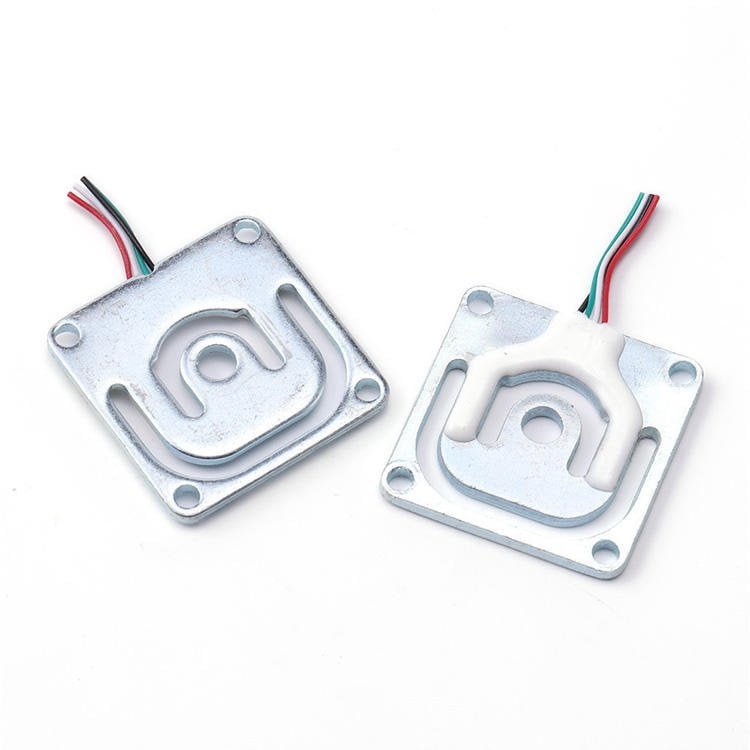
WST101 — the full-bridge option for small platforms
- 5 / 10 / 30 / 50 / 100 / 200 kg, one cell or a set of four
- Output 1.0 ±0.2 mV/V, alloy steel
- Comprehensive, linearity, repeatability and hysteresis all ±0.05 %F.S
- Zero and span drift ±0.1 %F.S/10 °C
- Insulation resistance ≥2 000 MΩ, excitation 5–10 VDC
The cost is the temperature window: −10 to +40 °C, the narrowest in this article. It is the only member of the six that you can also run as a genuine single-point cell at 200 kg, which is worth having if your platform is small and you want to avoid the set-of-four arithmetic entirely.
Half bridge · bathroom scale
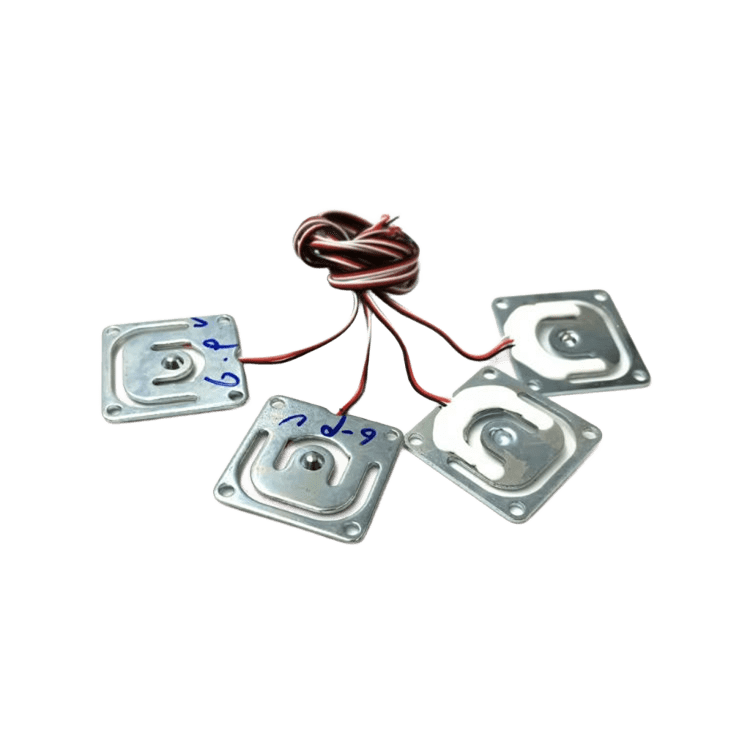
WST102 — the one I quote when the reading has to be trusted
- 5 / 10 / 30 / 50 / 100 kg per cell, four in a set
- Comprehensive error ±0.05 %F.S
- Repeatability, hysteresis and non-linearity all ±0.05 %F.S
- Zero and span drift ±0.1 %F.S/10 °C
- 1 000 Ω bridge, three-colour PVC lead 0.8 × 450 mm, IP65
- Safe overload 120 %F.S, ultimate 150 %F.S
Two gaps to know about. The page prints the bridge resistance as 1000 ±10 %Ω where the rest of this family prints a plain ±10 Ω, so treat that tolerance as unconfirmed until the factory answers in writing. And it publishes no four-angle figure at all — the number I would most like to have on this part, given that chapter four is entirely about corner behaviour.
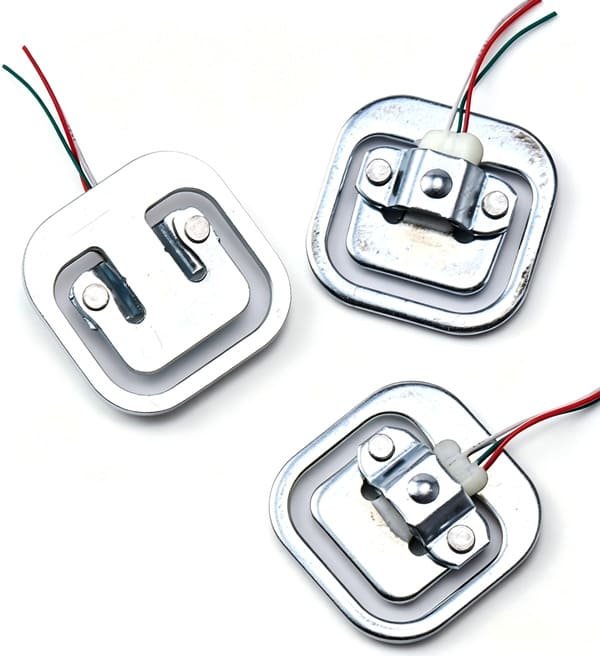
Half bridge · body scale
WST105 — the volume cell, and the honest cheap one
- 10 / 30 / 50 / 75 / 100 kg per cell, four to a set
- Manganese steel 65Mn, galvanised, silicone sealed, IP65
- Output 0.7 to 1.3 mV/V depending on capacity
- Comprehensive error ±0.3 %F.S, repeatability ±0.2 %F.S
- Zero and span drift ±0.3 %F.S/10 °C
- Four-angle error 1.0 %F.S, 1 000 ±10 Ω bridge
The published title says 50 kg to 200 kg; the specification table stops at 100 kg per cell. I quote from the table, and I would rather you heard that from me than discovered it in a drawing check. The 1.0 % four-angle figure is the one from chapter four: on a 50 kg cell that is 500 g between corners, or five display divisions on a bathroom scale.
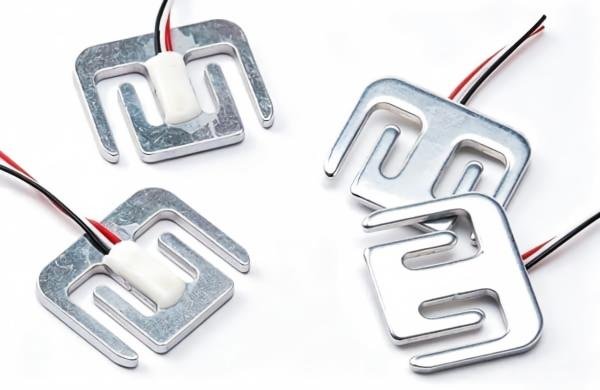
Half bridge · shared platform
WST106 — one platform for pets, bodies and small patients
- 20 / 50 / 75 kg per cell, four in a set
- Comprehensive error ±0.3 %F.S, repeatability ±0.1 %F.S
- Non-linearity, hysteresis ±0.2 %F.S, creep ±0.1 %F.S/3 min
- Zero and span drift ±0.3 %F.S/10 °C, four-angle 1.0 %F.S
- 1 000 ±5 Ω bridge — the tightest pairing in the micro family
- IP65, three-colour PVC lead 0.8 × 450 mm
My own page leads with smart litter boxes, and puts body scale, medical scale and pet scale behind that. So if you search my site for a body scale cell you will not find this one, even though its pairing tolerance is the best of the three half-bridges here. If you are building one platform and selling it into two markets, this is the cell that was designed for the idea. The pet-tech side of that story is written up in the cat litter box guide.
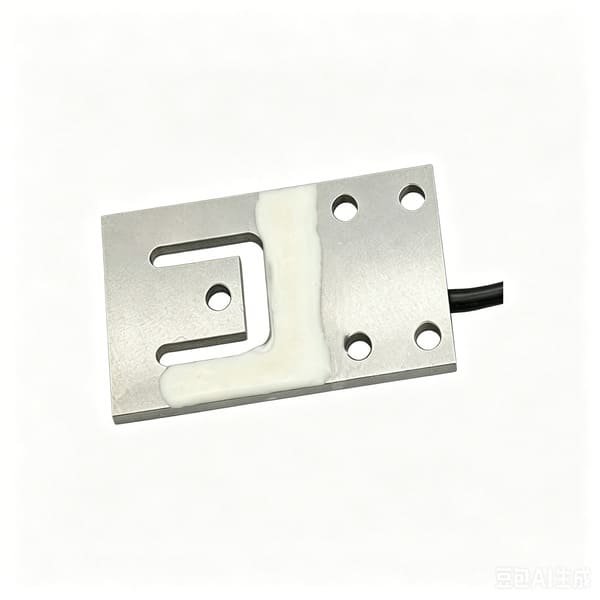
Planar beam · matched output
WST1101 — the thin one for large platforms
- 7.5 / 15 / 30 / 75 / 150 / 300 / 600 kg per cell, three or four per scale
- Comprehensive error ±0.05 %F.S, repeatability ±0.02 %F.S
- Hysteresis and non-linearity ±0.05 %F.S, creep ±0.02 %F.S/5 min
- Zero and span drift ±0.05 %F.S/10 °C
- Aluminium alloy, matched output as a stated feature
- Beam thickness 1.8 mm at 7.5 kg rising to 10.8 mm at 600 kg, IP65
- 1 090 ±30 Ω input, 1 000 ±10 Ω output
The page states its accuracy as 0.05 % of rated output in the prose and 0.05 % of full scale in the table. Those are two different quantities and I quote the table. It is also the only one of the six with a −20 to +60 °C window, which is the specification that decides this part for hot or unconditioned markets.

C3 parallel beam · not for bathroom scales
WST215 — excellent, and fifty times too small
- 0.3 / 0.5 / 1 / 2 / 3 kg, accuracy class C3
- Comprehensive error ±0.02 %F.S
- Repeatability and hysteresis ±0.015 %F.S
- Output 1.3 ±0.1 mV/V, 405 ±10 Ω input, 350 ±3 Ω output
- Safe overload 150 %F.S, ultimate 200 %F.S, IP65, platform 150 × 150 mm
- Compensated −10 to +40 °C, operating −20 to +60 °C
Its top capacity is 3 kg and a bathroom scale needs four cells near 50 kg. That is fifty times short, and no amount of class C3 marking bridges it. I quote this cell constantly — for counting scales, jewellery scales and bench instruments — and I am listing it here only because it lives in the same catalogue and gets requested by number when buyers see the accuracy class. If your product is a 3 kg scale for infants or small animals, it is the right part again.
If your application is not in this list — a bench scale, a retail scale, a luggage platform, a small industrial instrument — the selection logic is laid out in the selection guide, and the underlying physics in the complete guide to load cells.
Questions buyers actually send me
Can I use one 150 kg load cell instead of four 50 kg cells?
You can, and I will quote it if you insist, but you are buying a different product. A single cell under the centre of a glass platform forces the panel to carry a point load in the middle, so the glass must be stiff enough to spread a foot across the whole plate before the load reaches the cell. Four cells at 50 kg each give you a 200 kg platform with the load path distributed across four supports, and the panel can then be thin because it spans rather than bends. The capacity rule is in chapter two: four half-bridges give four times the capacity of one cell.
How accurate can a bathroom scale actually be?
On a 200 kg platform built from four 50 kg cells, the worst-case error is about 600 g with the ±0.3 %F.S family and about 100 g with the ±0.05 %F.S family. Those are multiplications, not opinions. Against a 100 g display division, the first family is allowed to move six digits and the second is allowed to move one. Anything tighter than that on this platform size is limited by the four-angle error and the thermal behaviour of the room rather than by the load cell.
Do I need class C3 accuracy for a bathroom scale?
No. C3 is an accuracy class for components intended for legal measuring instruments, and a bathroom scale never becomes one because no price is ever computed from its reading. What a bathroom scale needs is repeatability, corner consistency and drift stability, which are three different quantities from an accuracy class. If a supplier is selling you a bathroom scale cell on the strength of its C3 marking, he is selling you a document rather than a behaviour.
What is the difference between a half-bridge and a full-bridge load cell?
A half-bridge has two strain gauges and three wires; a full bridge has four gauges and four wires. The consequence people miss is the set rule. Chain four half-bridges and you get four times the capacity of one cell but only twice the output sensitivity, so per kilogram of load the assembled platform delivers about a third of the signal a single full-bridge cell of comparable capacity gives. That is the real trade on the cheaper part: not accuracy, gain.
Why does my bathroom scale read differently when I stand in a different spot?
Because the four-angle error is larger than the display division. A cell with a 1.0 %F.S four-angle specification on a 50 kg rating is allowed to differ by 500 g between corners, which is five display divisions on a 150 kg scale. Change where you stand, change how the panel flexes, and you change which corner carries more of you. Users describe this as unreliability. It is a specification, printed on the page, and it is why I argue for the tighter cell family whenever the same person is going to weigh themselves twice.
Does a body fat scale need a more accurate load cell than a bathroom scale?
No, and this is the counter-intuitive answer that has saved several of my customers money. Body weight moves the reported fat percentage by about 0.39 points per kilogram on the published BMI-based estimate, while the impedance measurement itself repeats to within roughly 2.5 points. Holding the weighing error under a tenth of a point needs better than 255 g, not better than 50 g. A body fat scale needs consistency from its cells, and a stiff panel under its electrodes, which is a different requirement again.
Can the same load cell be used for a baby scale?
Yes, and it usually is, because both instruments run on the same micro half-bridge family. But the baby scale is the harder brief: a 20 kg scale reading to 10 g needs 2 000 divisions, against 1 500 for a 150 kg bathroom scale at 100 g. The capacity sizing is also counter-intuitive — the standard recommendation is 20 kg per cell in a set of four, so an 80 kg platform under a 20 kg baby, because the patient moves to a corner while you are reading.
Is a bathroom scale a legal measuring instrument?
No. A price is never computed from the reading, so legal metrology does not apply to it in any market I sell into, and neither a body fat scale nor a home baby scale changes that. The EU instrument that does apply is the General Product Safety Regulation, which explicitly covers small battery-powered appliances that no other safety act reaches. Add RoHS, battery and recycling obligations, and add the Radio Equipment Directive if the scale talks to a phone. The moment your marketing claims a medical purpose, everything changes — and that claim, not the sensor, is what triggers it.
Include the panel material and thickness, whether the user steps up or shuffles on, the hottest and coldest the product will see, and whether it talks to a phone. I will tell you the cell count, the single-cell rating and the two numbers your specification is missing — and if your requirement belongs to a different instrument, I will say so.
or write directly to Robin@vektorforce.com
VektorForce · load cells, force sensors, junction boxes and weighing indicators · www.vektorforce.com · Robin@vektorforce.com