
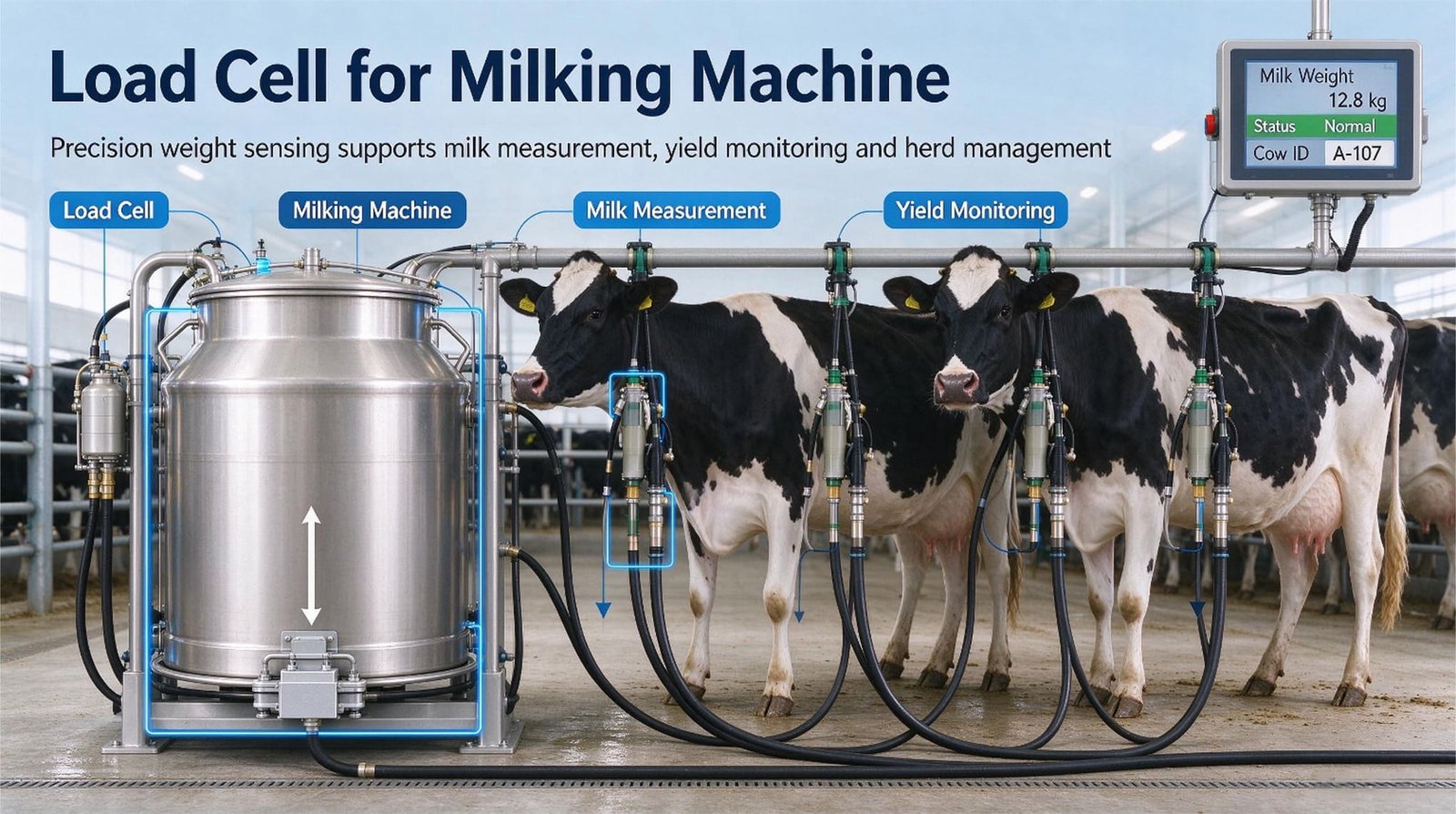
Load Cells for Milking Machines: Weight Is Not Volume
A parlour asks a load cell to do three unrelated jobs — weigh a cow’s yield, weigh a bulk tank, weigh a feed ration — and only one of them is really about milk. Almost every dairy enquiry I get names the wrong one. Then it turns out the vacuum system has been pushing on the weighing axis the whole time.
ICAR accuracy limits
Vacuum force on the load path
ISO 5707 · EN 13732
1. Three Jobs Hiding Under One Name
Say “we want to weigh the milking machine” to three different people on a dairy farm and you get three different projects. The herd manager means the yield of each individual cow. The farm owner means how much is in the bulk tank and when to call the tanker. The stockman means how much cake the parlour actually delivered this morning, because he does not believe the computer. Three projects, three completely different accuracy budgets, and one sentence.
This is the single most useful thing I have learned about dairy enquiries, so it goes first. If you buy one grade of hardware and apply it to all three jobs you will overspend in one place and fail in another, and the failure will not look like a hardware failure. It will look like a computer that lies.
| Job | Who asks for it | What is actually binding | Legal class |
|---|---|---|---|
| A. Per-cow yield jar, bucket or meter in the parlour |
Herd manager, breeding and herd-recording service | Bias across the whole range. A small constant offset is 3 % of a peak reading and 15 % of a late-lactation one. | ICAR approval for herd recording, if the data is used for genetic evaluation. That approval belongs to the complete device. |
| B. Bulk tank cells under the tank legs |
Farm owner, and the dairy’s collection driver | Repeatability against yesterday’s zero, and the load path. Absolute tonnes matter only if you convert to litres for a payment argument. | None, unless milk is priced off the reading. On-farm it is a management figure. |
| C. Parlour feeder hopper or weigh pan on the cake line |
Stockman, and whoever pays the feed bill | %FS as a fixed mass. A ration tolerance is a fixed number of grams, so the cell’s full-scale rating decides whether you can meet it at all. | None. Feed is not a traded quantity in this direction. |
Notice the shape of that table. Job B and job C fail mechanically — load paths and sizing. Job A fails arithmetically: the hardware is fine and the number is still wrong at one end of the lactation. Those are three different conversations and they need three different questions at the enquiry stage.
We have written around this subject before. The tank and silo module selection guide covers the vessel side, the TMR feed mixer wagon article covers mixed rations on the move, and the silo and feed tower integration guide covers bulk storage. What is different here is the vacuum, the species spread, and the fact that a dairy farm will measure the same milk three times a day with three instruments that disagree.
2. The Specification Moves With the Species
If you are building a parlour for dairy cows, this is the single most quotable table in the whole application. It is the accuracy the ICAR guidelines require of a milk recording device, split by species. ICAR is the international committee for animal recording, and its approval is what a breeding company looks for before it will accept your yield figures into a genetic evaluation.
| Species | Measuring range | Standard deviation limit | Bias limit |
|---|---|---|---|
| Cattle | 2–10 kg | 0.50 kg | 0.20 kg |
| Buffalo | 1–6 kg | 0.30 kg | 0.12 kg |
| Goat | 0.3–0.8 kg | 0.04 kg | 0.025 kg |
| Sheep | 0.3–0.8 kg | 0.04 kg | 0.025 kg |
A cattle meter has to hold 0.50 kg standard deviation. A sheep meter has to hold 0.04 kg — 12.5 times tighter, and its whole measuring range fits inside the bottom of the cattle range. Two specifications like that cannot come out of one bill of materials with different firmware, no matter how convincing the datasheet prose is. If you build for cows and sheep on one platform, the sheep market will always be the one where your numbers get challenged.
There is a second clause in the same ICAR document that matters more to a load cell designer than the limits themselves. It requires that bias and standard deviation be uniformly distributed across the measuring range, and it specifies a statistical test for it. Read that again, because it kills a habit this industry has: quoting accuracy at full scale.
Consider a plausible parlour figure. A good Jersey peaks around 16.9 litres in the morning, which at a milk density of about 1.0305 kg/L is 17.4 kg. The same cow in late lactation gives 4.5 litres in the afternoon — 4.64 kg. ICAR’s own field test for cattle accepts valid readings from 2 kg to 40 kg, so a 40 kg-capacity device is entirely legitimate. But that afternoon reading is then sitting at 11.6 % of capacity. Any error term that is a percentage of full scale, rather than a fixed mass, is silently amplified 4.7 times when you get to that end of the range. That is precisely what the homoscedasticity clause exists to catch.
The practical consequence for selection is simple and slightly uncomfortable: size the meter for the tail of lactation, not the peak. A smaller-capacity cell with the right overload protection beats a bigger one that is only comfortable at 17 kg. And note that ICAR’s bias limit of 0.20 kg is only two 0.1 kg display increments — so the entire error budget, thermal drift, non-linearity, creep and the zero all have to fit inside two digits.
If you want the general version of this argument, it is the same one that runs through the load cell selection guide: a rated capacity is not an accuracy, and an oversized cell hides its error in grams you never asked for.
3. The Vacuum Is the Load Cell’s Worst Neighbour
A milking machine is a vacuum system that happens to have a scale attached. Everything in the parlour — the cluster, the liners, the milk line, the receiver, the jar — is held together by a pressure difference of roughly 50 kPa, which for cows is the normal working vacuum and which ISO 5707 requires to be held within a couple of kPa of its set point.
Now put a number on that pressure. Force is pressure times area, and dairy hardware has a lot of area.
| Element | Area | Pressure difference | Force |
|---|---|---|---|
| 400 mm receiver lid | 0.1257 m² | 50 kPa (full working vacuum) | 6,283 N = 641 kgf |
| 300 mm lid or port | 0.0707 m² | 10 kPa (a plausible vacuum swing) | 707 N = 72 kgf |
| 16 mm vacuum hose, end force | 0.0002 m² | 50 kPa | 10.1 N = 1.03 kgf |
A container closed all round and sitting on a cell does not change weight when you pull a vacuum inside it: the atmosphere pushes down on the lid and up on the base, and if the two areas match, the forces cancel. I mention this because it is the reason people dismiss the problem. The problem appears the moment the geometry stops being symmetrical, and in a milking machine it almost never is, because the vacuum line has to go somewhere. Specifically:
- The lid is restrained by something other than the weighing element and the vessel is not. If the receiver lid is clamped to a frame for rigidity while the receiver itself hangs on the cell, you have just built a vacuum lifter. The full 641 kgf of pressure difference is now in your weighing axis, and it moves every time the vacuum moves.
- A hose under vacuum goes rigid and transmits force. A 16 mm line is only about 1 kgf of end force, which is small — but it is not zero, it is position-dependent, and it changes the moment somebody re-routes the hose during a service visit.
- The milk line itself. A pipeline system hangs the whole cluster from the milk line. The milk line’s slope, its support spacing and its expansion all move loads around, and a cell placed anywhere in that chain inherits them.
Take the 300 mm port with a 10 kPa swing: 72 kgf of force looking for a way into your measurement. Suppose 99 % of it is absorbed by the frame and 1 % leaks into the weighing axis. That is 0.72 kg. Against ICAR’s cattle standard deviation limit of 0.50 kg it is 44 % over budget; against the 0.20 kg bias limit it is 3.6 times the entire allowance. You do not need a badly designed machine for vacuum to ruin a milk meter. You need 1 % coupling and a bad day.
ISO 5707 gives you the size of the transient you are fighting. It caps system-vacuum instability by requiring that the product of the amplitude of vacuum variation and its duration, measured in the short milk tube, must not exceed 20 kPa·s. That is an unusual way to write a limit: a 2 kPa amplitude may persist for 10 seconds, a 10 kPa swing for only 2 seconds. During cluster attachment and removal the machine is nowhere near that budget, which is why transient force lands on the scale exactly when the milk is arriving.
Two consequences follow, and both are about the load path rather than the sensor. Give the vacuum connection enough slack that its reaction cannot resolve into the weighing axis, and route it so a technician cannot put it back into a rigid configuration by accident. Then weigh on the plateau, not through the transient — a settling gate that waits for the vacuum and the milk flow to both settle is worth more than any upgrade in cell specification.
If your flexures, hoses and stops are the unfamiliar part rather than the electronics, the diagnostic sequence for a suspect load cell is a good place to start, because it separates a damaged bridge from a load path that is being loaded by something you did not design for.
4. Weight Is Not Volume
Every dairy farm I have visited quotes milk in litres. Every load cell measures kilograms. Somewhere between those two there is a divisor, and almost nobody writes it down.
The divisor is the density, and raw milk density is not a constant. Published figures put Holstein milk at roughly 1.029–1.032 kg/L and Jersey milk at 1.032–1.035 kg/L, because fat is lighter than water and Jersey milk carries more of it. Skimmed milk goes the other way, up around 1.034–1.038. Across the breeds a farm might actually have, that is a spread of about 0.29 %.
| Source of the number | Density (kg/L) | What it is really telling you |
|---|---|---|
| FAO figure, milk in a tanker | 1.015–1.020 | Aerated, pumped, agitated. Air is the difference. |
| FAO figure, same milk in a laboratory | 1.028–1.033 | Degassed and settled. This is the density your scale is actually seeing in the tank. |
| Holstein / Jersey mid-points | 1.0305 / 1.0335 | Breed changes the divisor by 0.29 %. |
That gap in the table is the important one. The difference between aerated tanker milk at 1.0175 and settled milk at 1.0305 is 1.28 %, and it is a gap between two states of the same milk. If your scale weighs the milk and your software divides by a single number somebody typed in three years ago, the size of your error is decided by how much air happens to be in the tank at the moment of reading.
A 12,000 litre tank collected every second day gives roughly 180 pickups a year at about 11,400 litres each. A 1.28 % divisor error on each pickup is 145.7 litres, about 150 kg of milk. Over 180 pickups that is 27 tonnes a year. At the EU-27 weighted average farm-gate price for 2025 of about €524 per tonne, that is €14,000 of apparent discrepancy — not a loss, because the dairy’s own meter sets the payment, but a monthly argument you will have for as long as the two instruments disagree.
I want to be careful about what that number is and is not, because this is exactly where dairy suppliers overclaim. Your farm scale is not a payment instrument and the dairy does not pay you from it. What the 27 tonnes buys you is the elimination of a recurring argument, plus the ability to see a real problem in the tank — a leaking gland, a failed dump valve, a chilled-water fault — against a stable baseline instead of against a number that wobbles by more than the fault you are trying to find.
So the rules are short. Report kilograms, and convert to litres only where you must, and say which density you used. Take the density from a lab sample periodically rather than from a constant in a lookup table. If you do have to quote litres, quote a range. And read the weight only when the milk has settled — which is the same moment the agitator is off, and that is a mechanical problem, not a software one, as case 1 shows.
5. The Bulk Tank: 33 kN Per Leg, and a Motor You Have to Move
Bulk tanks are the easiest of the three jobs to size and the one where the mechanical detail most often gets missed. Work a common example properly, because the answer surprises people.
A 12,000 litre tank, full, at a density of 1.0305 kg/L holds 12.37 tonnes of milk. Add a generous 1.2 tonnes of stainless steel, insulation, the refrigeration jacket and the agitator, and the structure on the legs is 13.57 tonnes. On four legs that is 3.39 tonnes each, or a little over 33 kN per leg.
| Module rated capacity | Utilisation at full tank | Utilisation with the tank empty | Verdict |
|---|---|---|---|
| 30 kN | 110.9 % | 9.8 % | Over capacity. Do not do this. |
| 50 kN | 66.5 % | 5.9 % | The right answer. Inside the 30–70 % working band. |
| 100 kN | 33.3 % | 2.9 % | Works, but you have bought double the error in absolute grams for no benefit. |
Look at the middle column of that table and you will see why tank weighing drifts: an empty tank loads each leg at under 6 % of the module’s rating. You are asking a 50 kN module to resolve a few kilograms at the bottom of its range, and the tare dominates everything. That is not a reason to go smaller — it is a reason to respect the zero.
A bulk tank has a motor that stirs 12 tonnes of milk, and on a great many tanks that motor is bolted to the tank’s own frame. Its reaction torque has to go somewhere and the only place it can go is the legs — the same legs you have just put load cells under. The result is a reading that is a function of whether the agitator is running, which direction the paddles are pushing, and how much milk is in the tank. It is not noise you can filter out, because it is not random: it is a repeatable force with a repeatable direction. The fix is mechanical. Put the drive on a separate pedestal, or isolate it with a flexible coupling and a torque reaction arm that anchors to the floor rather than to the tank.
Three more details decide whether a tank retrofit works. The tanker hose: when the driver connects a pump hose, that hose has weight and stiffness, and hard-coupled to the tank outlet it turns leaning on the hose into a reading. Insist on a flexible section and a support that does not touch the weighed structure. The legs: a tank bolted to a slab with no allowance for thermal movement picks up a side force as it warms and cools, so the modules have to be able to move horizontally. The CIP return: if any of that pipework is rigidly attached to the tank you have added a second load path that changes with temperature.
Sizing the modules and wiring them into a sum is the part I do; the tank weighing selection guide covers the leg-count arithmetic in more detail, and the general principles guide covers why four cells in one junction box add up so much more reliably than four separate instruments.
6. The Feeder: %FS Against a 200 Gram Ration
This is where I see the most expensive mistake in the dairy sector, and it is purely arithmetic. Concentrate feeders dispense a ration per cow per milking. A typical in-parlour allowance is 4 kg a day, split across two milkings, and a reasonable feeding tolerance is 5 % — which is 200 grams on a 2 kg drop, or on the daily 4 kg allowance.
Now look at what a full-scale percentage means when the cell is the wrong size:
| Cell rated capacity | Error at 0.5 % FS | Against a 200 g tolerance | Can it hold the spec? |
|---|---|---|---|
| 150 kg | ±0.75 kg | 3.75× | No. Not with any calibration, any filter or any firmware. |
| 50 kg | ±0.25 kg | 1.25× | Marginal. It eats the whole budget before anything else goes wrong. |
| 20 kg | ±0.10 kg | 0.50× | Yes, and it leaves half the budget for the load path. |
The reason a 150 kg cell ends up in a feeder is not incompetence. It is that the hopper above it holds 30–50 kg of cake, somebody sized the cell for the static load, and nobody noticed that the quantity being controlled is 4 kg while the thing being weighed is 50.
This is not a theoretical worry, because parlour feeder accuracy has been measured in the field, and the numbers are worse than most farmers expect. Published UK and Irish survey work on in-parlour feeders has reported average deviations across farms running from roughly −15 % to +15 %, with individual units reaching −70 % and +100 % of the intended ration. A separate multi-farm study found feeders delivering between 62 % and 150 % of the expected amount, with only about 20 % of units landing inside ±5 %.
Take a 320-cow herd fed 5.0 kg of concentrate per cow per day in the parlour across a 200-day housed period. That is 320 tonnes of cake a year. An 11 % over-delivery is 35.2 tonnes, and at around €260 per tonne of dairy concentrate that is roughly €9,150 a year — spent on feed the ration did not call for, and largely wasted, because a cow does not turn surplus concentrate into surplus milk beyond her genetic capacity.
Note the direction of the failure is not fixed. Undersized delivery costs yield; oversized delivery costs feed. So the correct statement of the requirement is not “the feeder should be accurate” but “the feeder should sit inside a band”, and the band is a fixed number of grams. That is what makes the cell’s full-scale rating the deciding factor.
There is also a design choice hiding here. You can weigh the hopper and infer the drop from the loss in weight, or you can weigh the delivered portion in a small pan. Loss-in-weight on a big hopper forces you to resolve a 2 kg change on a 40 kg body, which is exactly the turn-down problem from §2 all over again. A small weigh pan with a small cell is the harder mechanical design and the easier measurement. When a builder asks me which to choose, my answer is usually the pan, and the reason is arithmetic rather than preference.
7. Washdown, CIP and the Numbers That Are Not Mine
Dairy is the harshest ordinary environment a load cell meets. Not because of temperature or vibration, but because everything gets washed, every day, with chemicals, and then the room sits wet. This is the section where I have to be honest about where my responsibility stops, because the interesting numbers all belong to whoever builds the tank or the parlour.
For bulk milk coolers on farms, the European reference is EN 13732:2022. It covers design, performance, safety and hygiene, and it is a genuinely detailed document. A few of its requirements show you how seriously the hygiene side is taken: the inner liner must be austenitic stainless steel or a proven equivalent, with a surface roughness of Ra ≤ 1 µm; internal corner radii must be R ≥ 20 mm; welds must be smooth with a radius of not less than 3 mm. Annex F sets out a standardised cleaning test — the tank is fouled with naturally coagulated raw milk held at 30 °C until it reaches pH 4.6, retained for four hours, then cleaned on the machine’s own cycle, and the result is judged by chemical residue testing, visual inspection and bacterial counts. Annex I requires equivalence testing for any stainless steel that is not austenitic, through pitting, intergranular and stress-corrosion tests.
EN 13732:2022 explicitly does not cover “calibration requirements for the measurement of the milk volume”. Read that carefully, because it means a CE-marked bulk tank tells you nothing at all about whether the weight on its display is right. The tank is certified as a machine and a hygienic vessel. The number is a separate question, and if you want that number to mean something you have to answer it with instruments, calibration and a zero policy — none of which the tank’s conformity assessment covers.
What that leaves for the sensor choice is narrower than most people expect, and it is mostly about ingress protection and materials. In a parlour, cells live in one of three places with a different requirement in each: under a tank leg on a wet concrete floor, under a feed hopper in a dry dusty corner, and inside a yield meter or jar that is washed in place. Ingress protection is not a number you maximise; it is a property of the whole assembly, and a well-sealed enclosure with a badly oriented gland will let in more water than a modestly rated one installed properly.
One counter-intuitive effect is worth repeating, because it comes up on dairy sites constantly. Water does not have to pass a seal to reach a load cell; it travels along the cable, inside the sheath. The most common route into a junction box is an upward-facing cable entry, and the result is a box that fills with condensation over weeks, so the fault appears in month three as an unstable zero rather than an obvious leak. I would rather you spent money on glands and routing than on another digit of IP rating, and I say that as somebody who sells the cells.
Two honest limits from our own catalogue. Our standard module family is compensated from −20 to +65 °C, which is comfortable for a parlour and for a tank leg in a chilled room, and is not a sterilisation temperature. And our standard cable is PVC, which is fine on the leg of a tank and not fine for a component sprayed daily with alkaline and acid cleaners at 60–80 °C. Those positions have to be declared at enquiry.
For in-bed and in-crib weighing — which shares the same zero-policy problem as a milk meter — the medical bed weighing article covers the reference-zero approach in more detail. The remote hive scale article covers the other half of the problem: what happens when nobody is present to press zero, and the structure creeps and the sun moves across it.
8. Does a Price Come Out of This Reading?
I use the same question in every weighing application and it works especially well in a parlour, because dairy has three separate approval regimes and people mix them up: ICAR approval for milk recording, legal metrology for trade, and the machinery and hygiene standards for the equipment itself. They are not interchangeable and none of them is satisfied by the others.
| Regime | Applies when | Who holds it | What my product certificate is worth |
|---|---|---|---|
| ICAR approval | Yield figures enter herd recording or genetic evaluation | The complete meter or jar, submitted by its manufacturer | Nothing on its own. A component certificate is not a device approval. |
| Legal metrology OIML R76 · MID MI-006 · EN 45501 |
A price is calculated from the reading — milk sold by weight, or a farm-direct sale | The complete instrument, type-approved and then verified in place | An OIML R60 certificate is a component certificate. It does not make a scale legal for trade. |
| Machinery & hygiene EN 13732 · EN 1672-2 · ISO 5707 / 6690 |
Always — it is the tank, the parlour and the installation being assessed | The tank or parlour builder, via CE marking and a technical file | Nothing. And as §7 showed, this regime excludes the measurement question. |
So the question is the same one I always ask: does a price get calculated from this reading? On a farm, the honest answer for a bulk tank and for a parlour feeder is almost always no, and for a yield meter it is no unless you are selling the data into a breeding programme. Where the answer is no, you should not be paying for metrology-grade hardware — you should be paying for a repeatable structure and a decent zero policy. Where the answer is yes, the approval is not something I can give you, because it belongs to the complete instrument and to the company that puts its name on the front of it.
If you are building a recording device, though, it is worth knowing the size of the approval you are walking into, because it is not trivial. ICAR’s own certification procedure for cattle requires the applicant to list 50 devices with serial numbers, from which the test centre selects two for laboratory testing and eight for field testing on two farms, plus one reserve. Each field device needs 40 valid readings, so eight devices is 320 readings before you have touched composition testing. And the field test’s valid reference range for cattle runs from 2 to 40 kg, which is wider than most people expect.
9. Case: The Tank That Never Reconciled
A dairy farm in County Cork, 2025. Two hundred and forty cows, a 12,000 litre bulk tank, and a farm computer that had been showing a daily milk figure for six months. The farmer’s complaint was specific and he had evidence: his own number and the dairy’s collection docket never matched, and his number was always the high one, by between 1.1 % and 1.4 %.
He had done the reasonable thing and asked for a new load cell. I asked for something else first, and it is the question I now ask on every tank retrofit: send me the tare log.
There was no tare log. There was a service technician who had zeroed the system at commissioning, and there was a note on the shed wall telling the relief milker to press ZERO if the number “looked wrong”. That second item turned out to be the expensive one, because the reading was being conditioned by two things at once and re-zeroing alternated between them.
The first was mechanical. The tank’s agitator motor was bolted to the tank frame, and the tank stands on four legs — the same four legs carrying the load cells. Every time the agitator ran, its reaction torque went down the legs. The tank’s agitation cycle was three minutes running followed by roughly twenty minutes off, so for about one seventh of the day the reading was loaded by a force that had nothing to do with how much milk was in the tank. Worse, the direction of that force depended on which way the paddles were pushing, so the offset was not constant across the fill.
The second was arithmetic, and it is the one from §4. The software converted kilograms to litres with a density of 1.030, typed in at commissioning. A settled sample from the farm’s own milk was reading 1.0305 in the local lab, which is fine. But the reading was being taken with the tank still moving, and agitated milk with entrained air reads nearer the FAO tanker figure. The 1.28 % gap between an aerated and a settled reading on an 11,400 litre pickup is 145.7 litres, about 150 kg — and there it was, week after week, sitting almost exactly on top of the 1.1–1.4 % discrepancy the farmer kept reporting.
The four modules were 50 kN units reading 33.26 kN at full tank — 66.5 % utilisation, right in the working band. The corner test showed a spread of 1.2 % across the four legs, which for a tank of that size is a good number. There was nothing wrong with the weighing hardware. Every kilogram of the discrepancy was in the agitator mounting, the reading moment and a density constant. Telling him that was worth more to the relationship than an order would have been, and it is the reason he came back eighteen months later with a parlour project.
The fixes were unglamorous. The agitator drive went onto a separate pedestal with a flexible coupling and a torque reaction arm bolted to the floor slab, so its reaction bypasses the tank legs entirely. The reading moved into a settle window: the instrument now accepts a weight only once the agitator has been off for a defined period and the reading has held within a band for a minimum time, and the display says which state the tank is in rather than just showing a number. The dairy figure switched to kilograms, with the litres conversion explicit and dated.
The ZERO button came off the shed wall and the zero policy went into writing: zero only with the tank empty, CIP complete, no agitation for the preceding period, and only by the named person, with the date and the temperature at the mounting point recorded. Six months of records later the two numbers still did not match exactly — the dairy’s meter is the payment meter and it has its own bias — but the gap was inside 0.3 % and stable, which is a spread you can diagnose against.
10. Case: The Feeder That Was 3.75× Out of Spec
Northern Ireland, 2024. A 320-cow spring-calving herd in a 20-unit rotary, with in-parlour concentrate feeders and a parlour computer that had been the subject of an ongoing argument between the owner and the farm manager. The owner’s position was that the cows were being fed more cake than the ration allowed and the feed bill agreed with him. The manager’s position was that the computer was doing exactly what it was told.
Both of them were right, and the reason is in §6. The feeder hopper sat on a 150 kg load cell. At 0.5 % full-scale, that cell contributes ±0.75 kg of error. The quantity being controlled was a 2 kg drop at each milking against a 5 % tolerance, which is 200 grams. The cell was 3.75 times less capable than the task. Nothing in the software could rescue that, and no amount of re-calibration would change it, because the limit was in the mechanical hardware from the day it was installed.
Two more things were making it worse, and both are worth describing because they are common. The auger drive motor was mounted on the weighed body of the hopper, so its reaction torque and the auger’s own drag went straight into the cell — the same class of error as the tank agitator, in a much smaller package, and it appears every single time the feeder runs rather than a few times a day. And the zero had been taken with cake still sitting in the auger flight. That residual — what the trade calls the boot — varies with the type of cake, with its moisture, and with how long the line has been idle. A zero taken with a variable residue in the line is not a zero.
I could not fix the arithmetic, so I changed the hardware. The hopper was re-instrumented with a 20 kg cell, which at the same 0.5 % specification contributes ±0.10 kg — half the 200 g budget instead of 3.75 times it. The drive was moved off the weighed body onto the frame, with a flexible coupling so the auger torque reacts to the frame rather than to the cell. And the calibration procedure was rewritten so the zero is taken with the line purged and the auger stopped, at a defined temperature, and recorded.
At 320 cows, 5.0 kg of concentrate per cow per day across a 200-day housed period, the herd uses 320 tonnes of cake a year. Before the change the feeders were delivering roughly 11 % over ration on the units that were checked. That is 35.2 tonnes of extra concentrate, about €9,150 a year at €260 a tonne. After re-instrumentation the spread across the feeders came down to a few percent, and inside the ±5 % band on most units. The bill did not fall by the full €9,150, because a feeder that used to over-deliver sometimes under-delivered, and under-delivery costs milk. What changed is that the band got narrow enough to manage, which is the whole point.
The part of this that stayed with me is the argument, not the equipment. The owner and the manager had been disagreeing for two years about a number neither of them could control, and both of them had assumed the other was wrong. A 150 kg cell in a feeder is not a mistake anybody makes maliciously; it is what happens when the only thing on the drawing is the static weight of a full hopper.
11. Case: The Yield Curve That Only Lied at the Tail
Denmark, 2025. An OEM building a conventional parlour with per-cow yield recording, heading for ICAR approval. The prototype worked, the mid-lactation numbers looked sensible, and the herd software was producing a lactation curve that the vet described as “noisy at the end”. That was the whole complaint, and it had been treated as a software filtering problem for four months.
The engineer sent me two things: the raw weight stream from a single milking, and a photograph of the prototype. The photograph answered the question. The receiver lid was clamped to the milk-line frame for rigidity. The receiver itself hung on the load cell. That is a vacuum lifter.
With the lid restrained externally and the vessel free, the pressure difference across the lid is directly in the weighing axis, and it is enormous compared with the milk. A 400 mm lid under a 50 kPa working vacuum carries 6,283 N, or 641 kgf — about 128 times the weight of a 5 kg yield. Even the small numbers are not small: a 300 mm port seeing a 10 kPa vacuum swing carries 72 kgf, and if just 1 % of that coupled into the weighing axis it would be 0.72 kg against ICAR’s 0.50 kg standard deviation limit and 0.20 kg bias limit for cattle. One percent coupling is 44 % over budget on the SD limit and 3.6 times the bias limit.
The raw stream showed exactly that signature. The reading was not noisy in any statistical sense; it was biased during the parts of the milking when the vacuum was moving, and stable during the plateau. And because vacuum behaviour is different at different flow rates, the size of the bias varied through the milking and through the lactation. Which brings us to the arithmetic that made this a commercial problem rather than a technical curiosity.
| Reading | Milk weight | 0.72 kg offset as a share |
|---|---|---|
| Peak lactation, morning | 22.000 kg | 3.28 % |
| Late lactation, afternoon | 4.635 kg | 15.55 % |
A constant offset of 0.72 kg is 3.28 % of a good cow’s morning yield and 15.55 % of a late-lactation afternoon yield — 4.7 times larger where it matters least tolerably. This is the practical meaning of ICAR’s requirement that bias be uniformly distributed across the range. A fixed error in kilograms is not a fixed error in percentage, and the cows whose records you are using to make culling and breeding decisions are exactly the cows at the low end.
The fixes ran in the order they deserved. The load path first: the lid was de-coupled from the frame and the vacuum connection was given slack and a routing that holds its shape, so the reaction could no longer resolve into the cell. Then the timing: the instrument now accepts a reading only once the vacuum has held inside its set band for a minimum period and the weight has held within a band tighter than the final tolerance, replacing the prototype’s two-consecutive-samples-and-go approach. Then the cell: swapped for a stainless single-point unit sized for the tail of lactation rather than the peak, with a mechanical overload stop, because cluster attachment is a dynamic event and a cow will lean on a jar.
One design limitation of ours belongs in this case rather than in a footnote. The digital family of cells gives you a clean serial interface and factory-set divisions, but it also gives you a deliberately minimal command set — set zero and read weight — and no field calibration routine. If your integration plan assumes you will be trimming the meter on site against a test bucket, that assumption has to change at the enquiry stage, not at commissioning.
A 2015 study in the Journal of Dairy Science looked at commercially available milk meters in the field and found many failing ICAR’s own limits — and one group of meters had not been calibrated at all, which alone moved the share of samples outside the 99 % band from 1.4 % to 7.9 %. Even with calibration, bias and standard deviation exceeded the limits. The lesson is not “buy a better cell”. It is that a load cell is one contributor among several, that calibration status is a bigger lever than component grade, and that anybody promising you a passing ICAR submission on the strength of a sensor datasheet is selling something they cannot deliver.
12. The Selection Worksheet
This is the sequence I run on every dairy enquiry, in this order, and the order matters because each step can eliminate the next one.
- Name the job. Yield, tank or feeder. Write it down. If the enquiry contains more than one, treat them as separate projects, because they have different accuracy budgets and different legal answers.
- Name the species and the range. Cattle 2–10 kg, buffalo 1–6 kg, goat and sheep 0.3–0.8 kg. The specification moves by a factor of 12.5 between cattle and sheep, so this step is not a formality.
- Decide whether a price comes out of the reading. If no, stop paying for metrology. If yes, the approval belongs to the complete instrument and to the OEM, and you should budget the certification programme rather than the sensor.
- Find the smallest load the device must resolve, and size for it. Not the peak. A late-lactation afternoon yield can be 11.6 % of a device sized for a peak cow. Any error term that scales with full scale is amplified 4.7× when you get there.
- Draw the load path and mark every rigid connection. Agitator drives, auger drives, CIP returns, tanker hoses, milk-line supports, junction-box brackets. Every one of them is a candidate for carrying a force that belongs to something else.
- Mark every pressure area. Lids, ports, receivers, and any surface across which a vacuum difference can act while one side is restrained and the other is not. Then decide whether the reaction resolves into the frame or into your cell.
- Set the reading moment, in writing. When is the weight valid? What has to have stopped, for how long, and how stable does it have to be? A good settling gate beats a better cell almost every time.
- Write the zero policy. Who may zero, with what conditions, at what temperature, and where the record goes. On this application the zero policy is the difference between a working system and a daily argument.
- Decide kg or litres, and if litres, which density and where it came from. Report kilograms as the primary figure. A density typed into a table three years ago is not a measurement.
- Check the environment and the cleaning regime. Where the cell physically sits, what sprays it, what the cable sheath is exposed to, and which way the glands point. Do this before the first washdown, not after.
- Plan the calibration and the verification. How will you take the empty reference, against what, and how often? On a tank, empty is a genuinely reachable state. On a jar it is not, which is why the empty-jar tare has to be captured automatically as part of the cycle.
- Decide what happens when the number is wrong. An alarm on a rate of change, a shift report, somebody who looks at it. A weighing system nobody reads is not an instrument; it is a witness.
Two of the three cases above were resolved at steps 5 and 7 rather than at step 4, which is the honest summary of this application. The sensor is rarely the weakest link in a milking machine. The sensor is usually the only component in the chain whose specification anybody actually reads, which is why it gets blamed.
13. What I Supply, and What I Do Not
I export weighing components. I am not a parlour builder, not a tank manufacturer, and not a herd-management software house. That boundary is worth stating precisely, because in dairy it is unusually easy for a component supplier to imply capabilities that belong to somebody else.
| What I supply | What I do not supply |
|---|---|
| Load cells and weighing modules, including matched sets for multi-leg vessels
Stainless single-point cells for jars, pans and meters Multi-channel junction boxes and the trim procedure for a set Weighing indicators and transmitters, with summing, taring and serial output Module selection arithmetic, shown so you can check it A written review of your load path if you send me the drawings Cable specification and gland orientation rules for wet areas The zero policy as a written procedure, with the temperature conditions spelled out Calibration guidance and a certificate for each unit |
The milking machine, the cluster, the liners or the vacuum system
The parlour, the bulk tank, or any hygienic fabrication Vacuum pump sizing, regulator selection or ISO 5707 / ISO 6690 compliance testing Clean-in-place design, spray-ball coverage or the cleanability testing in EN 13732 Annex F Stainless steel equivalence testing or any of the hygiene documentation in EN 13732 ICAR device approval, or any part of the submission programme in §8 Legal metrology type approval or verification, if milk is ever priced off the reading Herd-management software, breeding values or milk analysis Machine CE marking, the technical file, or the risk assessment |
Four limitations of our own products belong here rather than buried in a datasheet, because they are the things that cost people time when they discover them later.
- Our standard module family is compensated to +65 °C, not to sterilisation temperature. That is right for a parlour and for a tank leg, and it is not right for a component that gets steam. Tell me if you need higher and it becomes a custom enquiry.
- Our standard cable is PVC. PVC and daily caustic-and-acid spray is a short life. For positions that are washed in place, the sheath has to be declared at enquiry, not assumed.
- A digital cell does not fix a bad load path. Software can average noise away. It cannot subtract a force that is genuinely arriving through a bracket, and it cannot recover a reading that was latched during a transient. Cases 1 and 3 are both that mistake.
- IP ratings are properties of assemblies, not of components. A well-sealed housing with the cable entry facing upward will fail in a wet room. We will recommend gland orientation and cable routing, but the enclosure design is yours and the responsibility for it is yours.
The line I use when a builder asks me whether a weighing system will solve a parlour problem is this: a load cell measures the force that actually reaches its axis, and nothing else. Everything above it in the machine is either passing force to the cell or stealing it, and most of the work in a dairy project consists of finding out which.
14. Questions I Get From Parlour Builders
How many load cells does a milking machine need?
It depends which of the three jobs you are doing. A bulk tank needs one cell per leg, and tanks usually have three or four, occasionally six. A yield meter or jar usually needs one cell under the vessel, occasionally three or four if the jar is wide and the centre of gravity moves as it fills. A parlour feeder needs one cell, on the hopper or on a small weigh pan. There is no single answer, which is why the first question on a dairy enquiry should be which job, not how many.
Can a load cell measure an individual cow’s milk yield?
It can measure the mass, which is the hard part, but the accuracy of the yield figure depends on everything else in the device: the vacuum coupling, the reading moment, the tare and the zero policy. The ICAR limits for cattle are 0.50 kg standard deviation and 0.20 kg bias over a 2–10 kg range, and 0.20 kg is only two 0.1 kg display increments. A load cell contributes a few grams of that; the rest is load path and procedure. And if the figures are going into a genetic evaluation, ICAR approval belongs to the complete recording device, not to any component in it.
Why does my milk yield reading look worse in late lactation?
Because a fixed error in kilograms is a much bigger error in percentage on a small yield. An offset of 0.72 kg is 3.28 % of a 22 kg peak-lactation morning and 15.55 % of a 4.635 kg late-lactation afternoon — 4.7 times larger, on exactly the cows whose records you are using to make culling and breeding decisions. ICAR requires bias and standard deviation to be uniformly distributed across the measuring range for this reason, and a device sized only for the peak cow will fail that test.
Why doesn’t my tank weight match the dairy’s collection docket?
Almost always the density conversion, and sometimes a reading taken while the tank was still moving. Raw milk density runs about 1.029–1.032 for Holstein and 1.032–1.035 for Jersey, but milk full of entrained air reads nearer 1.015–1.020 while the same milk settled reads 1.028–1.033. That is a 1.28 % gap between two states of the same milk — about 145.7 litres on an 11,400 litre pickup, or 27 tonnes a year at 180 pickups. Report kilograms as the primary figure, take the density from a lab sample rather than a constant, and take the reading only in the settle window.
Does a bulk milk tank scale have to be legal for trade?
Only if a price is calculated from the reading, and on a farm it normally is not — the dairy pays you from its own collection meter. Two things are worth knowing. First, EN 13732:2022, the European standard for bulk milk coolers on farms, explicitly does not cover calibration requirements for the measurement of milk volume, so a CE-marked tank tells you nothing about the accuracy of the number on its display. Second, if the reading ever does price milk, the complete instrument needs type approval and verification, and an OIML R60 load cell certificate does not make a scale legal for trade.
What IP rating and cable do I need for a parlour load cell?
Treat the rating as a property of the assembly, not the cell. A stainless multi-channel junction box with its cable entries facing down and a properly sized gland does more for wet-room reliability than another digit of IP rating. Two things catch people out: water travels along the cable inside the sheath, so an upward-facing entry fills the box with condensation and the fault shows up in month three as an unstable zero; and our standard cable is PVC, which is fine under a tank leg and not fine for a component sprayed daily at 60–80 °C.
Can the same load cell serve cows, sheep and goats?
The same cell, yes. The same device approval, no. ICAR’s limit for cattle is 0.50 kg standard deviation over 2–10 kg; for sheep and goats it is 0.04 kg over 0.3–0.8 kg. That is a 12.5 times tighter specification, and the entire sheep range sits inside the bottom of the cattle range. A platform built and calibrated for cows will need a different cell capacity, a different resolution and its own submission before the small-ruminant market will accept its numbers.
How do I calibrate a milking machine scale I cannot load with test weights?
For a bulk tank the empty reference is genuinely reachable: calibrate each module on a press before installation, install them in the positions they were calibrated for, and take the empty tare with the tank clean and the CIP finished at a recorded temperature. For a jar or a meter, empty is not a state you can hold, so capture the tare automatically at the start of each cycle — the empty-vessel reading is free and it is the single most valuable number in the whole system. Whichever route you take, the deciding factor is the matched set: modules from one batch, with output trimmed in one junction box, will sum far more reliably than four units bought separately and calibrated in four places.
The Parts I Would Quote for a Milking Machine
Five parts, one for each of the three jobs in §1, plus the junction box and the indicator that tie them together.


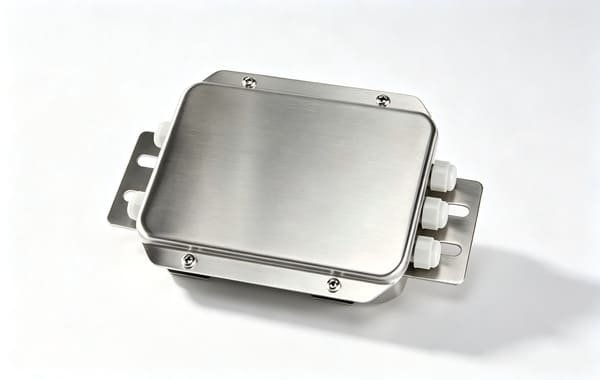
Three adjacent options, because they come up and I would rather name them than let you find them yourself. If your meter platform is larger than 200 × 200 mm, the WST219 is the stainless C3 single point at 400 × 400 mm and 50–500 lb. If the weight has to join a bus rather than a display, the WST1502 indicator sums a set and gives isolated RS-485 Modbus RTU with an optional 4–20 mA output. And if you are weighing cattle or a weigh crate rather than milk, the WST1103 planar beam at 1–3 t is the low-profile option that keeps a platform close to the floor.
If the weight data then has to travel into herd-management software or a parlour controller, the OEM integration guide for smart warehouse systems covers the interface and logging side, and the smart vending machine guide covers the same per-channel architecture in a different industry.
Send me the job, the species, the vessel or hopper capacity and leg count, the smallest load you need to resolve, and a sketch of the load path with every rigid connection marked. I will come back with the module sizing, the junction box and indicator, the written zero policy, and an honest answer about whether your vacuum or your agitator is going to be the problem — even when that answer costs me the order.
Request a specification →
Or email Robin directly