
Load Cells for Smart Pet Feeders: The Smallest Mass Is the One You Want
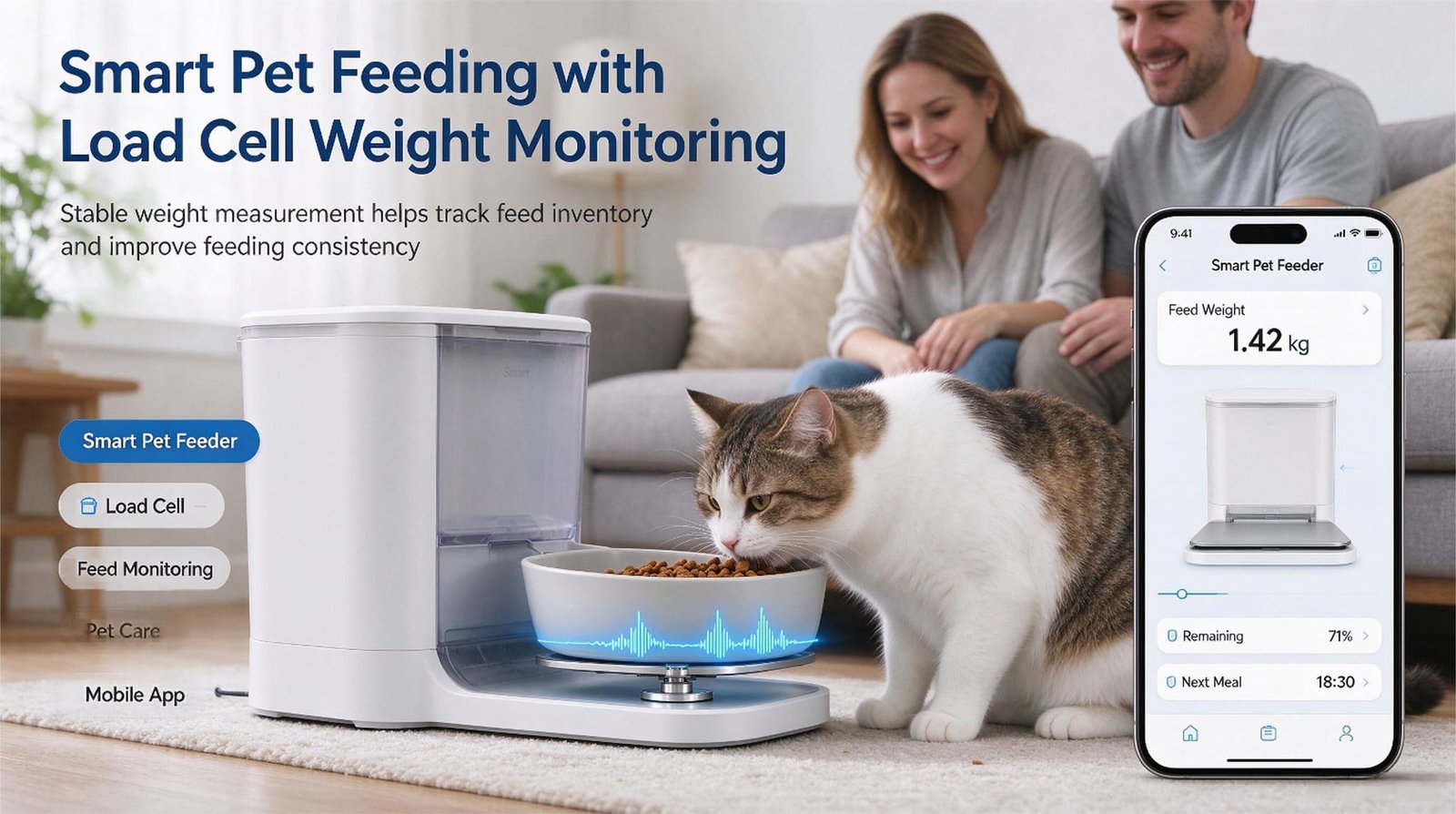
A cat’s meal is 27 g. The bowl plus that meal is 310 g. The hopper plus a week of food is 4,200 g. The cat is 4,000 g. Three of those four numbers will be offered to you as “the load”, and only the smallest one answers the question the product is actually sold on. I have quoted six smart-feeder programmes in the last two years. In four of them the load cell was in the wrong place — not through carelessness, but because repeatability is a percentage of the capacity you bought, not of the reading you need.
A 27 g meal on a 310 g gross
Gravimetric dosing vs a 3.3× measuring cup
1,000 Ω micro cells
IEC 60335-1 · IEC 62133-2 · RED 2014/53/EU
1. A smart feeder is four different weighing jobs
The brief always arrives the same way: “we need a load cell for our smart pet feeder.” That sentence covers four jobs with four different masses, four different error budgets and, in my experience, four different answers. Until I get the person on the call to separate them, the numbers we exchange are noise.
| Job | Typical mass at the cell | Question it answers | What “wrong” looks like |
|---|---|---|---|
| A. Bowl content | 250 g bowl + 27–400 g food | Did the pet eat, and how much is left? | The log says 5 g eaten and the bowl is empty |
| B. Hopper level | 600 g hopper + 1.2–8 kg food | Do we need to tell the owner to refill? | Refill alert fires on a full hopper, or never fires |
| C. Dispense verification | Difference of two readings, 10–120 g | Did the food actually leave the auger? | Two “successful” feeds logged, zero food in the bowl |
| D. Pet weight | 1.5–40 kg, on a separate pad | Is the animal gaining or losing? | Only the friendly cat ever gets weighed |
Job A is the one the product is sold on and the one with the smallest signal — the food in a cat’s bowl is about 1 % of the mass of the hopper you were probably thinking of instrumenting. Job B is a level gauge, not a meter. Job C is not a weighing problem at all, it is a verification problem, and it only works if A is trustworthy. Job D is a completely different product that happens to share a shopping list.
There are also three technology families competing for the same feature, and it is worth being clear about which one you are in before we talk about sensors:
Measures the mass directly. Works in the bowl, under the hopper, or on a separate pad. Tells you what the food is doing, not what the motor is doing. Everything below is about this family.
An auger or a rotary drum turns a fixed number of degrees and the firmware assumes a mass. Cheaper, and the assumption is wrong by a margin nobody publishes — see section 8.
Estimates kibble count from an image. Good at detecting presence and very good at being photographed at trade shows. Cannot tell you a mass, and cannot tell you the auger emptied itself into the bowl.
I supply the weighing chain: load cells, junction boxes, weighing indicators, and the matching data that tells you whether four cells in a set will agree with each other before you build the tray. I do not supply the feeder. The bowl, the hopper, the auger or valve, the motor, the gearbox, the app, the Bluetooth stack, the battery pack and the firmware thresholds are all yours. If your question is “how do I dose 27 g of kibble twice a day without the pet noticing a pattern”, that is a machine design question and I am the wrong supplier for it. If your question is “why does the same bowl read 296 g some mornings and 309 g on others”, that is my half of the problem and I will spend as long on it as you like.
If you are still deciding between a single-point cell, a set of planar beams and a four-cell summing tray, the general logic is in How to choose the right load cell for your project. This article assumes you have already chosen strain gauges and now have to place them.
2. A cup is not a mass, and it is your real competitor
Before we price anything, it is worth knowing what the load cell is being asked to beat. It is not another load cell. It is a plastic measuring cup, and the reason it is a serious competitor is that the Association for Pet Obesity Prevention’s 2025 pet weight and nutrition survey found something I have not been able to forget since I read it.
In the APOP 2025 opinion survey, 3 % of cat owners said they weigh their pet’s food. Sixteen percent of dog owners said the same. Everybody else — somewhere between 84 % and 97 % of the market — measures with a cup, an eye, or a feeling.
The same survey found 37 % of dog owners and 43 % of cat owners describe their pet as above ideal weight, and only 28 % of the dogs and 19 % of the cats that were put on a weight-loss plan actually reached a healthy weight.
So the competing instrument is used by almost everybody, and it does not work. Why not? Because a cup measures volume, and the thing you are trying to control is mass. The conversion factor between them is bulk density, and bulk density in this category is not a number — it is a range wide enough to swallow the entire clinical problem.
| Product style | Bulk density | One 240 mL cup holds |
|---|---|---|
| Extruded kibble (the mainstream) | 0.35–0.55 g/mL | 84–132 g |
| Cold-pressed / baked pellets | 0.28–0.36 g/mL | 67–86 g |
| Freeze-dried raw pieces | ≈ 0.18 g/mL | ≈ 43 g |
| Dense extruded pellets, high end | ≈ 0.60 g/mL | ≈ 144 g |
| Whole-market spread | — | 43–144 g = 3.3× |
The same scoop, the same instruction on the bag (“one cup twice daily”), and a 3.3× spread in the mass delivered. Even if you stay inside extruded kibble, which is what most of your customers feed, you are still looking at 84 g against 132 g — a 1.6× spread, with no way for the owner to know which end they are on, because pet food packs almost never print bulk density. The only reliable fix is the one the vets have been recommending for years: weigh it.
Here is why that margin matters more than it sounds like it should. Take a 4 kg indoor cat on 55 g a day — roughly 198 kcal at 3.6 kcal/g, which is an ordinary maintenance ration. Now express the error as time instead of grams, because that is how owners experience it:
| Daily error | 4 kg cat, 55 g/day | 15 kg dog, 240 g/day | As extra days of food per year |
|---|---|---|---|
| 2 % | 1.10 g/day · 402 g/year | 4.80 g/day · 1.75 kg/year | 7.3 days |
| 5 % | 2.75 g/day · 1.00 kg/year | 12.0 g/day · 4.38 kg/year | 18.3 days |
| 10 % | 5.50 g/day · 2.01 kg/year | 24.0 g/day · 8.76 kg/year | 36.5 days |
| 20 % (a cup) | 11.0 g/day · 4.02 kg/year | 48.0 g/day · 17.5 kg/year | 73 days |
Read the last column. A 10 % overfeed is not 10 % — it is 36.5 extra days of food per year, which is what it feels like to the animal and to the owner’s wallet. And look at the 4 kg cat row at 20 %: 4.02 kg of extra food a year, on a 4 kg animal. The measuring error is larger than the pet. I have used that sentence in three customer meetings and it has ended the argument each time.
A cup costs nothing, never needs charging, goes in the dishwasher, and takes two seconds. Your load cell will not win on any of those. It wins only if it removes the two things the cup needs from the human: attention and arithmetic. Which means the feature is not “it weighs things”. It is “it weighs things when nobody is looking, twice a day, for three years, without being asked.” Every specification decision below follows from that sentence, including the ones that make the sensor look worse on paper.
3. The precision band is four kibble pieces wide
Now I can say what precision you need, and it is much less than anybody asks for. Work back from what the veterinary literature treats as a meaningful change:
- Weight-management plans typically target 1–2 % of body weight lost per week. Faster than that and you risk muscle loss.
- Obesity risk rises meaningfully at just 10 % above ideal body weight — well before an animal looks overweight.
- A small published study of dogs with osteoarthritis found lameness improved starting at only a 6.1 % reduction in body weight. The clinical response curve is steep at the bottom.
- A University of Liverpool / Waltham study across more than 50,000 dogs in 12 breeds found overweight dogs’ lifespans were up to 2.5 years shorter than ideal-weight dogs’. In a species that averages 10–13 years, that is the whole tail of the animal’s life.
Put those together and the control band — the error you actually need to stay inside — is roughly ±2 % to ±5 % of the daily ration. Not 0.1 %. Not 0.01 %. Two to five percent.
| Control band | 4 kg cat (55 g/day) | 15 kg dog (240 g/day) | In medium kibble (≈ 1.2 g/piece) |
|---|---|---|---|
| ±2 % | ± 1.10 g/day | ± 4.80 g/day | 4 pieces |
| ±5 % | ± 2.75 g/day | ± 12.0 g/day | 10 pieces |
The entire daily error that changes a 15 kg dog’s life is four pieces of kibble. That is the size of the problem. Everything a feeder does beyond getting that arithmetic right is comfort features.
Write it as a control band, not a resolution. Something like: “daily delivered mass within ±1 g of target for a 55 g ration, verified over 30 consecutive days, with no human intervention.” That single sentence is achievable and it is the whole product promise.
What I keep being handed instead is “0.01 g resolution”. That is 110× finer than the smallest error that matters for a cat, and because of the way load cell specifications work — which is the next section — chasing it makes the product measurably worse.
“The band is 5 % so accuracy doesn’t matter” is the wrong reading. The band tells you the target is 1–5 %; it says nothing about whether you can hold it. A feeder with a 20 % systematic error is simply worse than the cup, because the cup at least fails in a way the owner can see. The distinction between accuracy and repeatability in the next section is the difference between a product that hits the band and a product that happens to pass through it.
4. Repeatability is a percentage of capacity, not of reading
This is the section I wish every pet-tech engineer read before they send me a drawing. It is also the reason I have had to tell four customers that the sensor they had already chosen was the wrong one, and in every case the sensor was fine.
Every strain-gauge specification that sounds like accuracy — repeatability, non-linearity, hysteresis, creep, temperature effect — is written as a percentage of full scale. Full scale is the cell’s rated capacity, not the load you happen to put on it. So the error a cell contributes to your reading is:
That ratio is the whole design. Buy a cell whose capacity is 3× your gross and you have just divided your resolution by three, at the same price and with the same datasheet. And if you put four cells under a tray, you multiply the capacity by four while the load stays the same — the averaging only claws back the square root.
Here is what that looks like with parts out of my own catalogue. Every one of these cells is specified at 0.05 %F·S repeatability except the two planar beams at 0.02 %. Nothing in the left-hand column is a trick.
| Where the cell goes | Gross load | Capacity bought | Used | Resolves |
|---|---|---|---|---|
| Cat bowl — WST109 500 g × 1 | 310 g | 500 g | 62 % | ± 0.25 g |
| Dog bowl — WST109 1 kg × 1 | 800 g | 1 kg | 80 % | ± 0.50 g |
| Dog bowl in a 4-cell tray — WST103 1 kg × 4 | 800 g | 4 kg | 20 % | ± 1.00 g |
| Cat bowl, over-bought — WST101 5 kg × 1 | 310 g | 5 kg | 6 % | ± 2.50 g |
| Dog bowl in a 4-cell tray — WST102 5 kg × 4 | 800 g | 20 kg | 4 % | ± 5.00 g |
| Hopper — WST1101 7.5 kg × 1 | 4.2 kg | 7.5 kg | 56 % | ± 1.50 g |
| Hopper in a 4-cell set — WST1101 7.5 kg × 4 | 4.2 kg | 30 kg | 14 % | ± 3.00 g |
| Mid hopper — WST107 20 kg × 1 | 4.2 kg | 20 kg | 21 % | ± 10.0 g |
| Bulk bin — WST101 50 kg × 1 | 12 kg | 50 kg | 24 % | ± 25.0 g |
Look at the span of column five: 0.25 g to 5.00 g, a factor of twenty, on cells whose datasheets all say the same number. The only thing that differs is how much capacity you bought that you were not using. Four bars of the same accuracy class, four completely different products.
The four-cell row is worth doing by hand, because it is the counterintuitive one. A 20 kg tray set is twenty times the capacity of a single 1 kg cell. Summing four cells averages their random errors, and averaging four independent things buys you √4 = 2. So you divide by twenty and multiply by two: ten times worse than one small cell, before a single real-world effect is added. The arithmetic is not subtle, but the intuition runs the other way — “more sensors must be better” — and I have watched four engineering teams go that way.
If your design puts a bowl on a four-cell summing tray and your gross is under about 2 kg, I cannot help you. The smallest half-bridge cell in my catalogue is rated 5 kg per cell (WST102), so a four-cell tray starts at 20 kg of capacity. The smallest planar beam is also 5 kg per cell (WS1102), so a three-point set starts at 15 kg. Against an 800 g gross that is 4–5 % utilisation, and 4–5 % utilisation is what produces the ±5 g row above.
There is no half-bridge and no planar beam in the catalogue rated below 5 kg. If you need sub-gram resolution on a bowl, you need a single small full-bridge cell under a single-point or three-pin pivot, and the smallest I make starts at 300 g (WST109). That is not a sales preference. It is the capacity-to-gross ratio doing the talking.
Pick the cell whose rated capacity is 1.2–2× the heaviest gross the cell will ever see, and then check that the pet, the bowl, the food and an accidental elbow still fit inside the safe overload. For a cat bowl that means a 500 g or 750 g cell. For a large dog it means 1 kg or 2 kg. For a 4 kg hopper it means 7.5 kg, not 30 kg.
The temptation is always to buy headroom “for safety”. Headroom is not free. It is paid for in exactly the units you were trying to improve.
One nuance before we leave it. Repeatability is not accuracy. Repeatability says the same load reads the same number twice; accuracy says that number is near the truth. A feeder needs the second one only on the day it is calibrated, and lives on the first one forever after. If your firmware computes “eaten = before − after”, a constant offset cancels completely and a wandering one does not. So the purchase spec should lead with repeatability, zero stability and creep, and put comprehensive error second — which is the opposite of how most quotes in this category are laid out. On a cell that reads 300 g for a living, 0.05 %F·S comprehensive error is 0.15 g, below everything else in the chain.
5. The pet is 17–40× the signal
Now put the animal in the picture, because the bowl scale has to share its platform with something that weighs more than the food by a very large factor and does not hold still.
| Scenario | Load transferred to the bowl | Food actually there | Ratio |
|---|---|---|---|
| 4 kg cat, one paw on the rim (≈ 25 % BW) | 1.00 kg | 60 g | 16.7× |
| 4 kg cat, leaning its chest on the rim (≈ 40 %) | 1.60 kg | 60 g | 26.7× |
| 15 kg dog, one paw | 3.75 kg | 120 g | 31.2× |
| 40 kg dog, one paw | 10.0 kg | 400 g | 25.0× |
| 40 kg dog, both front paws leaning | 16.0 kg | 400 g | 40.0× |
An ordinary cat, resting a paw on the rim while it decides whether it is hungry, puts sixteen times the entire food mass onto the platform. A large dog puts forty. And unlike the classic tare problem, this load is transient and it arrives exactly during the window you are trying to measure. The bowl scale cannot distinguish “the pet ate 20 g” from “the pet is standing on me” by looking at mass alone. There is no filtering trick around that; the information is not in the mass.
What does work is not a better cell but a better question. Three conditions in firmware, in this order:
- Stillness first. A reading only counts if the platform has been quiet to within a fraction of a gram for several seconds. A paw arriving is a step; a pet settling is a step; both are rejected by the same gate.
- Then direction and size. Eating removes mass in steps. Kibble removal is discrete, and the smallest meaningful step is one piece, which is 0.2 g for cat kibble and 2 g for large-breed kibble. Anything smaller than the local piece size is a crumb, or noise.
- Then persistence. The new level must hold. A paw leaning is a step and a reversal. Accept the step only if the level is stable after it, which is typically 20–60 seconds of patience that costs you nothing in the app and everything if you skip it.
I should be honest about the boundary here: that state machine is firmware, it is yours, and I do not write it or sell it. But it is the reason the sensor choice matters. A cell with poor zero stability makes condition 1 impossible — the platform never looks quiet, so nothing is ever accepted, and the product ships with a threshold loose enough to let the cat through. Weighing hardware that drifts is not a small quality problem. It silently sets the sensitivity of every decision above it. I wrote about the same mechanism from the other direction in 3D printer filament weighing, where a drifting load cell makes the spool-empty alert fire at the wrong time.
6. Pieces average out. The last piece does not.
Pet food is not a continuum. It is a count of discrete objects, and a smart feeder sits on top of that fact. A 240 g daily ration of medium kibble is about 200 pieces; a 55 g cat ration of 0.2 g kibble is 275 pieces. Your app reports a smooth number of grams. The physical system is counting.
Two different effects live inside that, and they behave in opposite ways. Individual kibble pieces are not identical — a premium extruded diet holds piece mass to roughly ±5 %, an economy diet closer to ±15 %. That is a random error, and random errors average away. But the granularity — the fact that mass can only arrive in 1.2 g steps — is not an error at all, and it does not average away. It stays exactly one piece wide no matter how long you average.
| Situation | Pieces present | Scatter of the sum (±5 % pieces) | Step size | Step as % of reading |
|---|---|---|---|---|
| Dog, full day — 240 g of 1.2 g kibble | 200 | ± 0.85 g | 1.2 g | 0.5 % |
| Dog, one meal — 120 g | 100 | ± 0.60 g | 1.2 g | 1.0 % |
| Cat, full day — 55 g of 0.2 g kibble | 275 | ± 0.17 g | 0.2 g | 0.4 % |
| Cat, one meal — 27 g | 135 | ± 0.12 g | 0.2 g | 0.7 % |
| The tail — 3 large kibble left | 3 | ± 0.18 g | 2.1 g | 33 % |
Read the last two columns together. Over a full bowl the food’s own piece-to-piece variation is worth less than a gram, and the granularity is half a percent — a 0.25 g cell is comfortably finer than both, which is why the cat bowl line in the previous section is not a compromise. But when three pieces are left, the step is 33 % of the reading. Your app can print “2 g remaining” and the truth is anywhere from 0 to 6 g, because the number cannot exist between pieces.
Report grams while the count is high, and report pieces when the count is low. Above roughly 20 pieces the quantum is under 5 % of the reading and grams are honest. Below about 5 pieces, “4 pieces left” is exact and “8 g left” is a fiction. Owners find piece counts more useful anyway — it is how they already think about the bowl.
If you want a hard threshold: switch to counting once the step size exceeds 5 % of the reading. With 1.2 g kibble that happens at a gross of 24 g. With 2.1 g kibble it happens at 42 g.
Crumb fall. Kibble breaks. A 0.4 g fragment leaving the bowl on a 27 g cat meal is a real mass change and not a meal. Set the step threshold below the local piece size and every crumb becomes a bite — which is exactly what a 0.1 g cell will do.
Piece settling. A loosely poured portion slumps as the pet noses through it, moving the centre of gravity and, on a multi-point platform, shifting load between supports. Real mass, no mass change. It is also why a 4-cell tray underperforms its paper specification: the specification assumes a centred load.
7. The food gains mass while nobody eats
Here is the failure mode that nobody budgets for, and it took me two projects to see it because it looks like the sensor drifting. Dry pet food is hygroscopic. Extruded kibble leaves the plant at roughly 8–10 % moisture and then spends the rest of its life trying to reach equilibrium with the room it is sitting in. In a bowl on a kitchen floor, over twelve hours, that can move the moisture content by a percentage point or two.
Moisture is expressed as a fraction of the as-fed mass, so the relationship between dry matter and total mass is m = mdry / (1 − w). Going from 8 % to 10 % is therefore a mass ratio of (1 − 0.08) / (1 − 0.10) = +2.22 % on the same amount of food. Nothing has been eaten. The scale is right. The mass genuinely increased.
| Where the kibble is sitting | Mass present | Mass gained at +2.22 % | What the app does with it |
|---|---|---|---|
| Cat meal | 27 g | +0.60 g | Under-reports the meal by 0.6 g (2.2 %) |
| Dog meal | 120 g | +2.67 g | Under-reports by 2.67 g |
| Dog bowl left out all day | 400 g | +8.89 g | Under-reports by 8.89 g — half a 2 % daily band |
| Hopper with a week of food | 3.6 kg | +80 g | Looks like two portions were dispensed |
The direction is what makes this expensive. Moisture adds mass, so a feeder that infers consumption from a falling bowl will under-report the meal every single time. On the cat’s day — two meals of 27 g — that is 1.20 g of phantom food, which is 2.2 % of the daily ration. Look back at section 3: the control band is 2–5 %. The humidity alone consumes the bottom of the band, systematically, in the safe direction for the pet and the wrong direction for your data.
On the hopper the same effect is an order of magnitude larger in absolute terms: 80 g on 3.6 kg, which is two whole 40 g portions. Compare that to the ±3 g a four-cell planar set resolves on that hopper and you can see the shape of the argument. The hopper’s humidity drift is more than twenty times its own resolution, so it is unmistakably visible — and completely useless as a meter.
I cannot stop kibble absorbing water. Sealing the hopper, choosing a barrier film, reducing the open bowl’s exposed surface, or shortening the between-meal window are all machine design decisions and they belong to you. What I can give you is the zero stability and short-term repeatability that makes a short-window detector work — measuring the change over a few minutes rather than trusting a level that has been sitting all night. If the cell’s zero wanders by 3 g over a day, no firmware can separate that from a 3 g moisture gain. If it holds within 0.3 g over an hour, the two are trivially separable and the moisture becomes a slow, visible, ignorable trend.
8. Volumetric dosing, and the bowl as the only witness
Most automatic feeders dispense by turning an auger or a rotary drum for a set number of revolutions. That is a volume device. To turn it into a mass you multiply by bulk density, and the multiplication has two problems that no amount of motor control fixes.
The first is the recipe. Extruded kibble runs 0.35–0.55 g/mL. Change the food, or change the formula, and the same ten revolutions deliver 1.6× the mass. Support gets a ticket saying “the feeder overfeeds” and the customer’s real problem is that they switched brand.
The second is the hopper level, and it is the one that catches people out. An auger does not fill completely. Under a full hopper the flights pack well; as the hopper empties and the material above the inlet stops pressing down, the fill factor falls. Take a flight volume of 12 mL and ten revolutions:
| Auger fill factor | Volume in 10 turns | Mass at 0.45 g/mL | Delivered vs target |
|---|---|---|---|
| 100 % — full hopper | 120 mL | 54.0 g | +35 % |
| 85 % — half full | 102 mL | 45.9 g | +15 % |
| 70 % — nearly empty | 84 mL | 37.8 g | −5.5 % |
The same thirty revolutions, the same firmware, the same food, and a 16.2 g difference — 41 % of a 40 g portion — purely because the hopper was emptier. A feeder calibrated on day one with a fresh hopper drifts by roughly 40 % of its target as the hopper drains. That is eight times the entire clinical control band, and it happens slowly enough that no owner connects it to the refill.
There is a third problem, and it is the reason I get called. Bridging. Kibble arches over the auger inlet, the auger turns in the air, and the firmware faithfully reports a successful feed. Nobody is home. Nobody notices for a week.
All three of those problems have the same solution, and it is not a better auger. It is a scale in the bowl. If you can see the bowl gain 38 g, you do not need to know the fill factor, the bulk density or whether the arch formed — you know the food arrived. The bowl scale closes the loop that the volumetric dispenser cannot close on itself.
Which means the load cell is not a wellness feature. It is a dispenser diagnostic, and that is the argument that survives procurement review. “We can tell you how much the pet ate” is nice. “We can detect a jammed auger, a bridged hopper and an empty bin, and we can tell the difference between them” is a support-cost reduction, and the customer can put a number on it.
The topology I now recommend to everyone: the hopper scale is a level gauge, the bowl scale is the meter. See case 2 for the project where the customer had it the other way round.
| Loop | Question | What it needs | What it must not be asked to do |
|---|---|---|---|
| Bowl scale | Did food leave, and did the pet eat? | Smallest possible capacity, ±0.25–0.5 g repeatability, tight zero | Absolute accuracy — the delta cancels it |
| Hopper scale | Is there enough food for tomorrow? | Reliability over millions of cycles, immunity to off-centre load, IP protection | Portion metering — the tare is 100× the portion |
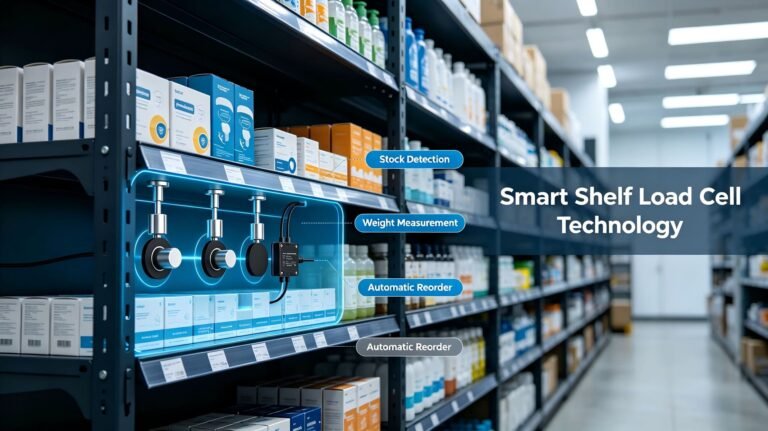
I have described the same structural idea in three other applications, and the geometry keeps repeating: in smart vending machines, in 0.1 g espresso dosing, and in smart shelves with one cell per bay. Wherever the machine actually moves something physical, the weighing sensor stops being a sensor and becomes a check.
9. Evaporation is a slope. Drinking is a step.
Most of the products that ask me for a food-bowl cell also want a water side — a fountain, a reservoir, a wet-food bowl. The physics is different in a way that matters, and I have seen a launch delayed by two months because of one number that nobody estimated.
Water in an open bowl at room temperature evaporates. Indoor still-air evaporation rates sit somewhere between roughly 0.5 and 2.5 mm/day equivalent depending on humidity, air movement and whether the pump is aerating the surface. Multiply by the surface area and you get mass leaving the bowl with no pet involved. For a 22 cm fountain basin that is 0.038 m²:
| Evaporation rate | Loss from a 22 cm basin | As share of a cat’s 150–250 mL/day |
|---|---|---|
| 0.5 mm/day — humid room | 19 mL/day | 8–13 % |
| 1.0 mm/day | 38 mL/day | 15–25 % |
| 1.5 mm/day — heated flat, winter | 57 mL/day | 23–38 % |
| 2.5 mm/day — dry, moving air | 95 mL/day | 38–63 % |
A cat drinks 10–20 mL per visit. So in a warm dry room, evaporation removes the equivalent of three to nine drinking visits per day that never happened — and because the loss is real and the scale is honest, the app reports them as intake. Note the direction: on the water side, the physical nuisance inflates the number, where on the food side humidity deflates it. Both are wrong, in opposite directions, and a product that tracks both had better know which is which.
There is also a counterintuitive detail: a circulating fountain is worse than a still bowl, not better. The pump keeps the whole basin wetted, aerates the water, and usually increases the exposed surface. Customers ask for the fountain and get more evaporation with it.
Compare the two mechanisms per unit time. At 1.5 mm/day, evaporation removes 0.00066 g per second. A 5 g step detector with a five-second window can be fooled by 0.0033 g in that window — about 1,500× smaller than the threshold. At 2.5 mm/day it is still 900× smaller. Evaporation is not a fast process; it just runs for a long time.
A daily-total algorithm integrates both drinking and evaporation and has no way to tell them apart. A step detector sees evaporation as a slope several orders of magnitude too slow to trigger. You do not filter it out. You choose a mechanism that cannot see it.
A customer came back asking for a higher-resolution cell because their drinking data was noisy. Their fountain uses a WST109 2 kg cell, whose repeatability is ±0.05 %F·S — 1 g — on a 1.25 kg gross. Against a recommended 5 g step threshold that is a five-to-one margin, which is plenty. Their noise was evaporation being integrated and their threshold being set at 2 g. The sensor was already 5× finer than the decision it was being asked to support. I told them so, and did not sell them the cell they asked for. That project is case 3.
The reason I can be specific about all of the above is that a pet feeder is one of the few product categories where the engineering constraints are unusually favourable and the commercial constraints are unusually hard. There is no legal metrology requirement anywhere in this article — nobody pays for pet food by weight, so no approved instrument is needed and no type approval applies. What that means in practice is that the only thing standing between you and a good product is physics, not paperwork. The next section covers the parts of the physics that live in the enclosure rather than the electronics.
10. The four things that break a feeder scale
Every one of these has come up in a real project, and none of them is a load cell specification problem. They are the reason I ask for photographs before I quote anything.
(1) The bowl comes off, twice a week, for the life of the product. Pet bowls get washed. That means the weighing platform has a removable member, which means the seat repeatability is part of your measurement chain. Work out the tolerance and you will see how tight it is: if you want ±1 g on a 60 g meal sitting on a 310 g gross, the bowl must return to the same position to within ±1 g, which is ±0.32 % of the gross. On three locating pins on a 120 mm bolt circle, 0.1 mm of slop at one pin is enough to move load between supports and drift the zero several grams. That number is a moulding tolerance, not a sensor specification, and no cell on the market fixes it. If your bowl is dropped onto a soft silicone mat instead of hard points, the mat’s compression set will add a slow drift on top of it.
(2) The bowl also goes in the dishwasher. A domestic cycle runs at 60–70 °C with steam and detergent, and the cells in this family are temperature-compensated over −10 to +40 °C. A cell inside the bowl will be at the edge of its compensated range every wash, then wet, then hot, and its zero will move. The design answer is simple and worth stating plainly: put the cells in the non-removable base and weigh the bowl through the seat. Then the dishwasher only ever sees plastic or stainless steel, and the electronics never leave the room.
(3) IP65 is not “washable”. Several cells in this family are IP65 (WST107, WST109, WST1101, WS1102, WST102), which is protection against dust and water jets from any direction — a good rating for a kitchen floor. It is not a dishwasher rating and it is not a submersion rating. Two practical details decide whether IP65 holds: cable entry direction and sealing of the cell in its recess. A gland or cable exit facing up collects water and turns into a bucket; I have written about that particular failure mode in how to tell whether a load cell is damaged. And where four cells are summed, the junction box is the other half of the water problem — use a sealed one with gasketed entries, and read the junction box wiring and adjustment guide before you decide where to put it.
(4) The animal tests the enclosure, not the sensor. Cables get chewed, a 40 kg dog leaning on a 600 g feeder tips it, a cat launches off the lid. None of that is a weighing problem, but all of it terminates in the weighing chain. Two habits cover most of it: run cables in a channel rather than in free air, and give the base enough footprint and mass that the pet has to try. The smart cat litter box guide covers the four-cell summing and matching logic a tray-based feeder inherits, in a far harsher mechanical environment — an animal deliberately climbing into the machine.
Hoppers cake. Kibble in a hopper absorbs moisture, the fat fraction migrates, and the material at the walls consolidates into a crust. Run that hopper to 30 % and the crust is carrying part of the load — which means the load cells are not seeing the whole mass and the level gauge reads high, so the feeder never asks for a refill. Adding a level scale does not replace cleaning, and I would rather tell you that than sell you a second sensor.
11. What to put in the spec sheet
Here is the sheet I actually want to receive. If you send me these nine lines I can quote the same day and the quote will be right the first time.
| # | What I need | Why it changes the answer |
|---|---|---|
| 1 | Which of the four jobs (bowl, hopper, dispensing check, pet pad) each sensor is for | Determines capacity, which determines everything else |
| 2 | Heaviest gross the platform will ever see, not the food weight | Sets the capacity/gross ratio — the whole game |
| 3 | Smallest mass change you must resolve, and how long it takes | Distinguishes a 1 g step from a 0.05 g ambition |
| 4 | Number of cells and whether they are summed | Tells me whether to send matched sets and what to expect from corners |
| 5 | Is the bowl removable for cleaning? Dishwasher or hand wash? | Decides IP level, temperature range and where the cell can live |
| 6 | Ambient range — kitchen, garage, unheated utility room, outdoor catio? | Our standard compensation is −10 to +40 °C; outside that, zero stability is not warranted |
| 7 | Excitation voltage and bridge resistance your board expects | 1,000 Ω bridges draw 5 mA at 5 V where 350 Ω draw 14.3 mA |
| 8 | Cable length, exit direction and connector | Longest lead time item after the cell itself; also the usual water-entry point |
| 9 | Annual volume and target unit cost band | Decides whether custom-by-dimension is worth tooling at all |
“What is the heaviest single item a person could put on this platform by accident?” Not the pet — a person. Someone will lean on it, kneel next to it, or set a full shopping bag on it once. If the answer is 40 kg and your cell is rated 1 kg, we need to talk about overload protection, because safe overload of 120–150 % is not designed for that.
“What does the app actually print when the count is low?” If the answer is a gram figure, we should fix the app before we pick the cell. Section 6 is the whole reason.
If you have not chosen a topology yet — single-point, planar set, or summing tray — start with the selection guide, and if you want the fundamentals first, The Complete Guide to Load Cells covers strain gauge physics and the difference between the families in more depth than I can here.
12. What I supply, and what I do not
This is the part of the article I would ask you to read even if you skip everything else, because getting it wrong wastes both our time. I am a weighing-component supplier. I am not a feeder manufacturer.
| I supply (the weighing chain) | I do not supply (the machine) |
|---|---|
| Load cells: micro flat, single-point, miniature, planar beam, half-bridge, 300 g to 200 kg | The bowl, the hopper, the lid, the auger or rotary dispenser, the motor, the gearbox, the valve |
| Matched output sets for 3- and 4-cell platforms, with the matching data written per set | The application, the cloud, the WiFi or BLE stack, the OTA update, the subscription |
| Junction boxes with potentiometer corner adjustment and surge protection | The firmware: stillness gates, step thresholds, piece counting, zeroing schedule, feeding schedule |
| Weighing indicators and digital-output cells where you want the conversion done locally | The calibration process at your factory and the end-of-line verification routine |
| Custom-by-dimension cells and cable assemblies for high volume | Appliance safety, EMC, radio and battery certification — IEC 60335-1, EN 55014, RED 2014/53/EU, FCC Part 15, IEC 62133-2 — all of these are the whole machine, and yours |
| The IP65 sealing on the cell, and honest numbers for what it survives | Food- and feed-contact material compliance — EU 1935/2004 and 10/2011, or FDA 21 CFR 177 — which follows the bowl and the hopper, not the sensor |
There is no legal metrology requirement in this application. Nobody pays for pet food by weight, so no approved instrument is needed, and I will not sell you one. If a competitor offers you “OIML-approved” cells for a pet feeder, ask what the approval is for. Component-level OIML R60 describes the cell; it does not approve your machine, and your machine does not need approving. What matters to your customer is that the portion is right and repeatable — a design and assembly question, not a certificate question.
- WST101 does not state an IP rating on its product page. Its capacity range starts at 5 kg, which also makes it a poor fit for a small bowl. If your design needs a 5–50 kg flat micro cell in a wet area, I would rather write a specification for a sealed variant than sell you a standard one and let you find out.
- WST103 specifies 0.2 %F·S temperature effect on zero, twice the 0.1 % of WST101 and four times the 0.05 % of the planar beams. In a warm kitchen with a 15 K swing that is a real number, not a datasheet decoration. It is a good cell; it is not the cell for a ±1 g task on a 1 kg gross.
- No half-bridge or planar cell in the catalogue is rated below 5 kg per cell. A three-point set therefore starts at 15 kg and a four-cell tray at 20 kg. If your gross is under 2 kg, a single small full-bridge cell is the only honest answer I have.
- WST1101’s smallest capacity is 7.5 kg and its repeatability is the best in this article at ±0.02 %F·S. That combination is why it wins the hopper and loses the bowl.
13. Field notes: Hangzhou, and an app that said 5 g
A Hangzhou OEM called me in the spring of 2026 with a WiFi feeder they had already shipped about three thousand of. The complaint was specific and strange: the app said the cat had eaten 5 g, and the owner could see an empty bowl. The support queue was full of it. Their engineering conclusion was that the load cell was no good, and they had already picked a replacement from a competitor.
I did not quote anything. I asked for one thing: log the raw gross reading for seventy-two hours with no cat, no food and no lid. They thought it was a waste of a week. It took about four hours to write and it answered the question before lunch on the first day.
- Days 1 and 2 flat to within 0.4 g. The cell itself is fine.
- A steady −7 g drift across day 3, smooth, no steps. Not an electronic event — a mechanical one.
- A +4 g jump immediately after the weekly wash, then a partial 2 g recovery over the next day.
- Peak-to-peak over the test: 11 g.
Two mechanisms, neither of them in the sensor. The bowl sat on a 2 mm silicone mat; under a 310 g load that mat takes a compression set over about three days, its effective height drops, and part of the load starts finding its way around the load cell into the housing. That is the smooth 7 g. And when the bowl came back from the wash, the keeper tabs were not fully home — the gross came back 4 g high, and the firmware helpfully zeroed on that as its new reference. The drift then stopped, because the firmware had just redefined the truth.
Here is the number that ended the discussion. A cat meal in that design is 27 g. Eleven grams of zero wander is 41 % of the signal, and it moves in both directions. Detect a 5 g bite against a reference that wanders by 11 g and the arithmetic produces exactly the support tickets they were reading: phantom meals, missing meals, and “5 g eaten, bowl empty.”
- Three moulded hard points instead of the silicone mat, so the seat height is a feature of the part rather than a property of a compressible material.
- A locating detent, so “tabs not fully home” stops being possible instead of merely being unlikely.
- Zero only when the gross sits inside the empty-bowl band for two hours and the temperature has been stable to about 1 °C. Not on power-up, not on a timer.
Phantom meal reports went from around six a week to fewer than one a month on the next firmware build. Same cells. Same tray. Same everything that cost money. I have had this conversation often enough now that I ask for the empty-platform log before I open a catalogue, and I recommend you make it the first acceptance test in your own process — forty-eight hours, no cat, and you will find out whether your weighing chain or your mechanics is the thing that moves.
Once the seat problem was visible, their next instinct was to buy resolution. They asked for a ±0.01 g cell, on the theory that more digits would somehow outvote the drift.
Run the capacity relation backwards and the request defeats itself. At ±0.05 %F·S repeatability, resolving 0.01 g requires a rated capacity of about 20 g. Their empty bowl weighs 250 g — twelve times the capacity that request implies. There is no such cell, and if there were, the bowl would destroy it before the first feeding. What they needed was for the reference to stop moving by 11 g, and that was free.
14. Field notes: Shenzhen, four cells under an 800 g bowl
A Shenzhen team sent me a tray drawing in 2026 and a requirement I have now seen four times: “we want ±1 g portion accuracy, and we are printing it on the box.” The tray was a formed stainless plate on four half-bridge cells rated 5 kg each, summed into one bridge, with the bowl sitting on top. Gross load, with a large-dog portion and a steel bowl: about 800 g.
I did the capacity arithmetic from section 4 in front of them. Four cells at 5 kg is 20 kg of capacity. Each cell carries ±0.05 % × 5 kg = ±2.5 g. Summing four averages the random part, buying √4 = 2, so the set resolves ±5 g. They were asking a platform for ±1 g that could not deliver ±5 g on a bench, and their 800 g gross was only 4 % of the capacity they had bought.
Then the second problem, which was worse and which I had not expected to have to raise. The half-bridge micro family publishes a four-angle error of 1.0 %F·S — I pulled up the WST105 and WST106 pages and showed them. On a 20 kg set that is a 200 g figure. Whether you see all of it or a fraction of it depends on how far off centre the bowl sits, and nobody was controlling that. They were having a ±1 g argument on a platform whose published corner sensitivity is two orders of magnitude larger.
- Keep four cells, shrink them to WST103 at 1 kg each. Capacity becomes 4 kg instead of 20 kg, utilisation rises to 20 %, and the set resolves ±1.0 g. It costs you platform stiffness and you will still need corner matching, but it is a real improvement of five times for the same sensor count.
- One WST109 1 kg on a three-pin pivot. Capacity 1 kg against an 800 g gross — 80 % utilisation — and ±0.5 g. One cell instead of four, and no junction box, no corner matching and no summing error at all.
- Keep the tray and change the claim. Keep the 5 kg cells, print “±5 g”, and use the bowl scale for what it is genuinely good at in that configuration: detecting that food arrived, that the auger ran, and that the hopper is empty. Stop advertising portion accuracy you have not measured.
They took option 1 for the tray product and option 2 for a compact model, which is the answer I would have given. What I did not do was sell them the ±1 g story. If a customer tells me a number is going on the packaging, my interest in that number goes up sharply, because a claim on a box is a claim you have to demonstrate at end of line on every unit, and a corner-sensitive platform makes that a per-unit measurement problem rather than a design property.
Two useful side effects came out of that project. They moved the level sensor from the bowl to a single WST1101 planar beam under the hopper, which at ±0.02 %F·S is the most repeatable part in this article and is exactly the right tool for “is there enough food for tomorrow.” And they started specifying gross utilisation as a design rule internally: nothing under 50 %, except the one part that is deliberately a level gauge.
15. Field notes: Utrecht, and a fountain nobody refilled
The most recent one came in during the summer of 2026 from a small team in Utrecht building a combined feeder and circulating water fountain. Their beta users had noticed something odd: on warm days the app reported the cat drinking more — sometimes 90 mL when the owner knew the animal’s normal was closer to 40 mL. Their read was that the load cell was too coarse and they wanted a finer one.
I asked for the raw trace rather than the daily totals, and the shape of it told the whole story. Underneath the visit steps there was a smooth downward slope of 2 to 4 g per hour, depending on the room, present day and night, that never stopped. Their visit threshold was set at 2 g, so the algorithm was happily counting the slope as a continuous stream of tiny drinking events. Their fountain basin is 22 cm across — 0.038 m² of open water with a pump keeping it moving and aerated.
| What the trace was actually showing | Value |
|---|---|
| Basin area | 0.038 m² |
| Evaporation, dry warm day (2.5 mm/day) | 95 mL/day = 4.0 g/h |
| Their visit threshold | 2 g |
| Evaporation in a 5-second window | 0.0055 g |
| A single cat visit | 10–20 mL |
| Phantom visits the app was inventing, per day | Roughly 3–9 |
The mechanism is not subtle once you see it, and the fix is not a filter — it is a different question. Evaporation and drinking live at completely different timescales. In five seconds, evaporation removes 0.0055 g; a genuine visit moves 10 g or more. That is a gap of nearly two thousand times, and it means you do not have to be clever. You have to stop asking for a daily total and start asking for steps.
- Step threshold from 2 g to 5 g, evaluated inside a 5-second window. A single lap is not a visit; a visit moves 10–20 g in well under that time.
- A slope gate: any mass change that is explained by a linear fit over the preceding hour is discarded as evaporation, not booked as drinking. This is what turns the 2 g/hour drift into a non-event.
- A smaller basin. Going from 22 cm to 16 cm cuts the open area by 47 % and takes the evaporation with it — a moulding change that buys more than any electronics work in this list.
Reported intake fell to a believable 35–55 mL/day and, more importantly, stayed believable on warm days instead of jumping. And the cell did not change. Their WST109 2 kg resolves 1 g against a 5 g decision threshold — a five-to-one margin on a 1.25 kg gross. A finer cell would have made the evaporation more visible, not less, which is a nice illustration of why “buy more resolution” is so often the wrong reflex.
Of the three projects in this article, two were solved without touching the sensor and one needed a smaller cell — and in the one that needed a smaller cell, the customer had been asking for a bigger one. That ratio is not unusual for this category. If you take one thing away, take the capacity-to-gross relation from section 4 and the empty-platform log from section 13.
16. Questions I get asked every time
What capacity load cell should I use for a smart pet feeder bowl?
Choose it from the heaviest gross load, not the food weight. A cat bowl with a 250 g bowl and a 60 g meal needs a 500 g or 750 g cell; a large-dog bowl at 800 g gross needs 1 kg or 2 kg. The aim is 50–80 % utilisation, because repeatability is a percentage of rated capacity. On an 800 g gross, a 1 kg cell resolves ±0.5 g and a 20 kg four-cell tray resolves ±5 g, from the same 0.05 %F·S datasheet.
Should I weigh the bowl or the hopper?
Both, for different jobs. The bowl is the meter — it has the smallest capacity and can resolve a single kibble. The hopper is the level gauge — its tare is 100× the portion, so even a good planar set only resolves about ±3 g on a 4.2 kg gross, which is ±7.5 % of a 40 g portion. If you only budget for one sensor, put it in the bowl; the hopper can be inferred from delivery counts.
My app reports “5 g eaten” but the bowl is empty. Is the load cell faulty?
Usually not. Log the raw gross reading for 48 hours with no cat, no food and no lid. If it is flat to within a few tenths of a gram, the cell is fine and the movement is mechanical or in the zeroing policy: a compressible mat under the bowl, a bowl that re-seats differently after washing, a zero taken on power-up while the bowl was still warm from the dishwasher. In one 2026 project an 11 g peak-to-peak wander against a 27 g meal — 41 % of the signal — produced exactly those symptoms, and no sensor change was involved.
Is ±0.1 g or ±0.01 g resolution worth paying for in a pet feeder?
No. The control band that changes an animal’s health is ±2 % to ±5 % of the daily ration — about 1.1 g for a 4 kg cat and 4.8 g for a 15 kg dog. For a medium dog that is four kibble pieces. And ±0.01 g at 0.05 %F·S repeatability implies a rated capacity of about 20 g, which an empty bowl would destroy on contact. Buy for repeatability and zero stability at the right capacity instead.
Can I use four half-bridge load cells under a bowl tray?
You can, but check two numbers first. Four 5 kg half bridges give 20 kg of capacity, so an 800 g gross is 4 % utilisation and the set resolves about ±5 g. And the half-bridge micro family publishes a four-angle error of 1.0 %F·S, which on a 20 kg set is 200 g at full eccentricity. Shrinking to 1 kg cells brings the set to ±1 g. Below roughly 2 kg of gross, no half-bridge or planar cell in my range is small enough and a single full-bridge cell is the better answer.
Why does the reading drift overnight even though nothing happens?
Usually a combination of three things: temperature, moisture and mechanics. All the cells in this range are compensated over −10 to +40 °C, and the temperature effect on zero alone is 0.05–0.5 %F·S per 10 °C depending on model, so a 15 K kitchen swing is a real number. Kibble absorbs moisture and gains mass by around 2.2 % going from 8 % to 10 % moisture, which shows up as less eaten than really happened. And a compressible seat or a soft foot takes a set under load. The empty-platform log separates all three in two days.
Does a pet feeder need certified or approved load cells?
No. There is no legal metrology requirement here — nobody pays for pet food by weight, so no approved instrument and no type approval applies, and component-level OIML R60 describes the cell rather than approving your machine. What your product does need is the standard appliance and radio set for your market: IEC 60335-1 for household appliance safety, EN 55014 for EMC (or RED 2014/53/EU and FCC Part 15 if there is a radio), IEC 62133-2 for the battery pack, and EU 1935/2004 with (EU) No 10/2011 or FDA 21 CFR 177 for the bowl material. All of those are the whole machine and belong to the feeder manufacturer, not to me.
Can the same setup track how much water my pet drinks?
Yes, if you detect steps rather than totals. A 22 cm basin loses 19–95 mL/day to evaporation depending on the room, which is 8–63 % of a cat’s daily intake and arrives as a smooth slope. A 5 g threshold inside a 5-second window is immune, because evaporation delivers only about 0.0055 g in that window — roughly 900–1500× below the threshold. Note the direction: on the water side evaporation inflates the reported intake, whereas on the food side moisture deflates it.
Recommended models
Six cells that cover every position discussed above: the bowl, the tray, the washable side, and two sizes of hopper. Capacities are the range members that matter for this application; every model has more sizes than the ones listed.
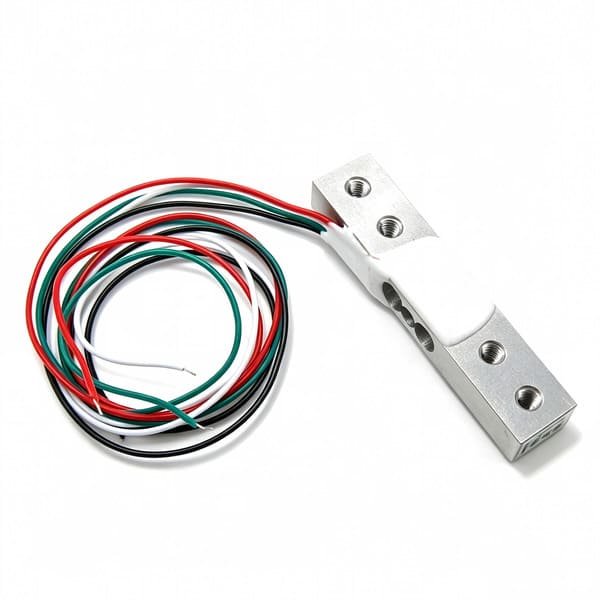
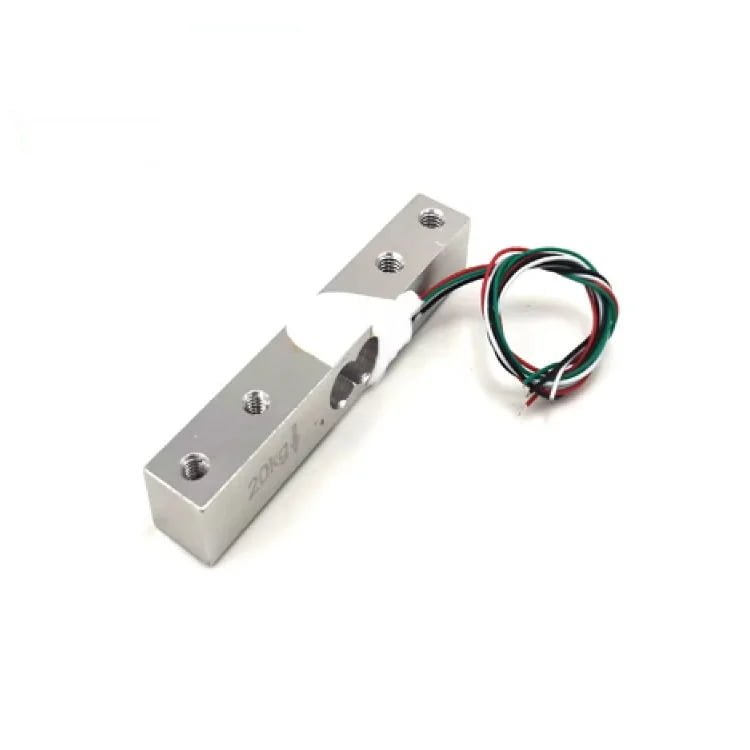
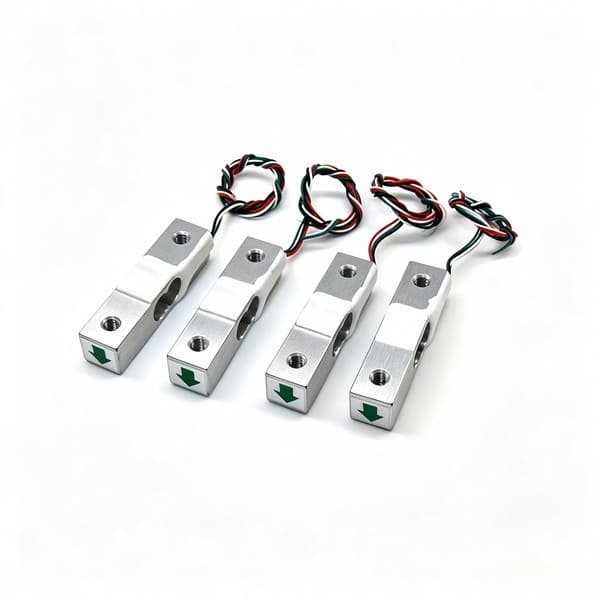
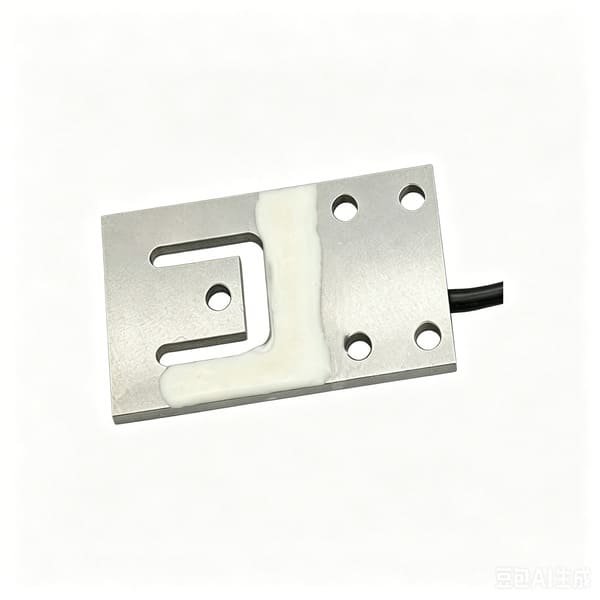
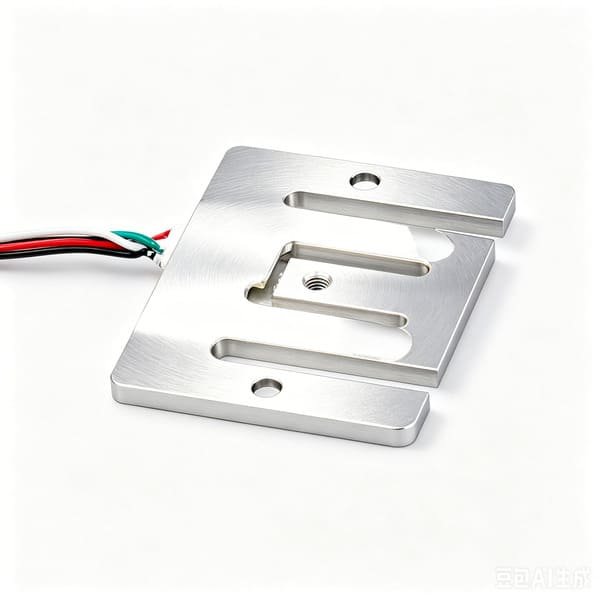
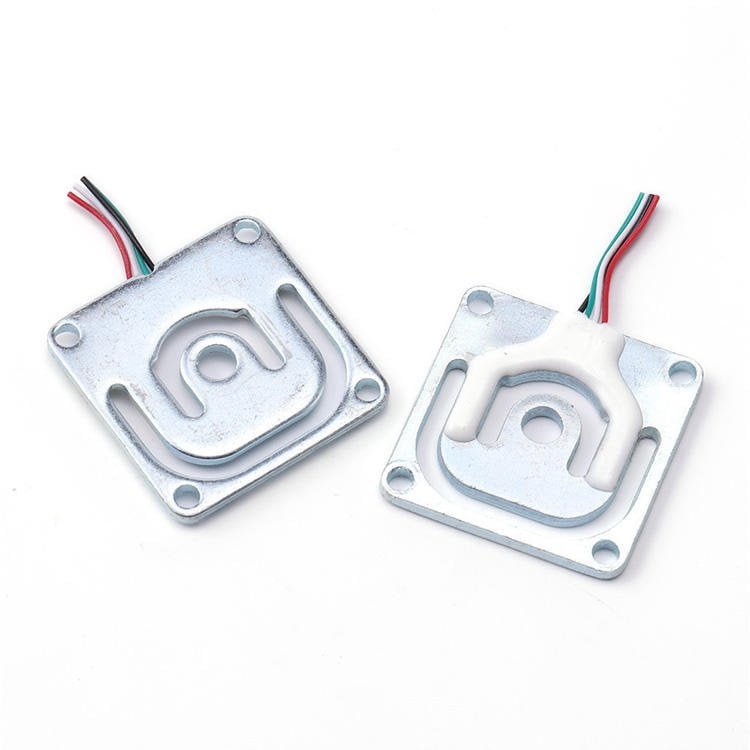
We already make a half-bridge micro cell sold specifically for pet-habitat products — WST106, rated 20–75 kg per cell, four to a set. It is the right part for a litter box, where the platform is large and the animal is 5 kg. For a food bowl the numbers go the wrong way: 4 × 20 kg is 80 kg of capacity under a 800 g bowl, the utilisation is 1 %, and the published four-angle error alone is 1.0 %F·S. If your product is a litter box, read the cat litter box guide instead — it is a different problem with different answers. If your product is a feeder, the bowl belongs on something much smaller.
Tell me the empty bowl mass, the heaviest gross, the smallest mass change you must resolve, how many cells you intend to sum, and whether the bowl comes off for washing. I will run the capacity-to-gross arithmetic in section 4 with your numbers and reply with which cell fits, which term will limit you, and whether the resolution you asked for is physically consistent with the platform you drew — including when the honest answer is that the load cell is not your problem.